Statutory Instruments
1994 No. 2421
INSOLVENCY
The Insolvent Partnerships Order 1994cross-notes
Made
13th September 1994
Laid before Parliament
16th September 1994
Coming into force
1st December 1994
The Lord Chancellor, in exercise of the powers conferred on him by section 420(1) and (2) of the Insolvency Act 1986(1) and section 21(2) of the Company Directors Disqualification Act 1986(2) and of all other powers enabling him in that behalf, with the concurrence of the Secretary of State, hereby makes the following Order:—
PART I GENERAL
Citation, commencement and extentI1
1.—(1) This Order may be cited as the Insolvent Partnerships Order 1994 and shall come into force on 1st December 1994.
(2) This Order—
(a)in the case of insolvency proceedings in relation to companies and partnerships, relates to companies and partnerships which the courts in England and Wales have jurisdiction to wind up; and
(b)in the case of insolvency proceedings in relation to individuals, extends to England and Wales only.
(3) In paragraph (2) the term “insolvency proceedings” has the meaning ascribed to it by article 2 below.
Interpretation: definitionsI2
case2.—(1) In this Order, except in so far as the context otherwise requires—
“the Act” means the Insolvency Act 1986 ;
“agricultural charge” has the same meaning as in the Agricultural Credits Act 1928 ( 3 );
“agricultural receiver” means a receiver appointed under an agricultural charge;
“corporate member” means an insolvent member which is a company;
“the court”, in relation to an insolvent partnership, means the court which has jurisdiction to wind up the partnership;
“individual member” means an insolvent member who is an individual;
“insolvency order” means—
in the case of an insolvent partnership or a corporate member, a winding-up order; and
in the case of an individual member, a bankruptcy order;
“insolvency petition” means, in the case of a petition presented to the court—
against a corporate member, a petition for its winding up by the court;
against an individual member, a petition for a bankruptcy order to be made against that individual,
where the petition is presented in conjunction with a petition for the winding up of the partnership by the court as an unregistered company under the Act;
“insolvency proceedings” means any proceedings under the Act, this Order or the [F1 Insolvency (England and Wales) Rules 2016 F1]
“insolvent member” means a member of an insolvent partnership, against whom an insolvency petition is being or has been presented;
“joint bankruptcy petition” means a petition by virtue of article 11 of this Order;
“joint debt” means a debt of an insolvent partnership in respect of which an order is made by virtue of Part IV or V of this Order;
“joint estate” means the partnership property of an insolvent partnership in respect of which an order is made by virtue of Part IV or V of this Order;
“joint expenses” means expenses incurred in the winding up of an insolvent partnership or in the winding up of the business of an insolvent partnership and the administration of its property;
“limited partner” has the same meaning as in the Limited Partnerships Act 1907 ( 4 );
“member” means a member of a partnership and any person who is liable as a partner within the meaning of section 14 of the Partnership Act 1890 ( 5 );
“officer”, in relation to an insolvent partnership, means—
a member; or
a person who has management or control of the partnership business;
“partnership property” has the same meaning as in the Partnership Act 1890 ;
“postponed debt” means a debt the payment of which is postponed by or under any provision of the Act or of any other enactment;
“responsible insolvency practitioner” means—
in winding up, the liquidator of an insolvent partnership or corporate member; and
in bankruptcy, the trustee of the estate of an individual member,
and in either case includes the official receiver when so acting;
“separate debt” means a debt for which a member of a partnership is liable, other than a joint debt;
“separate estate” means the property of an insolvent member against whom an insolvency order has been made;
“separate expenses” means expenses incurred in the winding up of a corporate member, or in the bankruptcy of an individual member; and
“trustee of the partnership” means a person authorised by order made by virtue of article 11 of this Order to wind up the business of an insolvent partnership and to administer its property.
(2) The definitions in paragraph (1), other than the first definition, shall be added to those in section 436 of the Act.
(3) References in provisions of the Act applied by this Order to any provision of the Act so applied shall, unless the context otherwise requires, be construed as references to the provision as so applied.
(4) Where, in any Schedule to this Order, all or any of the provisions of two or more sections of the Act are expressed to be modified by a single paragraph of the Schedule, the modification includes the combination of the provisions of those sections into the one or more sections set out in that paragraph.
Cases considering this provision (1)
- The Official Receiver v Paul John Hollens[2007] EWHC 753 (Ch)
Interpretation: expressions appropriate to companiesI3
3.—(1) This article applies for the interpretation in relation to insolvent partnerships of expressions appropriate to companies in provisions of the Act and of the Company Directors Disqualification Act 1986 applied by this Order, unless the contrary intention appears.
(2) References to companies shall be construed as references to insolvent partnerships and all references to the registrar of companies shall be omitted.
(3) References to shares of a company shall be construed—
(a)in relation to an insolvent partnership with capital, as references to rights to share in that capital; and
(b)in relation to an insolvent partnership without capital, as references to interests—
(i)conferring any right to share in the profits or liability to contribute to the losses of the partnership, or
(ii)giving rise to an obligation to contribute to the debts or expenses of the partnership in the event of a winding up.
(4) Other expressions appropriate to companies shall be construed, in relation to an insolvent partnership, as references to the corresponding persons, officers, documents or organs (as the case may be) appropriate to a partnership.
PART II VOLUNTARY ARRANGEMENTS
Voluntary arrangement of insolvent partnershipI4
4.[F2—(1) The provisions of Part I of, and Schedule A1 to, the Act shall apply in relation to an insolvent partnership, certain of those provisions being modified in such manner that, after modification, they are as set out in Schedule 1 to this Order.F2]
(2) For the purposes of the provisions of the Act applied by paragraph (1), the provisions of the Act specified in paragraph (3) below, insofar as they relate to company voluntary arrangements, shall also apply in relation to insolvent partnerships.
(3) The provisions referred to in paragraph (2) are—
[F3 (za)section 176AZA in Part IV,F3]
(a)[F4 sections 233, 233A and 233B and Schedule 4ZZAF4] in Part VI,
(b)Part VII, with the exception of section 250,
(c)Part XII,
(d)Part XIII,
(e)sections 411, 413, 414 and 419 in Part XV, and
(f)Parts XVI to XIX.
Voluntary arrangements of members of insolvent partnershipI5
5.—(1) Where insolvency orders are made against an insolvent partnership and an insolvent member of that partnership in his capacity as such, Part I of the Act shall apply to corporate members and Part VIII to individual members of that partnership, with the modification that any reference to the creditors of the company or of the debtor, as the case may be, includes a reference to the creditors of the partnership.
(2) Paragraph (1) is not to be construed as preventing the application of Part I or (as the case may be) Part VIII of the Act to any person who is a member of an insolvent partnership (whether or not a winding-up order has been made against that partnership) and against whom an insolvency order has not been made under this Order or under the Act.
[F5PART III ADMINISTRATION
Administration in relation to insolvent partnership
case6.—(1) The provisions of Part II of, and Schedule B1 to, the Act shall apply in relation to an insolvent partnership, certain of those provisions being modified in such manner that, after modification, they are as set out in Schedule 2 to this Order.
(2) In its application to insolvent partnerships, Part II of, and Schedule B1 to, the Act (as modified as set out in Schedule 2 to this Order) shall be read subject to paragraph (3).
(3) For every reference to—
(a) “administrative receiver” there shall be substituted “agricultural receiver”; and
(b) “floating charge” there shall be substituted “agricultural floating charge”.
(4) For the purposes of the provisions of the Act applied by paragraph (1), the provisions of the Act specified in paragraph (5) below, insofar as they relate to the appointment of an administrator, shall also apply in relation to insolvent partnerships.
(5) The provisions referred to in paragraph (4) are—
[F6 (za)section 176AZA in Part IV,F6]
(a)Part VI,
(b)Part VII (with the exception of section 250),
(c)Part XII,
(d)Part XIII,
(e)sections 411, 413, 414 and 419 in Part XV, and
(f)Parts XVI to XIX.
(6) For the purposes of this Article and the provisions of the Act applied by paragraph (1), “agricultural floating charge” shall be construed as a reference to a floating charge created under section 5 of the Agricultural Credits Act 1928 . F5]
Cases considering this provision (2)
- Oldham & Ors v Kyrris & Anor[2003] EWCA Civ 1506
- DKLL Solicitors v Revenue and Customs[2007] EWHC 2067 (Ch)
PART IV CREDITORS' ETC. WINDING-UP PETITIONS
Winding up of insolvent partnership as unregistered company on petition of creditor etc. where no concurrent petition presented against memberI6
case7.—(1) Subject to paragraph (2) below, the provisions of Part V of the Act shall apply in relation to the winding up of an insolvent partnership as an unregistered company on the petition of a creditor, [F7of a liquidator (within the meaning of Article 2(b) of the EC Regulation) appointed in proceedings by virtue of Article 3(1) of the EC Regulation, of a temporary administrator (within the meaning of Article 38 of the EC Regulation),F7] of a responsible insolvency practitioner[F8 , of the Secretary of State or of any other person other than a member,F8] where no insolvency petition is presented by the petitioner against a member or former member of that partnership in his capacity as such.
(2) Certain of the provisions referred to in paragraph (1) are modified in their application in relation to insolvent partnerships which are being wound up by virtue of that paragraph in such manner that, after modification, they are as set out in Part I of Schedule 3 to this Order.
(3) The provisions of the Act specified in Part II of Schedule 3 to this Order shall apply as set out in that Part for the purposes of section 221(5) of the Act, as modified by Part I of that Schedule.
Cases considering this provision (6)
- Stephen Hunt v Ravneet Ubhi[2023] EWCA Civ 417
- TOWN AND COUNTRY PROPERTIES (GB) LTD AND OTHERS v PATEL AND OTHERS[2023] EWHC 1168 (Ch)
- Town & Country Properties (GB) Ltd & Ors v Black Capital & Ors[2022] EWHC 2914 (Ch)
- Scott-Hake & Anor v Frost & Anor[2020] EWHC 3677 (Ch)
- The Official Receiver v Paul John Hollens[2007] EWHC 753 (Ch)
and 1 more in the case-law panel for this provision
[F9Winding up of insolvent partnership as unregistered company on the petition of creditor etc. where concurrent petitions presented against one or more membersF9] I7
case8.—(1) Subject to paragraph (2) below, the provisions of Part V of the Act (other than sections 223 and 224), shall apply in relation to the winding up of an insolvent partnership as an unregistered company on [F10the petition of a creditor, of a liquidator (within the meaning of Article 2(b) of the EC Regulation) appointed in proceedings by virtue of Article 3(1) of the EC Regulation, or of a temporary administrator (within the meaning of Article 38 of the EC Regulation)F10] where insolvency petitions are presented by the petitioner against the partnership and against one or more members or former members of the partnership in their capacity as such.
(2) Certain of the provisions referred to in paragraph (1) are modified in their application in relation to insolvent partnerships which are being wound up by virtue of that paragraph in such manner that, after modification, they are as set out in Part I of Schedule 4 to this Order.
(3) The provisions of the Act specified in Part II of Schedule 4 to this Order shall apply as set out in that Part for the purposes of section 221(5) of the Act, as modified by Part I of that Schedule.
(4) The provisions of the Act specified in paragraph (5) below, insofar as they relate to winding up of companies by the court in England and Wales on a creditor’s petition, shall apply in relation to the winding up of a corporate member or former corporate member (in its capacity as such) of an insolvent partnership which is being wound up by virtue of paragraph (1).
(5) The provisions referred to in paragraph (4) are—
(a)F11Part IV ...,
(b)Part VI,
(c)Part VII, and
(d)Parts XII to XIX.
(6) The provisions of the Act specified in paragraph (7) below, insofar as they relate to the bankruptcy of individuals in England and Wales on a petition presented by a creditor, shall apply in relation to the bankruptcy of an individual member or former individual member (in his capacity as such) of an insolvent partnership which is being wound up by virtue of paragraph (1).
(7) The provisions referred to in paragraph (6) are—
(a)Part IX (other than sections 269, 270, 287 and 297), and
(b)Parts X to XIX.
(8) Certain of the provisions referred to in paragraphs (4) and (6) are modified in their application in relation to the corporate or individual members or former corporate or individual members of insolvent partnerships in such manner that, after modification, they are as set out in Part II of Schedule 4 to this Order.
(9) The provisions of the Act applied by this Article shall further be modified so that references to a corporate or individual member include any former such member against whom an insolvency petition is being or has been presented by virtue of this Article.
Cases considering this provision (4)
- Stephen Hunt v Ravneet Ubhi[2023] EWCA Civ 417
- TOWN AND COUNTRY PROPERTIES (GB) LTD AND OTHERS v PATEL AND OTHERS[2023] EWHC 1168 (Ch)
- Town & Country Properties (GB) Ltd & Ors v Black Capital & Ors[2022] EWHC 2914 (Ch)
- Customs & Excise v Jack Baars Wholesale & Ors[2004] EWHC 18 (Ch)
case PART V MEMBERS' PETITIONS
Cases considering this provision (1)
- Town & Country Properties (GB) Ltd & Ors v Black Capital & Ors[2022] EWHC 2914 (Ch)
Winding up of insolvent partnership as unregistered company on member’s petition where no concurrent petition presented against memberI8
case9. The following provisions of the Act shall apply in relation to the winding up of an insolvent partnership as an unregistered company on the petition of a member where no insolvency petition is presented by the petitioner against a member of that partnership in his capacity as such—
(a)sections 117 and 221, modified in such manner that, after modification, they are as set out in Schedule 5 to this Order; and
(b)the other provisions of Part V of the Act, certain of those provisions being modified in such manner that, after modification, they are as set out in Part I of Schedule 3 to this Order.
Cases considering this provision (2)
- Pillar Securitisation SARL & Ors v Spicer & Anor (Court Administrators)[2010] EWHC 836 (Ch)
- The Official Receiver v Paul John Hollens[2007] EWHC 753 (Ch)
Winding up of insolvent partnership as unregistered company on member’s petition where concurrent petitions presented against all membersI9
case10.—(1) The following provisions of the Act shall apply in relation to the winding up of an insolvent partnership as an unregistered company on a member’s petition where insolvency petitions are presented by the petitioner against the partnership and against all its members in their capacity as such—
(a)sections 117, 124, 125, 221, 264, [F12265 and 271F12] of the Act, modified in such manner that, after modification, they are as set out in Schedule 6 to this Order; and
(b)sections 220, 225 and 227 to 229 in Part V of the Act, section 220 being modified in such manner that, after modification, it is as set out in Part I of Schedule 4 to this Order.
(2) The provisions of the Act specified in paragraph (3) below, insofar as they relate to winding up of companies by the court in England and Wales on a member’s petition, shall apply in relation to the winding up of a corporate member (in its capacity as such) of an insolvent partnership which is wound up by virtue of paragraph (1).
(3) The provisions referred to in paragraph (2) are—
(a)F13Part IV ...,
(b)Part VI,
(c)Part VII, and
(d)Parts XII to XIX.
(4) The provisions of the Act specified in paragraph (5) below, insofar as they relate to the bankruptcy of individuals in England and Wales where [F14a bankruptcy application is madeF14] by a debtor, shall apply in relation to the bankruptcy of an individual member (in his capacity as such) of an insolvent partnership which is being wound up by virtue of paragraph (1).
(5) The provisions referred to in paragraph (4) are—
(a)F15Part IX (other than sections ... 287 and 297), and
(b)Parts X to XIX.
[F16 (6) Certain of the provisions referred to in paragraphs (2) and (4) are modified in their application in relation to the corporate or individual members of insolvent partnerships in such manner that, after modification, they are as set out in Part II of Schedule 4 to this Order.F16]
Insolvency proceedings not involving winding up of insolvent partnership as unregistered company where individual members present joint bankruptcy petitionI10
case11.—(1) The provisions of the Act specified in paragraph (2) below shall apply in relation to the bankruptcy of the individual members of an insolvent partnership where those members jointly present a petition to the court for orders to be made for the bankruptcy of each of them in his capacity as a member of the partnership, and the winding up of the partnership business and administration of its property, without the partnership being wound up as an unregistered company under Part V of the Act.
(2) The provisions referred to in paragraph (1) are—
(a)Part IX (other than [F17sectionF17] 287), and
(b)Parts X to XIX,
insofar as they relate to the insolvency of individuals in England and Wales where [F18a bankruptcy application is madeF18] by a debtor.
(3) Certain of the provisions referred to in paragraph (1) are modified in their application in relation to the individual members of insolvent partnerships in such manner that, after modification, they are as set out in Schedule 7 to this Order.
Cases considering this provision (1)
- The Official Receiver v Paul John Hollens[2007] EWHC 753 (Ch)
PART VI PROVISIONS APPLYING IN INSOLVENCY PROCEEDINGS IN RELATION TO INSOLVENT PARTNERSHIPS
[F19Decision procedure in insolvency proceedings in relation to insolvent partnerships
11A. Sections 246ZE, 246ZF, 379ZA and 379ZB of the Act apply in insolvency proceedings in relation to insolvent partnerships with the modifications set out in Schedule 7A to this Order.F19]
Winding up of unregistered company which is a member of insolvent partnership being wound up by virtue of this OrderI11
12. Where an insolvent partnership or other body which may be wound up under Part V of the Act as an unregistered company is itself a member of an insolvent partnership being so wound up, articles 8 and 10 above shall apply in relation to the latter insolvent partnership as though the former body were a corporate member of that partnership.
Deposit on petitionsI12
case13.—(1) Where an order under section 414(4) or 415(3) of the Act (security for fees) provides for any sum to be deposited on presentation of a winding-up or bankruptcy petition, that sum shall, in the case of petitions presented by virtue of articles 8 and 10 above, only be required to be deposited in respect of the petition for winding up the partnership, but shall be treated as a deposit in respect of all those petitions.
(2) Production of evidence as to the sum deposited on presentation of the petition for winding up the partnership shall suffice for the filing in court of an insolvency petition against an insolvent member.
Cases considering this provision (1)
- Pillar Securitisation SARL & Ors v Spicer & Anor (Court Administrators)[2010] EWHC 836 (Ch)
Supplemental powers of courtI13
case14.—(1) At the end of section 168 of the Act there shall be inserted the following subsections:—
“(5A) Where at any time after a winding-up petition has been presented to the court against any person (including an insolvent partnership or other body which may be wound up under Part V of the Act as an unregistered company), whether by virtue of the provisions of the Insolvent Partnerships Order 1994(6) or not, the attention of the court is drawn to the fact that the person in question is a member of an insolvent partnership, the court may make an order as to the future conduct of the insolvency proceedings and any such order may apply any provisions of that Order with any necessary modifications.
(5B) Any order or directions under subsection (5A) may be made or given on the application of the official receiver, any responsible insolvency practitioner, the trustee of the partnership or any other interested person and may include provisions as to the administration of the joint estate of the partnership, and in particular how it and the separate estate of any member are to be administered.
(5C) Where the court makes an order under section 72(1)(a) of the Financial Services Act 1986(7) or section 92(1)(a) of the Banking Act 1987(8) for the winding up of an insolvent partnership, the court may make an order as to the future conduct of the winding-up proceedings, and any such order may apply any provisions of the Insolvent Partnerships Order 1994 with any necessary modifications.”.
(2) At the end of section 303 of the Act there shall be inserted the following subsections:—
“(2A) Where at any time after a bankruptcy petition has been presented to the court against any person, whether under the provisions of the Insolvent Partnerships Order 1994 or not, the attention of the court is drawn to the fact that the person in question is a member of an insolvent partnership, the court may make an order as to the future conduct of the insolvency proceedings and any such order may apply any provisions of that Order with any necessary modifications.
(2B) Where a bankruptcy petition has been presented against more than one individual in the circumstances mentioned in subsection (2A) above, the court may give such directions for consolidating the proceedings, or any of them, as it thinks just.
(2C) Any order or directions under subsection (2A) or (2B) may be made or given on the application of the official receiver, any responsible insolvency practitioner, the trustee of the partnership or any other interested person and may include provisions as to the administration of the joint estate of the partnership, and in particular how it and the separate estate of any member are to be administered.”.
Cases considering this provision (2)
- Town & Country Properties (GB) Ltd & Ors v Black Capital & Ors[2022] EWHC 2914 (Ch)
- The Official Receiver v Paul John Hollens[2007] EWHC 753 (Ch)
Meaning of “act as insolvency practitioner”I14
15.—(1) After section 388(2) of the Act there shall be inserted the following—
“(2A) A person acts as an insolvency practitioner in relation to an insolvent partnership by acting—
(a)as its liquidator, provisional liquidator or administrator, or
(b)as trustee of the partnership under article 11 of the Insolvent Partnerships Order 1994, or
(c)as supervisor of a voluntary arrangement approved in relation to it under Part I of this Act.”.
(2) In section 388(3) the words “to a partnership and” shall be omitted.
PART VII DISQUALIFICATION
Application of Company Directors Disqualification Act 1986cross-notesI15
case16. Where an insolvent partnership is wound up as an unregistered company under Part V of the Act, the provisions of [F20sections 1, 1A, 5A, 6 to 10, 12C, 13 to 15C, 17, 19(c) and 20 of, and Schedule 1 toF20] , the Company Directors Disqualification Act 1986 shall apply, certain of those provisions being modified in such manner that, after modification, they are as set out in Schedule 8 to this Order.
Cases considering this provision (1)
PART VIII MISCELLANEOUS
FormsI16
17.—(1) The forms contained in Schedule 9 to this Order shall be used in and in connection with proceedings by virtue of this Order, whether in the High Court or a county court.
(2) The forms shall be used with such variations, if any, as the circumstances may require.
Application of subordinate legislationcross-notesI17
18.—(1) The subordinate legislation specified in Schedule 10 to this Order shall apply as from time to time in force and with such modifications as the context requires for the purpose of giving effect to the provisions of the Act and of the Company Directors Disqualification Act 1986 which are applied by this Order.
(2) In the case of any conflict between any provision of the subordinate legislation applied by paragraph (1) and any provision of this Order, the latter provision shall prevail.
Supplemental and transitional provisionsI18
case19.—(1) This Order does not apply in relation to any case in which a winding-up or a bankruptcy order was made under the Insolvent Partnerships Order 1986(9) in relation to a partnership or an insolvent member of a partnership, and where this Order does not apply the law in force immediately before this Order came into force continues to have effect.
(2) Where winding-up or bankruptcy proceedings commenced under the provisions of the Insolvent Partnerships Order 1986 were pending in relation to a partnership or an insolvent member of a partnership immediately before this Order came into force, either—
(a)those proceedings shall be continued, after the coming into force of this Order, in accordance with the provisions of this Order, or
(b)if the court so directs, they shall be continued under the provisions of the 1986 Order, in which case the law in force immediately before this Order came into force continues to have effect.
(3) For the purpose of paragraph (2) above, winding-up or bankruptcy proceedings are pending if a statutory or written demand has been served or a winding-up or bankruptcy petition has been presented.
[F21 (4) Nothing in this Order is to be taken as preventing a petition being presented against an insolvent partnership under section 367 of the Financial Services and Markets Act 2000, or any other enactment [F22 except where paragraph 12 of Schedule A1 to the Act, as applied by this Order, has the effect of preventing a petition being so presentedF22] .F21]
(5) Nothing in this Order is to be taken as preventing any creditor or creditors owed one or more debts by an insolvent partnership from presenting a petition under the Act against one or more members of the partnership liable for that debt or those debts (as the case may be) without including the others and without presenting a petition for the winding up of the partnership as an unregistered company.
(6) Bankruptcy proceedings may be consolidated by virtue of article 14(2) above irrespective of whether they were commenced under the Bankruptcy Act 1914(10) or the Insolvency Act 1986 or by virtue of the Insolvent Partnerships Order 1986 or this Order, and the court shall, in the case of proceedings commenced under or by virtue of different enactments, make provision for the manner in which the consolidated proceedings are to be conducted.
Cases considering this provision (2)
- Town & Country Properties (GB) Ltd & Ors v Black Capital & Ors[2022] EWHC 2914 (Ch)
- The Official Receiver v Paul John Hollens[2007] EWHC 753 (Ch)
RevocationI19
20. The Insolvent Partnerships Order 1986 is hereby revoked.
Mackay of Clashfern, C.
Dated 8th September 1994
I concur, on behalf of the Secretary of State
Neil Hamilton
Parliamentary Under-Secretary of State for Corporate Affairs,
Department of Trade and Industry
Dated 13th September 1994
Article 4
[F23SCHEDULE 1 MODIFIED PROVISIONS OF PART I OF, AND SCHEDULE A1 TO, THE ACT (COMPANY VOLUNTARY ARRANGEMENTS) AS APPLIED BY ARTICLE 4
PART I Modified Provisions of Sections 1 to 7B of the Act
For sections 1 to 7B of the Act there shall be substituted:—
“PART I Partnership Voluntary Arrangements
The proposal
“1. Those who may propose an arrangement
(1) The members of an insolvent partnership (other than one [F24which is in administrationF24] , or which is being wound up as an unregistered company, or in respect of which an order has been made by virtue of article 11 of the Insolvent Partnerships Order 1994) may make a proposal under this Part to the partnership’s creditors for a composition in satisfaction of the debts of the partnership or a scheme of arrangement of its affairs (from here on referred to, in either case, as a “voluntary arrangement”).
(2) A proposal under this Part is one which provides for some person (“the nominee”) to act in relation to the voluntary arrangement either as trustee or otherwise for the purpose of supervising its implementation; and the nominee must be a person who is qualified to act as an insolvency practitioner F25... in relation to the voluntary arrangement.
(3) Such a proposal may also be made—
(a)where [F26the partnership is in administrationF26] , by the administrator,
(b)where the partnership is being wound up as an unregistered company, by the liquidator, and
(c)where an order has been made by virtue of article 11 of the Insolvent Partnerships Order 1994, by the trustee of the partnership.
F27(4) . . . . . . . . . . . . . . . . . . . . . . . . . . . . . . . .
“1A. Moratorium
(1) Where the members of an eligible insolvent partnership intend to make a proposal for a voluntary arrangement, they may take steps to obtain a moratorium for the insolvent partnership.
(2) Subject to subsections (3), (4), (5), (6) and (7), the provisions of Schedule A1 to this Act have effect with respect to—
(a)insolvent partnerships eligible for a moratorium under this section,
(b)the procedure for obtaining such a moratorium,
(c)the effects of such a moratorium, and
(d)the procedure applicable (in place of sections 2 to 6 and 7) in relation to the approval and implementation of a voluntary arrangement where such a moratorium is or has been in force.
(3) Certain of the provisions applied in relation to insolvent partnerships by virtue of subsection (2) are modified in their application in relation to insolvent partnerships in such manner that, after modification, they are as set out in Part II of Schedule 1 to the Insolvent Partnerships Order 1994.
(4) Paragraphs 4A, 4B, 4C, 4D, 4E, 4F, 4G, 4H, 4I, 4J, 4K, 5, 7(4), 8(8), 32(7), 34(2), 41(5) and 45 of Schedule A1 to this Act shall not apply.
(5) An insolvent partnership is not liable to a fine under paragraphs 16(2), 17(3), 18(3), 19(3), 22 or 23(1) of Schedule A1 to the Act.
(6) Notwithstanding subsection (5) an officer of an insolvent partnership may be liable to imprisonment or a fine under the paragraphs referred to in that subsection in the same manner as an officer of a company.
(7) In the application of Schedule A1, and the application of the entries in Schedule 10 relating to offences under Schedule A1, to insolvent partnerships—
(a)references to the directors or members of a company shall be construed as references to the members of an insolvent partnership,
(b)references to officers of a company shall be construed as references to the officers of an insolvent partnership,
(c)references to a meeting of a company shall be construed as references to a meeting of the members of an insolvent partnership, and
(d)references to a floating charge shall be construed as references to a floating charge created under section 5 of the Agricultural Credits Act 1928.
“2. Procedure where nominee is not the liquidator, administrator or trustee
(1) This section applies where the nominee under section 1 is not the liquidator, administrator or trustee of the insolvent partnership and the members of the partnership do not propose to take steps to obtain a moratorium under section 1A for the insolvent partnership.
(2) The nominee shall, within 28 days (or such longer period as the court may allow) after he is given notice of the proposal for a voluntary arrangement, submit a report to the court stating—
(a)whether, in his opinion, the proposed voluntary arrangement has a reasonable prospect of being approved and implemented,
[F28(b) whether, in his opinion, the proposal should be considered by a meeting of the members of the partnership and by the partnership’s creditors, and
(c)if in his opinion it should, the date on which, and time and place at which, he proposes a meeting should be held.F28]
(3) The nominee shall also state in his report whether there are in existence any insolvency proceedings in respect of the insolvent partnership or any of its members.
(4) For the purposes of enabling the nominee to prepare his report, the person intending to make the proposal shall submit to the nominee—
(a)a document setting out the terms of the proposed voluntary arrangement, and
(b)a statement of the partnership’s affairs containing—
(i)such particulars of the partnership’s creditors and of the partnership’s debts and other liabilities and of the partnership property as may be prescribed, and
(ii)such other information as may be prescribed.
(5) The court may—
(a)on an application made by the person intending to make the proposal, in a case where the nominee has failed to submit the report required by this section or has died, or
(b)on an application made by that person or the nominee, in a case where it is impracticable or inappropriate for the nominee to continue to act as such,
direct that the nominee be replaced as such by another person qualified to act as an insolvency practitioner F29... in relation to the voluntary arrangement.
“3. Summoning of meetings
(1) Where the nominee under section 1 is not the liquidator, administrator or trustee of the insolvent partnership, and it has been reported to the court [F30under section 2(2) that the proposal should be considered by a meeting of the members of the partnership and by the partnership’s creditorsF30] , the person making the report shall (unless the court otherwise [F31directs)—
(a)summon a meeting of the members of the partnership to consider the proposal for the time, date and place proposed in the report, and
(b)seek a decision from the partnership’s creditors as to whether they approve the proposal.F31]
(2) Where the nominee is the liquidator, administrator or trustee of the insolvent partnership, he [F32must—
(a)summon a meeting of the members of the partnership to consider the proposal for such time, date and place as he thinks fit, and
(b)seek a decision from the partnership’s creditors as to whether they approve the proposal.F32]
[F33(3) A decision of the partnership’s creditors as to whether they approve the proposal is to be made by a qualifying decision procedure.
(4) Notice of the qualifying decision procedure must be given to every creditor of the partnership of whose claim and address the person summoning the meeting is aware.F33]
Consideration and implementation of proposal
“4. Decisions of [F34the members of the partnership and its creditorsF34]
[F35(1) This section applies where, under section 3—
(a)a meeting of the members of the partnership is summoned to consider the proposed voluntary arrangement, and
(b)the partnership’s creditors are asked to decide whether to approve the proposed voluntary arrangement.
(1A) The members of the partnership and its creditors may approve the proposed voluntary arrangement with or without modifications.F35]
(2) The modifications may include one conferring the functions proposed to be conferred on the nominee on another person qualified to act as an insolvency practitioner F36... in relation to the voluntary arrangement.
But they shall not include any modification by virtue of which the proposal ceases to be a proposal such as is mentioned in section 1.
(3) [F37Neither the members of the partnership nor its creditors mayF37] approve any proposal or modification which affects the right of a secured creditor of the partnership to enforce his security, except with the concurrence of the creditor concerned.
(4) Subject as follows, [F38neither the members of the partnership nor its creditors mayF38] approve any proposal or modification under which—
(a)any preferential debt of the partnership is to be paid otherwise than in priority to such of its debts as are not preferential debts, F39...
[F40(aa)any ordinary preferential debt of the partnership is to be paid otherwise than in priority to any secondary preferential debts that it may have,F40]
(b)a preferential creditor of the partnership is to be paid an amount in respect of [F41an ordinary preferential debtF41] that bears to that debt a smaller proportion than is borne to [F42another ordinaryF42] preferential debt by the amount that is to be paid in respect of that other debt F43[F44...
(c)a preferential creditor of the partnership is to be paid an amount in respect of a secondary preferential debt that bears to that debt a smaller proportion than is borne to another secondary preferential debt by the amount that is to be paid in respect of that other debtF44] [F45or
(d)in the case of a company which is a relevant financial institution (see section 387A), any non-preferential debt is to be paid otherwise than in accordance with the rules in section 176AZA(2) or (3).F45]
However, [F46 such a proposal or modification may be approvedF46] with the concurrence of the F47... creditor concerned.
(5) Subject as above, [F48the meeting of the members of the partnership and the qualifying decision procedureF48] shall be conducted in accordance with the rules.
(6) After the conclusion of [F49the meeting of the members of the partnershipF49] in accordance with the rules, the chairman of the meeting shall report the result of the meeting to the court, and, immediately after reporting to the court, shall give notice of the result of the meeting to all those who were sent notice of the meeting in accordance with the rules.
[F50(6A) After the partnership’s creditors have decided whether to approve the proposed voluntary arrangement the person who sought the decision must—
(a)report the creditors’ decision to the court, and
(b)immediately after reporting to the court, give notice of the creditors’ decision to everyone who was invited to consider the proposal or to whom notice of a decision procedure or meeting was delivered.F50]
(7) References in this section to preferential debts [F51, ordinary preferential debts, secondary preferential debtsF51] and preferential creditors are to be read in accordance with section 386 in Part XII of this Act.
“4A. Approval of arrangement
(1) This section applies to a decision, under section 4, with respect to the approval of a proposed voluntary arrangement.
(2) The decision has effect if, in accordance with the rules—
(a)it has been taken by [F52the meeting of the members of the partnership summoned under section 3 and by the partnership’s creditors pursuant to that sectionF52] , or
(b)(subject to any order made under subsection (6)) it has been taken by the [F53partnership’s creditors pursuant toF53] that section.
(3) If the decision taken by the [F54partnership’s creditorsF54] differs from that taken by the meeting of the members of the partnership, a member of the partnership may apply to court.
(4) An application under subsection (3) shall not be made after the end of the period of 28 days beginning with—
(a)the day on which the decision was taken by the [F54partnership’s creditorsF54] , or
(b)where the decision of the meeting of the members of the partnership was taken on a later day, that day.
[F55(5) Where a member of an insolvent partnership which is regulated applies to the court under subsection (3), the appropriate regulator is entitled to be heard on the application.
(5A) “The appropriate regulator” means—
(a)where the partnership is a PRA-regulated partnership, the Prudential Regulation Authority and the Financial Conduct Authority;
(b)in any other case the Financial Conduct Authority.
(5B) For the purposes of subsection (5A), a “PRA-regulated partnership” means a partnership which—
(a)is or has been, a PRA–authorised person (within the meaning of the Financial Services and Markets Act 2000),
(b)is, or has been, an appointed representative within the meaning given by section 39 of that Act, whose principal (or one of whose principals) is, or was, a PRA-authorised person, or
(c)is carrying on, or has carried on, a PRA-regulated activity (within the meaning of that Act) in contravention of the general prohibition under section 19 of that Act.F55]
(6) On an application under subsection (3), the court may—
(a)order the decision of the meeting of the members of the partnership to have effect instead of the decision of the [F54partnership’s creditorsF54] , or
(b)make such other order as it thinks fit.
(7) In this section “regulated” in relation to an insolvent partnership means a person who—
(a)is, or has been, an authorised person within the meaning given by section 31 of the Financial Services and Markets Act 2000,
(b)is, or has been, an appointed representative within the meaning given by section 39 of that Act, or
(c)is carrying on, or has carried on, a regulated activity, within the meaning given by section 22 of that Act, in contravention of the general prohibition within the meaning given by section 19 of that Act.
“5. Effect of approval
(1) This section applies where a decision approving a voluntary arrangement has effect under section 4A.
(2) The voluntary arrangement—
(a)takes effect as if made by the members of the partnership at the [F56time the creditors decided to approve the voluntary arrangementF56] , and
(b)binds every person who in accordance with the rules—
(i)was entitled to vote [F57in the qualifying decision procedure by which the creditors’ decision to approve the voluntary arrangement was madeF57] , or
(ii)would have been so entitled if he had had notice of [F58the procedureF58] ,
as if he were a party to the voluntary arrangement.
(2A) If—
(a)when the arrangement ceases to have effect any amount payable under the arrangement to a person bound by virtue of subsection 2(b)(ii) has not been paid, and
(b)the arrangement did not come to an end prematurely,
the insolvent partnership shall at that time become liable to pay to that person the amount payable under the arrangement.
(3) Subject as follows, if the partnership is being wound up as an unregistered company, or [F59is in administrationF59] or an order by virtue of article 11 of the Insolvent Partnerships Order 1994 is in force, the court may do one or both of the following, namely—
(a)by order—
(i)stay all proceedings in the winding up or in the proceedings under the order made by virtue of the said article 11 (as the case may be), including any related insolvency proceedings of a member of the partnership in his capacity as such, or
(ii) [F60provide for the appointment of the administrator to cease to have effectF60] ;
(b)give such directions as it thinks appropriate for facilitating the implementation of the voluntary arrangement with respect to—
(i)the conduct of the winding up, the proceedings by virtue of the said article 11 or the administration (as the case may be), and
(ii)the conduct of any related insolvency proceedings as referred to in paragraph (a)(i) above.
(4) The court shall not make an order under subsection (3)(a)—
(a)at any time before the end of the period of 28 days beginning with the first day on which each of the reports required by section 4(6) [F61and (6A)F61] has been made to the court, or
(b)at any time when an application under the next section or an appeal in respect of such an application is pending, or at any time in the period within which such an appeal may be brought.
“6. Challenge of decisions
(1) Subject to this section, an application to the court may be made, by any of the persons specified below, on one or both of the following grounds, namely—
(a)that a voluntary arrangement which has effect under section 4A unfairly prejudices the interests of a creditor, member or contributory of the partnership;
(b)that there has been some material irregularity at or in relation to [F62the meeting of the members of the partnership or in the relevant qualifying decision procedureF62] .
(2) The persons who may apply under this section are—
(a)a person entitled, in accordance with the rules, to vote at [F63the meeting of the members of the partnership or in the relevant qualifying decision procedureF63] ;
(b)a person who would have been entitled, in accordance with the rules, to vote [F64in the relevant qualifying decision procedureF64] if he had had notice of it;
(c)the nominee or any person who has replaced him under section 2(5) or 4(2); and
(d)if the partnership is being wound up as an unregistered company or [F65is in administration or anF65] order by virtue of article 11 of the Insolvent Partnerships Order 1994 is in force, the liquidator, administrator or trustee of the partnership.
(3) An application under this section shall not be made—
(a)after the end of the period of 28 days beginning with the first day on which each of the reports required by section 4(6) [F66and (6A)F66] has been made to the court, or
(b)in the case of a person who was not given notice of the [F67relevant qualifying decision procedureF67] , after the end of the period of 28 days beginning with the day on which he became aware that [F68the relevant qualifying decision procedureF68] had taken place,
but (subject to that) an application made by a person within subsection (2)(b) on the ground that the voluntary arrangement prejudices his interests may be made after the voluntary arrangement has ceased to have effect, unless it came to an end prematurely.
(4) Where on such an application the court is satisfied as to either of the grounds mentioned in subsection (1), it may do [F69anyF69] of the following, namely—
(a)revoke or suspend any decision approving the voluntary arrangement which has effect under section 4A or, in a case falling within subsection (1)(b), any decision taken by the meeting [F70of the members of the partnership, or in the relevant qualifying decision procedure,F70] which has effect under that section;
(b)give a direction to any person for the summoning of [F71a further meeting of the members of the partnershipF71] to consider any revised proposal the person who made the original proposal may make or, in a case falling within subsection (1)(b), [F72and relating to the meeting of the members of the partnership, a further meeting of the members of the partnershipF72] to reconsider the original proposal.
[F73(c)direct any person—
(i)to seek a decision from the partnership’s creditors (using a qualifying decision procedure) as to whether they approve any revised proposal the person who made the original proposal may make, or
(ii)in a case falling within subsection (1)(b) and relating to the relevant qualifying decision procedure, to seek a decision from the partnership’s creditors (using a qualifying decision procedure) as to whether they approve the original proposal.F73]
(5) Where at any time after giving a direction under subsection (4)(b) [F74or (c) in relation toF74] a revised proposal the court is satisfied that the person who made the original proposal does not intend to submit a revised proposal, the court shall revoke the direction and revoke or suspend any decision approving the voluntary arrangement which has effect under section 4A.
(6) In a case where the court, on an application under this section with respect to any meeting [F75or relevant qualifying decision procedureF75] —
(a)gives a direction under subsection (4)(b) [F76or (c)F76] , or
(b)revokes or suspends an approval under subsection (4)(a) or (5),
the court may give such supplemental directions as it thinks fit, and, in particular, directions with respect to things done under the voluntary arrangement since it took effect.
(7) Except in pursuance of the preceding provisions of this section,
[F77(a)F77] a decision taken at a meeting [F78of the members of the partnershipF78] summoned under section 3 is not invalidated by any irregularity at or in relation to the meeting [F79, and
(b)a decision of the creditors of the partnership made in the relevant qualifying decision procedure is not invalidated by any irregularity in relation to the relevant qualifying decision procedure.F79]
“6A. False representations, etc.
(1) If, for the purpose of obtaining the approval of the members or creditors of an insolvent partnership or of the members or creditors of any of its members to a proposal for a voluntary arrangement in relation to the partnership or any of its members, a person who is an officer of the partnership or an officer (which for this purpose includes a shadow director) of a corporate member in relation to which a voluntary arrangement is proposed—
(a)makes a false representation, or
(b)fraudulently does, or omits to do, anything,
he commits an offence.
(2) Subsection (1) applies even if the proposal is not approved.
(3) A person guilty of an offence under this section is liable to imprisonment or a fine, or both.
“7. Implementation of proposal
(1) This section applies where a voluntary arrangement has effect under section 4A.
(2) The person who is for the time being carrying out in relation to the voluntary arrangement the functions conferred—
(a)on the nominee by virtue of the approval [F80of the voluntary arrangement by the members of the partnership or its creditors (or both) pursuant toF80] section 3, or
(b)by virtue of section 2(5) or 4(2) on a person other than the nominee,
shall be known as the supervisor of the voluntary arrangement.
(3) If any of the partnership’s creditors or any other person is dissatisfied by any act, omission or decision of the supervisor, he may apply to the court; and on the application the court may—
(a)confirm, reverse or modify any act or decision of the supervisor,
(b)give him directions, or
(c)make such other order as it thinks fit.
(4) The supervisor—
(a)may apply to the court for directions in relation to any particular matter arising under the voluntary arrangement, and
(b)is included among the persons who may apply to the court for the winding up of the partnership as an unregistered company or for an administration order to be made in relation to it.
(5) The court may, whenever—
(a)it is expedient to appoint a person to carry out the functions of the supervisor, and
(b)it is inexpedient, difficult or impracticable for an appointment to be made without the assistance of the court,
make an order appointing a person who is qualified to act as an insolvency practitioner F81... in relation to the voluntary arrangement, either in substitution for the existing supervisor or to fill a vacancy.
(6) The power conferred by subsection (5) is exercisable so as to increase the number of persons exercising the functions of supervisor or, where there is more than one person exercising those functions, so as to replace one or more of those persons.
“7A. Prosecution of delinquent officers of partnership
(1) This section applies where a moratorium under section 1A has been obtained for an insolvent partnership or the approval of a voluntary arrangement in relation to an insolvent partnership has taken effect under section 4A or paragraph 36 of Schedule A1.
(2) If it appears to the nominee or supervisor that any past or present officer of the insolvent partnership has been guilty of any offence in connection with the moratorium or, as the case may be, voluntary arrangement for which such officer is criminally liable, the nominee or supervisor shall forthwith—
(a)report the matter to the Secretary of State, and
(b)provide the Secretary of State with such information and give him such access to and facilities for inspecting and taking copies of documents (being information or documents in the possession or under the control of the nominee or supervisor and relating to the matter in question) as the Secretary of State requires.
(3) Where a prosecuting authority institutes criminal proceedings following any report under subsection (2), the nominee or supervisor, and every officer and agent of the insolvent partnership past or present (other than the defendant), shall give the authority all assistance in connection with the prosecution which he is reasonably able to give.
For this purpose—
“agent” includes any banker or solicitor of the insolvent partnership and any person employed by the insolvent partnership as auditor, whether that person is or is not an officer of the insolvent partnership,
“prosecuting authority” means the Director of Public Prosecutions or the Secretary of State.
(4) The court may, on the application of the prosecuting authority, direct any person referred to in subsection (3) to comply with that subsection if he has failed to do so.
“7B. Arrangements coming to an end prematurely
For the purposes of this Part, a voluntary arrangement the approval of which has taken effect under section 4A or paragraph 36 of Schedule A1 comes to an end prematurely if, when it ceases to have effect, it has not been fully implemented in respect of all persons bound by the arrangement by virtue of section 5(2)(b)(i) or, as the case may be, paragraph 37(2)(b)(i) of Schedule A1”.
PART II Modified Provisions of Schedule A1 to the Act
The following provisions of Schedule A1 to the Act are modified so as to read as follows:
“3.—(1) An insolvent partnership meets the requirements of this paragraph if the qualifying conditions are met—
(a)in the year ending with the date of filing, or
(b)in the tax year of the insolvent partnership which ended last before that date.
(2) For the purposes of sub-paragraph (1) the qualifying conditions are met by an insolvent partnership in a period if, in that period, it satisfies two or more of the requirements set out in sub-paragraph (3).
(3) The qualifying conditions referred to in this paragraph are—
(a)turnover of not more than [F82£5.6F82] million,
(b)assets of not more than [F83£2.8F83] million, and
(c)no more than 50 employees.
(4) For the purposes of sub-paragraph (3)—
(a)the total of turnover is the amount which is or would be, as the case may be, entered as turnover in the partnership’s tax return,
(b)the total of assets is the amount which—
(i)in the case of the period referred to in paragraph 3(1)(a), is entered in the partnership’s statement of affairs which must be filed with the court under paragraph 7(1)(b), or
(ii)in the case of the period referred to in paragraph 3(1)(b), would be entered in the partnership’s statement of affairs had it prepared such a statement on the last day of the period to which the amount for turnover is calculated for the purposes of paragraph 3(4)(a),
(c)the number of employees is the average number of persons employed by the insolvent partnership—
(i)in the case of the period referred to in paragraph 3(1)(a), in the period ending with the date of filing,
(ii)in the case of the period referred to in paragraph 3(1)(b), in the period to which the amount for turnover is calculated for the purposes of paragraph 3(4)(a).
(5) Where the period covered by the qualifying conditions in respect of the insolvent partnership is not a year the total of turnover referred to in paragraph 3(3)(a) shall be proportionately adjusted.
(6) The average number of persons employed by the insolvent partnership shall be calculated as follows—
(a)by ascertaining the number of persons employed by it under contracts of service for each month of the year (whether throughout the month or not),
(b)by adding those figures together, and
(c)by dividing the resulting figure by the number of months during which persons were so employed by it during the year.
(7) In this paragraph—
“tax return” means a return under section 12AA of the Taxes Management Act 1970,
“tax year” means the 12 months beginning with 6th April in any year.
4.—(1) An insolvent partnership is excluded from being eligible for a moratorium if, on the date of filing—
(a) [F84the partnership is in administrationF84] ,
(b)the insolvent partnership is being wound up as an unregistered company,
(c)there is an agricultural receiver of the insolvent partnership,
(d)a voluntary arrangement has effect in relation to the insolvent partnership,
(e)there is a provisional liquidator of the insolvent partnership,
(f)a moratorium has been in force for the insolvent partnership at any time during the period of 12 months ending with the date of filing and—
(i)no voluntary arrangement had effect at the time at which the moratorium came to an end, or
(ii)a voluntary arrangement which had effect at any time in that period has come to an end prematurely,
(g)a voluntary arrangement in relation to the insolvent partnership which had effect in pursuance of a proposal under section 1(3) has come to an end prematurely and, during the period of 12 months ending with the date of filing, an order under section 5(3)(a) has been made, or
(h)an order has been made by virtue of article 11 of the Insolvent Partnerships Order 1994.
(2) Sub-paragraph (1)(b) does not apply to an insolvent partnership which, by reason of a winding-up order made after the date of filing, is treated as being wound up on that date.
Effect on creditors, etc.
12.—(1) During the period for which a moratorium is in force for an insolvent partnership—
(a)no petition may be presented for the winding-up of the insolvent partnership as an unregistered company,
(b)no meeting of the members of the partnership may be called or requisitioned except with the consent of the nominee or the leave of the court and subject (where the court gives leave) to such terms as the court may impose,
(c)no order may be made for the winding-up of the insolvent partnership as an unregistered company,
[F85(d) no administration application may be made in respect of the partnership,
(da)no administrator of the partnership may be appointed under paragraph 14 or 22 of Schedule B1,F85]
(e)no agricultural receiver of the partnership may be appointed except with the leave of the court and subject to such terms as the court may impose,
(f)no landlord or other person to whom rent is payable may exercise any rights of forfeiture by peaceable re-entry in relation to premises forming part of the partnership property or let to one or more officers of the partnership in their capacity as such in respect of a failure by the partnership or one or more officers of the partnership to comply with any term or condition of the tenancy of such premises, except with the leave of the court and subject to such terms as the court may impose,
(g)no other steps may be taken to enforce any security over the partnership property, or to repossess goods in the possession, under any hire-purchase agreement, of one or more officers of the partnership in their capacity as such, except with the leave of the court and subject to such terms as the court may impose,
(h)no other proceedings and no execution or other legal process may be commenced or continued, and no distress may be levied, against the insolvent partnership or the partnership property except with the leave of the court and subject to such terms as the court may impose,
(i)no petition may be presented, and no order may be made, by virtue of article 11 of the Insolvent Partnerships Order 1994, and
(j)no application or order may be made under section 35 of the Partnership Act 1890 in respect of the insolvent partnership.
(2) Where a petition, other than an excepted petition, for the winding-up of the insolvent partnership has been presented before the beginning of the moratorium, section 127 shall not apply in relation to any disposition of partnership property, any transfer of an interest in the insolvent partnership or alteration in status of a member of the partnership made during the moratorium or at a time mentioned in paragraph 37(5)(a).
(3) Paragraph (a) of sub-paragraph (1) does not apply to an excepted petition and, where such a petition has been presented before the beginning of the moratorium or is presented during the moratorium, paragraphs (b) and (c) of that sub-paragraph do not apply in relation to proceedings on the petition.
(4) For the purposes of this paragraph, “excepted petition” means a petition under—
(a)article 7(1) of the Insolvent Partnerships Order 1994 presented by the Secretary of State on the grounds mentioned in subsections (b), (c) and (d) of section 124A of this Act,
(b)section 72 of the Financial Services Act 1986 on the ground mentioned in subsection (1)(b) of that section,
(c)section 92 of the Banking Act 1987 on the ground mentioned in subsection (1)(b) of that section, or
(d)section 367 of the Financial Services and Markets Act 2000 on the ground mentioned in subsection (3)(b) of that section.
Disposal of charged property, etc
20.—(1) This paragraph applies where—
(a)any partnership property of the insolvent partnership is subject to a security, or
(b)any goods are in possession of one or more officers of the partnership in their capacity as such under a hire-purchase agreement.
(2) If the holder of the security consents, or the court gives leave, the insolvent partnership may dispose of the property as if it were not subject to the security.
(3) If the owner of the goods consents, or the court gives leave, the insolvent partnership may dispose of the goods as if all rights of the owner under the hire-purchase agreement were vested in the members of the partnership.
(4) Where property subject to a security which, as created, was a floating charge is disposed of under sub-paragraph (2), the holder of the security has the same priority in respect of any partnership property directly or indirectly representing the property disposed of as he would have had in respect of the property subject to the security.
(5) Sub-paragraph (6) applies to the disposal under sub-paragraph (2) or (as the case may be) sub-paragraph (3) of—
(a)any property subject to a security other than a security which, as created, was a floating charge, or
(b)any goods in the possession of one or more officers of the partnership in their capacity as such under a hire-purchase agreement.
(6) It shall be a condition of any consent or leave under sub-paragraph (2) or (as the case may be) sub-paragraph (3) that—
(a)the net proceeds of the disposal, and
(b)where those proceeds are less than such amount as may be agreed, or determined by the court, to be the net amount which would be realised on a sale of the property or goods in the open market by a willing vendor, such sums as may be required to make good the deficiency,
shall be applied towards discharging the sums secured by the security or payable under the hire-purchase agreement.
(7) Where a condition imposed in pursuance of sub-paragraph (6) relates to two or more securities, that condition requires—
(a)the net proceeds of the disposal, and
(b)where paragraph (b) of sub-paragraph (6) applies, the sums mentioned in that paragraph,
to be applied towards discharging the sums secured by those securities in the order of their priorities.
(8) In this paragraph “floating charge” means a floating charge created under section 5 of the Agricultural Credits Act 1928.
Effect of approval of voluntary arrangement
37.—(1) This paragraph applies where a decision approving a voluntary arrangement has effect under paragraph 36.
(2) The approved voluntary arrangement—
(a)takes effect as if made by the members of the partnership at the [F86time the creditors decided to approve the voluntary arrangementF86] , and
(b)binds every person who in accordance with the rules—
(i)was entitled to vote [F87in the qualifying decision procedure by which the creditors’ decision to approve the voluntary arrangement was madeF87] , or
(ii)would have been so entitled if he had had notice of [F88the procedureF88] ,
as if he were a party to the voluntary arrangement.
(3) If—
(a)when the arrangement ceases to have effect any amount payable under the arrangement to a person bound by virtue of sub-paragraph (2)(b)(ii) has not been paid, and
(b)the arrangement did not come to an end prematurely,
the insolvent partnership shall at that time become liable to pay to that person the amount payable under the arrangement.
(4) Where a petition for the winding-up of the insolvent partnership as an unregistered company or a petition by virtue of article 11 of the Insolvent Partnerships Order 1994, other than an excepted petition within the meaning of paragraph 12, was presented before the beginning of the moratorium, the court shall dismiss the petition.
(5) The court shall not dismiss a petition under sub-paragraph (4)—
(a)at any time before the end of the period of 28 days beginning with the first day on which each of the reports F89... required by paragraph 30(3) [F90and (4)F90] has been made to the court, or
(b)at any time when an application under paragraph 38 or an appeal in respect of such an application is pending, or at any time in the period within which such an appeal may be brought.
Challenge of actions of officers of insolvent partnership
40.—(1) This paragraph applies in relation to acts or omissions of the officers of a partnership during a moratorium.
(2) A creditor or member of the insolvent partnership may apply to the court for an order under this paragraph on the ground—
(a)that the partnership’s affairs and business and partnership property are being or have been managed by the officers of the partnership in a manner which is unfairly prejudicial to the interests of its creditors or members generally, or of some part of its creditors or members (including at least the petitioner), or
(b)that any actual or proposed act or omission of the officers of the partnership is or would be so prejudicial.
(3) An application for an order under this paragraph may be made during or after the moratorium.
(4) On an application for an order under this paragraph the court may—
(a)make such order as it thinks fit for giving relief in respect of the matters complained of,
(b)adjourn the hearing conditionally or unconditionally, or
(c)make an interim order or any other order that it thinks fit.
(5) An order under this paragraph may in particular—
(a)regulate the management by the officers of the partnership of the partnership’s affairs and business and partnership property during the remainder of the moratorium,
(b)require the officers of the partnership to refrain from doing or continuing an act complained of by the petitioner, or to do an act which the petitioner has complained they have omitted to do,
(c)require the summoning of a meeting of F91... members of the partnership for the purpose of considering such matters as the court may direct,
[F92(ca)require a decision of the partnership’s creditors to be sought (using a qualifying decision procedure) on such matters as the court may direct,F92]
(d)bring the moratorium to an end and make such consequential provision as the court thinks fit.
(6) In making an order under this paragraph the court shall have regard to the need to safeguard the interests of persons who have dealt with the insolvent partnership in good faith and for value.
[F93(7) Sub-paragraph (8) applies where—
(a)the appointment of an administrator has effect in relation to the insolvent partnership and the appointment took effect before the moratorium came into force, or
(b)the insolvent partnership is being wound up as an unregistered company or an order by virtue of article 11 of the Insolvent Partnerships Order 1994 has been made, in pursuance of a petition presented before the moratorium came into force.
(8) No application for an order under this paragraph may be made by a creditor or member of the insolvent partnership; but such an application may be made instead by the administrator (or as the case may be) the liquidator.F93]
42.—(1) If, for the purpose of obtaining a moratorium, or an extension of a moratorium, for an insolvent partnership or any of its members (a moratorium meaning in the case of an individual the effect of an application for, or the making of, an interim order under Part VIII of the Act), a person who is an officer of an insolvent partnership or an officer (which for this purpose includes a shadow director) of a corporate member in relation to which a voluntary arrangement is proposed—
(a)makes any false representation, or
(b)fraudulently does, or omits to do, anything,
he commits an offence.
(2) Sub-paragraph (1) applies even if no moratorium or extension is obtained.
(3) A person guilty of an offence under this paragraph is liable to imprisonment or a fine, or both.”F23] .
Article 6
case [F94SCHEDULE 2 MODIFIED PROVISIONS OF PART II OF, AND SCHEDULE B1 TO, THE ACT (ADMINISTRATION) AS APPLIED BY ARTICLE 6 cross-notes
1. The following provisions of Schedule B1 and Schedule 1 to the Act are modified as follows.
2. Paragraph 2 is modified so as to read as follows—
“2. A person may be appointed as administrator of a partnership—
(a)by administration order of the court under paragraph 10,
(b)by the holder of an agricultural floating charge under paragraph 14, or
(c)by the members of the insolvent partnership in their capacity as such under paragraph 22.”.
3. Paragraph 7 is modified so as to read as follows—
“7. A person may not be appointed as administrator of a partnership which is in administration (subject to the provisions of paragraphs 90 to 93, 95 to 97, and 100 to 103 about replacement and additional administrators).”.
4. Paragraph 8 is modified so as to read as follows—
“8.—(1) A person may not be appointed as administrator of a partnership after—
(a)an order has been made in relation to it by virtue of Article 11 of the Insolvent Partnerships Order 1994; or
(b)an order has been made for it to be wound up by the court as an unregistered company.
(2) Sub-paragraph (1)(a) is subject to paragraph 38.
(3) Sub-paragraph (1)(b) is subject to paragraphs 37 and 38.”.
5. Paragraph 11 is modified so as to read as follows—
“11. The court may make an administration order in relation to a partnership only if satisfied—
(a)that the partnership is unable to pay its debts, and
(b)that the administration order is reasonably likely to achieve the purpose of administration.”.
6. Paragraph 12 is modified so as to read as follows—
“12.—(1) An application to the court for an administration order in respect of a partnership (“an administration application”) shall be by application in Form 1 in Schedule 9 to the Insolvent Partnerships Order 1994 and may be made only by—
(a)the members of the insolvent partnership in their capacity as such;
(b)one or more creditors of the partnership; or
(c)a combination of persons listed in paragraphs (a) and (b).
(2) As soon as is reasonably practicable after the making of an administration application the applicant shall notify—
(a)any person who has appointed an agricultural receiver of the partnership;
(b)any person who is or may be entitled to appoint an agricultural receiver of the partnership;
(c)any person who is or may be entitled to appoint an administrator of the partnership under paragraph 14; and
(d)such other persons as may be prescribed.
(3) An administration application may not be withdrawn without the permission of the court.
(4) In sub-paragraph (1) “creditor” includes a contingent creditor and a prospective creditor.
(5) Sub-paragraph (1) is without prejudice to section 7(4)(b).”.
7. Paragraph 14 is modified so as to read as follows—
“14.—(1) The holder of a qualifying agricultural floating charge in respect of partnership property may appoint an administrator of the partnership.
(2) For the purposes of sub-paragraph (1) an agricultural floating charge qualifies if created by an instrument which—
(a)states that this paragraph applies to the agricultural floating charge,
(b)purports to empower the holder of the agricultural floating charge to appoint an administrator of the partnership, [F95orF95]
(c)purports to empower the holder of the agricultural floating charge to make an appointment which would be the appointment of an agricultural receiver.
(3) For the purposes of sub-paragraph (1) a person is the holder of a qualifying agricultural floating charge in respect of partnership property if he holds one or more charges of the partnership secured—
(a)by a qualifying agricultural floating charge which relates to the whole or substantially the whole of the partnership property,
(b)by a number of qualifying agricultural floating charges which together relate to the whole or substantially the whole of the partnership property, or
(c)by charges and other forms of security which together relate to the whole or substantially the whole of the partnership property and at least one of which is a qualifying agricultural floating charge.”.
8. Paragraph 15 is modified so as to read as follows—
“15.—(1) A person may not appoint an administrator under paragraph 14 unless—
(a)he has given at least two business days' written notice to the holder of any prior agricultural floating charge which satisfies paragraph 14(2); or
(b)the holder of any prior agricultural floating charge which satisfies paragraph 14(2) has consented in writing to the making of the appointment.
[F96(2) For the purposes of this paragraph, one agricultural floating charge is prior to another in accordance with the provisions of section 8(2) of the Agricultural Credits Act 1928”F96] .
9. Paragraph 22 is modified so as to read as follows—
“22. The members of the insolvent partnership may appoint an administrator.”.
10. Paragraph 23 is modified so as to read as follows—
“23.—(1) This paragraph applies where an administrator of a partnership is appointed—
(a)under paragraph 22, or
(b)on an administration application made by the members of the partnership.
(2) An administrator of the partnership may not be appointed under paragraph 22 during the period of 12 months beginning with the date on which the appointment referred to in sub-paragraph (1) ceases to have effect.”.
11. Paragraph 26 is modified so as to read as follows—
“26.—(1) A person who proposes to make an appointment under paragraph 22 shall give at least five business days' written notice to—
(a)any person who is or may be entitled to appoint an agricultural receiver of the partnership, and
(b)any person who is or may be entitled to appoint an administrator of the partnership under paragraph 14.
(2) A person who proposes to make an appointment under paragraph 22 shall also give such notice as may be prescribed to such other persons as may be prescribed.
(3) A notice under this paragraph must—
(a)identify the proposed administrator, and
(b)be in Form 1A in Schedule 9 to the Insolvent Partnerships Order 1994.”.
12. Paragraph 27 is modified so as to read as follows—
“27.—(1) A person who gives notice of intention to appoint under paragraph 26 shall file with the court as soon as is reasonably practicable a copy of—
(a)the notice, and
(b)any document accompanying it.
(2) The copy filed under sub-paragraph (1) must be accompanied by a statutory declaration made by or on behalf of the person who proposes to make the appointment—
(a)that the partnership is unable to pay its debts,
(b)that the partnership is not in liquidation, and
(c)that, so far as the person making the statement is able to ascertain, the appointment is not prevented by paragraphs 23 to 25, and
(d)to such additional effect, and giving such information, as may be prescribed.
(3) A statutory declaration under sub-paragraph (2) must—
(a)be in the prescribed form, and
(b)be made during the prescribed period.
(4) A person commits an offence if in a statutory declaration under sub-paragraph (2) he makes a statement—
(a)which is false, and
(b)which he does not reasonably believe to be true.”.
13. Paragraph 29 is modified so as to read as follows—
“29.—(1) A person who appoints an administrator of a partnership under paragraph 22 shall file with the court—
(a)a notice of appointment, and
(b)such other documents as may be prescribed.
(2) The notice of appointment must include a statutory declaration by or on behalf of the person who makes the appointment—-
(a)that the person is entitled to make an appointment under paragraph 22,
(b)that the appointment is in accordance with this Schedule, and
(c)that, so far as the person making the statement is able to ascertain, the statements made, and information given in the statutory declaration filed with the notice of intention to appoint remain accurate.
(3) The notice of appointment must identify the administrator and must be accompanied by a statement by the administrator—
(a)that he consents to the appointment,
(b)that in his opinion the purpose of administration is reasonably likely to be achieved, and
(c)giving such other information and opinions as may be prescribed.
(4) For the purpose of a statement under sub-paragraph (3) an administrator may rely on information supplied by members of the partnership (unless he has reason to doubt its accuracy).
(5) The notice of appointment must be in Form 1B in Schedule 9 to the Insolvent Partnerships Order 1994 and any document accompanying it must be in the prescribed form.
(6) A statutory declaration under sub-paragraph (2) must be made during the prescribed period.
(7) A person commits an offence if in a statutory declaration under sub-paragraph (2) he makes a statement—
(a)which is false, and
(b)which he does not reasonably believe to be true.”.
14. Paragraph 35 is modified so as to read as follows—
“35.—(1) This paragraph applies where an administration application in respect of a partnership—
(a)is made by the holder of a qualifying agricultural floating charge in respect of the partnership property, and
(b)includes a statement that the application is made in reliance on this paragraph.
(2) The court may make an administration order—
(a)whether or not satisfied that the partnership is unable to pay its debts; but
(b)only if satisfied that the applicant could appoint an administrator under paragraph 14.”.
15. Paragraph 39 is modified so as to read as follows—
“39.—(1) Where there is an agricultural receiver of a partnership the court must dismiss an administration application in respect of the partnership unless—
(a)the person by or on behalf of whom the agricultural receiver was appointed consents to the making of the administration order,
(b)the court thinks that the security by virtue of which the agricultural receiver was appointed would be liable to be released or discharged under sections 238 to 240 (transaction at undervalue and preference) if an administration order were made, or
(c)the court thinks that the security by virtue of which the agricultural receiver was appointed would be avoided under section 245 (avoidance of floating charge) if an administration order were made.
(2) Sub-paragraph (1) applies whether the agricultural receiver is appointed before or after the making of the administration application.”.
16. Paragraph 41 is modified so as to read as follows—
“41.—(1) When an administration order takes effect in respect of a partnership any agricultural receiver of the partnership shall vacate office.
(2) Where a partnership is in administration, any receiver of part of the partnership property shall vacate office if the administrator requires him to.
(3) Where an agricultural receiver vacates office under sub-paragraph (1) or (2), his remuneration shall be charged on and paid out of any partnership property which was in his custody or under his control immediately before he vacated office.
(4) In the application of sub-paragraph (3)—
(a)“remuneration” includes expenses properly incurred and any indemnity to which the agricultural receiver is entitled out of the partnership property,
(b)the charge imposed takes priority over security held by the person by whom or on whose behalf the agricultural receiver was appointed, and
(c)the provision for payment is subject to paragraph 43.”.
17. Paragraph 42 is modified so as to read as follows—
“42.—(1) This paragraph applies to a partnership in administration.
(2) No order may be made for the winding up of the partnership.
(3) No order may be made by virtue of Article 11 of the Insolvent Partnerships Order 1994 in respect of the partnership.
(4) No order may be made under section 35 of the Partnership Act 1890 in respect of the partnership.
(5) Sub-paragraph (2) does not apply to an order made on a petition presented under—
(a)section 124A(public interest); or
(b)section 367 of the Financial Services and Markets Act 2000 (c. 8) [F97(winding-up petitions)F97] .
(6) If a petition presented under a provision referred to in sub-paragraph (5) comes to the attention of the administrator, he shall apply to the court for directions under paragraph 63.”.
18. Paragraph 43 is modified so as to read as follows—
“43.—(1) This paragraph applies to a partnership in administration.
(2) No step may be taken to enforce security over the partnership property except—
(a)with the consent of the administrator, or
(b)with the permission of the court.
(3) No step may be taken to repossess goods in the partnership’s possession under a hire-purchase agreement except—
(a)with the consent of the administrator, or
(b)with the permission of the court.
(4) A landlord may not exercise a right of forfeiture by peaceable re-entry in relation to premises forming part of the partnership property or let to one or more officers of the partnership in their capacity as such except—
(a)with the consent of the administrator, or
(b)with the permission of the court.
(5) No legal process (including legal proceedings, execution, distress and diligence) may be instituted or continued against the partnership or partnership property except—
(a)with the consent of the administrator, or
(b)with the permission of the court.
(6) An agricultural receiver of the partnership may not be appointed.
(7) Where the court gives permission for a transaction under this paragraph it may impose a condition on or a requirement in connection with the transaction.
(8) In this paragraph “landlord” includes a person to whom rent is payable.”.
19. Paragraph 47 is modified so as to read as follows—
“47.—(1) As soon as is reasonably practicable after appointment the administrator of a partnership shall by notice in the prescribed form require one or more relevant persons to provide the administrator with a statement of the affairs of the partnership.
(2) The statement must—
(a)be verified by a statement of truth in accordance with Civil Procedure Rules,
(b)be in the prescribed form,
(c)give particulars of the partnership property, debts and liabilities,
(d)give the names and addresses of the creditors of the partnership,
(e)specify the security held by each creditor,
(f)give the date on which each security was granted, and
(g)contain such other information as may be prescribed.
(3) In sub-paragraph (1) “relevant person” means—
(a)a person who is or has been an officer of the partnership,
(b)a person who took part in the formation of the partnership during the period of one year ending with the date on which the partnership enters administration,
(c)a person employed by the partnership during that period, and
(d)a person who is or has been during that period an officer or employee of a partnership which is or has been during that year an officer of the partnership.
(4) For the purpose of sub-paragraph (3) a reference to employment is a reference to employment through a contract of employment or a contract for services.”.
20. Paragraph 49 is modified so as to read as follows—
“49.—(1) The administrator of a partnership shall make a statement setting out proposals for achieving the purpose of administration.
(2) A statement under sub-paragraph (1) must, in particular—
(a)deal with such matters as may be prescribed, and
(b)where applicable, explain why the administrator thinks that the objective mentioned in paragraph 3(1)(a) or (b) cannot be achieved.
(3) Proposals under this paragraph may include a proposal for a voluntary arrangement under Part I of this Act (although this paragraph is without prejudice to section 4(3)).
(4) The administrator shall send a copy of the statement of his proposals—
(a)to the court,
(b)to every creditor of the partnership [F98, other than an opted-out creditor,F98] of whose claim and address he is aware, and
(c)to every member of the partnership of whose address he is aware.
(5) The administrator shall comply with sub-paragraph (4)—
(a)as soon as is reasonably practicable after the partnership enters administration, and
(b)in any event, before the end of the period of eight weeks beginning with the day on which the partnership enters administration.
(6) The administrator shall be taken to comply with sub-paragraph (4)(c) if he publishes in the prescribed manner a notice undertaking to provide a copy of the statement of proposals free of charge to any member of the partnership who applies in writing to a specified address.
(7) An administrator commits an offence if he fails without reasonable excuse to comply with sub-paragraph (5).
(8) A period specified in this paragraph may be varied in accordance with paragraph 107.”.
21. Paragraph 52 is modified so as to read as follows—
“52.—(1) Paragraph 51(1) shall not apply where the statement of proposals states that the administrator thinks—
(a)that the partnership has sufficient property to enable each creditor of the partnership to be paid in full,
(b)that the partnership has insufficient property to enable a distribution to be made to unsecured creditors, or
(c)that neither of the objectives specified in paragraph 3(1)(a) and (b) can be achieved.
(2) But the administrator shall [F99seek a decision from the partnership’s creditors as to whether they approve the proposals set out in the statement made under paragraph 49(1) if requested to do soF99] —
(a)by creditors of the partnership whose debts amount to at least 10 per cent of the total debts of the partnership,
(b)in the prescribed manner, and
(c)in the prescribed period.
[F100(3) Where a decision is sought by virtue of sub-paragraph (2) the initial decision date (as defined in paragraph 51(3)) must be within the prescribed period.F100]
(4) The period prescribed under sub-paragraph (3) may be varied in accordance with paragraph 107.”.
22. Paragraph 61 is modified so as to read as follows—
“61. The administrator of a partnership—
(a)may prevent any person from taking part in the management of the partnership business, and
(b)may appoint any person to be a manager of that business.”.
23. Paragraph 65 is modified so as to read as follows—
“65.—(1) The administrator of a partnership may make a distribution to a creditor of the partnership.
(2) [F101Section 175(1), (1A), (1B), and (3) and section 176AZAF101] shall apply in relation to a distribution under this paragraph as it applies in relation to a winding up.
(3) A payment may not be made by way of distribution under this paragraph to a creditor of the partnership who is neither secured nor preferential unless the court gives permission.”.
24. Paragraph 69 is modified so as to read as follows:—
“69.—(1) Subject to sub-paragraph (2) below, in exercising his function under this Schedule the administrator of a partnership acts as the agent of the members of the partnership in their capacity as such.
(2) An officer of the partnership shall not, unless he otherwise consents, be personally liable for the debts and obligations of the partnership incurred during the period when the partnership is in administration.”.
25. Paragraph 73 is modified so as to read as follows—
“73.—(1) An administrator’s statement of proposals under paragraph 49 may not include any action which—
(a)affects the right of a secured creditor of the partnership to enforce his security,
(b)would result in a preferential debt of the partnership being paid otherwise than in priority to its non-preferential debts, F102...
[F103(bb)would result in an ordinary preferential debt of the partnership being paid otherwise than in priority to any secondary preferential debts that it may have,F103]
(c)would result in one preferential creditor of the partnership being paid a smaller proportion of [F104an ordinary preferential debtF104] than another F105[F106...
(d)would result in one preferential creditor of the partnership being paid a smaller proportion of a secondary preferential debt than anotherF106] [F107or
(e)the company is a relevant financial institution (see section 387A), any non-preferential debt is to be paid otherwise than in accordance with the rules in section 176AZA(2) or (3).F107]
(2) Sub-paragraph (1) does not apply to—
(a)action to which the relevant creditor consents, or
(b)a proposal for a voluntary arrangement under Part I of this Act (although this sub-paragraph is without prejudice to section 4(3)).
(3) The reference to a statement of proposals in sub-paragraph (1) includes a reference to a statement as revised or modified.”.
26. Paragraph 74 is modified so as to read as follows—
“74.—(1) A creditor or member of a partnership in administration may apply to the court claiming that—
(a)the administrator is acting or has acted so as unfairly to harm the interests of the applicant (whether alone or in common with some or all other members or creditors), or
(b)the administrator proposes to act in a way which would unfairly harm the interests of the applicant (whether alone or in common with some or all other members or creditors).
(2) A creditor or member of a partnership in administration may apply to the court claiming that the administrator is not performing his functions as quickly or as efficiently as is reasonably practicable.
(3) The court may—
(a)grant relief;
(b)dismiss the application;
(c)adjourn the hearing conditionally or unconditionally;
(d)make an interim order;
(e)make any other order it thinks appropriate.
(4) In particular, an order under this paragraph may—
(a)regulate the administrator’s exercise of his functions;
(b)require the administrator to do or not do a specified thing;
[F108(c) require a decision of the partnership’s creditors to be sought on a matter;F108]
(d)provide for the appointment of an administrator to cease to have effect;
(e)make consequential provision.
(5) An order may be made on a claim under sub-paragraph (1) whether or not the action complained of—
(a)is within the administrator’s powers under that Schedule;
(b)was taken in reliance on an order under paragraph 71 or 72.
(6) An order may not be made under this paragraph if it would impede or prevent the implementation of—
(a)a voluntary arrangement approved under Part I, or
(b)proposals or a revision approved under paragraph 53 or 54 more than 28 days before the day on which the application for the order under this paragraph is made.”.
27. Omit paragraph 83.
28. Paragraph 84 is modified so as to read as follows—
“84.—(1) If the administrator of a partnership thinks that the partnership has no property which might permit a distribution to its creditors, he shall file a notice to that effect with the court.
(2) The court may on the application of the administrator of a partnership disapply sub-paragraph (1) in respect of the partnership.
(3) On the filing of a notice in respect of a partnership under sub-paragraph (1) the appointment of an administrator of the partnership shall cease to have effect.
(4) If an administrator files a notice under sub-paragraph (1) he shall as soon as is reasonably practicable send a copy of the notice to each creditor of whose claim and address he is aware.
(5) At the end of the period of three months beginning with the date of filing of a notice in respect of a partnership under sub-paragraph (1) the partnership is deemed to be dissolved.
(6) On an application in respect of a partnership by the administrator or another interested person the court may—
(a)extend the period specified in sub-paragraph (5);
(b)suspend that period; or
(c)disapply sub-paragraph (5).
(7) An administrator commits an offence if he fails without reasonable excuse to comply with sub-paragraph (4).”.
29. Paragraph 87 is modified to read as follows—
“87.—(1) An administrator may resign only in prescribed circumstances.
(2) Where an administrator may resign he may do so only—
(a)in the case of an administrator appointed by administration order, by notice in writing to the court,
(b)in the case of an administrator appointed under paragraph 14, by notice in writing to the holder of the agricultural floating charge by virtue of which the appointment was made, or
(c)in the case of an administrator appointed under paragraph 22, by notice in writing to the members of the insolvent partnership.”.
30. Paragraph 89 is modified so as to read as follows—
“89.—(1) The administrator of a partnership shall vacate office if he ceases to be qualified to act as an insolvency practitioner in relation to the partnership.
(2) Where an administrator vacates office by virtue of sub-paragraph (1) he shall give notice in writing—
(a)in the case of an administrator appointed by administration order, to the court,
(b)in the case of an administrator appointed under paragraph 14, to the holder of the agricultural floating charge by virtue of which the appointment was made, or
(c)in the case of an administrator appointed under paragraph 22, to the members of the insolvent partnership.
(3) An administrator who fails without reasonable excuse to comply with sub-paragraph (2) commits an offence.”.
31. Paragraph 90 is modified so as to read as follows—
“90. Paragraphs 91 to 93 and 95 apply where an administrator—
(a)dies
(b)resigns
(c)is removed from office under paragraph 88, or
(d)vacates office under paragraph 89.”.
32. Paragraph 91 is modified so as to read as follows—
“91.—(1) Where the administrator was appointed by administration order, the court may replace the administrator on an application under this sub-paragraph made by—
(a)a creditors' committee of the partnership,
(b)the members of the partnership,
(c)one or more creditors of the partnership, or
(d)where more than one person was appointed to act jointly or concurrently as the administrator, any of those persons who remains in office.
(2) But an application may be made in reliance on sub-paragraph (1)(b) and (c) only where—
(a)there is no creditors' committee of the partnership,
(b)the court is satisfied that the creditors' committee or a remaining administrator is not taking reasonable steps to make a replacement, or
(c)the court is satisfied that for another reason it is right for the application to be made.”.
33. Paragraph 93 is modified so as to read as follows—
“93.—(1) Where the administrator was appointed under paragraph 22 by the members of the partnership they may replace the administrator.
(2) A replacement under this paragraph may be made only—
(a)with the consent of each person who is the holder of a qualifying agricultural floating charge in respect of the partnership property, or
(b)where consent is withheld, with the permission of the court.”.
34. Omit paragraph 94.
35. Paragraph 95 is modified so as to read as follows—
“95. The court may replace an administrator on the application of a person listed in paragraph 91(1) if the court—
(a)is satisfied that a person who is entitled to replace the administrator under any of paragraphs 92 and 93 is not taking reasonable steps to make a replacement, or
(b)that for another reason it is right for the court to make the replacement.”.
36. Paragraph 96 is modified so as to read as follows—
“96.—(1) This paragraph applies where an administrator of a partnership is appointed under paragraph 14 by the holder of a qualifying agricultural floating charge in respect of the partnership property.
(2) The holder of a prior qualifying agricultural floating charge in respect of the partnership property may apply to the court for the administrator to be replaced by an administrator nominated by the holder of the prior agricultural floating charge.
(3) One agricultural floating charge is prior to another for the purposes of this paragraph if—
(a)it was created first, or
(b)it is to be treated as having priority in accordance with an agreement to which the holder of each agricultural floating charge was party.”.
37. Paragraph 97 is modified so as to read as follows—
“97.—(1) This paragraph applies where—
(a)an administrator of a partnership is appointed by the members of the partnership under paragraph 22, and
(b)there is no holder of a qualifying agricultural floating charge in respect of the partnership property.
[F109(2) The administrator may be replaced by a decision of the creditors made by a qualifying decision procedure.
(3) The decision has effect only if, before the decision is made, the new administrator has consented to act in writing ”.F109]
38. Paragraph 103 is modified so as to read as follows—
“103.—(1) Where a partnership is in administration, a person may be appointed to act as administrator jointly or concurrently with the person or persons acting as the administrator of the partnership.
(2) Where a partnership entered administration by administration order, an appointment under sub-paragraph (1) must be made by the court on the application of—
(a)a person or group listed in paragraph 12(1)(a) to (c), or
(b)the person or persons acting as the administrator of the partnership.
(3) Where a partnership entered administration by virtue of an appointment under paragraph 14, an appointment under sub-paragraph (1) must be made by—
(a)the holder of the agricultural floating charge by virtue of which the appointment was made, or
(b)the court on the application of the person or persons acting as the administrator of the partnership.
(4) Where a partnership entered administration by virtue of an appointment under paragraph 22, an appointment under sub-paragraph (1) above must be made either by the court on the application of the person or persons acting as the administrator of the partnership or—
(a)by the members of the partnership, and
(b)with the consent of each person who is the holder of a qualifying agricultural floating charge in respect of the partnership property or, where consent is withheld, with the permission of the court.
(5) An appointment under sub-paragraph (1) may be made only with the consent of the person or persons acting as the administrator of the partnership.”.
39. Omit paragraph 105.
40. Paragraph 106 is modified so as to read as follows—
“106.—(1) A person who is guilty of an offence under this Schedule is liable to a fine (in accordance with section 430 and Schedule 10).
(2) A person who is guilty of an offence under any of the following paragraphs of this Schedule is liable to a daily default fine (in accordance with section 430 and Schedule 10)—
(a)paragraph 20,
(b)paragraph 32,
(c)paragraph 46,
(d)paragraph 48,
(e)paragraph 49,
(f)paragraph 51,
(g)paragraph 53,
(h)paragraph 54,
(i)paragraph 56,
(j)paragraph 78,
(k)paragraph 80,
(l)paragraph 84, and
(m)paragraph 89.”.
41. Paragraph 111 is modified so as to read as follows—
“111.—(1) In this Schedule—
“administrator” has the meaning given by paragraph 1 and, where the context requires, includes a reference to a former administrator,
“agricultural floating charge” means a charge which is an agricultural floating charge on its creation,
F110...
F110...
“enters administration” has the meaning given by paragraph 1,
“in administration” has the meaning given by paragraph 1,
“hire-purchase agreement” includes a conditional sale agreement, a chattel leasing agreement and a retention of title agreement,
“holder of a qualifying agricultural floating charge” in respect of partnership property has the meaning given by paragraph 14,
“market value” means the amount which would be realised on a sale of property in the open market by a willing vendor,
“the purpose of administration” means an objective specified in paragraph 3, and
“unable to pay its debts” has the meaning given by sections 222, 223, and 224.
(2) A reference in this Schedule to a thing in writing includes a reference to a thing in electronic form.
(3) In this Schedule a reference to action includes a reference to inaction.”.
42. Omit paragraphs 112–116.
43. Schedule 1 is modified to read as follows:—
Paragraph 60 of Schedule B1
Cases considering this provision (2)
- Pillar Securitisation SARL & Ors v Spicer & Anor (Court Administrators)[2010] EWHC 836 (Ch)
- DKLL Solicitors v Revenue and Customs[2007] EWHC 2067 (Ch)
“SCHEDULE 1 POWERS OF ADMINISTRATOR
1. Power to take possession of, collect and get in the partnership property and, for that purpose, to take such proceedings as may seem to him expedient.
2. Power to sell or otherwise dispose of the partnership property by public auction or private auction or private contract or, in Scotland, to sell, feu, hire out or otherwise dispose of the partnership property by public roup or private bargain.
3. Power to raise or borrow money and grant security therefor over the partnership property.
4. Power to appoint a solicitor or accountant or other professionally qualified person to assist him in the performance of his functions.
5. Power to bring or defend any action or other legal proceedings in the name and on behalf of any member of the partnership in his capacity as such or of the partnership.
6. Power to refer to arbitration any question affecting the partnership.
7. Power to effect and maintain insurances in respect of the partnership business and property.
8. Power to do all acts and execute, in the name and on behalf of the partnership or of any member of the partnership in his capacity as such, any deed, receipt or other document.
9. Power to draw, accept, make and endorse any bill of exchange or promissory note in the name and on behalf of any member of the partnership in his capacity as such or of the partnership.
10. Power to appoint any agent to do any business which he is unable to do himself or which can more conveniently be done by an agent and power to employ and dismiss employees.
11. Power to do all such things (including the carrying out of works) as may be necessary for the realisation of the partnership property.
12. Power to make any payment which is necessary or incidental to the performance of his functions.
13. Power to carry on the business of the partnership.
14. Power to establish subsidiary undertakings of the partnership.
15. Power to transfer to subsidiary undertakings of the partnership the whole or any part of the business of the partnership or of the partnership property.
16. Power to grant or accept a surrender of a lease or tenancy of any of the partnership property, and to take a lease or tenancy of any property required or convenient for the business of the partnership.
17. Power to make any arrangement or compromise on behalf of the partnership or of its members in their capacity as such.
18. Power to rank and claim in the bankruptcy, insolvency, sequestration or liquidation of any person indebted to the partnership and to receive dividends, and to accede to trust deeds for the creditors of any such person.
19. Power to present or defend a petition for the winding up of the partnership under the Insolvent Partnerships Order 1994.
20. Power to do all other things incidental to the exercise of the foregoing powers.”F94] .
Article 7
case SCHEDULE 3 PROVISIONS OF THE ACT WHICH APPLY WITH MODIFICATIONS FOR THE PURPOSES OF ARTICLE 7 TO WINDING UP OF INSOLVENT PARTNERSHIP ON PETITION OF CREDITOR ETC. WHERE NO CONCURRENT PETITION PRESENTED AGAINST MEMBER
Cases considering this provision (1)
- Stephen Hunt v Ravneet Ubhi[2023] EWCA Civ 417
PART I MODIFIED PROVISIONS OF PART V OF THE ACT I20
1. Sections 220 to 223 of the Act are set out as modified in Part I of this Schedule, and sections 117, 131, 133, 234 and Schedule 4 are set out as modified in Part II.
Section 220: Meaning of “unregistered company”I21
case2. Section 220 is modified so as to read as follows:—
“220. For the purposes of this Part, the expression “unregistered company” includes any insolvent partnership.”.
Cases considering this provision (1)
Section 221: Winding up of unregistered companiesI22
3. Section 221 is modified so as to read as follows:—
“221.—(1) Subject to subsections (2) and (3) below and to the provisions of this Part, any insolvent partnership may be wound up under this Act if it has, or at any time had, in England and Wales either—
(a)a principal place of business, or
(b)a place of business at which business is or has been carried on in the course of which the debt (or part of the debt) arose which forms the basis of the petition for winding up the partnership.
(2) Subject to subsection (3) below, an insolvent partnership shall not be wound up under this Act if the business of the partnership has not been carried on in England and Wales at any time in the period of 3 years ending with the day on which the winding-up petition is presented.
(3) If an insolvent partnership has a principal place of business situated in Scotland or in Northern Ireland, the court shall not have jurisdiction to wind up the partnership unless it had a principal place of business in England and Wales—
(a)in the case of a partnership with a principal place of business in Scotland, at any time in the period of 1 year, or
(b)in the case of a partnership with a principal place of business in Northern Ireland, at any time in the period of 3 years,
ending with the day on which the winding-up petition is presented.
[F111(3A) The preceding subsections are subject to Article 3 of the EC Regulation (jurisdiction under the EC Regulation).F111]
(4) No insolvent partnership shall be wound up under this Act voluntarily.
(5) To the extent that they are applicable to the winding up of a company by the court in England and Wales on the petition of a creditor or of the Secretary of State, all the provisions of this Act and the Companies Act about winding up apply to the winding up of an insolvent partnership as an unregistered company—
(a)with the exceptions and additions mentioned in the following subsections of this section and in section 221A, and
(b)with the modifications specified in Part II of Schedule 3 to the Insolvent Partnerships Order 1994.
(6) Sections 73(1), 74(2)(a) to (d) and (3), 75 to 78, 83, 122, 123, [F112176A,F112] 202, 203, 205 and 250 shall not apply.
(7) The circumstances in which an insolvent partnership may be wound up as an unregistered company are as follows—
(a)if the partnership is dissolved, or has ceased to carry on business, or is carrying on business only for the purpose of winding up its affairs;
(b)if the partnership is unable to pay its debts;
(c)if the court is of the opinion that it is just and equitable that the partnership should be wound up.
[F113(d)at the time at which a moratorium for the insolvent partnership under section 1A comes to an end, no voluntary arrangement approved under Part I of this Act has effect in relation to the insolvent partnership.
(7A) A winding-up petition on the ground set out in section 221(7)(d) may only be presented by one or more creditors.F113]
(8) Every petition for the winding up of an insolvent partnership under Part V of this Act shall be verified by affidavit in Form 2 in Schedule 9 to the Insolvent Partnerships Order 1994.
Petition by liquidator, administrator, trustee or supervisor to wind up insolvent partnership as unregistered company
221A.—(1) A petition in Form 3 in Schedule 9 to the Insolvent Partnerships Order 1994 for winding up an insolvent partnership may be presented by—
(a)the liquidator or administrator of a corporate member or of a former corporate member, or
(b)the administrator of the partnership, or
(c)the trustee of an individual member's, or of a former individual member's, estate, or
(d)the supervisor of a voluntary arrangement approved under Part I of this Act in relation to a corporate member or the partnership, or under Part VIII of this Act in relation to an individual member,
if the ground of the petition is one of the circumstances set out in section 221(7).
(2) In this section “petitioning insolvency practitioner” means a person who has presented a petition under subsection (1).
(3) If the ground of the petition presented under subsection (1) is that the partnership is unable to pay its debts and the petitioning insolvency practitioner is able to satisfy the court that an insolvency order has been made against the member whose liquidator or trustee he is because of that member’s inability to pay a joint debt, that order shall, unless it is proved otherwise to the satisfaction of the court, be proof for the purposes of section 221(7) that the partnership is unable to pay its debts.
(4) Where a winding-up petition is presented under subsection (1), the court may appoint the petitioning insolvency practitioner as provisional liquidator of the partnership under section 135 (appointment and powers of provisional liquidator).
(5) Where a winding-up order is made against an insolvent partnership after the presentation of a petition under subsection (1), the court may appoint the petitioning insolvency practitioner as liquidator of the partnership; and where the court makes an appointment under this subsection, section 140(3) (official receiver not to become liquidator) applies as if an appointment had been made under that section.
(6) Where a winding-up petition is presented under subsection (1), in the event of the partnership property being insufficient to satisfy the costs of the petitioning insolvency practitioner the costs may be paid out of the assets of the corporate or individual member, as the case may be, as part of the expenses of the liquidation, administration, bankruptcy or voluntary arrangement of that member, in the same order of priority as expenses properly chargeable or incurred by the practitioner in getting in any of the assets of the member.”.
Section 222: Inability to pay debts: unpaid creditor for £750 or moreI23
4. Section 222 is modified so as to read as follows:—
“222.—(1) An insolvent partnership is deemed (for the purposes of section 221) unable to pay its debts if there is a creditor, by assignment or otherwise, to whom the partnership is indebted in a sum exceeding £750 then due and—
(a)the creditor has served on the partnership, in the manner specified in subsection (2) below, a written demand in the prescribed form requiring the partnership to pay the sum so due, and
(b)the partnership has for 3 weeks after the service of the demand neglected to pay the sum or to secure or compound for it to the creditor’s satisfaction.
(2) Service of the demand referred to in subsection (1)(a) shall be effected—
(a)by leaving it at a principal place of business of the partnership in England and Wales, or
(b)by leaving it at a place of business of the partnership in England and Wales at which business is carried on in the course of which the debt (or part of the debt) referred to in subsection (1) arose, or
(c)by delivering it to an officer of the partnership, or
(d)by otherwise serving it in such manner as the court may approve or direct.
(3) The money sum for the time being specified in subsection (1) is subject to increase or reduction by regulations under section 417 in Part XV; but no increase in the sum so specified affects any case in which the winding-up petition was presented before the coming into force of the increase.”.
Section 223: Inability to pay debts: debt remaining unsatisfied after action broughtI24
5. Section 223 is modified so as to read as follows:—
“223.—(1) An insolvent partnership is deemed (for the purposes of section 221) unable to pay its debts if an action or other proceeding has been instituted against any member for any debt or demand due, or claimed to be due, from the partnership, or from him in his character of member, and—
(a)notice in writing of the institution of the action or proceeding has been served on the partnership in the manner specified in subsection (2) below, and
(b)the partnership has not within 3 weeks after service of the notice paid, secured or compounded for the debt or demand, or procured the action or proceeding to be stayed or sisted, or indemnified the defendant or defender to his reasonable satisfaction against the action or proceeding, and against all costs, damages and expenses to be incurred by him because of it.
(2) Service of the notice referred to in subsection (1)(a) shall be effected—
(a)by leaving it at a principal place of business of the partnership in England and Wales, or
(b)by leaving it at a place of business of the partnership in England and Wales at which business is carried on in the course of which the debt or demand (or part of the debt or demand) referred to in subsection (1) arose, or
(c)by delivering it to an officer of the partnership, or
(d)by otherwise serving it in such manner as the court may approve or direct.”.
PART II OTHER MODIFIED PROVISIONS OF THE ACT ABOUT WINDING UP BY THE COURT
Section 117: High Court and county court jurisdictionI25
6. Section 117 is modified so as to read as follows:—
“117.—(1) Subject to subsections (3) and (4) below, the High Court has jurisdiction to wind up any insolvent partnership as an unregistered company by virtue of article 7 of the Insolvent Partnerships Order 1994 if the partnership has, or at any time had, in England and Wales either—
(a)a principal place of business, or
(b)a place of business at which business is or has been carried on in the course of which the debt (or part of the debt) arose which forms the basis of the petition for winding up the partnership.
(2) Subject to subsections (3) and (4) below, a petition for the winding up of an insolvent partnership by virtue of the said article 7 may be presented to a county court in England and Wales if the partnership has, or at any time had, within the insolvency district of that court either—
(a)a principal place of business, or
(b)a place of business at which business is or has been carried on in the course of which the debt (or part of the debt) arose which forms the basis of the winding-up petition.
(3) Subject to subsection (4) below, the court only has jurisdiction to wind up an insolvent partnership if the business of the partnership has been carried on in England and Wales at any time in the period of 3 years ending with the day on which the petition for winding it up is presented.
(4) If an insolvent partnership has a principal place of business situated in Scotland or in Northern Ireland, the court shall not have jurisdiction to wind up the partnership unless it had a principal place of business in England and Wales—
(a)in the case of a partnership with a principal place of business in Scotland, at any time in the period of 1 year, or
(b)in the case of a partnership with a principal place of business in Northern Ireland, at any time in the period of 3 years,
ending with the day on which the petition for winding it up is presented.
(5) The Lord Chancellor [F114may, with the concurrence of the Lord Chief Justice, by orderF114] in a statutory instrument exclude a county court from having winding-up jurisdiction, and for the purposes of that jurisdiction may attach its district, or any part thereof, to any other county court, and may by statutory instrument revoke or vary any such order.
In exercising the powers of this section, the Lord Chancellor shall provide that a county court is not to have winding-up jurisdiction unless it has for the time being jurisdiction for the purposes of Parts VIII to XI of this Act (individual insolvency).
(6) Every court in England and Wales having winding-up jurisdiction has for the purposes of that jurisdiction all the powers of the High Court; and every prescribed officer of the court shall perform any duties which an officer of the High Court may discharge by order of a judge of that court or otherwise in relation to winding up.
[F115(7) This section is subject to Article 3 of the EC Regulation (jurisdiction under the EC Regulation).F115]
[F116(8) The Lord Chief Justice may nominate a judicial office holder (as defined in section 109(4) of the Constitutional Reform Act 2005) to exercise his functions under this section.”F116] .
Section 131: Statement of affairs of insolvent partnershipI26
7. Section 131 is modified so as to read as follows:—
“131.—(1) Where the court has, by virtue of article 7 of the Insolvent Partnerships Order 1994, made a winding-up order or appointed a provisional liquidator in respect of an insolvent partnership, the official receiver may require some or all of the persons mentioned in subsection (3) below to make out and submit to him a statement in the prescribed form as to the affairs of the partnership.
(2) The statement shall be verified by affidavit by the persons required to submit it and shall show—
(a)particulars of the debts and liabilities of the partnership and of the partnership property;
(b)the names and addresses of the partnership’s creditors;
(c)the securities held by them respectively;
(d)the dates when the securities were respectively given; and
(e)such further or other information as may be prescribed or as the official receiver may require.
(3) The persons referred to in subsection (1) are—
(a)those who are or have been officers of the partnership;
(b)those who have taken part in the formation of the partnership at any time within one year before the relevant date;
(c)those who are in the employment of the partnership, or have been in its employment within that year, and are in the official receiver’s opinion capable of giving the information required;
(d)those who are or have been within that year officers of, or in the employment of, a company which is, or within that year was, an officer of the partnership.
(4) Where any persons are required under this section to submit a statement of affairs to the official receiver, they shall do so (subject to the next subsection) before the end of the period of 21 days beginning with the day after that on which the prescribed notice of the requirement is given to them by the official receiver.
(5) The official receiver, if he thinks fit, may—
(a)at any time release a person from an obligation imposed on him under subsection (1) or (2) above; or
(b)either when giving the notice mentioned in subsection (4) or subsequently, extend the period so mentioned;
and where the official receiver has refused to exercise a power conferred by this subsection, the court, if it thinks fit, may exercise it.
(6) In this section—
“employment” includes employment under a contract for services; and
“the relevant date” means—
in a case where a provisional liquidator is appointed, the date of his appointment; and
in a case where no such appointment is made, the date of the winding-up order.
(7) If a person without reasonable excuse fails to comply with any obligation imposed under this section, he is liable to a fine and, for continued contravention, to a daily default fine.”.
Section 133: Public examination of officers of insolvent partnershipsI27
8. Section 133 is modified so as to read as follows:—
“133.—(1) Where an insolvent partnership is being wound up by virtue of article 7 of the Insolvent Partnerships Order 1994, the official receiver may at any time before the winding up is complete apply to the court for the public examination of any person who—
(a)is or has been an officer of the partnership; or
(b)has acted as liquidator or administrator of the partnership or as receiver or manager or, in Scotland, receiver of its property; or
(c)not being a person falling within paragraph (a) or (b), is or has been concerned, or has taken part, in the formation of the partnership.
(2) Unless the court otherwise orders, the official receiver shall make an application under subsection (1) if he is requested in accordance with the rules to do so by one-half, in value, of the creditors of the partnership.
(3) On an application under subsection (1), the court shall direct that a public examination of the person to whom the application relates shall be held on a day appointed by the court; and that person shall attend on that day and be publicly examined as to the formation or management of the partnership or as to the conduct of its business and affairs, or his conduct or dealings in relation to the partnership.
(4) The following may take part in the public examination of a person under this section and may question that person concerning the matters mentioned in subsection (3), namely—
(a)the official receiver;
(b)the liquidator of the partnership;
(c)any person who has been appointed as special manager of the partnership’s property or business;
(d)any creditor of the partnership who has tendered a proof in the winding up.”.
[F117Sections 165 and 167
8A. —(1) Section 165(2) has effect as if for “Parts 1 to 3” there were substituted “Parts 1 and 2”.
(2) Section 167(1) has effect as if for “Parts 1 to 3” there were substituted “Parts 1 and 2”. F117]
Section 234: Getting in the partnership propertycross-notesI28,I29
9. Section 234 is modified so as to read as follows:—
“234.—(1) This section applies where, by virtue of article 7 of the Insolvent Partnerships Order 1994—
(a)an insolvent partnership is being wound up, or
(b)a provisional liquidator of an insolvent partnership is appointed;
and “the office-holder” means the liquidator or the provisional liquidator, as the case may be.
(2) Any person who is or has been an officer of the partnership, or who is an executor or administrator of the estate of a deceased officer of the partnership, shall deliver up to the office-holder, for the purposes of the exercise of the office-holder’s functions under this Act and (where applicable) the Company Directors Disqualification Act 1986(11), possession of any partnership property which he holds for the purposes of the partnership.
(3) Where any person has in his possession or control any property, books, papers or records to which the partnership appears to be entitled, the court may require that person forthwith (or within such period as the court may direct) to pay, deliver, convey, surrender or transfer the property, books, papers or records to the office-holder or as the court may direct.
(4) Where the office-holder—
(a)seizes or disposes of any property which is not partnership property, and
(b)at the time of seizure or disposal believes, and has reasonable grounds for believing, that he is entitled (whether in pursuance of an order of the court or otherwise) to seize or dispose of that property,
the next subsection has effect.
(5) In that case the office-holder—
(a)is not liable to any person in respect of any loss or damage resulting from the seizure or disposal except in so far as that loss or damage is caused by the office-holder’s own negligence, and
(b)has a lien on the property, or the proceeds of its sale, for such expenses as were incurred in connection with the seizure or disposal.”.
10. Schedule 4 is modified so as to read as follows:—
Section 167
“SCHEDULE 4 POWERS OF LIQUIDATOR IN A WINDING UP
PART I F118...
1. Power to pay any class of creditors in full.
2. Power to make any compromise or arrangement with creditors or persons claiming to be creditors, or having or alleging themselves to have any claim (present or future, certain or contingent, ascertained or sounding only in damages) against the partnership, or whereby the partnership may be rendered liable.
3. Power to compromise, on such terms as may be agreed—
(a)all debts and liabilities capable of resulting in debts, and all claims (present or future, certain or contingent, ascertained or sounding only in damages) subsisting or supposed to subsist between the partnership and a contributory or alleged contributory or other debtor or person apprehending liability to the partnership, and
(b)all questions in any way relating to or affecting the partnership property or the winding up of the partnership,
and take any security for the discharge of any such debt, liability or claim and give a complete discharge in respect of it.
[F1193A. Power to bring legal proceedings under section 213, 214, 238, 239 or 423F119]
4. Power to bring or defend any action or other legal proceeding in the name and on behalf of any member of the partnership in his capacity as such or of the partnership.
5. Power to carry on the business of the partnership so far as may be necessary for its beneficial winding up.
PART II F120...
6. Power to sell any of the partnership property by public auction or private contract, with power to transfer the whole of it to any person or to sell the same in parcels.
7. Power to do all acts and execute, in the name and on behalf of the partnership or of any member of the partnership in his capacity as such, all deeds, receipts and other documents.
8. Power to prove, rank and claim in the bankruptcy, insolvency or sequestration of any contributory for any balance againt his estate, and to receive dividends in the bankruptcy, insolvency or sequestration in respect of that balance, as a separate debt due from the bankrupt or insolvent, and rateably with the other separate creditors.
9. Power to draw, accept, make and endorse any bill of exchange or promissory note in the name and on behalf of any member of the partnership in his capacity as such or of the partnership, with the same effect with respect to the liability of the partnership or of ny member of the partnership in his capacity as such as if the bill or note had been drawn, accepted, made or endorsed in the course of the partnership’s business.
10. Power to raise on the security of the partnership property any money requisite.
11. Power to take out in his official name letters of administration to any deceased contributory, and to do in his official name any other act necessary for obtaining payment of any money due from a contributory or his estate which cannot conveniently be done in the name of the partnership. In all such cases the money due is deemed, for the purpose of enabling the liquidator to take out the letters of administration or recover the money, to be due to the liquidator himself.
12. Power to appoint an agent to do any business which the liquidator is unable to do himself.
13. Power to do all such other things as may be necessary for winding up the partnership’s affairs and distributing its property.”.
Article 8
case SCHEDULE 4 PROVISIONS OF THE ACT WHICH APPLY WITH MODIFICATIONS FOR THE PURPOSES OF ARTICLE 8 TO WINDING UP OF INSOLVENT PARTNERSHIP ON CREDITOR'S PETITION WHERE CONCURRENT PETITIONS ARE PRESENTED AGAINST ONE OR MORE MEMBERS
Cases considering this provision (2)
- Stephen Hunt v Ravneet Ubhi[2023] EWCA Civ 417
- Town & Country Properties (GB) Ltd & Ors v Black Capital & Ors[2022] EWHC 2914 (Ch)
PART I MODIFIED PROVISIONS OF PART V OF THE ACT I30
1.—(1) Sections 220 to 222 of the Act are set out as modified in Part I of this Schedule, and the provisions of the Act specified in sub-paragraph (2) below are set out as modified in Part II.
(2) The provisions referred to in sub-paragraph (1) are sections 117, 122 to 125, 131, 133, 136, 137, 139 to 141, 143, 146, 147, 168, 172, 174, 175, 189, 211, 230, 231, 234 264, 265, 267, 268, 271, 283, [F121283AF121] , 284, 288, 292 to 296, 298 to 303, 305, [F121313AF121] , 314, 328, 331 and 356, and Schedule 4.
Section 220: Meaning of “unregistered company”I31
2. Section 220 is modified so as to read as follows—
“220. For the purposes of this Part, the expression “unregistered company” includes any insolvent partnership.”.
Section 221: Winding up of unregistered companiesI32
3. Section 221 is modified so as to read as follows—
“221.—(1) Subject to subsections (2) and (3) below and to the provisions of this Part, any insolvent partnership may be wound up under this Act if it has, or at any time had, in England and Wales either—
(a)a principal place of business, or
(b)a place of business at which business is or has been carried on in the course of which the debt (or part of the debt) arose which forms the basis of the petition for winding up the partnership.
(2) Subject to subsection (3) below, an insolvent partnership shall not be wound up under this Act if the business of the partnership has not been carried on in England and Wales at any time in the period of 3 years ending with the day on which the winding-up petition is presented.
(3) If an insolvent partnership has a principal place of business situated in Scotland or in Northern Ireland, the court shall not have jurisdiction to wind up the partnership unless it had a principal place of business in England and Wales—
(a)in the case of a partnership with a principal place of business in Scotland, at any time in the period of 1 year, or
(b)in the case of a partnership with a principal place of business in Northern Ireland at any time in the period of 3 years,
ending with the day on which the winding-up petition is presented.
[F122(3A) The preceding subsections are subject to Article 3 of the EC Regulation (jurisdiction under the EC Regulation).F122]
(4) No insolvent partnership shall be wound up under this Act voluntarily.
(5) To the extent that they are applicable to the winding up of a company by the court in England and Wales on a creditor’s petition, all the provisions of this Act and the Companies Act about winding up apply to the winding up of an insolvent partnership as an unregistered company—
(a)with the exceptions and additions mentioned in the following subsections of this section, and
(b)with the modifications specified in Part II of Schedule 4 to the Insolvent Partnerships Order 1994.
(6) Sections 73(1), 74(2)(a) to (d) and (3), 75 to 78, 83, 154, [F123176A,F123] 202, 203, 205 and 250 shall not apply.
(7) Unless the contrary intention appears, a member of a partnership against whom a insolvency order has been made by virtue of article 8 of the Insolvent Partnerships Order 1994 shall not be treated as a contributory for the purposes of this Act.
[F124(8) The circumstances in which an insolvent partnership may be wound up as an unregistered company are as follows—
(a)the partnership is unable to pay its debts,
(b)at the time at which a moratorium for the insolvent partnership under section 1A comes to an end, no voluntary arrangement approved under Part I of this Act has effect in relation to the insolvent partnership.F124]
(9) Every petition for the winding up of an insolvent partnership under Part V of this Act shall be verified by affidavit in Form 2 in Schedule 9 to the Insolvent Partnerships Order 1994.”.
Section 222: Inability to pay debts: unpaid creditor for £750 or moreI33
4. Section 222 is modified so as to read as follows—
“222.—(1) An insolvent partnership is deemed (for the purposes of section 221) unable to pay its debts if there is a creditor, by assignment or otherwise, to whom the partnership is indebted in a sum exceeding £750 then due and—
(a)the creditor has served on the partnership, in the manner specified in subsection (2) below, a written demand in Form 4 in Schedule 9 to the Insolvent Partnerships Order 1994 requiring the partnership to pay the sum so due,
(b)the creditor has also served on any one or more members or former members of the partnership liable to pay the sum due (in the case of a corporate member by leaving it at its registered office and in the case of an individual member by serving it in accordance with the rules) a demand in Form 4 in Schedule 9 to that Order, requiring that member or those members to pay the sum so due, and
(c)the partnership and its members have for 3 weeks after the service of the demands, or the service of the last of them if served at different times, neglected to pay the sum or to secure or compound for it to the creditor’s satisfaction.
(2) Service of the demand referred to in subsection (1)(a) shall be effected—
(a)by leaving it at a principal place of business of the partnership in England and Wales, or
(b)by leaving it at a place of business of the partnership in England and Wales at which business is carried on in the course of which the debt (or part of the debt) referred to in subsection (1) arose, or
(c)by delivering it to an officer of the partnership, or
(d)by otherwise serving it in such manner as the court may approve or direct.
(3) The money sum for the time being specified in subsection (1) is subject to increase or reduction by regulations under section 417 in Part XV; but no increase in the sum so specified affects any case in which the winding-up petition was presented before the coming into force of the increase.”.
PART II OTHER MODIFIED PROVISIONS OF THE ACT ABOUT WINDING UP BY THE COURT AND BANKRUPTCY OF INDIVIDUALS
Sections 117 and 265: High Court and county court jurisdictionI34
5. Sections 117 and 265 are modified so as to read as follows—
“117.—(1) Subject to the provisions of this section, the High Court has jurisdiction to wind up any insolvent partnership as an unregistered company by virtue of article 8 of the Insolvent Partnerships Order 1994 if the partnership has, or at any time had, in England and Wales either—
(a)a principal place of business, or
(b)a place of business at which business is or has been carried on in the course of which the debt (or part of the debt) arose which forms the basis of the petition for winding up the partnership.
(2) Subject to subsections (3) and (4) below, a petition for the winding up of an insolvent partnership by virtue of the said article 8 may be presented to a county court in England and Wales if the partnership has, or at any time had, within the insolvency district of that court either—
(a)a principal place of business, or
(b)a place of business at which business is or has been carried on in the course of which the debt (or part of the debt) arose which forms the basis of the winding-up petition
(3) Subject to subsection (4) below, the court only has jurisdiction to wind up an insolvent partnership if the business of the partnership has been carried on in England and Wales at any time in the period of 3 years ending with the day on which the petition for winding it up is presented.
(4) If an insolvent partnership has a principal place of business situated in Scotland or in Northern Ireland, the court shall not have jurisdiction to wind up the partnership unless it had a principal place of business in England and Wales—
(a)in the case of a partnership with a principal place of business in Scotland, at any time in the period of 1 year, or
(b)in the case of a partnership with a principal place of business in Northern Ireland at any time in the period of 3 years,
ending with the day on which the petition for winding it up is presented.
(5) Subject to subsection (6) below, the court has jurisdiction to wind up a corporate member or former corporate member, or make a bankruptcy order against an individual member or former individual member, of a partnership against which a petition has been presented by virtue of article 8 of the Insolvent Partnerships Order 1994 if it has jurisdiction in respect of the partnership.
(6) Petitions by virtue of the said article 8 for the winding up of an insolvent partnership and the bankruptcy of one or more members or former members of that partnership may not be presented to a district registry of the High Court.
(7) The Lord Chancellor [F125may, with the concurrence of the Lord Chief Justice, by orderF125] in a statutory instrument exclude a county court from having winding-up jurisdiction, and for the purposes of that jurisdiction may attach its district, or any part thereof, to any other county court, and may by statutory instrument revoke or vary any such order.
In exercising the powers of this section, the Lord Chancellor shall provide that a county court is not to have winding-up jurisdiction unless it has for the time being jurisdiction for the purposes of Parts VIII to XI of this Act (individual insolvency).
(8) Every court in England and Wales having winding-up jurisdiction has for the purposes of that jurisdiction all the powers of the High Court; and every prescribed officer of the court shall perform any duties which an officer of the High Court may discharge by order of a judge of that court or otherwise in relation to winding up.
[F126(9) This section is subject to Article 3 of the EC Regulation (jurisdiction under the EC Regulation)F126]
[F127(10) The Lord Chief Justice may nominate a judicial office holder (as defined in section 109(4) of the Constitutional Reform Act 2005) to exercise his functions under this section”F127] .
Circumstances in which members of insolvent partnerships may be wound up or made bankrupt by the court: Section 122 corporate member Section 267 individual memberI35
6
(a).Section 122 is modified so as to read as follows—
[F128“122. A corporate member or former corporate member of an insolvent partnership may be wound up by the court if—
(a)it is unable to pay its debts,
(b)there is a creditor, by assignment or otherwise, to whom the insolvent partnership is indebted and the corporate member or former corporate member is liable in relation to that debt and at the time at which a moratorium for the insolvent partnership under section 1A comes to an end, no voluntary arrangement approved under Part I of this Act has effect in relation to the insolvent partnership.”F128] .
(b).Section 267 is modified so as to read as follows—
“267.—(1) Where a petition for the winding up of an insolvent partnership has been presented to the court by virtue of article 8 of the Insolvent Partnerships Order 1994, a creditor’s petition against any individual member or former individual member of that partnership by virtue of that article must be in respect of one or more joint debts owed by the insolvent partnership, and the petitioning creditor or each of the petitioning creditors must be a person to whom the debt or (as the case may be) at least one of the debts is owed.
(2) Subject to [F129subsection (2A) below andF129] section 268, a creditor’s petition may be presented to the court in respect of a joint debt or debts only if, at the time the petition is presented—
(a)the amount of the debt, or the aggregate amount of the debts, is equal to or exceed the bankruptcy level,
(b)the debt, or each of the debts, is for a liquidated sum payable to the petitioning creditor, or one or more of the petitioning creditors, immediately, and is unsecured,
(c)the debt, or each of the debts, is a debt for which the individual member or former member is liable and which he appears to be unable to pay, and
(d)there is no outstanding application to set aside a statutory demand served (under section 268 below) in respect of the debt or any of the debts.
[F130(2A) A creditor’s petition may be presented to the court in respect of a joint debt or debts if at the time at which a moratorium for the insolvent partnership under section 1A comes to an end, no voluntary arrangement approved under Part I of this Act has effect in relation to the insolvent partnership.F130]
(3) “The bankruptcy level” is [F131£5,000F131] ; but the Secretary of State may by order in a statutory instrument substitute any amount specified in the order for that amount or (as th case may be) for the amount which by virtue of such an order is for the time being the mount of the bankruptcy level.
(4) An order shall not be made under subsection (3) unless a draft of it has been laid before, and approved by a resolution of, each House of Parliament.”.
Definition of inability to pay debts: Section 123-corporate member Section 268 individual memberI36
7
(a).Section 123 is modified so as to read as follows—
“123.—(1) A corporate member or former member is deemed unable to pay its debts if there is a creditor, by assignment or otherwise, to whom the partnership is indebted in a sum exceeding £750 then due for which the member or former member is liable and—
(a)the creditor has served on that member or former member and the partnership, in the manner specified in subsection (2) below, a written demand in Form 4 in Schedule 9 to the Insolvent Partnerships Order 1994 requiring that member or former member and the partnership to pay the sum so due, and
(b)the corporate member or former member and the partnership have for 3 weeks after the service of the demands, or the service of the last of them if served at different times neglected to pay the sum or to secure or compound for it to the creditor’s satisfaction
(2) Service of the demand referred to in subsection (1)(a) shall be effected, in th case of the corporate member or former corporate member, by leaving it at its registere office, and, in the case of the partnership—
(a)by leaving it at a principal place of business of the partnership in England and Wales, or
(b)by leaving it at a place of business of the partnership in England and Wales at which business is carried on in the course of which the debt (or part of the debt) referred to in subsection (1) arose, or
(c)by delivering it to an officer of the partnership, or
(d)by otherwise serving it in such manner as the court may approve or direct.
(3) The money sum for the time being specified in subsection (1) is subject to increase or reduction by order under section 416 in Part XV.”.
(b).Section 268 is modified so as to read as follows—
“268.—(1) For the purposes of section 267(2)(c), an individual member or former individual member appears to be unable to pay a joint debt for which he is liable if the debt is payable immediately and the petitioning creditor to whom the insolvent partnership owes the joint debt has served—
(a)on the individual member or former individual member in accordance with the rules a demand (known as “the statutory demand”), in Form 4 in Schedule 9 to the Insolvent Partnerships Order 1994, and
(b)on the partnership in the manner specified in subsection (2) below a demand (known as “the written demand”) in the same form,
requiring the member or former member and the partnership to pay the debt or to secure or compound for it to the creditor’s satisfaction, and at least 3 weeks have elapsed since the service of the demands, or the service of the last of them if served at different times, and neither demand has been complied with nor the demand against the member set aside in accordance with the rules.
(2) Service of the demand referred to in subsection (1)(b) shall be effected—
(a)by leaving it at a principal place of business of the partnership in England and Wales, or
(b)by leaving it at a place of business of the partnership in England and Wales at which business is carried on in the course of which the debt (or part of the debt) referred to in subsection (1) arose, or
(c)by delivering it to an officer of the partnership, or
(d)by otherwise serving it in such manner as the court may approve or direct.”.
Sections 124 and 264: Applications to wind up insolvent partnership and to wind up or bankrupt insolvent memberI37
8. Sections 124 and 264 are modified so as to read as follows—
“124.—(1) An application to the court by virtue of article 8 of the Insolvent Partnerships Order 1994 for the winding up of an insolvent partnership as an unregistered company and the winding up or bankruptcy (as the case may be) of at least one of its members or former members shall—
(a)in the case of the partnership, be by petition in Form 5 in Schedule 9 to that Order,
(b)in the case of a corporate member or former corporate member, be by petition in Form 6 in that Schedule, and
(c)in the case of an individual member or former individual member, be by petition in Form 7 in that Schedule.
(2) Each of the petitions mentioned in subsection (1) may be presented by [F132a liquidator (within the meaning of Article 2(b) of the EC Regulation) appointed in proceedings by virtue of Article 3(1) of the EC Regulation, a temporary administrator (within the meaning of Article 38 of the EC Regulation) orF132] any creditor or creditors to whom the partnership and the member or former member in question is indebted in respect of a liquidated sum payable immediately.
(3) The petitions mentioned in subsection (1)—
(a)shall all be presented to the same court and, except as the court otherwise permits or directs, on the same day, and
(b)except in the case of the petition mentioned in subsection (1)(c), shall be advertised in Form 8 in the said Schedule 9.
(4) At any time after presentation of a petition under this section the petitioner may, with the leave of the court obtained on application and on such terms as it thinks just, add other members or former members of the partnership as parties to the proceedings in relation to the insolvent partnership.
(5) Each petition presented under this section shall contain particulars of other petitions being presented in relation to the partnership, identifying the partnership and members concerned.
(6) The hearing of the petition against the partnership fixed by the court shall be in advance of the hearing of any petition against an insolvent member.
(7) On the day appointed for the hearing of the petition against the partnership, the petitioner shall, before the commencement of the hearing, hand to the court Form 9 in Schedule 9 to the Insolvent Partnerships Order 1994, duly completed.
(8) Any member of the partnership or any person against whom a winding-up or bankruptcy petition has been presented in relation to the insolvent partnership is entitled to appear and to be heard on any petition for the winding up of the partnership.
(9) A petitioner under this section may at the hearing withdraw a petition if—
(a)subject to subsection (10) below, he withdraws at the same time every other petitio which he has presented under this section; and
(b)he gives notice to the court at least 3 days before the date appointed for the hearing of the relevant petition of his intention to withdraw the petition.
(10) A petitioner need not comply with the provisions of subsection (9)(a) in the case of a petition against an insolvent member if the court is satisfied on application made to it by the petitioner that, because of difficulties in serving the petition or for any other reason, the continuance of that petition would be likely to prejudice or delay the proceedings on the petition which he has presented against the partnership or on any petition which he has presented against any other insolvent member.
(11) Where notice is given under subsection (9)(b), the court may, on such terms as it thinks just, substitute as petitioner, both in respect of the partnership and in respect of each insolvent member against whom a petition has been presented, any creditor of the partnership who in its opinion would have a right to present the petitions, and if the court makes such a substitution the petitions in question will not be withdrawn.
(12) Reference in subsection (11) to substitution of a petitioner includes reference to change of carriage of the petition in accordance with the rules.”.
Sections 125 and 271: Powers of court on hearing of petitions against insolvent partnership and membersI38
9. Sections 125 and 271 are modified so as to read as follows—
“125.—(1) Subject to the provisions of section 125A, on hearing a petition under section 124 against an insolvent partnership or any of its insolvent members, the court may dismiss it, or adjourn the hearing conditionally or unconditionally or make any other order that it thinks fit; but the court shall not refuse to make a winding-up order against the partnership or a corporate member on the ground only that the partnership property or (as the case may be) the member’s assets have been mortgaged to an amount equal to or in excess of that property or those assets, or that the partnership has no property or the member no assets.
(2) An order under subsection (1) in respect of an insolvent partnership may contain directions as to the future conduct of any insolvency proceedings in existence against any insolvent member in respect of whom an insolvency order has been made.
Hearing of petitions against members
125A.—(1) On the hearing of a petition against an insolvent member the petitioner shall draw the court’s attention to the result of the hearing of the winding-up petition against the partnership and the following subsections of this section shall apply.
(2) If the court has neither made a winding-up order, nor dismissed the winding-up petition, against the partnership the court may adjourn the hearing of the petition against the member until either event has occurred.
(3) Subject to subsection (4) below, if a winding-up order has been made against the partnership, the court may make a winding-up order against the corporate member in respect of which, or (as the case may be) a bankruptcy order against the individual member in respect of whom, the insolvency petition was presented.
(4) If no insolvency order is made under subsection (3) against any member within 2 days of the making of the winding-up order against the partnership, the proceedings against the partnership shall be conducted as if the winding-up petition against the partnership had been presented by virtue of article 7 of the Insolvent Partnerships Order 1994 and the proceedings against any member shall be conducted under this Act without the modifications made by that Order (other than the modifications made to sections 168 and 303 by article 14).
(5) If the court has dismissed the winding-up petition against the partnership, the court may dismiss the winding-up petition against the corporate member or (as the case may be) the bankruptcy petition against the individual member.However, if an insolvency order is made against a member, the proceedings against that member shall be conducted under this Act without the modifications made by the Insolvent Partnerships Order 1994 (other than the modifications made to sections 168 and 303 of this Act by article 14 of that Order).
(6) The court may dismiss a petition against an insolvent member if it considers it just to do so because of a change in circumstances since the making of the winding-up order against the partnership.
(7) The court may dismiss a petition against an insolvent member who is a limited partner, if—
(a)the member lodges in court for the benefit of the creditors of the partnership sufficient money or security to the court’s satisfaction to meet his liability for the debts and obligations of the partnership; or
(b)the member satisfies the court that he is no longer under any liability in respect of the debts and obligations of the partnership.
(8) Nothing in sections 125 and 125A or in sections 267 and 268 prejudices the power of the court, in accordance with the rules, to authorise a creditor’s petition to be amended by the omission of any creditor or debt and to be proceeded with as if things done for the purpses of those sections had been done only by or in relation to the remaining creditors or debts.”.
Sections 131 and 288: Statements of affairs Insolvent partnerships; corporate members; individual membersI39
10. Sections 131 and 288 are modified so as to read as follows—
“131.—(1) This section applies where the court has, by virtue of article 8 of the Insolvent Partnerships Order 1994—
(a)made a winding-up order or appointed a provisional liquidator in respect of an insolvent partnership, or
(b)made a winding-up order or appointed a provisional liquidator in respect of any corporate member of that partnership, or
(c)made a bankruptcy order in respect of any individual member of that partnership.
(2) The official receiver may require some or all of the persons mentioned in subsection (4) below to make out and submit to him a statement as to the affairs of the partnership or member in the prescribed form.
(3) The statement shall be verified by affidavit by the persons required to submit it and shall show—
(a)particulars of the debts and liabilities of the partnership or of the member (as the case may be), and of the partnership property and member’s assets;
(b)the names and addresses of the creditors of the partnership or of the member (as the case may be);
(c)the securities held by them respectively;
(d)the dates when the securities were respectively given; and
(e)such further or other information as may be prescribed or as the official receiver may require.
(4) The persons referred to in subsection (2) are—
(a)those who are or have been officers of the partnership;
(b)those who are or have been officers of the corporate member;
(c)those who have taken part in the formation of the partnership or of the corporate member at any time within one year before the relevant date;
(d)those who are in the employment of the partnership or of the corporate member, or have been in such employment within that year, and are in the official receiver’s opinion capable of giving the information required;
(e)those who are or have been within that year officers of, or in the employment of, a company which is, or within that year was, an officer of the partnership or an officer of the corporate member.
(5) Where any persons are required under this section to submit a statement of affairs to the official receiver, they shall do so (subject to the next subsection) before the end of the period of 21 days beginning with the day after that on which the prescribed notice of the requirement is given to them by the official receiver.
(6) The official receiver, if he thinks fit, may—
(a)at any time release a person from an obligation imposed on him under subsection (2) or (3) above; or
(b)either when giving the notice mentioned in subsection (5) or subsequently, extend the period so mentioned;
and where the official receiver has refused to exercise a power conferred by this sub section, the court, if it thinks fit, may exercise it.
(7) In this section
“employment” includes employment under a contract for services; and
“the relevant date” means—
(a)in a case where a provisional liquidator is appointed, the date of his appointment; and
(b)in a case where no such appointment is made, the date of the winding-up order.
(8) Any person who without reasonable excuse fails to comply with any obligation imposed under this section (other than, in the case of an individual member, an obligation in respect of his own statement of affairs), is liable to a fine and, for continued contravention, to a daily default fine.
(9) An individual member who without reasonable excuse fails to comply with any obligation imposed under this section in respect of his own statement of affairs, is guilty of a contempt of court and liable to be punished accordingly (in addition to any other punishment to which he may be subject).”.
Section 133: Public examination of officers of insolvent partnershipsI40
11. Section 133 is modified so far as insolvent partnerships are concerned so as to read as follows—
“133.—(1) Where an insolvent partnership is being wound up by virtue of article 8 of the Insolvent Partnerships Order 1994, the official receiver may at any time before the winding up is complete apply to the court for the public examination of any person who—
(a)is or has been an officer of the partnership; or
(b)has acted as liquidator or administrator of the partnership or as receiver or manager or, in Scotland, receiver of its property;
(c)not being a person falling within paragraph (a) or (b), is or has been concerned, or has taken part, in the formation of the partnership.
(2) Unless the court otherwise orders, the official receiver shall make an application under subsection (1) if he is requested in accordance with the rules to do so by one-half, in value, of the creditors of the partnership.
(3) On an application under subsection (1), the court shall direct that a public examination of the person to whom the application relates shall be held on a day appointed by the court; and that person shall attend on that day and be publicly examined as to the formation or management of the partnership or as to the conduct of its business and affairs, or his conduct or dealings in relation to the partnership.
(4) The following may take part in the public examination of a person under this section and may question that person concerning the matters mentioned in subsection (3), namely—
(a)the official receiver;
(b)the liquidator of the partnership;
(c)any person who has been appointed as special manager of the partnership’s property or business;
(d)any creditor of the partnership who has tendered a proof in the winding up.
(5) On an application under subsection (1), the court may direct that the public examination of any person under this section in relation to the affairs of an insolvent partnership be combined with the public examination of any person under this Act in relation to the affairs of a corporate member of that partnership against which, or an individual member of the partnership against whom, an insolvency order has been made.”.
Sections 136, 293 and 294: Functions of official receiver in relation to office of responsible insolvency practitionerI41
12. Sections 136, 293 and 294 are modified so as to read as follows—
“136.—(1) The following provisions of this section F133... have effect, subject to section 140 below, where insolvency orders are made in respect of an insolvent partnership and one or more of its insolvent members by virtue of article 8 of the Insolvent Partnerships Order 1994.
(2) The official receiver, by virtue of his office, becomes the responsible insolvency practitioner of the partnership and of any insolvent member and continues in office until another person becomes responsible insolvency practitioner under the provisions of this Part.
(3) The official receiver is, by virtue of his office, the responsible insolvency practitioner of the partnership and of any insolvent member during any vacancy.
(4) At any time when he is the responsible insolvency practitioner of the insolvent partnership and of any insolvent member, the official receiver may [F134in accordance with the rules seek nominations fromF134] the creditors of the partnership and the creditors of such member, for the purpose of choosing a person to be responsible insolvency practitioner in place of the official receiver.
[F135(5) It is the duty of the official receiver—
(a)as soon as practicable in the period of 12 weeks beginning with the day on which the insolvency order was made, to decide whether to exercise his power under subsection (4), and
(b)if in pursuance of paragraph (a) he decides not to exercise that power, to give notice of his decision, before the end of that period, to the court and to the creditors of the partnership and of the creditors of any insolvent member against whom an insolvency order has been made, and
(c)(whether or not he has decided to exercise that power) to exercise his power under subsection (4) if he is at any time requested, in accordance with the rules, to do so by one-quarter, in value, of either—
(i)the partnership’s creditors, or
(ii)the creditors of any insolvent member against whom an insolvency order has been made,
and accordingly, where the duty imposed by paragraph (c) arises before the official receiver has performed a duty imposed by paragraph (a) or (b), he is not required to perform the latter duty.
(6) A notice given under subsection (5)(b) to the creditors must contain an explanation of the creditors’ power under subsection (5)(c) to require the official receiver to seek nominations from the creditors of the partnership and of any insolvent member.F135]
Duty of official receiver to summon meetings
F136136A. . . . . . . . . . . . . . . . . . . . . . . . . . . . . . . . .”.
Sections 137, 295, 296 and 300: Appointment of responsible insolvency practitioner by Secretary of StateI42
13. Sections 137, 295, 296 and 300 are modified so as to read as follows—
“137.—(1) This section and the next apply where the court has made insolvency orders in respect of an insolvent partnership and one or more of its insolvent members by virtue of article 8 of the Insolvent Partnerships Order 1994.
(2) The official receiver may, at any time when he is the responsible insolvency practitioner of the partnership and of any insolvent member, apply to the Secretary of State for the appointment of a person as responsible insolvency practitioner of both the partnership and of such member in his place.
(3) If [F137a nomination is sought from the creditors of the partnership and of any insolvent memberF137] , but no person is chosen to be responsible insolvency practitioner [F138by the creditorsF138] , it is the duty of the official receiver to decide whether to refer the need for an appointment to the Secretary of State.
Consequences of section 137 application
137A.—(1) On an application under section 137(2), or a reference made in pursuance of a decision under section 137(3), the Secretary of State shall either make an appointment to decline to make one.
(2) If on an application under section 137(2), or a reference made in pursuance of a decision under section 137(3), no appointment is made, the official receiver shall continue to be responsible insolvency practitioner of the partnership and its insolvent member or members, but without prejudice to his power to make a further application or reference.
(3) Where a responsible insolvency practitioner has been appointed by the Secretary of State under subsection (1) of this section, and an insolvency order is subsequently made against a further insolvent member by virtue of article 8 of the Insolvent Partnerships Order 1994, then the practitioner so appointed shall also be the responsible insolvency practitioner of the member against whom the subsequent order is made.
(4) Where a responsible insolvency practitioner has been appointed by the Secretary of State under subsection (1), or has become responsible insolvency practitioner of a further insolvent member under subsection (3), that practitioner shall give notice of his appointment or further appointment (as the case may be) to the creditors of the insolvent partnership and the creditors of the insolvent member or members against whom insolvency orders have been made or, if the court so allows, shall advertise his appointment in accordance with the directions of the court.
(5) Subject to subsection (6) below, in that notice or advertisement the responsible insolvency practitioner [F139must explain the procedure for establishing a liquidation committee under section 141.F139]
[F140(6) In a case where subsection (3) applies, in the notice or advertisement the responsible insolvency practitioner must—
(a)if a liquidation committee has already been established under section 141, state whether he proposes to appoint additional members of the committee under section 141A(3); or
(b)if such a committee has not been established, explain the procedure for establishing a liquidation committee under section 141.”F140] .
Section 139: Rules applicable to [F141decision makingF141] I43
14. Section 139 is modified so as to read as follows—
“139.—(1) This section applies where the court has made insolvency orders against a insolvent partnership and one or more of its insolvent members by virtue of article 8 of the Insolvent Partnerships Order 1994.
[F142(2) Subject to subsection (4) below, the rules relating to decision making on the winding up of a company are to apply (with the necessary modifications) to decisions sought from creditors of the partnership, of any corporate members against which an insolvency order has been made or of any insolvent member, where the decision is one to be made with creditors of the partnership.
(3) Subject to subsection (4) below, the rules relating to decision making on the bankruptcy of an individual are to apply (with the necessary modifications) to decisions sought from creditors of any individual member against whom an insolvency order has been made.
(4) Any decision to be made by the creditors of the partnership and of the insolvent member or members must be conducted as if there were a single set of creditors”F142] .
Section 140: Appointment by the court following administration or voluntary arrangementI44
15. Section 140 is modified so as to read as follows—
“140.—(1) This section applies where insolvency orders are made in respect of an insolvent partnership and one or more of its insolvent members by virtue of article 8 of the Insolvent Partnerships Order 1994.
(2) Where the orders referred to in subsection (1) are made immediately upon the [F143appointment of an administrator in respect of the partnership ceasing to have effectF143] , the court may appoint a responsible insolvency practitioner the person [F143whose appointment as administrator has ceased to have effectF143] .
(3) Where the orders referred to in subsection (1) are made at a time when there is a supervisor of a voluntary arrangement approved in relation to the partnership under Part I, the court may appoint as responsible insolvency practitioner the person who is the supervisor at the time when the winding-up order against the partnership is made.
(4) Where the court makes an appointment under this section, the official receiver does not become the responsible insolvency practitioner as otherwise provided by section 36(2), and [F144section 136(5)(a) and (b) does not apply”F144] .
Sections 141, 301 and 302: Creditors' Committee: Insolvent partnership and membersI45
16. Sections 141, 301 and 302 are modified so as to read as follows—
[F145“141.—( 1) This section applies where insolvency orders are made in respect of an insolvent partnership and one or more of its insolvent members by virtue of article 8 of the Insolvent Partnerships Order 1994.
(2) If both the creditors of the partnership and the creditors of any insolvent members decide that a liquidation committee should be established, a liquidation committee is to be established in accordance with the rules.
(3) A “liquidation committee” is a committee having such functions as are conferred on it by or under this Act.
(4) The responsible insolvency practitioner must seek a decision from the creditors of the partnership and of any insolvent members as to whether a liquidation committee should be established if requested, in accordance with the rules, to do so by one-tenth in value of the creditors.F145]
Functions and membership of creditors' committee
141A.—(1) The committee established under section 141 shall act as liquidation committee for the partnership and for any corporate member against which an insolvency order has been made, and as creditors' committee for any individual member against whom an insolvency order has been made, and shall as appropriate exercise the functions conferred on liquidation and creditors' committees in a winding up or bankruptcy by or under this Act.
(2) The rules relating to liquidation committees are to apply (with the necessary modifications and with the exclusion of all references to contributories) to a committee established under section 141.
(3) Where the appointment of the responsible insolvency practitioner also takes effect in relation to a further insolvent member under section 136A(5) or 137A(3), the practitioner may appoint any creditor of that member (being qualified under the rules to be a member of the committee) to be a additional member of any creditors' committee already established under section 141, provided that the creditor concerned consents to act.
(4) The court may at any time, on application by a creditor of the partnership or of any insolvent member against whom an insolvency order has been made, appoint additional members of the creditors' committee.
(5) If additional members of the creditors' committee are appointed under subsection (3) or (4), the limit on the maximum number of members of the committee specified in the rules shall be increased by the number of additional members so appointed.
(6) The creditors' committee is not to be able or required to carry out its functions at any time when the official receiver is responsible insolvency practitioner of the partnership and of its insolvent member or members; but at any such time its functions are vested in the Secretary of State except to the extent that the rules otherwise provide.
(7) Where there is for the time being no creditors' committee, and the responsible insolvency practitioner is a person other than the official receiver, the functions of such a committee are vested in the Secretary of State except to the extent that the rules otherwise provide.”.
Sections 143, 168(4) and 305: General functions of responsible insolvency practitionerI46
17. Sections 143, 168(4) and 305 are modified so as to read as follows—
“143.—(1) The functions of the responsible insolvency practitioner of an insolvent partnership and of its insolvent member or members against whom insolvency orders have been made by virtue of article 8 of the Insolvent Partnerships Order 1994, are to secure that the partnership property and the assets of any such corporate member, and the estate of any such individual member, are got in, realised and distributed to their respective creditors and, if there is a surplus of such property or assets or in such estate, to the persons entitled to it.
(2) In the carrying out of those functions, and in the management of the partnership property and of the assets of any corporate member and of the estate of any individual member, the responsible insolvency practitioner is entitled, subject to the provisions of this Act, to use his own discretion.
(3) It is the duty of the responsible insolvency practitioner, if he is not the official receiver—
(a)to furnish the official receiver with such information,
(b)to produce to the official receiver, and permit inspection by the official receiver of, such books, papers and other records, and
(c)to give the official receiver such other assistance,
as the official receiver may reasonably require for the purposes of carrying out his functions in relation to the winding up of the partnership and any corporate member or the bankruptcy of any individual member.
(4) The official name of the responsible insolvency practitioner in his capacity as trustee of an individual member shall be “the trustee of the estate of ... ... ... ..., a bankrupt” (inserting the name of the individual member); but he may be referred to as “the trustee in bankruptcy” of the particular member.”.
Sections 146 and 331: Duty to summon final meeting of creditorsI47
18. Sections 146 and 331 are modified so as to read as follows—
[F146Final Account
146.—(1) This section applies if it appears to the responsible insolvency practitioner of an insolvent partnership which is being wound up by virtue of article 8 of the Insolvent Partnerships Order 1994 and of its insolvent member or members that the winding up of the partnership or of any corporate member, or the administration of any individual member’s estate is for practical purposes complete and the practitioner is not the official receiver.
(2) The responsible insolvency practitioner must make up an account of the winding up or administration, showing how it has been conducted and the property disposed of.
(3) The responsible insolvency practitioner must—
(a)send a copy of the account to the creditors of the partnership (other than opted-out creditors), and
(b)give the partnership’s creditors (other than opted-out creditors) a notice explaining the effect of section 174(4)(d) and how they may object to the liquidator’s release.
(4) The liquidator must during the relevant period send to the court and, in the case of a corporate member, send to the registrar of companies—
(a)a copy of the account, and
(b)a statement of whether any of the partnership’s creditors objected to the liquidator’s release.
(5) The relevant period is the period of 7 days beginning with the day after the last day of the period prescribed by the rules as the period within which the creditors may object to the responsible insolvency practitioner’s release.”F146] .
Section 147: Power of court to stay proceedingsI48
19. Section 147 is modified, so far as insolvent partnerships are concerned, so as to read as follows—
“147.—(1) The court may, at any time after an order has been made by virtue of article of the Insolvent Partnerships Order 1994 for winding up an insolvent partnership, on the application either of the responsible insolvency practitioner or the official receiver or any creditor or contributory, and on proof to the satisfaction of the court that all proceedings in the winding up of the partnership ought to be stayed, make an order staying the proceedings, either altogether or for a limited time, on such terms and conditions as the court thinks fit.
(2) If, in the course of hearing an insolvency petition presented against a member of an insolvent partnership, the court is satisfied that an application has been or will be made under subsection (1) in respect of a winding-up order made against the partnership, the court may adjourn the petition against the insolvent member, either conditionally or unconditionally.
(3) Where the court makes an order under subsection (1) staying all proceedings on the order for winding up an insolvent partnership—
(a)the court may, on hearing any insolvency petition presented against an insolvent member of the partnership, dismiss that petition; and
(b)if any insolvency order has already been made by virtue of article 8 of the Insolvent Partnerships Order 1994 in relation to an insolvent member of the partnership, the court may make an order annulling or rescinding that insolvency order, or may make any other order that it thinks fit.
(4) The court may, before making any order under this section, require the official receiver to furnish to it a report with respect to any facts or matters which are in his opinion relevant to the application.”.
[F147Sections 165 and 167
19A. —(1) Section 165(2) has effect as if for “Parts 1 to 3” there were substituted “Parts 1 and 2”.
(2) Section 167(1) has effect as if for “Parts 1 to 3” there were substituted “Parts 1 and 2”. F147]
Sections 168, 303 and 314(7): Supplementary powers of responsible insolvency practitionerI49
20. Sections 168(1) to (3) and (5), 303 and 314(7) are modified so as to read as follows:—
“168.—(1) This section applies where the court has made insolvency orders in respect of an insolvent partnership and one or more of its insolvent members by virtue of article 8 of the Insolvent Partnerships Order 1994.
[F148(2) The responsible insolvency practitioner may seek a decision on any matter from the creditors of the partnership or of any insolvent member; and must seek a decision on a matter if requested to do so by one-tenth in value of the creditors.F148]
F149(3) . . . . . . . . . . . . . . . . . . . . . . . . . . . . . . . .
(4) The responsible insolvency practitioner may apply to the court (in the prescribed manner) for directions in relation to any particular matter arising in the winding up of the insolvent partnership or in the winding up or bankruptcy of an insolvent member.
(5) If any person is aggrieved by an act or decision of the responsible insolvency practitioner, that person may apply to the court; and the court may confirm, reverse or modify the act or decision complained of, and make such order in the case as it thinks just.”.
Sections 172 and 298: Removal etc.of responsible insolvency practitioner or of provisional liquidatorI50
21. Sections 172 and 298 are modified so as to read as follows—
“172.—(1) This section applies with respect to the removal from office and vacation of office of—
(a)the responsible insolvency practitioner of an insolvent partnership which is being wound up by virtue of article 8 of the Insolvent Partnerships Order 1994 and of its insolvent member or members against whom insolvency orders have been made, or
(b)a provisional liquidator of an insolvent partnership, and of any corporate member of that partnership, against which a winding-up petition is presented by virtue of that article,
and, subject to subsections (6) and (7) below, any removal from or vacation of office under this section relates to all offices held in the proceedings relating to the partnership.
(2) Subject as follows, the responsible insolvency practitioner or provisional liquidator may be removed from office only by an order of the court.
(3) If appointed by the Secretary of State, the responsible insolvency practitioner may be removed from office by a direction of the Secretary of State.
(4) A responsible insolvency practitioner or provisional liquidator, not being the official receiver, shall vacate office if he ceases to be a person who is qualified to act as an insolvency practitioner in relation to the insolvent partnership or any insolvent member of it against whom an insolvency order has been made.
(5) The responsible insolvency practitioner may, with the leave of the court (or, if appointed by the Secretary of State, with the leave of the court or the Secretary of State), resign his office by giving notice of his resignation to the court.
[F150(6) A responsible insolvency practitioner who has produced an account of the winding up or administration under section 146 must vacate office immediately upon complying with the requirements of section 146(3).F150]
(7) The responsible insolvency practitioner shall vacate office as trustee of the estate of an individual member if the insolvency order against that member is annulled.”.
Sections 174 and 299: Release of responsible insolvency practitioner or of provisional liquidatorI51
22. Sections 174 and 299 are modified so as to read as follows—
“174.—(1) This section applies with respect to the release of—
(a)the responsible insolvency practitioner of an insolvent partnership which is being wound up by virtue of article 8 of the Insolvent Partnerships Order 1994 and of its insolvent member or members against whom insolvency orders have been made, or
(b)a provisional liquidator of an insolvent partnership, and of any corporate member of that partnership, against which a winding-up petition is presented by virtue of that article.
(2) Where the official receiver has ceased to be the responsible insolvency practitioner and a person is appointed in his stead, the official receiver has his release with effect from the following time, that is to say—
(a)in a case where that person was nominated by [F151theF151] creditor of the partnership and of any insolvent member or members, or was appointed by the Secretary of State, the time at which the official receiver gives notice to the court that he has been replaced;
(b)in a case where that person is appointed by the court, such time as the court may determine.
(3) If the official receiver while he is a responsible insolvency practitioner give notice to the Secretary of State that the winding up of the partnership or of any corporate member or the administration of the estate of any individual member is for practical purposes complete, he has his release as liquidator or trustee (as the case may be) with effect from such time as the Secretary of State may determine.
(4) A person other than the official receiver who has ceased to be a responsible in solvency practitioner has his release with effect from the following time, that is to say—
(a)in the case of a person who has died, the time at which notice is given to the court in accordance with the rules that that person has ceased to hold office;
(b)in the case of a person who has been removed from office by the court or by the Secretary of State, or who has vacated office under section 172(4), such time as the Secretary of State may, on an application by that person, determine;
(c)in the case of a person who has resigned, such time as may be directed by the court (or, if he was appointed by the Secretary of State, such time as may be directed by the court or as the Secretary of State may, on an application by that person, determine);
[F152(d) in the case of a person who has vacated office under section 172(6)—
(i)if any of the creditors of the partnership or of any insolvent member objected to the person’s release before the end of the period for so objecting prescribed by the rules, such time as the Secretary of State may, on an application by that person, determine, and
(ii)otherwise, the time at which the person vacated office.F152]
(5) A person who has ceased to hold office as a provisional liquidator has his release with effect from such time as the court may, on an application by him, determine.
(6) Where a bankruptcy order in respect of an individual member is annulled, the responsible insolvency practitioner at the time of the annulment has his release with effect from such time as the court may determine.
(7) Where the responsible insolvency practitioner or provisional liquidator (including in both cases the official receiver when so acting) has his release under this section, he is, with effect from the time specified in the preceding provisions of this section discharged from all liability both in respect of acts or omissions of his in the winding up of the insolvent partnership or any corporate member or the administration of the estate of any individual member (as the case may be) and otherwise in relation to his conduct as responsible insolvency practitioner or provisional liquidator.
But nothing in this section prevents the exercise, in relation to a person who has had his release under this section, of the court’s powers under section 212 (summary remedy against delinquent directors, liquidators, etc.) or section 304 (liability of trustee).”.
Sections 175 [F153, 176AZAF153] and 328: Priority of expenses and debtsI52
23. Sections 175 and 328(1) to (3) and (6) are modified so as to read as follows—
Priority of expenses
175.—(1) The provisions of this section shall apply in a case where article 8 of the Insolvent Partnerships Order 1994 applies, as regards priority of expenses incurred by responsible insolvency practitioner of an insolvent partnership, and of any insolvent member of that partnership against whom an insolvency order has been made.
(2) The joint estate of the partnership shall be applicable in the first instance in payment of the joint expenses and the separate estate of each insolvent member shall be applicable in the first instance in payment of the separate expenses relating to that member.
(3) Where the joint estate is insufficient for the payment in full of the joint expenses, the unpaid balance shall be apportioned equally between the separate estates of the insolvent members against whom insolvency orders have been made and shall form part of the expenses to be paid out of those estates.
(4) Where any separate estate of an insolvent member is insufficient for the payment in full of the separate expenses to be paid out of that estate, the unpaid balance shall form part of the expenses to be paid out of the joint estate.
(5) Where after the transfer of any unpaid balance in accordance with subsection (3 or (4) any estate is insufficient for the payment in full of the expenses to be paid out of that estate, the balance then remaining unpaid shall be apportioned equally between the other estates.
(6) Where after an apportionment under subsection (5) one or more estates are insufficient for the payment in full of the expenses to be paid out of those estates, the total of the unpaid balances of the expenses to be paid out of those estates shall continue to be apportioned equally between the other estates until provision is made for the payment in full of the expenses or there is no estate available for the payment of the balance finally remaining unpaid, in which case it abates in equal proportions between all the estates.
(7) Without prejudice to subsections (3) to (6) above, the responsible insolvency practitioner may, with the sanction of any creditors' committee established under section 41 or with the leave of the court obtained on application—
(a)pay out of the joint estate as part of the expenses to be paid out of that estate any expenses incurred for any separate estate of an insolvent member; or
(b)pay out of any separate estate of an insolvent member any part of the expenses incurred for the joint estate which affects that separate estate.
Priority of debts in joint estate
175A.—(1) The provisions of this section and the next (which are subject to the provisions of section 9 of the Partnership Act 1890(12) as respects the liability of the estate of a deceased member) shall apply as regards priority of debts in a case where article 8 of the Insolvent Partnerships Order 1994 applies.
(2) After payment of expenses in accordance with section 175 and subject to section 175C(2), the joint debts of the partnership shall be paid out of its joint estate in the following order of priority—
[F154(a) the ordinary preferential debts;
(aa)the secondary preferential debts;F154]
[F155(b) the ordinary non-preferential debts;
(ba)the secondary non-preferential debts;
(bb)the tertiary non-preferential debts;F155]
(c)interest under section 189 on the joint debts (other than postponed debts);
(d)the postponed debts;
(e)interest under section 189 on the postponed debts.
(3) The responsible insolvency practitioner shall adjust the rights among themselves of the members of the partnership as contributories and shall distribute any surplus to the members or, where applicable, to the separate estates of the members, according to their espective rights and interests in it.
(4) The debts referred to in each of [F156paragraphs (a) to (ba)F156] of subsection (2) rank equally between themselves, and in each case if the joint estate is insufficient for meeting them, they abate in equal proportions between themselves.
(5) Where the joint estate is not sufficient for the payment of the joint debts in accordance with [F157paragraphs (a), (aa) and (b)F157] of subsection (2), the responsible insolvency practitioner shall aggregate the value of those debts to the extent that they have not been satisfied or are not capable of being satisfied, and that aggregate amount shall be a claim against the separate estate of each member of the partnership against whom an insolvency order has been made which—
(a)shall be a debt provable by the responsible insolvency practitioner in each such estate, and
(b)shall rank equally with the debts of the member referred to in section 175B(1)(b) below.
[F158(5A) Where the joint estate is not sufficient for the payment of the secondary non-preferential debts in accordance with paragraph (ba) of subsection (2), the responsible insolvency practitioner shall aggregate the value of those debts to the extent that they have not been satisfied or are not capable of being satisfied, and that aggregate amount shall be a claim against the separate estate of each member of the partnership against whom an insolvency order has been made which–
(a)shall be a debt provable by the responsible insolvency practitioner in each such estate, and
(b)shall rank equally with the debts of the member referred to in section 175B(1)(ba) below.
(5B) Where the joint estate is not sufficient for the payment of the tertiary non-preferential debts in accordance with paragraph (bb) of subsection (2), the responsible insolvency practitioner shall aggregate the value of those debts to the extent that they have not been satisfied or are not capable of being satisfied, and that aggregate amount shall be a claim against the separate estate of each member of the partnership against whom an insolvency order has been made which–
(a)shall be a debt provable by the responsible insolvency practitioner in each such estate, and
(b)shall rank as a debt of the member in accordance with section 175B(1)(bc) below.F158]
(6) Where the joint estate is sufficient for the payment of the joint debts in accordance with [F159paragraphs (a) to (bb)F159] of subsection (2) but not for the payment of interest under paragraph (c) of that subsection, the responsible insolvency practitioner shall aggregate the value of that interest to the extent that it has not been satisfied or is not capable of being satisfied, and that aggregate amount shall be a claim against the separate estate of each member of the partnership against whom an insolvency order has been made which—
(a)shall be a debt provable by the responsible insolvency practitioner in each such estate, and
(b)shall rank equally with the interest on the separate debts referred to in section 175B(1)(c) below.
(7) Where the joint estate is not sufficient for the payment of the postponed joint debts in accordance with paragraph (d) of subsection (2), the responsible insolvency practitioner shall aggregate the value of those debts to the extent that they have not been satisfied or are not capable of being satisfied, and that aggregate amount shall be a claim against the separate estate of each member of the partnership against whom an insolvency order has been made which—
(a)shall be a debt provable by the responsible insolvency practitioner in each such estate, and
(b)shall rank equally with the postponed debts of the member referred to in section 175B(1)(d) below.
(8) Where the joint estate is sufficient for the payment of the postponed joint debts in accordance with paragraph (d) of subsection (2) but not for the payment of interest under paragraph (e) of that subsection, the responsible insolvency practitioner shall aggregate the value of that interest to the extent that it has not been satisfied or is not capable of being satisfied, and that aggregate amount shall be a claim against the separate estate of each member of the partnership against whom an insolvency order has been made which—
(a)shall be a debt provable by the responsible insolvency practitioner in each such estate, and
(b)shall rank equally with the interest on the postponed debts referred to in section 175B(1)(e) below.
(9) Where the responsible insolvency practitioner receives any distribution from the separate estate of a member in respect of a debt referred to in paragraph (a) of subsection (5), [F160(5A), (5B),F160] (6), (7) or (8) above, that distribution shall become part of the joint estate and shall be distributed in accordance with the order of priority set out in subsection (2 above.
Priority of debts in separate estate
175B.—(1) The separate estate of each member of the partnership against whom an insolvency order has been made shall be applicable, after payment of expenses in accordance with section 175 and subject to section 175C(2) below, in payment of the separate debts of that member in the following order of priority—
[F161(a) the ordinary preferential debts;
(aa)the secondary preferential debts;F161]
[F162(b) the ordinary non-preferential debts (including any debt referred to in section 175A(5)(a));
(ba)the secondary non-preferential debts (including any debt referred to in section 175A(5A)(a));
(bb)the tertiary non-preferential debts;
(bc)the debt referred to in section 175A(5B)(a);F162]
(c)interest under section 189 on the separate debts and under section 175A(6);
(d)the postponed debts of the member (including any debt referred to in section 17 A(7)(a));
(e)interest under section 189 on the postponed debts of the member and under section 175A(8).
(2) The debts referred to in each of [F163paragraphs (a) to (ba)F163] of subsection (1) rank equally between themselves, and in each case if the separate estate is insufficient for meeting them, they abate in equal proportions between themselves.
(3) Where the responsible insolvency practitioner receives any distribution from the joint estate or from the separate estate of another member of the partnership against whom an insolvency order has been made, that distribution shall become part of the separate estate and shall be distributed in accordance with the order of priority set out in subsection (1) of this section.
Provisions generally applicable in distribution of joint and separate estates
175C.—(1) Distinct accounts shall be kept of the joint estate of the partnership and of the separate estate of each member of that partnership against whom an insolvency order is made.
(2) No member of the partnership shall prove for a joint or separate debt in competition with the joint creditors, unless the debt has arisen—
(a)as a result of fraud, or
(b)in the ordinary course of a business carried on separately from the partnership business.
(3) For the purpose of establishing the value of any debt referred to in section 175A(5)(a) [F164, (5A)(a), (5B)(a)F164] or (7)(a), that value may be estimated by the responsible insolvency practitioner in accordance with section 322 or (as the case may be) in accordance with the rules.
(4) Interest under section 189 on preferential debts ranks equally with interest on [F165ordinary non-preferential debts, secondary non-preferential debts and tertiary non-preferential debtsF165] .
(5) Sections 175A and 175B are without prejudice to any provision of this Act or of any other enactment concerning the ranking between themselves of postponed debts and interest thereon, but in the absence of any such provision postponed debts and interest thereon rank equally between themselves.
(6) If any two or more members of an insolvent partnership constitute a separate partnership, the creditors of such separate partnership shall be deemed to be a separate set of creditors and subject to the same statutory provisions as the separate creditors of any member of the insolvent partnership.
(7) Where any surplus remains after the administration of the estate of a separate partnership, the surplus shall be distributed to the members or, where applicable, to the separate estates of the members of that partnership according to their respective rights and interests in it.
(8) Neither the official receiver, the Secretary of State nor a responsible insolvency practitioner shall be entitled to remuneration or fees under the [F166Insolvency (England and Wales) Rules 2016F166] the Insolvency Regulations 1986 or the Insolvency Fees Order 1986(13) for his service in connection with—
(a)the transfer of a surplus from the joint estate to a separate estate under section 175A(3),
(b)a distribution from a separate estate to the joint estate in respect of a claim referred to in section 175A(5), [F167(5A), (5B),F167] (6), (7) or (8), or
(c)a distribution from the estate of a separate partnership to the separate estate of the members of that partnership under subsection (7) above.”.
Sections 189 and 328: Interest on debtsI53
24. Sections 189 and 328(4) and (5) are modified so as to read as follows—
“189.—(1) In the winding up of an insolvent partnership or the winding up or bankruptcy (as the case may be) of any of its insolvent members interest is payable in accordance with this section, in the order of priority laid down by sections 175A and 175B, on any debt proved in the winding up or bankruptcy, including so much of any such debt as represents interest on the remainder.
(2) Interest under this section is payable on the debts in question in respect of the periods during which they have been outstanding since the winding-up order was made against the partnership or any corporate member (as the case may be) or the bankruptcy order was made against any individual member.
(3) The rate of interest payable under this section in respect of any debt (“the official rate” for the purposes of any provision of this Act in which that expression is used) is whichever is the greater of—
(a)the rate specified in section 17 of the Judgments Act 1838(14) on the day on which the winding-up or bankruptcy order (as the case may be) was made, and
(b)the rate applicable to that debt apart from the winding up or bankruptcy.”.
Sections 211 and 356: False representations to creditorscross-notesI54
25. Sections 211 and 356(2)(d) are modified so as to read as follows—
“211.—(1) This section applies where insolvency orders are made against an insolvent partnership and any insolvent member or members of it by virtue of article 8 of the Insolvent Partnerships Order 1994.
(2) Any person, being a past or present officer of the partnership or a past or present officer (which for these purposes includes a shadow director) of a corporate member against which an insolvency order has been made—
(a)commits an offence if he makes any false representation or commits any other fraud for the purpose of obtaining the consent of the creditors of the partnership (or any of them) or of the creditors of any of its members (or any of such creditors) to an agreement with reference to the affairs of the partnership or of any of its members or to the winding up of the partnership or of a corporate member, or the bankruptcy of an individual member, and
(b)is deemed to have committed that offence if, prior to the winding up or bankruptcy (as the case may be), he has made any false representation, or committed any other fraud, for that purpose.
(3) A person guilty of an offence under this section is liable to imprisonment or a fine, or both.”.
Sections 230, 231 and 292: Appointment to office of responsible insolvency practitioner or provisional liquidatorI55
26. Sections 230, 231 and 292 are modified so as to read as follows—
“230.—(1) This section applies with respect to the appointment of—
(a)the responsible insolvency practitioner of an insolvent partnership which is being wound up by virtue of article 8 of the Insolvent Partnerships Order 1994 and of one or more of its insolvent members, or
(b)a provisional liquidator of an insolvent partnership, or of any of its corporate members, against which a winding-up petition is presented by virtue of that article,
but is without prejudice to any enactment under which the official receiver is to be, or may be, responsible insolvency practitioner or provisional liquidator.
(2) No person may be appointed as responsible insolvency practitioner unless he is, at the time of the appointment, qualified to act as an insolvency practitioner both in relation to the insolvent partnership and to the insolvent member or members.
(3) No person may be appointed as provisional liquidator unless he is, at the time of the appointment, qualified to act as an insolvency practitioner both in relation to the insolvent partnership and to any corporate member in respect of which he is appointed.
(4) If the appointment or nomination of any person to the office of responsible insolvency practitioner or provisional liquidator relates to more than one person, or has the effect that the office is to be held by more than one person, then subsection (5) below applies.
(5) The appointment or nomination shall declare whether any act required or authorised under any enactment to be done by the responsible insolvency practitioner or by the provisional liquidator is to be done by all or any one or more of the persons for the time being holding the office in question.
(6) The appointment of any person as responsible insolvency practitioner takes effect only if that person accepts the appointment in accordance with the rules.Subject to this, the appointment of any person as responsible insolvency practitioner takes effect at the time specified in his certificate of appointment.
Conflicts of interest
230A.—(1) If the responsible insolvency practitioner of an insolvent partnership being wound up by virtue of article 8 of the Insolvent Partnerships Order 1994 and of one or more of its insolvent members is of the opinion at any time that there is a conflict of interest between his functions as liquidator of the partnership and his functions as responsible insolvency practitioner of any insolvent member, or between his functions as responsible insolvency practitioner of two or more insolvent members, he may apply to the court for directions.
(2) On an application under subsection (1), the court may, without prejudice to the generality of its power to give directions, appoint one or more insolvency practitioners either in place of the applicant to act as responsible insolvency practitioner of both the partnership and its insolvent member or members or to act as joint responsible insolvency practitioner with the applicant.”.
Section 234: Getting in the partnership propertyI56
27. Section 234 is modified, so far as insolvent partnerships are concerned, so as to read as follows—
“234.—(1) This section applies where—
(a)insolvency orders are made by virtue of article 8 of the Insolvent Partnerships Order 1994 in respect of an insolvent partnership and its insolvent member or members, or
(b)a provisional liquidator of an insolvent partnership and any of its corporate members is appointed by virtue of that article;
and “the office-holder” means the liquidator or the provisional liquidator, as the case may be.
(2) Any person who is or has been an officer of the partnership, or who is an executor or administrator of the estate of a deceased officer of the partnership, shall deliver up to the office-holder, for the purposes of the exercise of the office-holder’s functions under this Act and (where applicable) the Company Directors Disqualification Act 1986(15), possession of any partnership property which he holds for the purposes of the partnership.
(3) Where any person has in his possession or control any property, books, papers or records to which the partnership appears to be entitled, the court may require that person forthwith (or within such period as the court may direct) to pay, deliver, convey, surrender or transfer the property books, papers or records to the office-holder or as the court may direct.
(4) Where the office-holder—
(a)seizes or disposes of any property which is not partnership property, and
(b)at the time of seizure or disposal believes, and has reasonable grounds for believing, that he is entitled (whether in pursuance of an order of the court or otherwise) to seize or dispose of that property,
the next subsection has effect.
(5) In that case the office-holder—
(a)is not liable to any person in respect of any loss or damage resulting from the seizure or disposal except in so far as that loss or damage is caused by the office-holder’s own negligence, and
(b)has a lien on the property, or the proceeds of its sale, for such expenses as were incurred in connection with the seizure or disposal.”.
Section 283: Definition of individual member’s estateI57
28. Section 283 is modified so as to read as follows—
“283.—(1) Subject as follows, the estate of an individual member for the purposes of this Act comprises—
(a)all property belonging to or vested in the individual member at the commencement of the bankruptcy, and
(b)any property which by virtue of any of the provisions of this Act is comprised in that estate or is treated as falling within the preceding paragraph.
(2) Subsection (1) does not apply to—
(a)such tools, books, vehicles and other items of equipment as are not partnership property and as are necessary to the individual member for use personally by him in his employment, business or vocation;
(b)such clothing, bedding, furniture, household equipment and provisions as are not partnership property and as are necessary for satisfying the basic domestic needs of the individual member and his family.
This subsection is subject to section 308 in Chapter IV (certain excluded property reclaimable by trustee).
(3) Subsection (1) does not apply to—
(a)property held by the individual member on trust for any other person, or
(b)the right of nomination to a vacant ecclesiastical benefice.
(4) References in any provision of this Act to property, in relation to an individual member, include references to any power exercisable by him over or in respect of property except in so far as the power is exercisable over or in respect of property not for the time being comprised in the estate of the individual member and—
(a)is so exercisable at a time after either the official receiver has had his release in respect of that estate under section 174(3) or [F168the trustee of that estate has vacated office under section 298(6)F168] , or
(b)cannot be so exercised for the benefit of the individual member;
and a power exercisable over or in respect of property is deemed for the purposes of any provision of this Act to vest in the person entitled to exercise it at the time of the transaction or event by virtue of which it is exercisable by that person (whether or not it becomes so exercisable at that time).
(5) For the purposes of any such provision of this Act, property comprised in an individual member’s estate is so comprised subject to the rights of any person other than the individual member (whether as a secured creditor of the individual member or otherwise in relation thereto, but disregarding any rights which have been given up in accordance with the rules.
(6) This section has effect subject to the provisions of any enactment not contained in this Act under which any property is to be excluded from a bankrupt’s estate.”.
[F169 28A. Section 283A: Individual member’s home ceasing to form part of estate
Section 283A is modified so as to read as follows:—
“283A.—(1) This section applies where property comprised in the estate of an individual member consists of an interest in a dwelling-house which at the date of the bankruptcy was the sole or principal residence of—
(a)the individual member;
(b)the individual member’s spouse [F170or civil partnerF170] , or
(c)a former spouse [F171or former civil partnerF171] of the individual member.
(2) At the end of the period of three years beginning with the date of the bankruptcy the interest mentioned in subsection (1) shall—
(a)cease to be comprised in the individual member’s estate, and
(b)vest in the individual member (without conveyance, assignment or transfer).
(3) Subsection (2) shall not apply if during the period mentioned in that subsection—
(a)the trustee realises the interest mentioned in subsection (1),
(b)the trustee applies for an order for sale in respect of the dwelling-house,
(c)the trustee applies for an order for possession of the dwelling-house,
(d)the trustee applies for an order under section 313 in Chapter IV in respect of that interest, or
(e)the trustee and the individual member agree that the individual member shall incur a specified liability to his estate (with or without the addition of interest from the date of the agreement) in consideration of which the interest mentioned in subsection (1) shall cease to form part of the estate.
(4) Where an application of a kind described in subsection (3)(b) to (d) is made during the period mentioned in subsection (2) and is dismissed, unless the court orders otherwise the interest to which the application relates shall on the dismissal of the application—
(a)cease to be comprised in the individual member’s estate, and
(b)vest in the individual member (without conveyance, assignment or transfer).
(5) If the individual member does not inform the trustee or the official receiver of his interest in a property before the end of the period of three months beginning with the date of the bankruptcy, the period of three years mentioned in subsection (2)—
(a)shall not begin with the date of the bankruptcy, but
(b)shall begin with the date on which the trustee or official receiver becomes aware of the individual member’s interest.
(6) The court may substitute for the period of three years mentioned in subsection (2) a longer period—
(a)in prescribed circumstances, and
(b)in such other circumstances as the court thinks appropriate.
(7) The rules may make provision for this section to have effect with the substitution of a shorter period for the period of three years mentioned in subsection (2) in specified circumstances (which may be described by reference to action to be taken by a trustee in bankruptcy).
(8) The rules may also, in particular, make provision—
(a)requiring or enabling the trustee of an individual member’s estate to give notice that this section applies or does not apply;
(b)about the effect of a notice under paragraph (a);
(c)requiring the trustee of an individual member’s estate to make an application to the Chief Land Registrar.
(9) Rules under subsection (8)(b) may, in particular—
(a)disapply this section;
(b)enable a court to disapply this section;
(c)make provision in consequence of a disapplication of this section;
(d)enable a court to make provision in consequence of a disapplication of this section;
(e)make provision (which may include provision conferring jurisdiction on a court or tribunal) about compensation.”.F169]
Section 284: Individual member: Restrictions on dispositions of propertyI58,I59
29. Section 284 is modified so as to read as follows—
“284.—(1) Where an individual member is adjudged bankrupt by virtue of article 8 of the Insolvent Partnerships Order 1994, any disposition of property made by that member in the period to which this section applies is void except to the extent that it is or was made with the consent of the court, or is or was subsequently ratified by the court.
(2) Subsection (1) applies to a payment (whether in cash or otherwise) as it applies to a disposition of property and, accordingly, where any payment is void by virtue of that subsection, the person paid shall hold the sum paid for the individual member as part of his estate.
(3) This section applies to the period beginning with the day of the presentation of the petition for the bankruptcy order and ending with the vesting, under Chapter IV of his Part, of the individual member’s estate in a trustee.
(4) The preceding provisions of this section do not give a remedy against any person—
(a)in respect of any property or payment which he received before the commencement of the bankruptcy in good faith, for value and without notice that the petition had been presented, or
(b)in respect of any interest in property which derives from an interest in respect of which there is, by virtue of this subsection, no remedy.
(5) Where after the commencement of his bankruptcy the individual member has incurred a debt to a banker or other person by reason of the making of a payment which is void under this section, that debt is deemed for the purposes of any provision of this Act to have been incurred before the commencement of the bankruptcy unless—
(a)that banker or person had notice of the bankruptcy before the debt was incurred, or
(b)it is not reasonably practicable for the amount of the payment to be recovered from the person to whom it was made.
(6) A disposition of property is void under this section notwithstanding that the property is not or, as the case may be, would not be comprised in the individual member’s state; but nothing in this section affects any disposition made by a person of property held by him on trust for any other person other than a disposition made by an individual member of property held by him on trust for the partnership.”.
[F172 29A. Section 313A: Low value home: application for sale, possession or charge
Section 313A is modified so as to read as follows:—
“313A.—(1) This section applies where—
(a)property comprised in the individual member’s estate consists of an interest in a dwelling-house which at the date of the bankruptcy was the sole or principal residence of—
(i)the individual member,
(ii)the individual member’s spouse [F173or civil partnerF173] , or
(iii)a former spouse [F174or former civil partnerF174] of the individual member, and
(b)the trustee applies for an order for the sale of the property, for an order for possession of the property or for an order under section 313 in respect of the property.
(2) The court shall dismiss the application if the value of the interest is below the amount prescribed for the purposes of this subsection.
(3) In determining the value of an interest for the purposes of this section the court shall disregard any matter which it is required to disregard by the order which prescribes the amount for the purposes of subsection (2).”.F172]
30. Schedule 4 is modified so as to read as follows—
Section 167
“SCHEDULE 4 POWERS OF LIQUIDATOR IN A WINDING UP
PART I F175...
1. Power to pay any class of creditors in full.
2. Power to make any compromise or arrangement with creditors or persons claiming to be creditors, or having or alleging themselves to have any claim (present or future, certain or contingent, ascertained or sounding only in damages) against the partnership, or whereby the partnership may be rendered liable.
3. Power to compromise, on such terms as may be agreed—
(a)all debts and liabilities capable of resulting in debts, and all claims (present or future, certain or contingent, ascertained or sounding only in damages) subsisting or supposed to subsist between the partnership and a contributory or alleged contributory or other debtor or person apprehending liability to the partnership, and
(b)all questions in any way relating to or affecting the partnership property or the winding up of the partnership,
and take any security for the discharge of any such debt, liability or claim and give a complete discharge in respect of it.
[F1763A. Power to bring legal proceedings under section 213, 214, 238, 239 or 423.F176]
4. Power to bring or defend any action or other legal proceeding in the name and on behalf of any member of the partnership in his capacity as such or of the partnership.
5. Power to carry on the business of the partnership so far as may be necessary for its beneficial winding up.
PART II F177...
6. Power to sell any of the partnership property by public auction or private contract, with power to transfer the whole of it to any person or to sell the same in parcels.
7. Power to do all acts and execute, in the name and on behalf of the partnership or of any member of the partnership in his capacity as such, all deeds, receipts and other documents.
8. Power to prove, rank and claim in the bankruptcy, insolvency or sequestration of any contributory for any balance against his estate, and to receive dividends in the bankruptcy, insolvency or sequestration in respect of that balance, as a separate debt due from the bankrupt or insolvent, and rateably with the other separate creditors.
9. Power to draw, accept, make and endorse any bill of exchange or promissory note in the name and on behalf of any member of the partnership in his capacity as such or of the partnership, with the same effect with respect to the liability of the partnership or of any member of the partnership in his capacity as such as if the bill or note had been drawn, accepted, made or endorsed in the course of the partnership’s business.
10. Power to raise on the security of the partnership property any money requisite.
11. Power to take out in his official name letters of administration to any deceased contributory, and to do in his official name any other act necessary for obtaining payment of any money due from a contributory or his estate which cannot conveniently be done in the name of the partnership.
In all such cases the money due is deemed, for the purpose of enabling the liquidator to take out the letters of administration or recover the money, to be due to the liquidator himself.
12. Power to appoint an agent to do any business which the liquidator is unable to do himself.
13. Power to do all such other things as may be necessary for winding up the partnership’s affairs and distributing its property.”.
Article 9
case SCHEDULE 5 PROVISIONS OF THE ACT WHICH APPLY WITH MODIFICATIONS FOR THE PURPOSES OF ARTICLE 9 TO WINDING UP OF INSOLVENT PARTNERSHIP ON MEMBER'S PETITION WHERE NO CONCURRENT PETITION PRESENTED AGAINST MEMBER
Section 117: High Court and county court jurisdictionI60
1. Section 117 is modified so as to read as follows—
“117.—(1) Subject to subsections (3) and (4) below, the High Court has jurisdiction to wind up any insolvent partnership as an unregistered company by virtue of article 9 of th Insolvent Partnerships Order 1994 if the partnership has, or at any time had, a principal place of business in England and Wales.
(2) Subject to subsections (3) and (4) below, a petition for the winding up of an insolvent partnership by virtue of the said article 9 may be presented to a county court in England and Wales if the partnership has, or at any time had, a principal place of business within the insolvency district of that court.
(3) Subject to subsection (4) below, the court only has jurisdiction to wind up an insolvent partnership if the business of the partnership has been carried on in England and Wales at any time in the period of 3 years ending with the day on which the petition for winding it up is presented.
(4) If an insolvent partnership has a principal place of business situated in Scotland or in Northern Ireland, the court shall not have jurisdiction to wind up the partnership unless it had a principal place of business in England and Wales—
(a)in the case of a partnership with a principal place of business in Scotland, at any time in the period of 1 year, or
(b)in the case of a partnership with a principal place of business in Northern Ireland at any time in the period of 3 years,
ending with the day on which the petition for winding it up is presented.
(5) The Lord Chancellor [F178may, with the concurrence of the Lord Chief Justice, by orderF178] in a statutory instrument exclude a county court from having winding-up jurisdiction, and for the purposes of that jurisdiction may attach its district, or any part thereof, to any other county court, and may by statutory instrument revoke or vary any such order.
In exercising the powers of this section, the Lord Chancellor shall provide that a county court is not to have winding-up jurisdiction unless it has for the time being jurisdiction for the purposes of Parts VIII to XI of this Act (individual insolvency).
(6) Every court in England and Wales having winding-up jurisdiction has for the purposes of that jurisdiction all the powers of the High Court; and every prescribed officer of the court shall perform any duties which an officer of the High Court may discharge by order of a judge of that court or otherwise in relation to winding up.
[F179(7) This section is subject to Article 3 of the EC Regulation (jurisdiction under the EC Regulation)F179]
[F180(8) The Lord Chief Justice may nominate a judicial office holder (as defined in section 109(4) of the Constitutional Reform Act 2005) to exercise his functions under this section.”F180] .
Section 221: Winding up of unregistered companiesI61
2. Section 221 is modified so as to read as follows—
“221.—(1) Subject to subsections (2) and (3) below and to the provisions of this Part, any insolvent partnership which has, or at any time had, a principal place of busines in England and Wales may be wound up under this Act.
(2) Subject to subsection (3) below an insolvent partnership shall not be wound up under this Act if the business of the partnership has not been carried on in England and Wales at any time in the period of 3 years ending with the day on which the winding-up petition is presented.
(3) If an insolvent partnership has a principal place of business situated in Scotland or in Northern Ireland, the court shall not have jurisdiction to wind up the partnership unless it had a principal place of business in England and Wales—
(a)in the case of a partnership with a principal place of business in Scotland, at any time in the period of 1 year, or
(b)in the case of a partnership with a principal place of business in Northern Ireland at any time in the period of 3 years,
ending with the day on which the winding-up petition is presented.
[F181(3A) The preceding subsections are subject to Article 3 of the EC Regulation (jurisdiction under the EC Regulation).F181]
(4) No insolvent partnership shall be wound up under this Act voluntarily.
(5) To the extent that they are applicable to the winding up of a company by the court in England and Wales on a member’s petition or on a petition by the company, all the provisions of this Act and the Companies Act about winding up apply to the winding up of an insolvent partnership as an unregistered company—
(a)with the exceptions and additions mentioned in the following subsections of this section and in section 221A, and
(b)with the modifications specified in Part II of Schedule 3 to the Insolvent Partnerships Order 1994.
(6) Sections 73(1), 74(2)(a) to (d) and (3), 75 to 78, 83, 122, 123, 124(2) and (3), [F182176A,F182] 202, 203, 205 and 250 shall not apply.
(7) The circumstances in which an insolvent partnership may be wound up as an unregistered company are as follows—
(a)if the partnership is dissolved, or has ceased to carry on business, or is carrying on business only for the purpose of winding up its affairs;
(b)if the partnership is unable to pay its debts;
(c)if the court is of the opinion that it is just and equitable that the partnership should be wound up.
(8) Every petition for the winding up of an insolvent partnership under Part V of this Act shall be verified by affidavit in Form 2 in Schedule 9 to the Insolvent Partnerships Order 1994.
Who may present petition
221A.—(1) A petition for winding up an insolvent partnership may be presented by any member of the partnership if the partnership consists of not less than 8 members.
(2) A petition for winding up an insolvent partnership may also be presented by any member of it with the leave of the court (obtained on his application) if the court is satisfied that—
(a)the member has served on the partnership, by leaving at a principal place of bu iness of the partnership in England and Wales, or by delivering to an officer of the par nership, or by otherwise serving in such manner as the court may approve or direct, a wr tten demand in Form 10 in Sched le 9 to the Insolvent Partnerships Order 1994 in respect of a joint debt or debts exceed ng £750 then due from the partnership but paid by the member, other than out of partners ip property;
(b)the partnership has for 3 weeks after the service of the demand neglected to pay the sum or to secure or compound for it to the member’s satisfaction; and
(c)the member has obtained a judgment, decree or order of any court against the partnership for reimbursement to him of the amount of the joint debt or debts so paid and all reasonable steps (other than insolvency proceedings) have been taken by the member to enforce that judgment, decree or order.
(3) Subsection (2)(a) above is deemed included in the list of provisions specified in subsection (1) of section 416 of this Act for the purposes of the Secretary of State’s order-making power under that section.”.
Article 10
case SCHEDULE 6 PROVISIONS OF THE ACT WHICH APPLY WITH MODIFICATIONS FOR THE PURPOSES OF ARTICLE 10 TO WINDING UP OF INSOLVENT PARTNERSHIP ON MEMBER'S PETITION WHERE CONCURRENT PETITIONS ARE RESENTED AGAINST ALL THE MEMBERS
Sections 117 and 265: High Court and county court jurisdictionI62
1. Sections 117 and 265 are modified so as to read as follows—
“117.—(1) Subject to the provisions of this section, the High Court has jurisdiction to wind up any insolvent partnership as an unregistered company by virtue of article 10 of the Insolvent Partnerships Order 1994 if the partnership has, or at any time had, a principal place of business in England and Wales.
(2) Subject to the provisions of this section, a petition for the winding up of an insolvent partnership by virtue of the said article 10 may be presented to a county court in England and Wales if the partnership has, or at any time had, a principal place of business within the insolvency district of that court.
(3) Subject to subsection (4) below, the court only has jurisdiction to wind up an insolvent partnership if the business of the partnership has been carried on in England and Wales at any time in the period of 3 years ending with the day on which the petition for winding it up is presented.
(4) If an insolvent partnership has a principal place of business situated in Scotland or in Northern Ireland, the court shall not have jurisdiction to wind up the partnership unless it had a principal place of business in England and Wales—
(a)in the case of a partnership with a principal place of business in Scotland, at any time in the period of 1 year, or
(b)in the case of a partnership with a principal place of business in Northern Ireland, at any time in the period of 3 years,
ending with the day on which the petition for winding it up is presented.
(5) Subject to subsection (6) below, the court has jurisdiction to wind up a corporate member, or make a bankruptcy order against an individual member, of a partnership against which a petition has been presented by virtue of article 10 of the Insolvent Partnership Order 1994 if it has jurisdict on in respect of the partnership.
(6) Petitions by virtue of the said article 10 for the winding up of an insolvent partnership and the bankruptcy of one or more members of that partnership may not be presented to a district registry of the High Court.
(7) The Lord Chancellor [F183may, with the concurrence of the Lord Chief Justice, by orderF183] in a statutory instrument exclude a county court from having winding-up jurisdiction, and for the purposes of that jurisdiction may attach its district, or any part thereof, to any other county court, and may by statutory instrument revoke or vary any such order.
In exercising the powers of this section, the Lord Chancellor shall provide that a county court is not to have winding-up jurisdiction unless it has for the time being jurisdiction for the purposes of Parts VIII to XI of this Act (individual insolvency).
(8) Every court in England and Wales having winding-up jurisdiction has for the purpose of that jurisdiction all the powers of the High Court; and every prescribed officer of the court shall perform any duties which an officer of the High Court may discharge by order of a judge of that court or otherwise in relation to winding up.
[F184(9) This section is subject to Article 3 of the EC Regulation (jurisdiction under the EC Regulation)F184]
[F185(10) The Lord Chief Justice may nominate a judicial office holder (as defined in section 109(4) of the Constitutional Reform Act 2005) to exercise his functions under this section”F185] .
Sections [F186124 and 264F186] : Applications to wind up insolvent partnership and to wind up or bankrupt insolvent membersI63
2. Sections [F187124 and 264F187] are modified so as to read as follows—
“124.—(1) An application to the court by a member of an insolvent partnership by virtue of article 10 of the Insolvent Partnerships Order 1994 for the winding up of the partnership as an unregistered company and the winding up or bankruptcy (as the case may be) of all its members shall—
(a)in the case of the partnership, be by petition in Form 11 in Schedule 9 to that Order,
(b)in the case of a corporate member, be by petition in Form 12 in that Schedule, and
(c)in the case of an individual member, be by petition in Form 13 in that Schedule
(2) Subject to subsection (3) below, a petition under subsection (1)(a) may only be presented by a member of the partnership on the grounds that the partnership is unable to pay its debts and if—
(a)petitions are at the same time presented by that member for insolvency orders against every member of the partnership (including himself or itself); and
(b)each member is willing for an insolvency order to be made against him or it and the petition against him or it contains a statement to this effect.
(3) If the court is satisfied, on application by any member of an insolvent partnership that presentation of petitions under subsection (1) against the partnership and every member of it would be impracticable, the court may direct that petitions be presented against the partnership and such member or members of it as are specified by the court.
(4) The petitions mentioned in subsection (1)—
(a)shall all be presented to the same court and, except as the court otherwise permits or directs, on the same day, and
(b)except in the case of the petition mentioned in subsection (1)(c) shall be advertised in Form 8 in the said Schedule 9.
(5) Each petition presented under this section shall contain particulars of the other petitions being presented in relation to the partnership, identifying the partnership and members concerned.
(6) The hearing of the petition against the partnership fixed by the court shall be in advance of the hearing of the petitions against the insolvent members.
(7) On the day appointed for the hearing of the petition against the partnership, the petitioner shall, before the commencement of the hearing, hand to the court Form 9 in Schedule 9 to the Insolvent Partnerships Order 1994, duly completed.
(8) Any person against whom a winding-up or bankruptcy petition has been presented in relation to the insolvent partnership is entitled to appear and to be heard on any petition for the winding up of the partnership.
(9) A petitioner under this section may at the hearing withdraw the petition if—
(a)subject to subsection (10) below, he withdraws at the same time every other petition which he has presented under this section; and
(b)he gives notice to the court at least 3 days before the date appointed for the hearing of the relevant petition of his intention to withdraw the petition.
(10) A petitioner need not comply with the provisions of subsection (9)(a) in the case of a petition against a member, if the court is satisfied on application made to it by the petitioner that, because of difficulties in serving the petition or for any other reason, the continuance of that petition would be likely to prejudice or delay the proceedings on the petition which he has presented against the partnership or on any petition which he has presented against any other insolvent member.”.
Sections 125 and 271: Powers of court on hearing of petitions against insolvent partnership and membersI64
3. Sections 125 and 271 are modified so as to read as follows—
“125.—(1) Subject to the provisions of section 125A, on hearing a petition under section 124 against an insolvent partnership or any of its insolvent members, the court may dismiss it, or adjourn the hearing conditionally or unconditionally or make any other order that it thinks fit; but the court shall not refuse to make a winding-up order against the partnership or a corporate member on the ground only that the partnership property or (as the case may be) the member’s assets have been mortgaged to an amount equal to or in excess of that property or those assets, or that the partnership has no property or the member no assets.
(2) An order under subsection (1) in respect of an insolvent partnership may contain directions as to the future conduct of any insolvency proceedings in existence against any insolvent member in respect of whom an insolvency order has been made.
Hearing of petitions against members
125A.—(1) On the hearing of a petition against an insolvent member the petitioner shall draw the court’s attention to the result of the hearing of the winding-up petition against the partnership and the following subsections of this section shall apply.
(2) If the court has neither made a winding-up order, nor dismissed the winding-up petition, against the partnership the court may adjourn the hearing of the petition against the member until either event has occurred.
(3) Subject to subsection (4) below, if a winding-up order has been made against the partnership, the court may make a winding-up order against the corporate member in respect of which, or (as the case may be) a bankruptcy order against the individual member in respect of whom, the insolvency petition was presented.
(4) If no insolvency order is made under subsection (3) against any member within 28 days of the making of the winding-up order against the partnership, the proceedings against the partnership shall be conducted as if the winding-up petition against the partnership had been presented by virtue of article 7 of the Insolvent Partnerships Order 1994, and the proceedings against any member shall be conducted under this Act without the modifications made by that Order (other than the modifications made to sections 168 and 303 by article 14).
(5) If the court has dismissed the winding-up petition against the partnership, the court may dismiss the winding-up petition against the corporate member or (as the case may be) the bankruptcy petition against the individual member.However, if an insolvency order is made against a member, the proceedings against that member shall be conducted under this Act without the modification made by the Insolvent Partnerships Order 1994 (other than the modifications made to sections 168 and 303 of this Act by article 14 of that Order).
(6) The court may dismiss a petition against an insolvent member if it considers it just to do so because of a change in circumstances since the making of the winding-up order against the partnership.
(7) The court may dismiss a petition against an insolvent member who is a limited partner, if—
(a)the member lodges in court for the benefit of the creditors of the partnership sufficient money or security to the court’s satisfaction to meet his liability for the debts and obligations of the partnership; or
(b)the member satisfies the court that he is no longer under any liability in respect of the debts and obligations of the partnership.”.
Section 221: Winding up of unregistered companiesI65
4. Section 221 is modified so as to read as follows—
“221.—(1) Subject to subsections (2) and (3) below and to the provisions of this Part, any insolvent partnership which has, or at any time had, a principal place of business in England and Wales may be wound up under this Act.
(2) Subject to subsection (3) below, an insolvent partnership shall not be wound up under this Act if the business of the partnership has not been carried on in England and Wales at any time in the period of 3 years ending with the day on which the winding-up petition is presented.
(3) If an insolvent partnership has a principal place of business situated in Scotland or in Northern Ireland, the court shall not have jurisdiction to wind up the partnership unless it had a principal place of business in England and Wales—
(a)in the case of a partnership with a principal place of business in Scotland, at any time in the period of 1 year, or
(b)in the case of a partnership with a principal place of business in Northern Ireland, at any time in the period of 3 years,
ending with the day on which the winding-up petition is presented.
[F188(3A) The preceding subsections are subject to Article 3 of the EC Regulation (jurisdiction under the EC Regulation).F188]
(4) No insolvent partnership shall be wound up under this Act voluntarily.
(5) To the extent that they are applicable to the winding up of a company by the court in England and Wales on a member’s petition, all the provisions of this Act and the Companies Act about winding up apply to the winding up of an insolvent partnership as an unregistered company—
(a)with the exceptions and additions mentioned in the following subsections of this section, and
(b)with the modifications specified in Part II of Schedule 4 to the Insolvent Partnerships Order 1994.
(6) Sections 73(1), 74(2)(a) to (d) and (3), 75 to 78, 83, 124(2) and (3), 154, [F189176A,F189] 202, 203, 205 and 250 shall not apply.
(7) Unless the contrary intention appears, the members of the partnership against whom insolvency orders are made by virtue of article 10 of the Insolvent Partnerships Order 1994 shall not be treated as contributories for the purposes of this Act.
(8) The circumstances in which an insolvent partnership may be wound up as an unregistered company are that the partnership is unable to pay its debts.
(9) Every petition for the winding up of an insolvent partnership under Part V of this Act shall be verified by affidavit in Form 2 in Schedule 9 to the Insolvent Partnerships Order 1994.”.
Article 11
case SCHEDULE 7 PROVISIONS OF THE ACT WHICH APPLY WITH MODIFICATIONS FOR THE PURPOSES OF ARTICLE 11 WHERE JOINT BANKRUPTCY PETITION PRESENTED BY INDIVIDUAL MEMBERS WITHOUT WINDING UP PARTNERSHIP AS UNREGISTERED COMPANY I66
1.—(1) The provisions of the Act specified in sub-paragraph (2) below, are set out as modified in this Schedule.
F190,F191(2) The provisions referred to in sub-paragraph (1) above are sections 264 to 266, ...,... 283, 284, 290, 292 to 301, 305, 312, 328, 331 and 387.
Cases considering this provision (1)
- The Official Receiver v Paul John Hollens[2007] EWHC 753 (Ch)
Section 264: Presentation of joint bankruptcy petitionI67
2. Section 264 is modified so as to read as follows—
“264.—(1) Subject to section 266(1) below, a joint bankruptcy petition may be presented to the court by virtue of article 11 of the Insolvent Partnerships Order 1994 by all the members of an insolvent partnership in their capacity as such provided that all the members are individuals and none of them is a limited partner.
(2) A petition may not be presented under paragraph (1) by the members of an insolvent partnership [F192if the partnership—
(a)has permission under Part 4 of the Financial Services and Markets Act 2000 to accept deposits, other than such a permission only for the purpose of carrying on another regulated activity in accordance with that permission, or
(b)continues to have a liability in respect of a deposit which was held by it in accordance with the Banking Act 1979 or the Banking Act 1987.F192]
[F193(2A) Subsection (2)(a) must be read with—
(a)section 22 of the Financial Services and Markets Act 2000;
(b)any relevant order under that section; and
(c)Schedule 2 to that Act.F193]
(3) The petition—
(a)shall be in Form 14 in Schedule 9 to the Insolvent Partnerships Order 1994; and
(b)shall contain a request that the trustee shall wind up the partnership business and administer the partnership property without the partnership being wound up as an unregistered company under Part V of this Act.
(4) The petition shall either—
(a)be accompanied by an affidavit in Form 15 in Schedule 9 to the Insolvent Partnerships Order 1994 made by the member who signs the petition, showing that all the members are individual members (and that none of them is a limited partner) and concur in the presentation of the petition, or
(b)contain a statement that all the members are individual members and be signed by all the members.
(5) On presentation of a petition under this section, the court may make orders in Form 16 in Schedule 9 to the Insolvent Partnerships Order 1994 for the bankruptcy of the members and the winding up of the partnership business and administration of its property.”.
Section 265: Conditions to be satisfied in respect of membersI68
3. Section 265 is modified so as to read as follows—
“265.—(1) Subject to the provisions of this section, a joint bankruptcy petition by virtue of article 11 of the Insolvent Partnerships Order 1994 may be presented—
(a)to the High Court (other than to a district registry of that Court) if the partnership has, or at any time had, a principal place of business in England and Wales, or
(b)to a county court in England and Wales if the partnership has, or at any time had, a principal place of business within the insolvency district of that court.
(2) A joint bankruptcy petition shall not be presented to the court by virtue of article 11 unless the business of the partnership has been carried on in England and Wales at any time in the period of 3 years ending with the day on which the joint bankruptcy petition is presented.
[F194(3) A joint bankruptcy petition may be presented to the court by the members of a partnership only on the grounds that the partnership is unable to pay its debts.
(4) A petition under subsection (3) must be accompanied by—
(a)a statement of each member’s affairs in Form 17 in Schedule 9 to the Insolvent Partnerships Order 1994, and
(b)a statement of the affairs of the partnership in Form 18 in that Schedule, sworn by one or more members of the partnership.
(5) The statements of affairs required by subsection (4) must contain—
(a)particulars of the member’s or (as the case may be) partnership’s creditors, debts and other liabilities and of their assets, and
(b)such other information as is required by the relevant form.”F194] .
Section 266: Other preliminary conditionsI69
4. Section 266 is modified so as to read as follows—
“266.—(1) If the court is satisfied, on application by any member of an insolvent partnership, that the presentation of the petition under section 264(1) by all the members of the partnership would be impracticable, the court may direct that the petition be presented by such member or members as are specified by the court.
(2) A joint bankruptcy petition shall not be withdrawn without the leave of the court.
(3) The court has a general power, if it appears to it appropriate to do so on the grounds that there has been a contravention of the rules or for any other reason, to dismiss joint bankruptcy petition or to stay proceedings on such a petition; and, where it stay proceedings on a petition, it may do so on such terms and conditions as it thinks fit.”.
Section 272: Grounds of joint bankruptcy petition
caseF1955. . . . . . . . . . . . . . . . . . . . . . . . . . . . . . . . .
Cases considering this provision (1)
- The Official Receiver v Paul John Hollens[2007] EWHC 753 (Ch)
Section 275: Summary Administration
F1966. . . . . . . . . . . . . . . . . . . . . . . . . . . . . . . . .
Section 283: Definition of member’s estateI70
7. Section 283 is modified so as to read as follows—
“283.—(1) Subject as follows, a member’s estate for the purposes of this Act comprises—
(a)all property belonging to or vested in the member at the commencement of the bankruptcy, and
(b)any property which by virtue of any of the provisions of this Act is comprised in that estate or is treated as falling within the preceding paragraph.
(2) Subsection (1) does not apply to—
(a)such tools, books, vehicles and other items of equipment as are not partnership property and as are necessary to the member for use personally by him in his employment, business or vocation;
(b)such clothing, bedding, furniture, household equipment and provisions as are not partnership property and as are necessary for satisfying the basic domestic needs of the member and his family.
This subsection is subject to section 308 in Chapter IV (certain excluded property reclaimable by trustee).
(3) Subsection (1) does not apply to—
(a)property held by the member on trust for any other person, or
(b)the right of nomination to a vacant ecclesiastical benefice.
(4) References in any provision of this Act to property, in relation to a member, include references to any power exercisable by him over or in respect of property except insofar as the power is exercisable over or in respect of property not for the time being comprised in the member’s estate and—
(a)is so exercisable at a time after either the official receiver has had his release in respect of that estate under section 299(2) in Chapter III or [F197the trustee of that estate has vacated office under section 298(6)F197] , or
(b)cannot be so exercised for the benefit of the member;
and a power exercisable over or in respect of property is deemed for the purposes of any provision of this Act to vest in the person entitled to exercise it at the time of the transaction or event by virtue of which it is exercisable by that person (whether or not it becomes so exercisable at that time).
(5) For the purposes of any such provision of this Act, property comprised in a member' estate is so comprised subject to the rights of any person other than the member (whether as a secured creditor of the member or otherwise) in relation thereto, but disregarding any rights which have been given up in accordance with the rules.
(6) This section has effect subject to the provisions of any enactment not contained in this Act under which any property is to be excluded from a bankrupt’s estate.”.
[F198 7A. Section 283A: Bankrupt’s home ceasing to form part of estate
Section 283A is modified so as to read as follows:—
“283A.—(1) This section applies where property comprised in the estate of an individual member consists of an interest in a dwelling-house which at the date of the bankruptcy was the sole or principal residence of—
(a)the individual member;
(b)the individual member’s spouse [F199or civil partnerF199] , or
(c)a former spouse [F200or former civil partnerF200] of the individual member.
(2) At the end of the period of three years beginning with the date of the bankruptcy the interest mentioned in subsection (1) shall—
(a)cease to be comprised in the individual member’s estate, and
(b)vest in the individual member (without conveyance, assignment or transfer).
(3) Subsection (2) shall not apply if during the period mentioned in that subsection—
(a)the trustee realises the interest mentioned in subsection (1),
(b)the trustee applies for an order for sale in respect of the dwelling-house,
(c)the trustee applies for an order for possession of the dwelling-house,
(d)the trustee applies for an order under section 313 in Chapter IV in respect of that interest, or
(e)the trustee and the individual member agree that the individual member shall incur a specified liability to his estate (with or without the addition of interest from the date of the agreement) in consideration of which the interest mentioned in subsection (1) shall cease to form part of the estate.
(4) Where an application of a kind described in subsection (3)(b) to (d) is made during the period mentioned in subsection (2) and is dismissed, unless the court orders otherwise the interest to which the application relates shall on the dismissal of the application—
(a)cease to be comprised in the individual member’s estate, and
(b)vest in the individual member (without conveyance, assignment or transfer).
(5) If the individual member does not inform the trustee or the official receiver of his interest in a property before the end of the period of three months beginning with the date of the bankruptcy, the period of three years mentioned in subsection (2)—
(a)shall not begin with the date of the bankruptcy, but
(b)shall begin with the date on which the trustee or official receiver becomes aware of the individual member’s interest.
(6) The court may substitute for the period of three years mentioned in subsection (2) a longer period—
(a)in prescribed circumstances, and
(b)in such other circumstances as the court thinks appropriate.
(7) The rules may make provision for this section to have effect with the substitution of a shorter period for the period of three years mentioned in subsection (2) in specified circumstances (which may be described by reference to action to be taken by a trustee in bankruptcy).
(8) The rules may also, in particular, make provision—
(a)requiring or enabling the trustee of an individual member’s estate to give notice that this section applies or does not apply;
(b)about the effect of a notice under paragraph (a);
(c)requiring the trustee of an individual member’s estate to make an application to the Chief Land Registrar.
(9) Rules under subsection (8)(b) may, in particular—
(a)disapply this section;
(b)enable a court to disapply this section;
(c)make provision in consequence of a disapplication of this section;
(d)enable a court to make provision in consequence of a disapplication of this section;
(e)make provision (which may include provision conferring jurisdiction on a court or tribunal) about compensation.”.F198]
Section 284: Restrictions on dispositions of propertyI71
8. Section 284 is modified so as to read as follows—
“284.—(1) Where a member is adjudged bankrupt on a joint bankruptcy petition, any disposition of property made by that member in the period to which this section applies is void except to the extent that it is or was made with the consent of the court, or is or was subsequently ratified by the court.
(2) Subsection (1) applies to a payment (whether in cash or otherwise) as it applies to a disposition of property and, accordingly, where any payment is void by virtue of that subsection, the person paid shall hold the sum paid for the member as part of his estate.
(3) This section applies to the period beginning with the day of the presentation of the joint bankruptcy petition and ending with the vesting, under Chapter IV of this Part, of the member’s estate in a trustee.
(4) The preceding provisions of this section do not give a remedy against any person—
(a)in respect of any property or payment which he received before the commencement of the bankruptcy in good faith, for value, and without notice that the petition had been presented, or
(b)in respect of any interest in property which derives from an interest in respect of which there is, by virtue of this subsection, no remedy.
(5) Where after the commencement of his bankruptcy the member has incurred a debt to a banker or other person by reason of the making of a payment which is void under this section, that debt is deemed for the purposes of any provision of this Act to have been incurred before the commencement of the bankruptcy unless—
(a)that banker or person had notice of the bankruptcy before the debt was incurred or
(b)it is not reasonably practicable for the amount of the payment to be recovered from the person to whom it was made.
(6) A disposition of property is void under this section notwithstanding that the property is not or, as the case may be, would not be comprised in the member’s estate; but nothing in this section affects any disposition made by a person of property held by him on trust for any other person other than a disposition made by a member of property held by him on trust for the partnership.”.
Section 290: Public examination of memberI72
9. Section 290 is modified so as to read as follows—
“290.—(1) Where orders have been made against the members of an insolvent partnership of a joint bankruptcy petition, the official receiver may at any time before the discharge of any such member apply to the court for the public examination of that member.
(2) Unless the court otherwise orders, the official receiver shall make an application under subsection (1) if notice requiring him to do so is given to him, in accordance with the rules, by one of the creditors of the member concerned with the concurrence of not less than one-half, in value, of those creditors (including the creditor giving notice).
(3) On an application under subsection (1), the court shall direct that a public examination of the member shall be held on a day appointed by the court; and the member shall attend on that day and be publicly examined as to his affairs, dealings and property and as to those of the partnership.
(4) The following may take part in the public examination of the member and may question him concerning the matters mentioned in subsection (3), namely—
(a)the official receiver,
(b)the trustee of the member’s estate, if his appointment has taken effect,
(c)any person who has been appointed as special manager of the member’s estate or business or of the partnership property or business,
(d)any creditor of the member who has tendered a proof in the bankruptcy.
(5) On an application under subsection (1), the court may direct that the public examination of a member under this section be combined with the public examination of any other person.
(6) If a member without reasonable excuse fails at any time to attend his public examination under this section he is guilty of a contempt of court and liable to be punished accordingly (in addition to any other punishment to which he may be subject).”.
Section 292: Power to appoint trusteeI73
10. Section 292 is modified so as to read as follows—
“292.—(1) This section applies to any appointment of a person (other than the official receiver) as trustee of a bankrupt’s estate.F201]
(2) No person may be appointed as trustee of the members' estates and as trustee of the partnership unless he is, at the time of the appointment, qualified to act as an insolvency practitioner both in relation to the insolvent partnership and to each of the members.
(3) Any power to appoint a person as trustee of the members' estates and of the partnership includes power to appoint two or more persons as joint trustees; but such an appointment must make provision as to the circumstances in which the trustees must act together and the circumstances in which one or more of them may act for the others.
(4) The appointment of any person as trustee of the members' estates and of the partnership takes effect only if that person accepts the appointment in accordance with the rules.Subject to this, the appointment of any person as trustee takes effect at the time specified in his certificate of appointment.
F202(5) . . . . . . . . . . . . . . . . . . . . . . . . . . . . . . . .
Conflicts of interest
292A.—(1) If the trustee of the members' estates and of the partnership is of the opinion at any time that there is a conflict of interest between his functions as trustee of the members' estates and his functions as trustee of the partnership, or between his functions as trustee of the estates of two or more members, he may apply to the court for directions.
(2) On an application under subsection (1), the court may, without prejudice to the generality of its power to give directions, appoint one or more insolvency practitioners either in place of the applicant to act both as trustee of the members' estates and as trustee of the partnership, or to act as joint trustee with the applicant.”.
Sections 293 and 294: Summoning of meeting to appoint trustee
F20311. . . . . . . . . . . . . . . . . . . . . . . . . . . . . . . . .
Section 295: Failure of meeting to appoint trustee
F20312. . . . . . . . . . . . . . . . . . . . . . . . . . . . . . . . .
Section 296: Appointment of trustee by Secretary of StateI74
13. Section 296 is modified so as to read as follows—
“296.—(1) At any time when the official receiver is the trustee of the members' estates and of the partnership by virtue of any provision of this Chapter he may apply to the Secretary of State for the appointment of a person as trustee instead of the official receiver.
(2) On an application under subsection (1) the Secretary of State shall either make an appointment or decline to make one.
(3) Such an application may be made notwithstanding that the Secretary of State has declined to make an appointment either on a previous application under subsection (1) or on reference under section 295 or under section 300(2) below.
(4) Where a trustee has been appointed by the Secretary of State under subsection (2) of this section, and an insolvency order is subsequently made against a further insolvent member by virtue of article 11 of the Insolvent Partnerships Order 1994, then the trustee so appointed shall also be the trustee of the member against whom the subsequent order is made.
(5) Where the trustee of the members' estates and of the partnership has been appointed by the Secretary of State (whether under this section or otherwise) or has become trustee of a further insolvent member under subsection (4), the trustee shall give notice of his appointment or further appointment (as the case may be) to the creditors of the members and the creditors of the partnership or, if the court so allows, shall advertise his appointment in accordance with the court’s directions.
[F204(6) In that notice or advertisement the trustee must explain the procedure for establishing a creditors’ committee under section 301, except in a case where such a committee has already been formed, in which case the trustee must state whether he proposes to appoint additional members of the committee under section 301A(3).”F204] .
Section 297: Rules applicable to meetings of creditors
F20514. . . . . . . . . . . . . . . . . . . . . . . . . . . . . . . . .
Section 298: Removal of trustee; vacation of officeI75
15. Section 298 is modified so as to read as follows—
[F206“298.—(1) Subject as follows, the trustee of the estates of the members and of the partnership may be removed from office only by an order of the court or by a decision of the creditors of the members and the partnership made by a creditors’ decision procedure instigated specially for that purpose in accordance with the rules.
(1A) Where the official receiver is trustee or a trustee is appointed by the Secretary of State or by the court, a creditors’ decision procedure may be instigated for the purpose of removing the trustee only if—
(a)the trustee thinks fit;
(b)the court so directs; or
(c)one of the creditors of the members or the partnership so requests, with the concurrence of not less than one-quarter, in value, of the creditors (including the creditor making the request).
(1B) Where the creditors of the members and the partnership decide to remove a trustee, they may in accordance with the rules appoint another person as trustee in his place.
(1C) Where the decision to remove a trustee is made under subsection (1A), the decision does not take effect until the creditors of the members and the partnership appoint another person as trustee in his place.
(2) If the trustee was appointed by the Secretary of State, he may be removed by a direction of the Secretary of State.
(3) The trustee (not being the official receiver) shall vacate office if he ceases to be a person who is for the time being qualified to act as an insolvency practitioner in relation to any member or to the partnership.
(4) The trustee may, with the leave of the court (or, if appointed by the Secretary of State, with the leave of the court or the Secretary of State), resign his office by giving notice of his resignation to the court.
(5) Subject to [F207subsections (6) and (7)F207] , any removal from or vacation of office under this section relates to all offices held in the proceedings by virtue of article 11 of the Insolvent Partnerships Order 1994.
(6) A trustee who has produced an account of the winding up or administration under section 331 vacates office immediately upon complying with the requirements of [F208section 331(2)F208] .
(7) The trustee must vacate office as trustee of a member if the order made by virtue of article 11 of the Insolvent Partnerships Order 1994 in relation to that member is annulled.”F206] .
Section 299: Release of trusteeI76
16. Section 299 is modified so as to read as follows—
“299.—(1) Where the official receiver has ceased to be the trustee of the members' estates and of the partnership and a person is appointed in his stead, the official receiver shall have his release with effect from the following time, that is to say—
(a)where that person is appointed by [F209theF209] creditors of the members and of the partnership or by the Secretary of State, the time at which the official receiver gives notice [F210under this paragraph to the prescribed personF210] that he has been replaced, and
(b)where that person is appointed by the court, such time as the court may determine.
(2) If the official receiver while he is the trustee gives notice to the Secretary of State that the administration of the estate of any member, or the winding up of the partnership business and administration of its affairs, is for practical purposes complete, he shall have his release as truste of any member or as trustee of the partnership (as the case may be) with effect from such time as the Secretary of State may determine.
(3) A person other than the official receiver who has ceased to be the trustee of the estate of any member or of the partnership shall have his release with effect from the following time, that is to say—
(a)in the case of a person who has died, the time at which notice is given to the court in accordance with the rules that that person has ceased to hold office;
(b)in the case of a person who has been removed from office by the court or by the Secretary of State, or who has vacated office under section 298(3), such time as the Secretary of State may, on an application by that person, determine;
(c)in the case of a person who has resigned, such time as may be directed by the court (or, if he was appointed by the Secretary of State, such time as may be directed by he court or as the Secretary of State may, on an application by that person, determine);
[F211(d) in the case of a person who has vacated office under section 298(6)—
(i)if any of the creditors of the members and of the partnership objected to the person’s release before the end of the period for so objecting prescribed by the rules, such time as the Secretary of State may, on an application by that person, determine, and
(ii)otherwise, the time at which the person vacated office.F211]
(4) Where an order by virtue of article 11 of the Insolvent Partnerships Order 1994 is annulled in so far as it relates to any member, the trustee at the time of the annulment as his release in respect of that member with effect from such time as the court may determine.
(5) Where the trustee (including the official receiver when so acting) has his release under this section, he shall, with effect from the time specified in the preceding provisions of this section, be discharged from all liability both in respect of acts or omissions of his in the administration of the estates of the members and in the winding up of the partnership business and administration of its affairs and otherwise in relation to his conduct as trustee.
But nothing in this section prevents the exercise, in relation to a person who has had his release under this section, of the court’s powers under section 304 (liability of trustee).”.
Section 300: Vacancy in office of trusteeI77
17. Section 300 is modified so as to read as follows—
“300.—(1) This section applies where the appointment of any person as trustee of the members' estates and of the partnership fails to take effect or, such an appointment having taken effect, there is otherwise a vacancy in the office of trustee.
(2) The official receiver may refer the need for an appointment to the Secretary of State and shall be trustee until the vacancy is filled.
(3) On a reference to the Secretary of State under subsection (2) the Secretary of State shall either make an appointment or decline to make one.
(4) If on a reference under subsection (2) no appointment is made, the official receiver shall continue to be trustee, but without prejudice to his power to make a further reference.
(5) References in this section to a vacancy include a case where it is necessary, in relation to any property which is or may be comprised in a member’s estate, to revive the trusteeship of that estate after the [F212vacation of office by the trustee under section 298(6)F212] or the giving by the official receiver of notice under section 299(2).”.
Section 301: Creditors' committeeI78
18. Section 301 is modified so as to read as follows—
“301.—(1) Subject as follows, [F213the creditors of the members and of the partnershipF213] may establish a committee (known as “the creditors' committee”) to exercise the functions conferred on it by or under this Act.
(2) [F214TheF214] creditors of the members and of the partnership shall not establish such a committee, or confer any functions on such a committee, at any time when the official receiver is the trustee, except in connection with [F215the appointmentF215] of a person to be trustee instead of the official receiver.
Functions and membership of creditors' committee
301A.—(1) The committee established under section 301 shall act as creditors' committee for each member and as liquidation committee for the partnership, and shall as appropriate exercise the functions conferred on creditors' and liquidation committees in a bankruptcy or winding up by or under this Act.
(2) The rules relating to liquidation committees are to apply (with the necessary modifications and with the exclusion of all references to contributories) to a committee established under section 301.
(3) Where the appointment of the trustee also takes effect in relation to a further insolvent member under section 293(8) or 296(4), the trustee may appoint any creditor of that member (being qualified under the rules to be a member of the committee) to be an additional member of any creditors' committee already established under section 301, provided that the creditor concerned consents to act.
(4) The court may at any time, on application by a creditor of any member or of the partnership, appoint additional members of the creditors' committee.
(5) If additional members of the creditors' committee are appointed under subsection (3 or (4), the limit on the maximum number of members of the committee specified in the rules shall be increased by the number of additional members so appointed.”.
Section 305: General functions and powers of trusteeI79
19. Section 305 is modified so as to read as follows—
“305.—(1) The function of the trustee of the estates of the members and of the partnership is to get in, realise and distribute the estates of the members and the partnership property in accordance with the following provisions of this Chapter.
(2) The trustee shall have all the functions and powers in relation to the partnership ad the partnership property that he has in relation to the members and their estates.
(3) In the carrying out of his functions and in the management of the members' estates and the partnership property the trustee is entitled, subject to the following provisions of this Chapter, to use his own discretion.
(4) It is the duty of the trustee, if he is not the official receiver—
(a)to furnish the official receiver with such information,
(b)to produce to the official receiver, and permit inspection by the official receiver of, such books, papers and other records, and
(c)to give the official receiver such other assistance,
as the official receiver may reasonably require for the purpose of enabling him to carry out his functions in relation to the bankruptcy of the members and the winding up of the partnership business and administration of its property.
(5) The official name of the trustee in his capacity as trustee of a member shall be “the trustee of the estate of ... ... ... ..., a bankrupt” (inserting the name of the member concerned); but he may be referred to as “the trustee in bankruptcy” of the particular member.
(6) The official name of the trustee in his capacity as trustee of the partnership shall be “the trustee of ... ... ... ..., a partnership” (inserting the name of the partnership concerned).”.
Section 312: Obligation to surrender control to trusteeI80
20. Section 312 is modified so as to read as follows—
“312.—(1) This section applies where orders are made by virtue of article 11 of the Insolvent Partnerships Order 1994 and a trustee is appointed.
(2) Any person who is or has been an officer of the partnership in question, or who is an executor or administrator of the estate of a deceased officer of the partnership, shall deliver up to the trustee of the partnership, for the purposes of the exercise of the trustee’s functions under this Act, possession of any partnership property which he holds for the purposes of the partnership.
(3) Each member shall deliver up to the trustee possession of any property, books, papers or other records of which he has possession or control and of which the trustee is required to take possession.
This is without prejudice to the general duties of the members as bankrupts under section 333 in this Chapter.
(4) If any of the following is in possession of any property, books, papers or other records of which the trustee is required to take possession, namely—
(a)the official receiver,
(b)a person who has ceased to be trustee of a member’s estate,
(c)a person who has been the administrator of the partnership or supervisor of a voluntary arrangement approved in relation to the partnership under Part I,
(d)a person who has been the supervisor of a voluntary arrangement approved in relation to a member under Part VIII,
the official receiver or, as the case may be, that person shall deliver up possession of the property, books, papers or records to the trustee.
(5) Any banker or agent of a member or of the partnership, or any other person who hold any property to the account of, or for, a member or the partnership shall pay or deliver to the trustee all property in his possession or under his control which forms part of he member’s estate or which is partnership property and which he is not by law entitled to retain as against the member, the partnership or the trustee.
(6) If any person without reasonable excuse fails to comply with any obligation imposed by this section, he is guilty of a contempt of court and liable to be punished accordingly (in addition to any other punishment to which he may be subject).”.
[F216 20A. Section 313A: Low value home: application for sale, possession or charge
Section 313A is modified so as to read as follows:—
“313A.—(1) This section applies where—
(a)property comprised in the individual member’s estate consists of an interest in a dwelling-house which at the date of the bankruptcy was the sole or principal residence of—
(i)the individual member,
(ii)the individual member’s spouse [F217or civil partnerF217] , or
(iii)a former spouse [F218or former civil partnerF218] of the individual member, and
(b)the trustee applies for an order for the sale of the property, for an order for possession of the property or for an order under section 313 in respect of the property.
(2) The court shall dismiss the application if the value of the interest is below the amount prescribed for the purposes of this subsection.
(3) In determining the value of an interest for the purposes of this section the court shall disregard any matter which it is required to disregard by the order which prescribes the amount for the purposes of subsection (2).”.F216]
Section 328: Priority of expenses and debtsI81,I82
21. Section 328 is modified so as to read as follows—
Priority of expenses
328.—(1) The provisions of this section shall apply in a case where article 11 of the Insolvent Partnerships Order 1994 applies, as regards priority of expenses incurred by a person acting as trustee of the estates of the members of an insolvent partnership and as trustee of that partnership.
(2) The joint estate of the partnership shall be applicable in the first instance in payment of the joint expenses and the separate estate of each insolvent member shall be applicable in the first instance in payment of the separate expenses relating to that member.
(3) Where the joint estate is insufficient for the payment in full of the joint expenses, the unpaid balance shall be apportioned equally between the separate estates of the insolvent members against whom insolvency orders have been made and shall form part of the expenses to be paid out of those estates.
(4) Where any separate estate of an insolvent member is insufficient for the payment in full of the separate expenses to be paid out of that estate, the unpaid balance shall form part of the expenses to be paid out of the joint estate.
(5) Where after the transfer of any unpaid balance in accordance with subsection (3) or (4) any estate is insufficient for the payment in full of the expenses to be paid out of that estate, the balance then remaining unpaid shall be apportioned equally between the other estates.
(6) Where after an apportionment under subsection (5) one or more estates are insufficient for the payment in full of the expenses to be paid out of those estates, the total of the unpaid balances of the expenses to be paid out of those estates shall continue to be apportioned equally between the other estates until provision is made for the payment in full of the expenses or there is no estate available for the payment of the balance finally remaining unpaid, in which case it abates in equal proportions between all the estates.
(7) Without prejudice to subsections (3) to (6) above, the trustee may, with the sanction of any creditors' committee established under section 301 or with the leave of the court obtained on application—
(a)pay out of the joint estate as part of the expenses to be paid out of that estate any expenses incurred for any separate estate of an insolvent member; or
(b)pay out of any separate estate of an insolvent member any part of the expenses incurred for the joint estate which affects that separate estate.
Priority of debts in joint estate
328A.—(1) The provisions of this section and the next (which are subject to the provisions of section 9 of the Partnership Act 1890(16) as respects the liability of the estate of a deceased member) shall apply as regards priority of debts in a case where article 11 of the Insolvent Partnerships Order 1994 applies.
(2) After payment of expenses in accordance with section 328 and subject to section 328 (2), the joint debts of the partnership shall be paid out of its joint estate in the following order of priority—
[F219(a) the ordinary preferential debts;
(aa)the secondary preferential debts;F219]
[F220(b) the ordinary non-preferential debts;
(ba)the secondary non-preferential debts;
(bb)the tertiary non-preferential debts;F220]
(c)interest under section 328D on the joint debts (other than postponed debts);
(d)the postponed debts;
(e)interest under section 328D on the postponed debts.
(3) The responsible insolvency practitioner shall adjust the rights among themselves of the members of the partnership as contributories and shall distribute any surplus to the members or, where applicable, to the separate estates of the members, according to their respective rights and interests in it.
(4) The debts referred to in each of [F221paragraphs (a) to (ba)F221] of subsection (2) rank equally between themselves, and in each case if the joint estate is insufficient for meeting them, they abate in equal proportions between themselves.
(5) Where the joint estate is not sufficient for the payment of the joint debts in accordance with [F222paragraphs (a), (aa) and (b)F222] of subsection (2), the responsible insolvency practitioner shall aggregate the value of those debts to the extent that they have not been satisfied or are not capable of being satisfied, and that aggregate amount shall be a claim against the separate estate of each member of the partnership against whom an insolvency order has been made which—
(a)shall be a debt provable by the responsible insolvency practitioner in each such estate, and
(b)shall rank equally with the debts of the member referred to in section 328B(1)(b) below.
[F223(5A) Where the joint estate is not sufficient for the payment of the secondary non-preferential debts in accordance with paragraph (ba) of subsection (2), the responsible insolvency practitioner shall aggregate the value of those debts to the extent that they have not been satisfied or are not capable of being satisfied, and that aggregate amount shall be a claim against the separate estate of each member of the partnership against whom an insolvency order has been made which–
(a)shall be a debt provable by the responsible insolvency practitioner in each such estate, and
(b)shall rank equally with the debts of the member referred to in section 328B(1)(ba) below.
(5B) Where the joint estate is not sufficient for the payment of the tertiary non-preferential debts in accordance with paragraph (bb) of subsection (2), the responsible insolvency practitioner shall aggregate the value of those debts to the extent that they have not been satisfied or are not capable of being satisfied, and that aggregate amount shall be a claim against the separate estate of each member of the partnership against whom an insolvency order has been made which–
(a)shall be a debt provable by the responsible insolvency practitioner in each such estate, and
(b)shall rank as a debt of the member in accordance with section 328B(1)(bc) below.F223]
(6) Where the joint estate is sufficient for the payment of the joint debts in accordance with [F224paragraphs (a) to (bb)F224] of subsection (2) but not for the payment of interest under paragraph (c) of that subsection, the responsible insolvency practitioner shall aggregate the value of that interest to the extent that it has not been satisfied or is not capable of being satisfied, and that aggregate amount shall be a claim against the separate estate of each member of the partnership against whom an insolvency order has been made which—
(a)shall be a debt provable by the responsible insolvency practitioner in each such estate, and
(b)shall rank equally with the interest on the separate debts referred to in section 328B(1)(c) below.
(7) Where the joint estate is not sufficient for the payment of the postponed joint debts in accordance with paragraph (d) of subsection (2), the responsible insolvency practitioner shall aggregate the value of those debts to the extent that they have not been satisfied or are not capable of being satisfied, and that aggregate amount shall be a claim against the separate estate of each member of the partnership against whom an insolvency order has been made which—
(a)shall be a debt provable by the responsible insolvency practitioner in each such estate, and
(b)shall rank equally with the postponed debts of the member referred to in sectio 328B(1)(d) below.
(8) Where the joint estate is sufficient for the payment of the postponed joint debts in accordance with paragraph (d) of subsection (2) but not for the payment of interest under paragraph (e) of that subsection, the responsible insolvency practitioner shall aggregate the value of that interest to the extent that it has not been satisfied or is not capable of being satisfied, and that aggregate amount shall be a claim against the separate estate of each member of the partnership against whom an insolvency order has been made which—
(a)shall be a debt provable by the responsible insolvency practitioner in each such estate, and
(b)shall rank equally with the interest on the postponed debts referred to in section 328B(1)(e) below.
(9) Where the responsible insolvency practitioner receives any distribution from the separate estate of a member in respect of a debt referred to in paragraph (a) of subsection (5), [F225(5A), (5B),F225] (6), (7) or (8) above, that distribution shall become part of the joint estate and shall be distributed in accordance with the order of priority set out in subsection (2) above.
Priority of debts in separate estate
328B.—(1) The separate estate of each member of the partnership against whom an insolvency order has been made shall be applicable, after payment of expenses in accordance with section 328 and subject to section 328C(2) below, in payment of the separate debts of that member in the following order of priority—
[F226(a) the ordinary preferential debts;
(aa)the secondary preferential debts;F226]
[F227(b) the ordinary non-preferential debts (including any debt referred to in section 328A(5)(a));
(ba)the secondary non-preferential debts (including any debt referred to in section 328A(5A)(a));
(bb)the tertiary non-preferential debts;
(bc)the debt referred to in section 175A(5B)(a);F227]
(c)interest under section 328D on the separate debts and under section 328A(6);
(d)the postponed debts of the member (including any debt referred to in section 328A(7)(a));
(e)interest under section 328D on the postponed debts of the member and under section 328A(8).
(2) The debts referred to in each of [F228paragraphs (a) to (ba)F228] of subsection (1) rank qually between themselves, and in each case if the separate estate is insufficient for meeting them, they abate in equal proportions between themselves.
(3) Where the responsible insolvency practitioner receives any distribution from the joint estate or from the separate estate of another member of the partnership against whom an insolvency order has been made, that distribution shall become part of the separate estate and shall be distribute in accordance with the order of priority set out in subsection (1) of this section.
Provisions generally applicable in distribution of joint and separate estates
328C.—(1) Distinct accounts shall be kept of the joint estate of the partnership and of the separate estate of each member of that partnership against whom an insolvency order is made.
(2) No member of the partnership shall prove for a joint or separate debt in competition with the joint creditors, unless the debt has arisen—
(a)as a result of fraud, or
(b)in the ordinary course of a business carried on separately from the partnership business.
(3) For the purpose of establishing the value of any debt referred to in section 328A(5)(a) [F229, (5A)(a), (5B)(a)F229] or (7)(a), that value may be estimated by the responsible insolvency practitioner in accordance with section 322.
(4) Interest under section 328D on preferential debts ranks equally with interest of [F230ordinary non-preferential debts, secondary non-preferential debts and tertiary non-preferential debtsF230] .
(5) Sections 328A and 328B are without prejudice to any provision of this Act or of any other enactment concerning the ranking between themselves of postponed debts and interest thereon, but in the absence of any such provision postponed debts and interest thereon rank equally between themselves.
(6) If any two or more members of an insolvent partnership constitute a separate partnership, the creditors of such separate partnership shall be deemed to be a separate set of creditors and subject to the same statutory provisions as the separate creditors of any member of the insolvent partnership.
(7) Where any surplus remains after the administration of the estate of a separate partnership, the surplus shall be distributed to the members or, where applicable, to the separate estates of the members of that partnership according to their respective rights and interests in it.
(8) Neither the official receiver, the Secretary of State nor a responsible insolvency practitioner shall be entitled to remuneration or fees under the [F231Insolvency (England and Wales) Rules 2016F231] , the Insolvency Regulations 1986(17) or the Insolvency Fees Order 1986(18) for his services in connection with—
(a)the transfer of a surplus from the joint estate to a separate estate under section 28A(3),
(b)a distribution from a separate estate to the joint estate in respect of a claim referred to in section 328A(5), [F232(5A), (5B),F232] (6), (7) or (8), or
(c)a distribution from the estate of a separate partnership to the separate estates of the members of that partnership under subsection (7) above.
Interest on debts
328D.—(1) In the bankruptcy of each of the members of an insolvent partnership and in the winding up of that partnership’s business and administration of its property, interest is payable in accordance with this section, in the order of priority laid down by sections 328A and 328B, on any debt proved in the bankruptcy including so much of any such debt as represents interest on the remainder.
(2) Interest under this section is payable on the debts in question in respect of the periods during which they have been outstanding since the relevant order was made by virtue of article 11 of the Insolvent Partnerships Order 1994.
(3) The rate of interest payable under this section in respect of any debt (“the official rate” for the purposes of any provision of this Act in which that expression is used) is whichever is the greater of—
(a)the rate specified in section 17 of the Judgments Act 1838(19) on the day on which t e relevant order was made, and
(b)the rate applicable to that debt apart from the bankruptcy or winding up.”.
[F233Section 331: Final Account
22. Section 331 is modified to read as follows—
“331.—(1) Subject as follows in this section and the next, this section applies where—
(a)it appears to the trustee of the estates of the members and of the partnership that the administration of any member’s estate or the winding up of the partnership business and administration of the partnership property is for practical purposes complete, and
(b)the trustee is not the official receiver.
(2) The trustee must—
(a)give the creditors of the members and of the partnership (other than opted-out creditors) notice that it appears to the trustee that the administration of the member’s estate or the winding up of the partnership business and administration of the partnership property is for practical purposes complete,
(b)make up an account of the administration or winding up, showing how it has been conducted and the property disposed of.
(c)send a copy of the account to the creditors of the members and of the partnership (other than opted-out creditors), and
(d)give the creditors of the members and of the partnership (other than opted-out creditors) a notice explaining the effect of section 299(3)(d) and how they may object to the trustee’s release.
(3) The trustee must during the relevant period send to the court and, in the case of a corporate member, send to the registrar of companies—
(a)a copy of the account, and
(b)a statement of whether any of the creditors of the members and of the partnership objected to the trustee’s release.
(4) The relevant period is the period of 7 days beginning with the day after the last day of the period prescribed by the rules as the period within which the creditors may object to the trustee’s release.”.F233]
Section 387: The “relevant date”I83
23. Section 387 is modified so as to read as follows—
“387. Where an order has been made in respect of an insolvent partnership by virtue of article 11 of the Insolvent Partnerships Order 1994, references in Schedule 6 to this Act to the relevant date (being the date which determines the existence and amount of a referential debt) are to the date on which the said order was made.”.
Article 11A
[F234SCHEDULE 7A
Decisions of Creditors of the Partnership and of the Members of the Partnership
1. Sections 246ZE, 246ZF, 379ZA and 379ZB of the Act are set out as modified in this Schedule.
2. Sections 246ZE and 246ZF are modified so as to read as follows—
Creditors’ decisions: general
246ZE.—(1) This section applies where, for the purposes of this Group of Parts, a person (“P”) seeks a decision about any matter from the creditors of the partnership and the creditors of any insolvent members.
(2) The decision may be made by any qualifying decision procedure P thinks fit, except that it may not be made by a meeting of the creditors of the partnership and the creditors of any insolvent members unless subsection (3) applies.
(3) This subsection applies if at least the minimum number of creditors make a request to P in writing that the decision be made by a meeting.
(4) If subsection (3) applies P must summon a meeting of the creditors of the partnership and the creditors of any insolvent members.
(5) Subsection (2) is subject to any provision of this Act, the rules or any other legislation, or any order of the court—
(a)requiring a decision to be made, or prohibiting a decision from being made, by a particular qualifying decision procedure (other than a meeting);
(b)permitting or requiring a decision to be made by a meeting.
(6) Section 246ZF provides that in certain cases the deemed consent procedure may be used instead of a qualifying decision procedure.
(7) For the purposes of subsection (3) the “minimum number” of creditors is any of the following—
(a)10% in value of the creditors;
(b)10% in number of the creditors;
(c)10 creditors.
(8) The references in subsection (7) to creditors are to creditors of any class, even where a decision is sought only from creditors of a particular class.
(9) In this section references to a meeting are to a meeting where the creditors are invited to be present together at the same place (whether or not it is possible to attend the meeting without being present at that place).
(10) Except as provided by subsection (8), references in this section to creditors include creditors of a particular class.
(11) In this Group of Parts “qualifying decision procedure” means a procedure prescribed or authorised under paragraph 8A of Schedule 8.
Deemed consent procedure
246ZF.—(1) The deemed consent procedure may be used instead of a qualifying decision procedure where the creditors of the partnership and the creditors of any insolvent members are to make a decision about any matter, unless—
(a)a decision about the matter is required by virtue of this Act, the rules, or any other legislation to be made by a qualifying decision procedure, or
(b)the court orders that a decision about the matter is to be made by a qualifying decision procedure.
(2) If the rules provide for the creditors of the partnership and the creditors of any insolvent members to make a decision about the remuneration of any person, they must provide that the decision is to be made by a qualifying decision procedure.
(3) The deemed consent procedure is that the relevant creditors (other than opted-out creditors) are given notice of—
(a)the matter about which they are to make a decision,
(b)the decision that the person giving the notice proposes should be made (the “proposed decision”),
(c)the effect of subsections (4) and (5), and
(d)the procedure for objecting to the proposed decision.
(4) If less than the appropriate number of relevant creditors object to the proposed decision in accordance with the procedure set out in the notice, the creditors are to be treated as having made the proposed decision.
(5) Otherwise—
(a)the creditors are to be treated as not having made a decision about the matter in question, and
(b)if a decision about that matter is again sought from the creditors it must be sought using a qualifying decision procedure.
(6) For the purposes of subsection (4) the “appropriate number” of relevant creditors or is 10% in value of those creditors.
(7) “Relevant creditors” means the creditors who, if the decision were to be made by a qualifying decision procedure, would be entitled to vote in the procedure.
(8) In this section references to creditors include creditors of a particular class.”
3. Sections 379ZA and 379ZB are modified so as to read as follows—
Creditors’ decisions: general
379ZA.—(1) This section applies where, for the purposes of this Group of Parts, a person (“P”) seeks a decision from the creditors of the partnership and the creditors of any insolvent members about any matter.
(2) The decision may be made by any creditors’ decision procedure P thinks fit, except that it may not be made by a meeting of the creditors of the partnership and the creditors of any insolvent members unless subsection (3) applies.
(3) This subsection applies if at least the minimum number of creditors request in writing that the decision be made by a creditors’ meeting.
(4) If subsection (3) applies, P must summon a meeting of the creditors of the partnership and the creditors of any insolvent member.
(5) Subsection (2) is subject to any provision of this Act, the rules or any other legislation, or any order of the court—
(a)requiring a decision to be made, or prohibiting a decision from being made, by a particular creditors’ decision procedure (other than a meeting);
(b)permitting or requiring a decision to be made by a meeting.
(6) Section 379ZB provides that in certain cases the deemed consent procedure may be used instead of a creditors’ decision procedure.
(7) For the purposes of subsection (3) the “minimum number” of creditors is any of the following—
(a)10% in value of the creditors;
(b)10% in number of the creditors;
(c)10 creditors.
(8) The references in subsection (7) to creditors are to creditors of any class, even where a decision is sought only from creditors of a particular class.
(9) In this section references to a meeting are to a meeting where the creditors are invited to be present together at the same place (whether or not it is possible to attend the meeting without being present at that place).
(10) Except as provided by subsection (8), references in this section to creditors include creditors of a particular class.
(11) In this Group of Parts “creditors’ decision procedure” means a procedure prescribed or authorised under paragraph 11A of Schedule 9.
Deemed consent procedure
379ZB.—(1) The deemed consent procedure may be used instead of a creditors’ decision procedure where the creditors of the partnership and the creditors of any insolvent members are to make a decision about any matter, unless—
(a)a decision about the matter is required by virtue of this Act, the rules or any other legislation to be made by a creditors’ decision procedure, or
(b)the court orders that a decision about the matter is to be made by a creditors’ decision procedure.
(2) If the rules provide for the creditors of the partnership and the creditors of any insolvent members to make a decision about the remuneration of any person, they must provide that the decision is to be made by a creditors’ decision procedure.
(3) The deemed consent procedure is that the relevant creditors (other than opted-out creditors) are given notice of—
(a)the matter about which the creditors are to make a decision,
(b)the decision the person giving the notice proposes should be made (the “proposed decision”),
(c)the effect of subsections (4) and (5), and
(d)the procedure for objecting to the proposed decision.
(4) If less than the appropriate number of relevant creditors object to the proposed decision in accordance with the procedure set out in the notice, the creditors are to be treated as having made the proposed decision.
(5) Otherwise—
(a)the creditors are to be treated as not having made a decision about the matter in question, and
(b)if a decision about that matter is again sought from the creditors, it must be sought using a creditors’ decision procedure.
(6) For the purposes of subsection (4) the “appropriate number” of relevant creditors is 10% in value of those creditors.
(7) “Relevant creditors” means the creditors who, if the decision were to be made by a creditors’ decision procedure, would be entitled to vote in the procedure.
(8) In this section references to creditors include creditors of a particular class.
(9) The rules may make further provision about the deemed consent procedure.”F234]
Article 16
SCHEDULE 8 MODIFIED PROVISIONS OF COMPANY DIRECTORS DISQUALIFICATION ACT 1986 FOR THE PURPOSES OF ARTICLE 16 I84
The following provisions of the Company Directors Disqualification Act 1986(20) are modified so as to read as follows—
[F235Section 5A: Disqualification for certain convictions abroad
5A.—(1) If it appears to the Secretary of State that it is expedient in the public interest that a disqualification order under this section should be made against a person, the Secretary of State may apply to the court for such an order.
(2) The court may, on an application under subsection (1), make a disqualification order against a person who has been convicted of a relevant foreign offence.
(3) A “relevant foreign offence” is an offence committed outside Great Britain in connection with the promotion, formation, management or liquidation of a partnership (or any similar procedure) which corresponds to an indictable offence under the law of England and Wales.
(4) Where it appears to the Secretary of State that, in the case of a person who has offered to give a disqualification undertaking—
(a)the person has been convicted of a relevant foreign offence; and
(b)it is expedient in the public interest that the Secretary of State should accept the undertaking (instead of applying, or proceeding with an application, for a disqualification order),
the Secretary of State may accept the undertaking.
(5) In this section—
“partnership” includes an overseas partnership;
“the court” means the High Court.
(6) The maximum period of disqualification under an order under this section is 15 years.F235]
[F236Section 6: Duty of court to disqualify unfit officers of certain partnerships
6.—(1) The court shall make a disqualification order against a person in any case where, on an application under this section, it is satisfied—
(a)that he is or has been an officer of a partnership which has at any time become insolvent (whether while he was an officer or subsequently); and
(b)that his conduct as an officer of that partnership (either taken alone or taken together with his conduct as an officer of one or more other partnerships or overseas partnerships, or as a director of one or more companies or overseas companies) makes him unfit to be concerned in the management of a company.
(1A) In this section references to a person’s conduct as an officer of any partnership or overseas partnership, or as a director of any company or overseas company include, where that partnership or overseas partnership, or company or overseas company, has become insolvent, references to that person’s conduct in relation to any matter connected with or arising out of the insolvency.
(2) For the purposes of this section—
(a)a partnership becomes insolvent if—
(i)the court makes an order for it to be wound up as an unregistered company at a time when its assets are insufficient for the payment of its debts and other liabilities and the expenses of the winding up; or
(ii)the partnership enters administration; and
(b)a company becomes insolvent if—
(i)the company goes into liquidation at a time when its assets are insufficient for the payment of its debts and other liabilities and the expenses of the winding up;
(ii)the company enters administration; or
(iii)an administrative receiver of the company is appointed.
(2A) For the purposes of this section, an overseas company or partnership becomes insolvent if the company or partnership enters into insolvency proceedings of any description (including interim proceedings) in any jurisdiction.
(3) In this section and section 7(2), “the court” means—
(a)where the partnership in question is being or has been wound up as an unregistered company by the court, that court;
(b)where paragraph (a) does not apply but an administrator has at any time been appointed in relation to the partnership in question, any court which has jurisdiction to wind it up.
(3A) Section 117 of the Insolvency Act 1986 (High Court and county court jurisdiction), as modified and set out in Schedule 5 to the 1994 Order, shall apply for the purposes of subsection (3) as if in a case within paragraph (b) of that subsection the references to the presentation of the petition for winding up in sections 117(3) and 117(4) of the Insolvency Act 1986, as modified and set out in that Schedule, were references to the making of the administration order.
(3B) Nothing in subsection (3) invalidates any proceedings by reason of their being taken in the wrong court; and proceedings—
(a)for or in connection with a disqualification order under this section; or
(b)in connection with a disqualification undertaking accepted under section 7,
may be retained in the court in which the proceedings were commenced, although it may not be the court in which they ought to have been commenced.
(3C) In this section and section 7, “director” includes a shadow director.
(4) Under this section the minimum period of disqualification is 2 years, and the maximum period is 15 years.
Section 7: Disqualification order or undertaking; applications and acceptance of undertakings
7.—(1) If it appears to the Secretary of State that it is expedient in the public interest that a disqualification order under section 6 should be made against any person, an application for the making of such an order against that person may be made—
(a)by the Secretary of State; or
(b)if the Secretary of State so directs in the case of a person who is or has been an officer of a partnership which is being or has been wound up by the court as an unregistered company, by the official receiver.
(2) Except with the leave of the court, an application for the making under that section of a disqualification order against any person shall not be made after the end of the period of 3 years beginning with the day on which the partnership of which that person is or has been an officer became insolvent.
(2A) If it appears to the Secretary of State that the conditions mentioned in section 6(1) are satisfied as respects any person who has offered to give him a disqualification undertaking, he may accept the undertaking if it appears to him that it is expedient in the public interest that he should do so (instead of applying, or proceeding with an application, for a disqualification order).
(4) The Secretary of State or the official receiver may require any person—
(a)to furnish him with such information with respect to that person’s or another person’s conduct as an officer of a partnership, or as a director of a company which has at any time become insolvent (whether while the person was an officer or director or subsequently); and
(b)to produce and permit inspection of such books, papers and other records as are considered by the Secretary of State or (as the case may be) the official receiver to be relevant to that person’s or another person’s conduct as such an officer or director,
as the Secretary of State or the official receiver may reasonably require for the purpose of determining whether to exercise, or of exercising, any function of his under this section.
(5) Subsections (1A) and (2) of section 6 apply for the purposes of this section as they apply for the purposes of that section.F236]
[F237Section 7A: Office-holder’s report on conduct of officers of the partnership
7A.—(1) The office-holder in respect of a partnership which is insolvent must prepare a report (a “conduct report”) about the conduct of each person who was an officer of the partnership—
(a)on the insolvency date; or
(b)at any time during the period of 3 years ending with that date.
(2) For the purposes of this section a partnership is insolvent if—
(a)the partnership is in liquidation and at the time it went into liquidation its assets were insufficient for the payment of its debts and other liabilities and the expenses of the winding up; or
(b)the partnership enters administration,
and subsection (1A) of section 6 applies for the purposes of this section as it applies for the purpose of that section.
(3) A conduct report must, in relation to each person, describe any conduct of the person which may assist the Secretary of State in deciding whether to exercise the power under section 7(1) or (2A) in relation to the person.
(4) The office-holder must send the conduct report to the Secretary of State before the end of—
(a)the period of 3 months beginning with the insolvency date; or
(b)such other longer period as the Secretary of State considers appropriate in the particular circumstances.
(5) If new information comes to the attention of an office-holder, the office-holder must send that information to the Secretary of State as soon as reasonably practicable.
(6) “New information” is information which an office-holder considers should have been included in a conduct report prepared in relation to the partnership, or would have been so included had it been available before the report was sent.
(7) If there is more than one office-holder in respect of a partnership at any particular time, subsection (1) applies only to the first of the office-holders to be appointed.
(9) The “office-holder” in respect of a partnership which is insolvent is—
(a)in the case of a partnership being wound up by the court in England and Wales, the official receiver;
(b)in the case of a partnership being wound up otherwise, the liquidator;
(c)in the case of a partnership in administration, the administrator.
(10) The “insolvency date”—
(a)in the case of a partnership being wound up by the court, means the date on which the court makes the winding-up order (see section 125 of the Insolvency Act 1986);
(b)in the case of a partnership being wound up by way of a members’ voluntary winding up, means the date on which the liquidator forms the opinion that the partnership will be unable to pay its debts in full (together with interest at the official rate) within the period stated in the declaration of solvency under section 89 of the Insolvency Act 1986;
(c)in the case of a partnership being wound up by way of a creditors’ voluntary winding up where no such declaration under section 89 of that Act has been made, means the date of the passing of the resolution for voluntary winding up;
(d)in the case of a company which has entered administration, means the date the company did so.
(12) In this section “court” has the same meaning as in section 6.F237]
[F238Section 8: Disqualification of officer on finding of unfitness
8.—(1) If it appears to the Secretary of State that it is expedient in the public interest that a disqualification order should be made against a person who is or has been an officer of an insolvent partnership, he may apply to the court for such an order.
(2) The court may make a disqualification order against a person where, on an application under this section, it is satisfied that his conduct in relation to the partnership (either taken alone or taken together with his conduct as an officer of one or more other partnerships or overseas partnerships, or as a director of one or more companies or overseas companies) makes him unfit to be concerned in the management of a company.
(2A) Where it appears to the Secretary of State that, in the case of a person who has offered to give him a disqualification undertaking—
(a)the conduct of the person in relation to an insolvent partnership of which the person is or has been an officer (either taken alone or taken together with his conduct as an officer of one or more other partnerships or overseas partnerships, or as a director of one or more companies or overseas companies) makes him unfit to be concerned in the management of a company; and
(b)it is expedient in the public interest that he should accept the undertaking (instead of applying, or proceeding with an application, for a disqualification order),
he may accept the undertaking.
(2B) Subsection (1A) of section 6 applies for the purposes of this section as it applies for the purposes of that section.
(3) In this section “the court” means the High Court.
(4) The maximum period of disqualification under this section is 15 years.F238]
[F239Section 8ZA: Persons instructing unfit officers
8ZA.—(1) The court may make a disqualification order against a person (“P”) if, on an application under section 8ZB, it is satisfied—
(a)either—
(i)that a disqualification order under section 6 has been made against a person who is or has been an officer of a partnership; or
(ii)that the Secretary of State has accepted a disqualification undertaking from such a person under section 7(2A); and
(b)that P exercised the requisite amount of influence over the person.
That person is referred to in this section as “the main transgressor”.
(2) For the purposes of this section, P exercised the requisite amount of influence over the main transgressor if any of the conduct—
(a)for which the main transgressor is subject to the order made under section 6; or
(b)in relation to which the undertaking was accepted from the main transgressor under section 7(2A),
was the result of the main transgressor acting in accordance with P’s directions or instructions.
(3) But P does not exercise the requisite amount of influence over the main transgressor by reason only that the main transgressor acts on advice given by P in a professional capacity.
(4) Under this section the minimum period of disqualification is 2 years and the maximum period is 15 years.
(5) In this section and section 8ZB “the court” has the same meaning as in section 6; and subsection (3B) of section 6 applies in relation to proceedings mentioned in subsection (6) below as it applies in relation to proceedings mentioned in section 6(3B)(a) and (b).
(6) The proceedings are proceedings—
(a)for or in connection with a disqualification order under this section; or
(b)in connection with a disqualification undertaking accepted under section 8ZC.
Section 8ZB: Application for order under section 8ZA
8ZB.—(1) If it appears to the Secretary of State that it is expedient in the public interest that a disqualification order should be made against a person under section 8ZA, the Secretary of State may—
(a)make an application to the court for such an order; or
(b)in a case where an application for an order under section 6 against the main transgressor has been made by the official receiver, direct the official receiver to make such an application.
(2) Except with the leave of the court, an application for a disqualification order under section 8ZA must not be made after the end of the period of 3 years beginning with the day on which the partnership in question became insolvent (within the meaning given by section 6(2)).
(3) Subsection (4) of section 7 applies for the purposes of this section as it applies for the purposes of that section.
Section 8ZC: Disqualification undertaking instead of an order under section 8ZA
8ZC.—(1) If it appears to the Secretary of State that it is expedient in the public interest to do so, the Secretary of State may accept a disqualification undertaking from a person (“P”) if—
(a)any of the following is the case—
(i)a disqualification order under section 6 has been made against a person who is or has been an officer of a partnership;
(ii)the Secretary of State has accepted a disqualification undertaking from such a person under section 7(2A); or
(iii)it appears to the Secretary of State that such an undertaking could be accepted from such a person (if one were offered); and
(b)it appears to the Secretary of State that P exercised the requisite amount of influence over the person.
That person is referred to in this section as “the main transgressor”.
(2) For the purposes of this section, P exercised the requisite amount of influence over the main transgressor if any of the conduct—
(a)for which the main transgressor is subject to the disqualification order made under section 6;
(b)in relation to which the disqualification undertaking was accepted from the main transgressor under section 7(2A); or
(c)which led the Secretary of State to the conclusion set out in subsection (1)(a)(iii),
was the result of the main transgressor acting in accordance with P’s directions or instructions.
(3) But P does not exercise the requisite amount of influence over the main transgressor by reason only that the main transgressor acts on advice given by P in a professional capacity.
(4) Subsection (4) of section 7 applies for the purposes of this section as it applies for the purposes of that section.
Section 8ZD: Order disqualifying person instructing unfit director; other cases
8ZD.—(1) The court may make a disqualification order against a person (“P”) if, on an application under this section, it is satisfied—
(a)either—
(i)that a disqualification order under section 8 has been made against a person who is or has been an officer of a partnership; or
(ii)that the Secretary of State has accepted a disqualification undertaking from such a person under section 8(2A); and
(b)that P exercised the requisite amount of influence over the person.
That person is referred to in this section as “the main transgressor”.
(2) The Secretary of State may make an application to the court for a disqualification order against P under this section if it appears to the Secretary of State that it is expedient in the public interest for such an order to be made.
(3) For the purposes of this section, P exercised the requisite amount of influence over the main transgressor if any of the conduct—
(a)for which the main transgressor is subject to the order made under section 8; or
(b)in relation to which the undertaking was accepted from the main transgressor under section 8(2A),
was the result of the main transgressor acting in accordance with P’s directions or instructions.
(4) But P does not exercise the requisite amount of influence over the main transgressor by reason only that the main transgressor acts on advice given by P in a professional capacity.
(5) Under this section the maximum period of disqualification is 15 years.
(6) In this section “the court” means the High Court.
Section 8ZE: Disqualification undertaking instead of an order under section 8ZD
8ZE.—(1) If it appears to the Secretary of State that it is expedient in the public interest to do so, the Secretary of State may accept a disqualification undertaking from a person (“P”) if—
(a)any of the following is the case—
(i)a disqualification order under section 8 has been made against a person who is or has been an officer of a partnership;
(ii)the Secretary of State has accepted a disqualification undertaking from such a person under section 8(2A); or
(iii)it appears to the Secretary of State that such an undertaking could be accepted from such a person (if one were offered); and
(b)it appears to the Secretary of State that P exercised the requisite amount of influence over the person.
That person is referred to in this section as “the main transgressor”.
(2) For the purposes of this section, P exercised the requisite amount of influence over the main transgressor if any of the conduct—
(a)for which the main transgressor is subject to the disqualification order made under section 8;
(b)in relation to which the disqualification undertaking was accepted from the main transgressor under section 8(2A); or
(c)which led the Secretary of State to the conclusion set out in subsection (1)(a)(iii),
was the result of the main transgressor acting in accordance with P’s directions or instructions.
(3) But P does not exercise the requisite amount of influence over the main transgressor by reason only that the main transgressor acts on advice given by P in a professional capacity.F239]
Section 9: Matters for determining unfitness of officers of partnerships
F2409. . . . . . . . . . . . . . . . . . . . . . . . . . . . . . . . .
[F241Section 12C: Determining unfitness etc.: matters to be taken into account
12C.—(1) This section applies where a court must determine—
(a)whether a person’s conduct as an officer of a partnership (either taken alone or taken together with his conduct as an officer of one or more other partnerships or overseas partnerships, or as a director of one or more companies or overseas companies) makes the person unfit to be concerned in the management of a company;
(b)whether to exercise any discretion it has to make a disqualification order under any of sections 5A or 8;
(c)where the court has decided to make a disqualification order under any of those sections or is required to make an order under section 6, what the period of disqualification should be.
(3) This section also applies where the Secretary of State must determine—
(a)whether a person’s conduct as an officer of a partnership (either taken alone or taken together with his conduct as an officer of one or more other partnerships or overseas partnerships, or as a director of one or more companies or overseas companies) makes the person unfit to be concerned in the management of a company;
(b)whether to exercise any discretion the Secretary of State has to accept a disqualification undertaking under section 5A, 7 or 8.
(4) In making any such determination in relation to a person, the court or the Secretary of State must—
(a)in every case, have regard in particular to the matters set out in paragraphs 1 to 4 of Schedule 1;
(b)in a case where the person concerned is or has been an officer of a partnership or overseas partnership, or director of a company or overseas company, also have regard in particular to the matters set out in paragraphs 5 to 7 of that Schedule.
(6) Subsection (1A) of section 6 applies for the purposes of this section as it applies for the purposes of that section.F241]
[F242Section 13: Criminal penalties
13. If a person acts in contravention of a disqualification order or disqualification undertaking he is liable—
(a)on conviction on indictment, to imprisonment for not more than 2 years or a fine or both; and
(b)on summary conviction, to imprisonment for not more than 6 months or a fine not exceeding the statutory maximum, or both.
Section 14: Offences by body corporate
14.—(1) Where a body corporate is guilty of an offence of acting in contravention of a disqualification order or disqualification undertaking and it is proved that the offence occurred with the consent or connivance of, or was attributable to any neglect on the part of any director, manager, secretary or other similar officer of the body corporate, or any person who was purporting to act in any such capacity he, as well as the body corporate, is guilty of the offence and liable to be proceeded against and punished accordingly.
(2) Where the affairs of a body corporate are managed by its members, subsection (1) applies in relation to the acts and defaults of a member in connection with his functions of management as if he were a director of the body corporate.
Section 15: Personal liability for company’s debts where person acts while disqualified
15.—(1) A person is personally responsible for all the relevant debts of a company if at any time—
(a)in contravention of a disqualification order or disqualification undertaking he is involved in the management of the company, or
(b)as a person who is involved in the management of the company, he acts or is willing to act on instructions given without the leave of the court by a person whom he knows at that time to be the subject of a disqualification order or disqualification undertaking or a disqualification order under Part II of the Companies (Northern Ireland) Order 1989 or to be an undischarged bankrupt.
(2) Where a person is personally responsible under this section for the relevant debts of a company, he is jointly and severally liable in respect of those debts with the company and any other person who, whether under this section or otherwise, is so liable.
(3) For the purposes of this section the relevant debts of a company are—
(a)in relation to a person who is personally responsible under paragraph (a) of subsection (1), such debts and other liabilities of the company as are incurred at a time when that person was involved in the management of the company, and
(b)in relation to a person who is personally responsible under paragraph (b) of that subsection, such debts and other liabilities of the company as are incurred at a time when that person was acting or was willing to act on instructions given as mentioned in that paragraph.
(4) For the purposes of this section, a person is involved in the management of a company if he is a director of the company or if he is concerned, whether directly or indirectly, or takes part, in the management of the company.
(5) For the purposes of this section a person who, as a person involved in the management of a company, has at any time acted on instructions given without the leave of the court by a person whom he knew at that time to be the subject of a disqualification order or disqualification undertaking or a disqualification order under Part II of the Companies (Northern Ireland) Order 1989 or to be an undischarged bankrupt is presumed, unless the contrary is shown, to have been willing at any time thereafter to act on any instructions given by that person.
[F243Section 15A: Compensation orders and undertakings
15A.—(1) The court may make a compensation order against a person on the application of the Secretary of State if it is satisfied that the conditions mentioned in subsection (3) are met.
(2) If it appears to the Secretary of State that the conditions mentioned in subsection (3) are met in respect of a person who has offered to give the Secretary of State a compensation undertaking, the Secretary of State may accept the undertaking instead of applying, or proceeding with an application, for a compensation order.
(3) The conditions are that—
(a)the person is subject to a disqualification order or disqualification undertaking under this Act; and
(b)conduct for which the person is subject to the order or undertaking has caused loss to one or more creditors of an insolvent partnership of which the person has at any time been an officer.
(4) An “insolvent partnership” is a partnership that is or has been insolvent and a partnership becomes insolvent if the partnership goes into liquidation at a time when its assets are insufficient for the payment of its debts and other liabilities and the expenses of the winding up.
(5) The Secretary of State may apply for a compensation order at any time before the end of the period of two years beginning with the date on which the disqualification order referred to in paragraph (a) of subsection (3) was made, or the disqualification undertaking referred to in that paragraph was accepted.
(6) In the case of a person subject to a disqualification order under section 8ZA or 8ZD, or a disqualification undertaking under section 8ZC or 8ZE, the reference in subsection (3)(b) to conduct is a reference to the conduct of the main transgressor in relation to which the person has exercised the requisite amount of influence.
(7) In this section and sections 15B and 15C “the court” means—
(a)in a case where a disqualification order has been made, the court that made the order;
(b)in any other case, the High Court.
Section 15B: Amounts payable under compensation orders and undertakings
15B.—(1) A compensation order is an order requiring the person against whom it is made to pay an amount specified in the order—
(a)to the Secretary of State for the benefit of—
(i)a creditor or creditors specified in the order;
(ii)a class or classes of creditor so specified;
(b)as a contribution to the assets of a partnership so specified.
(2) A compensation undertaking is an undertaking to pay an amount specified in the undertaking—
(a)to the Secretary of State for the benefit of—
(i)a creditor or creditors specified in the undertaking;
(ii)a class or classes of creditor so specified;
(b)as a contribution to the assets of a partnership so specified.
(3) When specifying an amount the court (in the case of an order) and the Secretary of State (in the case of an undertaking) must in particular have regard to—
(a)the amount of the loss caused;
(b)the nature of the conduct mentioned in section 15A(3)(b);
(c)whether the person has made any other financial contribution in recompense for the conduct (whether under a statutory provision or otherwise).
(4) An amount payable by virtue of subsection (2) under a compensation undertaking is recoverable as if payable under a court order.
(5) An amount payable under a compensation order or compensation undertaking is provable as a bankruptcy debt.F243]
[F244Section 17: Application for leave under an order or undertaking
17.—(1) Where a person is subject to a disqualification order made by a court having jurisdiction to wind up partnerships, any application for leave for the purposes of section 1(1)(a) shall be made to that court.
(3) Where a person is subject to a disqualification undertaking accepted at any time under section 5A, 7 or 8, any application for leave for the purposes of section 1A(1)(a) shall be made to any court to which, if the Secretary of State had applied for a disqualification order under the section in question at that time, his application could have been made.
(3ZA) Where a person is subject to a disqualification undertaking accepted at any time under section 8ZC, any application for leave for the purposes of section 1A(1)(a) must be made to any court to which, if the Secretary of State had applied for a disqualification order under section 8ZA at that time, that application could have been made.
(3ZB) Where a person is subject to a disqualification undertaking accepted at any time under section 8ZE, any application for leave for the purposes of section 1A(1)(a) must be made to the High Court.
(3A) Where a person is subject to a disqualification undertaking accepted at any time under section 9B any application for leave for the purposes of section 9B(4) must be made to the High Court.
(4) But where a person is subject to two or more disqualification orders or undertakings (or to one or more disqualification orders and to one or more disqualification undertakings), any application for leave for the purposes of sections 1(1)(a) or 1A(1)(a) shall be made to any court to which any such application relating to the latest order to be made, or undertaking to be accepted, could be made.
(5) On the hearing of an application for leave for the purposes of section 1(1)(a) or 1A(1)(a), the Secretary of State shall appear and call the attention of the court to any matters which seem to him to be relevant, and may himself give evidence or call witnesses.F244]
Section 9
[F245SCHEDULE 1 DETERMINING UNFITNESS ETC.: MATTERS TO BE TAKEN INTO ACCOUNT
Matters to be taken into account in all cases
1. The extent to which the person was responsible for the causes of any material contravention by a partnership or overseas partnership, or a company or overseas company, of any applicable legislative or other requirement.
2. Where applicable, the extent to which the person was responsible for the causes of a partnership or overseas partnership, or company or overseas company, becoming insolvent.
3. The frequency of conduct of the person which falls within paragraph 1 or 2.
4. The nature and extent of any loss or harm caused, or any potential loss or harm which could have been caused, by the person’s conduct as an officer of any partnership or overseas partnership or as a director of any company or overseas company.
Additional matters to be taken into account where person is or has been an officer of a partnership or a director
5. Any misfeasance or breach of any fiduciary or other duty by the person in relation to a partnership or overseas partnership or a company or overseas company.
6. Any material breach of any legislative or other obligation of the person which applies as a result of being—
(a)an officer of a partnership or overseas partnership; or
(b)a director of a company or overseas company.
7. The frequency of conduct of the person which falls within paragraph 5 or 6.
Interpretation
8. Subsections (1A) to (2A) of section 6 apply for the purposes of this Schedule as they apply for the purposes of that section.
9. In this Schedule “director” includes a shadow director.”F245] .F242]
Article 17
case SCHEDULE 9 FORMS I85
| Form No. | Description |
|---|---|
| 1 | [F246 Administration applicationF246] |
| [F247 1A | Notice of intention to appoint an administrator by the members of the partnership |
| 1B | Notice of an appointment of an administrator by the members of the partnership (where a notice of intention to appoint has not been issued)F247] |
| 2 | Affidavit verifying petition to wind up partnership |
| 3 | Petition to wind up partnership by liquidator, administrator, trustee or supervisor |
| 4 | Written/statutory demand by creditor |
| 5 | Creditor’s petition to wind up partnership (presented in conjunction with petitions against members) |
| 6 | Creditor’s petition to wind up corporate member (presented in conjunction with petition against partnership) |
| 7 | Creditor’s bankruptcy petition against individual member (presented in conjunction with petition against partnership) |
| 8 | Advertisement of winding-up petition(s) against partnership (and any corporate member) |
| 9 | Notice to court of progress on petitions presented |
| 10 | Demand by member |
| 11 | Members' petition to wind up partnership (presented in conjunction with petitions against members) |
| 12 | Members' petition to wind up corporate member (presented in conjunction with petition against partnership) |
| 13 | Member’s bankruptcy petition against individual member (presented in conjunction with petition against partnership) |
| 14 | Joint bankruptcy petition against individual members |
| 15 | Affidavit of individual member(s) as to concurrence of all members in presentation of joint bankruptcy petition against individual members |
| 16 | Bankruptcy orders on joint bankruptcy petition presented by individual members |
| 17 | Statement of affairs of member of partnership |
| 18 | Statement of affairs of partnership. |
F248FORM 1


F249FORM 1A


F250FORM 1B


FORM 2

F251FORM 3


F252FORM 4


Schedule 4 para 8 S124(1)(a)
F253FORM 5 Creditor’s Petition to Wind Up Partnership (Presented in Conjunction with Petitions against Members)


Schedule 4 para 8 S124(1)(b)
F254FORM 6 Creditor’s Petition to Wind Up Corporate Member (Presented in Conjunction with Petition against Partnership)


Schedule 4 para 8 S124(1)(c)
F255FORM 7 Creditor’s Bankruptcy Petition against Individual Member (Presented in Conjunction with Petition against Partnership)


FORM 8

FORM 9
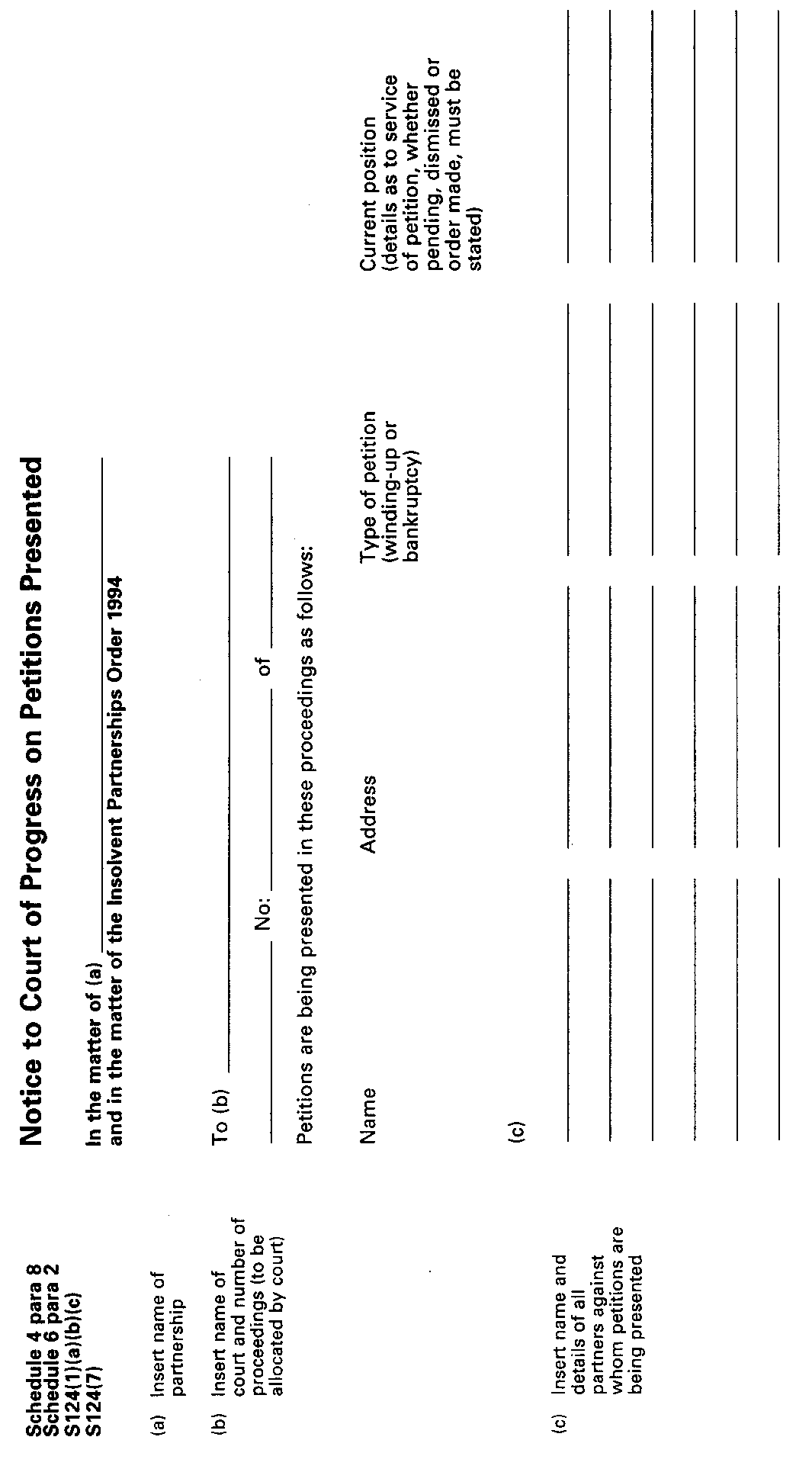
FORM 10


F256FORM 11


F257FORM 12


F258FORM 13


F259FORM 14


FORM 15
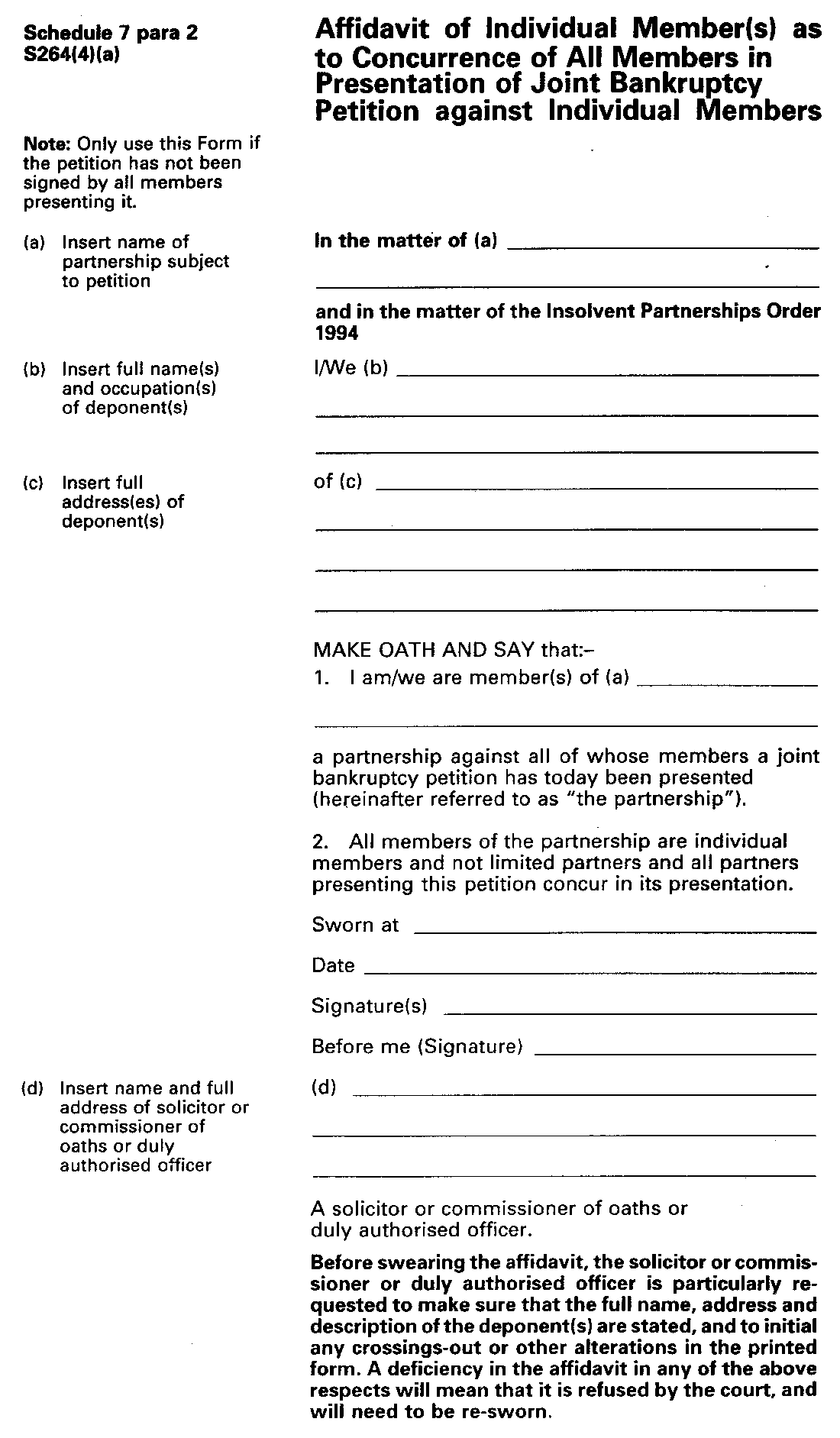
F260FORM 16

FORM 17
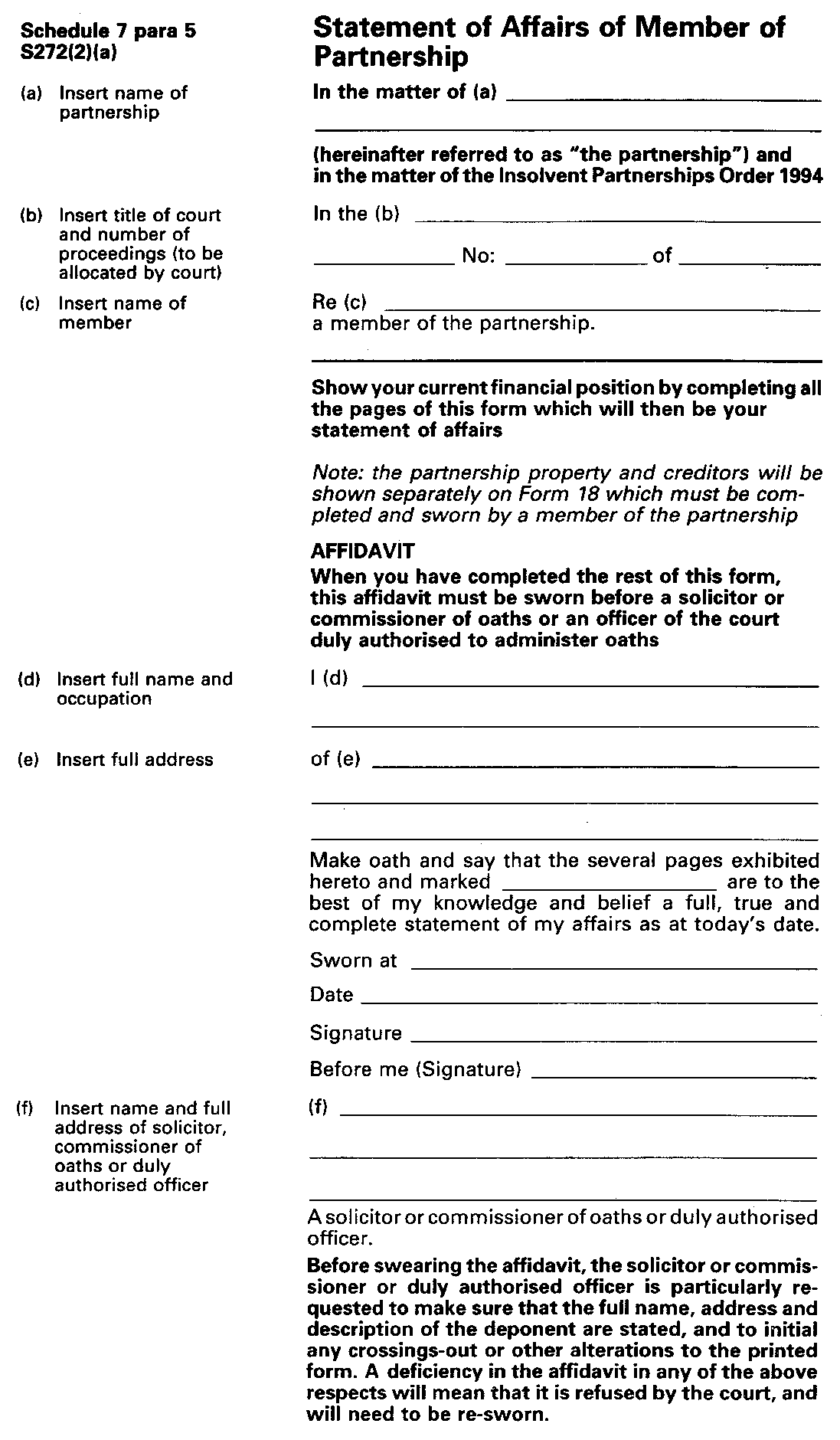


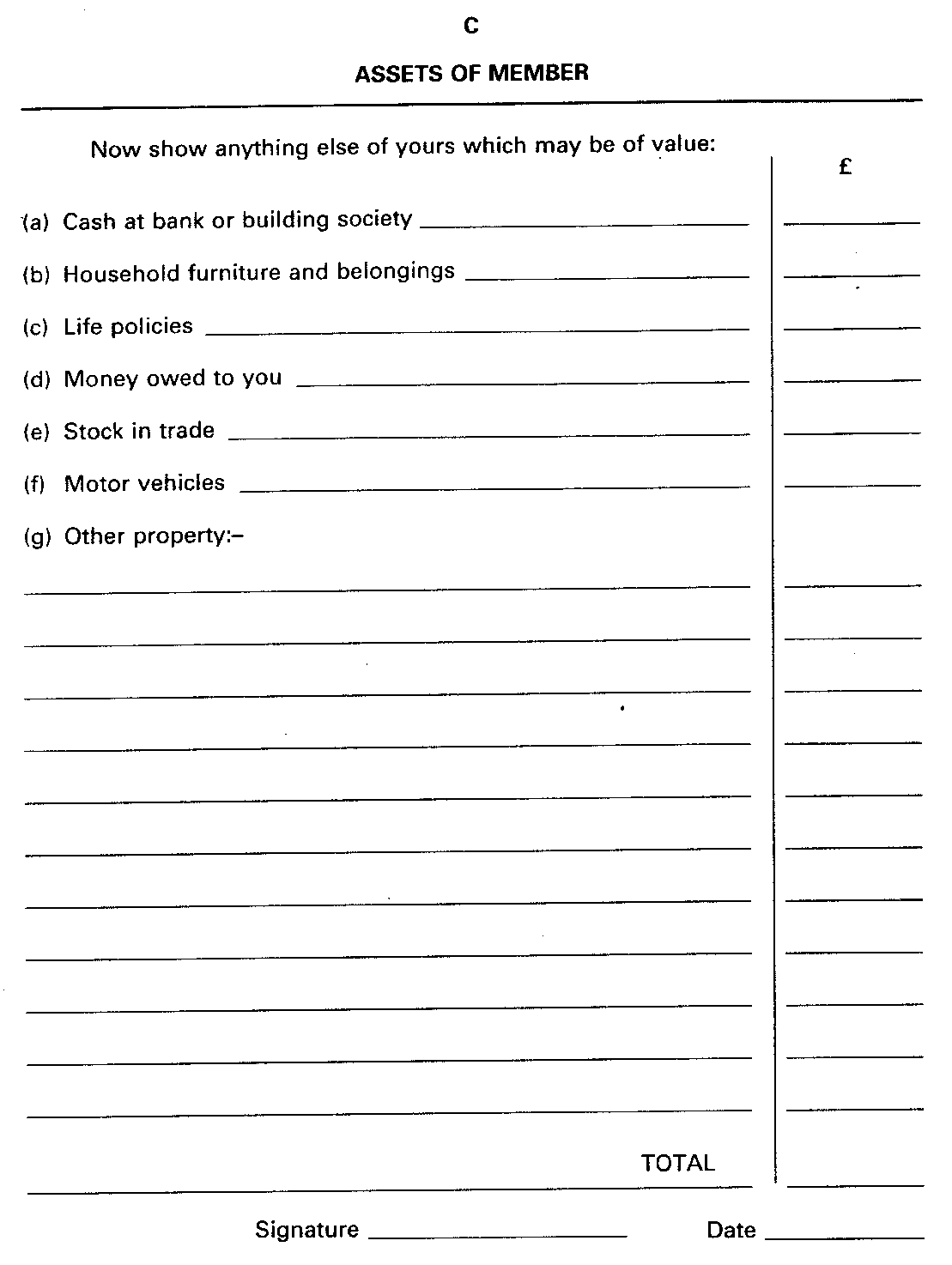
FORM 18


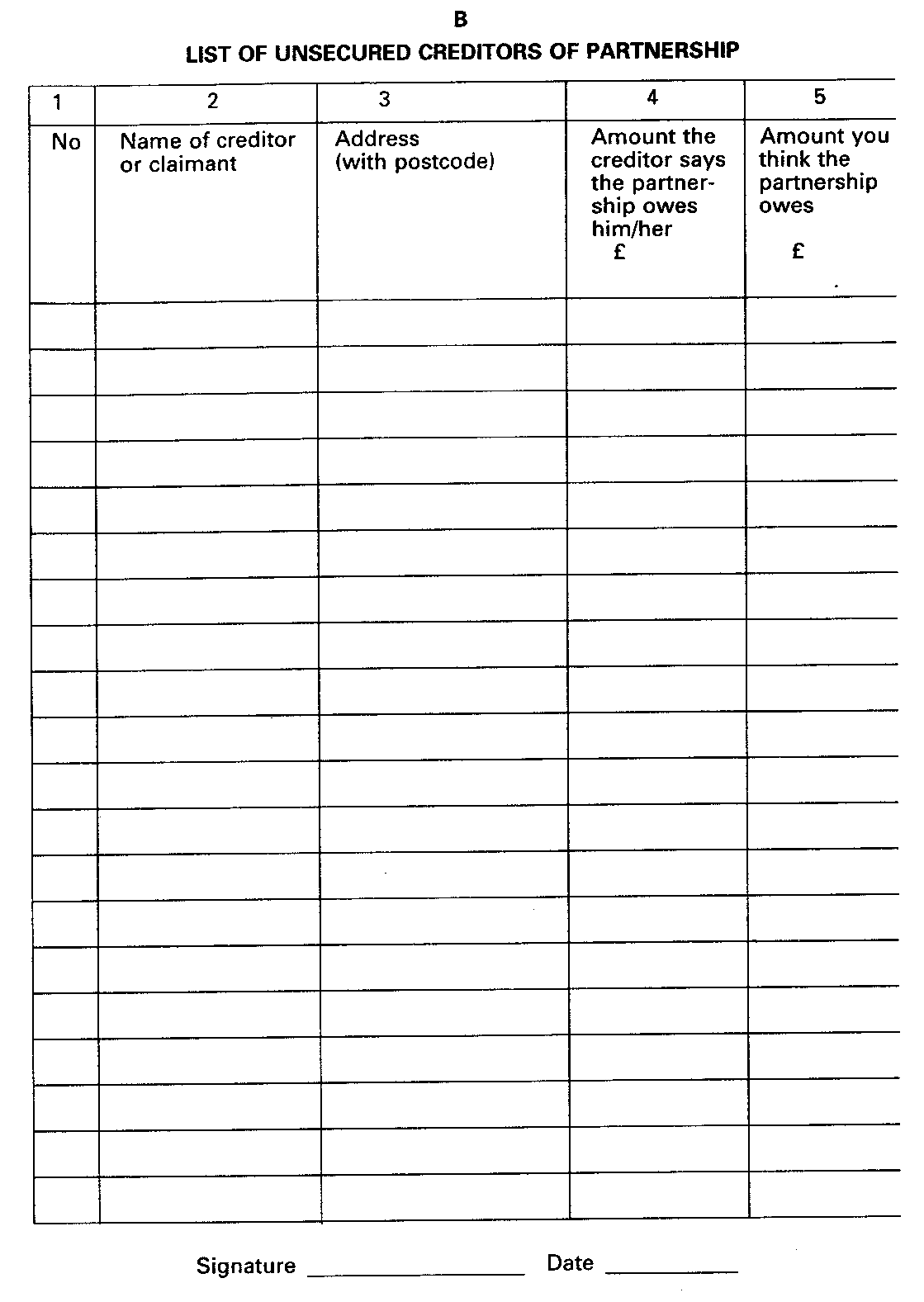

Cases considering this provision (2)
- Town & Country Properties (GB) Ltd & Ors v Black Capital & Ors[2022] EWHC 2914 (Ch)
- Pillar Securitisation SARL & Ors v Spicer & Anor (Court Administrators)[2010] EWHC 836 (Ch)
Article 18
SCHEDULE 10 SUBORDINATE LEGISLATION APPLIED cross-notesI86
The Insolvency Practitioners Tribunal (Conduct of Investigations) Rules 1986(21)
The Insolvency Practitioners (Recognised Professional Bodies) Order 1986(22)
[F261 The Insolvency (England and Wales) Rules 2016F261]
[F262 The Insolvency Regulations 1994F262]
The Insolvency Proceedings (Monetary Limits) Order 1986(23)
The Administration of Insolvent Estates of Deceased Persons Order 1986(24)
The Insolvency (Amendment of Subordinate Legislation) Order 1986(25)
F263 ...
[F264 The Companies (Disqualification Orders) Regulations 2001;F264]
The Co-operation of Insolvency Courts (Designation of Relevant Countries and Territories) Order 1986(26)
[F265 The Insolvent Companies (Reports on Conduct of Directors) Rules 1996;F265]
The Insolvent Companies (Disqualification of Unfit Directors) Proceedings Rules 1987(27)
[F266 The Insolvency Practitioners Regulations 2005;F266]
[F267 The Insolvency Practitioners and Insolvency Services Accounts (Fees) Order 2003;
The Insolvency Proceedings (Fees) Order 2004F267]
1986 c. 46; the amendments to section 21(2) made by the Companies Act 1989 (c. 40) are not relevant for the purposes of this Order.
1928 c. 43.
1907 c. 24.
1890 c. 39.
S.I. 1994/2421.
S.I. 1986/2142.
1914 c. 59.
1890 c. 39
S.I. 1986/2030, amended by S.I. 1988/95, S.I. 1990/560, S.I. 1991/496 and S.I. 1992/34.
1838 c. 110.
1890 c. 39.
S.I. 1986/1994, amended by S.I. 1987/1959, S.I. 1988/1739 and S.I. 1991/380.
S.I. 1986/2030, amended by S.I. 1988/95, S.I. 1990/560, S.I. 1991/496 and S.I. 1992/34.
1838 c. 110.
S.I. 1986/952.
S.I. 1986/1764.
S.I. 1986/1996.
S.I. 1986/1999.
S.I. 1986/2001, amended by S.I. 1986/2245 and S.I. 1987/1398.
S.I. 1986/2123.
S.I. 1987/2023.