Statutory Instruments
1986 No. 1925
INSOLVENCY
COMPANIES, INDIVIDUALS, ENGLAND AND WALES
The Insolvency Rules 1986cross-notes
Made
10th November 1986
Laid before Parliament
1st December 1986
Coming into force
29th December 1986
The Lord Chancellor, in the exercise of his powers under sections 411 and 412 of the Insolvency Act 1986, with the concurrence of the Secretary of State, and after consulting the committee existing for that purpose under section 413 of that Act, hereby makes the following Rules:—
INTRODUCTORY PROVISIONS
Citation and commencementI1
0.1. These Rules may be cited as the Insolvency Rules 1986 and shall come into force on 29th December 1986.
[F1Construction and interpretation
0.2.—(1) In these Rules–
“the Act” means the Insolvency Act 1986 (any reference to a numbered section being to a section of that Act);
“the Companies Act” means the Companies Act 1985 ;
“CPR” means the Civil Procedure Rules 1998 and “CPR” followed by a Part or rule by number means the Part or rule with that number in those Rules;
“RSC” followed by an Order by number means the Order with that number set out in Schedule 1 to the CPR; and
“the Rules” means the Insolvency Rules 1986.
(2) References in the Rules to ex parte hearings shall be construed as references to hearings without notice being served on any other party; references to applications made ex parte as references to applications made without notice being served on any other party and other references which include the expression “ ex parte ” shall be similarly construed.
(3) Subject to paragraphs (1) and (2), Part 13 of the Rules has effect for their interpretation and application.F1]
ExtentI2
0.3.—(1) Parts 1, 2 and 4 of the Rules, and Parts 7 to 13 as they relate to company insolvency, apply in relation to companies which the courts in England and Wales have jurisdiction to wind up.
[F2 (2) Rule 3.1 applies to all receivers to whom Part III of the Act applies, Rule 3.39 and 3.40 apply to all receivers who are not administrative receivers, and the remainder of Part 3 of the Rules applies to administrative receivers appointed otherwise than under section 51 (Scottish Receivership).F2]
(3) Parts 5 and 6 of the Rules, and Parts 7 to 13 as they relate to individual insolvency, extend to England and Wales only.
THE FIRST GROUP OF PARTS
PART 1 COMPANY VOLUNTARY ARRANGEMENTS
CHAPTER 1 PRELIMINARY
Scope of this Part; interpretationI3
case1.1.—(1) The Rules in this Part apply where, pursuant to Part I of the Act, it is intended to make, and there is made, a proposal to a company and its creditors for a voluntary arrangement, that is to say, a composition in satisfaction of its debts or a scheme of arrangement of its affairs.
(2) In this Part—
[F3 (a)Chapter 2 applies where the proposal for the voluntary arrangement is made by the directors of the company and
(i)the company is neither in liquidation nor is [F4 the company in administrationF4] ; and
(ii)no steps have been taken to obtain a moratorium under Schedule A1 to the Act in connection with the proposal;F3]
(b)Chapter 3 applies where the company is in liquidation or [F5the company is in administrationF5] , and the proposal is made by the liquidator or (as the case may be) the administrator, he in either case being the nominee for the purposes of the proposal;
[F6 (c)Chapter 4 applies in the same case as Chapter 3, but where the nominee is not the liquidator or administrator;
(d)Chapter 5 applies in all the three cases mentioned in sub-paragraphs (a) to (c) above;
(e)Chapters 7 and 8 apply to all voluntary arrangements with or without a moratorium; and
(f)Chapter 9 applies where the proposal is made by the directors of an eligible company with a view to obtaining a moratorium.F6]
(3)
[F7 (4) In this Part, a reference to an “eligible company” is to a company that is eligible for a moratorium in accordance with paragraph 2 of Schedule A1 to the Act. F7]
Cases considering this provision (1)
- Prudential Assurance Company Ltd & Ors v PRG Powerhouse Ltd. & Ors[2007] EWHC 1002 (Ch)
CHAPTER 2 PROPOSAL BY DIRECTORS
Preparation of proposalI4
1.2. The directors shall prepare for the intended nominee a proposal on which (with or without amendments to be made under Rule 1.3 below) to make his report to the court under section 2.
Contents of proposalI5
case1.3.—(1) The directors' proposal shall provide a short explanation why, in their opinion, a voluntary arrangement under Part I of the Act is desirable, and give reasons why the company's creditors may be expected to concur with such an arrangement.
(2) The following matters shall be stated, or otherwise dealt with, in the directors' proposal—
(a)the following matters, so far as within the directors' immediate knowledge—
(i)the company's assets, with an estimate of their respective values,
(ii)the extent (if any) to which the assets are charged in favour of creditors,
(iii)the extent (if any) to which particular assets are to be excluded from the voluntary arrangement;
(b)particulars of any property, other than assets of the company itself, which is proposed to be included in the arrangement, the source of such property and the terms on which it is to be made available for inclusion;
(c)the nature and amount of the company's liabilities (so far as within the directors' immediate knowledge), the manner in which they are proposed to be met, modified, postponed or otherwise dealt with by means of the arrangement, and (in particular)—
(i)how it is proposed to deal with preferential creditors (defined in section 4(7)) and creditors who are, or claim to be, secured,
(ii)how persons connected with the company (being creditors) are proposed to be treated under the arrangement, and
(iii)whether there are, to the directors' knowledge, any circumstances giving rise to the possibility, in the event that the company should go into liquidation, of claims under—
section 238 (transactions at an undervalue),
section 239 (preferences),
section 244 (extortionate credit transactions), or
section 245 (floating charges invalid);
and, where any such circumstances are present, whether, and if so how, it is proposed under the voluntary arrangement to make provision for wholly or partly indemnifying the company in respect of such claims;
[F8 (ca)an estimate (to the best of the directors' knowledge and belief and subject to paragraph (4)) of—
(i)the value of the prescribed part, should the company go into liquidation if the proposal for the voluntary arrangement is not accepted, whether or not section 176A is to be disapplied; and
(ii)the value of the company’s net property on the date that the estimate is made;F8]
(d)whether any, and if so what, guarantees have been given of the company's debts by other persons, specifying which (if any) of the guarantors are persons connected with the company;
(e)the proposed duration of the voluntary arrangement;
(f)the proposed dates of distributions to creditors, with estimates of their amounts;
[F9 (fa)How it is proposed to deal with the claim of any person who is bound by the arrangement by virtue of section 5(2)(b)(ii)(1);F9]
(g)the amount proposed to be paid to the nominee (as such) by way of remuneration and expenses;
(h)the manner in which it is proposed that the supervisor of the arrangement should be remunerated, and his expenses defrayed;
(j)whether, for the purposes of the arrangement, any guarantees are to be offered by directors, or other persons, and whether (if so) any security is to be given or sought;
(k)the manner in which funds held for the purposes of the arrangement are to be banked, invested or otherwise dealt with pending distribution to creditors;
(l)the manner in which funds held for the purpose of payment to creditors, and not so paid on the termination of the arrangement, are to be dealt with;
(m)the manner in which the business of the company is proposed to be conducted during the course of the arrangement;
(n)details of any further credit facilities which it is intended to arrange for the company, and how the debts so arising are to be paid;
(o)F10the functions which are to be undertaken by the supervisor of the arrangement; ...
[F11 (p)the name, address and qualification of the person proposed as supervisor of the voluntary arrangement, and confirmation that he is either qualified to act as an insolvency practitioner in relation to the company or is an authorised person in relation to the company; andF11]
(q)whether the EC Regulation will apply and, if so, whether the proceedings will be main proceedings, secondary proceedings or territorial proceedings.
(3) With the agreement in writing of the nominee, the directors' proposal may be amended at any time up to delivery of the former's report to the court under section 2(2).
[F12 (4) Nothing in paragraph (2)(ca) is to be taken as requiring the estimate referred to in that paragraph to include any information, the disclosure of which could seriously prejudice the commercial interests of the company. If such information is excluded from the calculation the estimate shall be accompanied by a statement to that effect.F12]
Cases considering this provision (3)
- Inland Revenue v Wimbledon Football Club Ltd & Ors Rev 2[2004] EWCA Civ 655
- In re NT Gallagher & Son Ltd (Shierson v Tomlinson, NT Gallagher & Sons Ltd v Howard)[2002] EWCA Civ 404
- Prudential Assurance Company Ltd & Ors v PRG Powerhouse Ltd. & Ors[2007] EWHC 1002 (Ch)
Notice to intended nomineeI6
1.4.—(1) The directors shall give to the intended nominee written notice of their proposal.
(2) The notice, accompanied by a copy of the proposal, shall be delivered either to the nominee himself, or to a person authorised to take delivery of documents on his behalf.
(3) If the intended nominee agrees to act, he shall cause a copy of the notice to be endorsed to the effect that it has been received by him on a specified date; and the period of 28 days referred to in section 2(2) then runs from that date.
(4) The copy of the notice so endorsed shall be returned by the nominee forthwith to the directors at an address specified by them in the notice for that purpose.
Statement of affairsI7
1.5.—(1) The directors shall, within 7 days after their proposal is delivered to the nominee, or within such longer time as he may allow, deliver to him a statement of the company's affairs.
(2) The statement shall comprise the following particulars (supplementing or amplifying, so far as is necessary for clarifying the state of the company's affairs, those already given in the directors' proposal)—
(a)a list of the company's assets, divided into such categories as are appropriate for easy identification, with estimated values assigned to each category;
(b)in the case of any property on which a claim against the company is wholly or partly secured, particulars of the claim and its amount, and of how and when the security was created;
(c)the names and addresses of the company's preferential creditors (defined in section 4(7)), with the amounts of their respective claims;
(d)the names and addresses of the company's unsecured creditors, with the amounts of their respective claims;
(e)particulars of any debts owed by or to the company to or by persons connected with it;
(f)the names and addresses of the company's members, with details of their respective shareholdings;
(g)such other particulars (if any) as the nominee may in writing require to be furnished for the purposes of making his report to the court on the directors' proposal.
(3) The statement of affairs shall be made up to a date not earlier than 2 weeks before the date of the notice to the nominee under Rule 1.4.
However, the nominee may allow an extension of that period to the nearest practicable date (not earlier than 2 months before the date of the notice under Rule 1.4); and if he does so, he shall give his reasons in his report to the court on the directors' proposal.
(4) The statement shall be certified as correct, to the best of their knowledge and belief, by two or more directors of the company, or by the company secretary and at least one director (other than the secretary himself).
Additional disclosure for assistance of nomineeI8
1.6.—(1) If it appears to the nominee that he cannot properly prepare his report on the basis of information in the directors' proposal and statement of affairs, he may call on the directors to provide him with—
(a)further and better particulars as to the circumstances in which, and the reasons why, the company is insolvent or (as the case may be) threatened with insolvency;
(b)particulars of any previous proposals which have been made in respect of the company under Part I of the Act;
(c)any further information with respect to the company's affairs which the nominee thinks necessary for the purposes of his report.
(2) The nominee may call on the directors to inform him, with respect to any person who is, or at any time in the 2 years preceding the notice under Rule 1.4 has been, a director or officer of the company, whether and in what circumstances (in those 2 years or previously) that person—
(a)has been concerned in the affairs of any other company (whether or not incorporated in England and Wales) which has become insolvent, or
(b)has himself been adjudged bankrupt or entered into an arrangement with his creditors.
(3) For the purpose of enabling the nominee to consider their proposal and prepare his report on it, the directors must give him access to the company's accounts and records.
Nominee's report on the proposalI9
1.7.—(1) With his report to the court under section 2 the nominee shall deliver—
(a)a copy of the directors' proposal (with amendments, if any, authorised under Rule 1.3(3)); and
(b)a copy or summary of the company's statement of affairs.
(2) If the nominee makes known his opinion [F13that the directors' proposal has a reasonable prospect of being approved and implemented andF13] that meetings of the company and its creditors should be summoned under section 3, his report shall have annexed to it his comments on the proposal.
If his opinion is otherwise, he shall give his reasons for that opinion.
(3) The court shall cause the nominee's report to be endorsed with the date on which it is filed in court. Any director, member or creditor of the company is entitled, at all reasonable times on any business day, to inspect the file.
(4) The nominee shall send a copy of his report, and of his comments (if any), to the company.
[F14Replacement of nominee
1.8.—(1) Where a person other than the nominee intends to apply to the court under section 2(4) for the nominee to be replaced, (except in any case where the nominee has died) he shall give to the nominee at least 7 days' notice of his application.
(2) Where the nominee intends to apply to the court under section 2(4) of the Act to be replaced, he shall give at least 7 days' notice of his application to the person intending to make the proposal.
(3) No appointment of a replacement nominee shall be made by the court unless there is filed in court a statement by the replacement nominee—
(a)[[FORM 8.1]] indicating his consent to act, and
(b)that he is qualified to act as an insolvency practitioner in relation to the company or is an authorised person in relation to the company.F14]
Summoning of meetings under s. 3I10
case1.9.—(1) If in his report the nominee states that in his opinion meetings of the company and its creditors should be summoned to consider the directors' proposal, the date on which the meetings are to be held shall be not less than 14, nor more than 28, days from that on which the nominee's report is filed in court under Rule 1.7.
(2) Notices calling the meetings shall be sent by the nominee, at least 14 days before the day fixed for them to be held—
(a)in the case of the creditors' meeting, to all the creditors specified in the statement of affairs, and any other creditors of the company of whom he is otherwise aware; and
(b)in the case of the meeting of members of the company, to all persons who are, to the best of the nominee's belief, members of it.
(3) Each notice sent under this Rule shall specify the court to which the nominee's report under section 2 has been delivered and shall state the effect of Rule 1.19(1), (3) and (4) (requisite majorities (creditors)); and with each notice there shall be sent—
(a)a copy of the directors' proposal;
(b)a copy of the statement of affairs or, if the nominee thinks fit, a summary of it (the summary to include a list of creditors and the amount of their debts); and
(c)the nominee's comments on the proposal.
CHAPTER 3 PROPOSAL BY ADMINISTRATOR OR LIQUIDATOR (HIMSELF THE NOMINEE)
Preparation of proposalI11
1.10.—(1) The responsible insolvency practitioner's proposal shall specify—
(a)all such matters as under Rule 1.3 [F15(subject to paragraph (3) below)F15] in Chapter 2 the directors of the company would be required to include in a proposal by them [F16, with the addition, where the company is [F17 in administrationF17] , of the names and addresses of the company’s preferential creditors (defined in section 4(7)), with the amounts of their respective claimsF16] , and
(b)such other matters (if any) as the insolvency practitioner considers appropriate for ensuring that members and creditors of the company are enabled to reach an informed decision on the proposal.
(2) Where the company is being wound up by the court, the insolvency practitioner shall give notice of the proposal to the official receiver.
[F18 (3) The administrator or liquidator shall include, in place of the estimate required by Rule 1.3(2)(ca), a statement which contains—
(a)to the best of the administrator or liquidator’s knowledge and belief—
(i)an estimate of the value of the prescribed part (whether or not he proposes to make an application to court under section 176A(5) or section 176A(3) applies), and
(ii)an estimate of the value of the company’s net property, and
(b)whether, and, if so, why, the administrator or liquidator proposes to make an application to court under section 176A(5).
(4) Nothing in this Rule is to be taken as requiring any such estimate to include any information, the disclosure of which could seriously prejudice the commercial interests of the company. If such information is excluded from the calculation the estimate shall be accompanied by a statement to that effect.F18]
Summoning of meetings under s. 3I12
case1.11.—(1) The responsible insolvency practitioner shall fix a venue for the creditors' meeting and the company meeting, and give at least 14 days' notice of the meetings—
(a)in the case of the creditors' meeting, to all the creditors specified in the company's statement of affairs, and to any other creditors of whom the insolvency practitioner is aware; and
(b)in the case of the company meeting, to all persons who are, to the best of his belief, members of the company.
(2) Each notice sent out under this Rule shall state the effect of Rule 1.19(1), (3) and (4) (requisite majorities (creditors)); and with it there shall be sent—
(a)a copy of the responsible insolvency practitioner's proposal, and
(b)a copy of the statement of affairs or, if he thinks fit, a summary of it (the summary to include a list of creditors and the amounts of their debts).
Cases considering this provision (1)
- Re T & N Ltd[2006] EWHC 842 (Ch)
CHAPTER 4 PROPOSAL BY ADMINISTRATOR OR LIQUIDATOR (ANOTHER INSOLVENCY PRACTITIONER THE NOMINEE)
Preparation of proposal and notice to nomineeI13
case1.12.—(1) The responsible insolvency practitioner shall give notice to the intended nominee, and prepare his proposal for a voluntary arrangement, in the same manner as is required of the directors, in the case of a proposal by them, under Chapter 2.
(2) Rule 1.2 applies to the responsible insolvency practitioner as it applies to the directors; and Rule 1.4 applies as regards the action to be taken by the nominee.
(3) The content of the proposal shall be as required by Rule 1.3 [F19(and, where relevant, Rule 1.10)F19] , reading references to the directors as referring to the responsible insolvency practitioner.
(4) Rule 1.6 applies in respect of the information to be furnished to the nominee, reading references to the directors as referring to the responsible insolvency practitioner.
(5) With the proposal the responsible insolvency practitioner shall provide a copy of the company's statement of affairs.
(6) Where the company is being wound up by the court, the responsible insolvency practitioner shall send a copy of the proposal to the official receiver, accompanied by the name and address of the insolvency practitioner [F20or authorised personF20] who has agreed to act as nominee.
(7) Rules 1.7 to 1.9 apply as regards a proposal under this Chapter as they apply to a proposal under Chapter 2.
Cases considering this provision (1)
- Inland Revenue v Wimbledon Football Club Ltd & Ors Rev 2[2004] EWCA Civ 655
CHAPTER 5 PROCEEDINGS ON A PROPOSAL MADE BY THE DIRECTORS, OR BY THE ADMINISTRATOR, OR BY THE LIQUIDATOR
SECTION A: MEETINGS OF COMPANY'S CREDITORS AND MEMBERS
Summoning of meetings
case[F21 1.13. —(1) Subject as follows, in fixing the venue for the creditors' meeting and the company meeting, the person summoning the meeting (“the convener”) shall have regard primarily to the convenience of the creditors.
(2) ) Meetings shall in each case be summoned for commencement between 10.00 and 16.00 hours on a business day.
(3) The meetings may be held on the same day or on different days. If held on the same day, the meetings shall be held in the same place, but in either case the creditors' meeting shall be fixed for a time in advance of the company meeting.
(4) Where the meetings are not held on the same day, they shall be held within 7 days of each other.
(5) With every notice summoning either meeting there shall be sent out forms of proxy.F21]
Cases considering this provision (1)
- Re T & N Ltd[2006] EWHC 842 (Ch)
The chairman at meetingsI14
case1.14.—(1) Subject as follows, at both the creditors' meeting and the company meeting, and at any combined meeting, the convener shall be chairman.
F22(2) If for any reason he is unable to attend, he may nominate another person to act as chairman in his place; but a person so nominated must be ...—
[F23 (a)a person qualified to act as an insolvency practitioner in relation to the company;
(b)an authorised person in relation to the company; or
(c)an employee of the convenor or his firm who is experienced in insolvency matters.F23]
Cases considering this provision (1)
- Re T & N Ltd[2006] EWHC 842 (Ch)
The chairman as proxy-holderI15
1.15. The chairman shall not by virtue of any proxy held by him vote to increase or reduce the amount of the remuneration or expenses of the nominee or the supervisor of the proposed arrangement, unless the proxy specifically directs him to vote in that way.
Attendance by company officersI16
1.16.—(1) At least 14 days' notice to attend the meetings shall be given by the convener—
(a)to all directors of the company, and
(b)to any persons in whose case the convener thinks that their presence is required as being officers of the company, or as having been directors or officers of it at any time in the 2 years immediately preceding the date of the notice.
(2) The chairman may, if he thinks fit, exclude any present or former director or officer from attendance at a meeting, either completely or for any part of it; and this applies whether or not a notice under this Rule has been sent to the person excluded.
SECTION B: VOTING RIGHTS AND MAJORITIES
[F24Entitlement to vote (creditors)
case1.17.—(1) Subject as follows, every creditor who has notice of the creditors' meeting is entitled to vote at the meeting or any adjournment of it.
(2) Votes are calculated according to the amount of the creditor’s debt as at the date of the meeting or, where the company is being wound up or is [F25 in administrationF25] , the date of its going into liquidation or (as the case may be) of the [F25 when the company entered administrationF25] .
(3) A creditor may vote in respect of a debt for an unliquidated amount or any debt whose value is not ascertained and for the purposes of voting (but not otherwise) his debt shall be valued at £1 unless the chairman agrees to put a higher value on it.
Cases considering this provision (4)
- Leighton Contracting (Qatar) WLL v Simms & Ors[2011] EWHC 1735 (Ch)
- HMRC v Portsmouth City Football Club Ltd & Ors[2010] EWHC 2013 (Ch)
- Re T & N Ltd[2006] EWHC 842 (Ch)
- T&N Ltd & Ors, Re Insolvency Act 1986[2005] EWHC 2870 (Ch)
Procedure for admission of creditors' claims for voting purposes
case1.17A.—(1) Subject as follows, at any creditors' meeting the chairman shall ascertain the entitlement of persons wishing to vote and shall admit or reject their claims accordingly.
(2) The chairman may admit or reject a claim in whole or in part.
(3) The chairman’s decision on any matter under this Rule or under paragraph (3) of Rule 1.17 is subject to appeal to the court by any creditor or member of the company.
(4) If the chairman is in doubt whether a claim should be admitted or rejected, he shall mark it as objected to and allow votes to be cast in respect of it, subject to such votes being subsequently declared invalid if the objection to the claim is sustained.
(5) If on an appeal the chairman’s decision is reversed or varied, or votes are declared invalid, the court may order another meeting to be summoned, or make such order as it thinks just.
The court’s power to make an order under this paragraph is exercisable only if it considers that the circumstances giving rise to the appeal give rise to unfair prejudice or material irregularity.
(6) An application to the court by way of appeal against the chairman’s decision shall not be made after the end of the period of 28 days beginning with the first day on which the report required by section 4(6) has been made to the court.
(7) The chairman is not personally liable for any costs incurred by any person in respect of an appeal under this Rule.F24]
Cases considering this provision (3)
- Leighton Contracting (Qatar) WLL v Simms & Ors[2011] EWHC 1735 (Ch)
- Macaria Investments Ltd v Sanders & Anor[2010] EWHC 3353 (Ch)
- HMRC v Portsmouth City Football Club Ltd & Ors[2010] EWHC 2013 (Ch)
Voting rights (members)I17
1.18.—(1) Subject as follows, members of the company at their meeting vote according to the rights attaching to their shares respectively in accordance with the articles.
F26(2) . . . . . . . . . . . . . . . . . . . . . . . . . . . . . . . .
(3) References in this Rule to a person's shares include any other interest which he may have as a member of the company.
Requisite majorities (creditors)I18
case1.19.—(1) Subject as follows, at the creditors' meeting for any resolution to pass approving any proposal or modification there must be a majority in excess of three-quarters in value of the creditors present in person or by proxy and voting on the resolution.
(2) The same applies in respect of any other resolution proposed at the meeting, but substituting one-half for three-quarters.
(3) In the following cases there is to be left out of account a creditor's vote in respect of any claim or part of a claim—
(a)where written notice of the claim was not given, either at the meeting or before it, to the chairman or convener of the meeting;
(b)where the claim or part is secured;
(c)where the claim is in respect of a debt wholly or partly on, or secured by, a current bill of exchange or promissory note, unless the creditor is willing—
(i)to treat the liability to him on the bill or note of every person who is liable on it antecedently to the company, and against whom a bankruptcy order has not been made (or in the case of a company, which has not gone into liquidation), as a security in his hands, and
(ii)to estimate the value of the security and (for the purpose of entitlement to vote, but not of any distribution under the arrangement) to deduct it from his claim.
(4) Any resolution is invalid if those voting against it include more than half in value of the creditors, counting in these latter only those—
(a)to whom notice of the meeting was sent;
(b)whose votes are not to be left out of account under paragraph (3); and
(c)who are not, to the best of the chairman's belief, persons connected with the company.
(5) It is for the chairman of the meeting to decide whether under this Rule—
(a)a vote is to be left out of account in accordance with paragraph (3), or
(b)a person is a connected person for the purposes of paragraph (4)(c);
and in relation to the second of these two cases the chairman is entitled to rely on the information provided by the company's statement of affairs or otherwise in accordance with this Part of the Rules.
(6) If the chairman uses a proxy contrary to Rule 1.15, his vote with that proxy does not count towards any majority under this Rule.
[F27 (7) The chairman’s decision on any matter under this Rule is subject to appeal to the court by any creditor or member and paragraphs (5) to (7) of Rule 1.17A apply as regards such an appeal.F27]
Cases considering this provision (2)
- Fitzroy Street Capital Inc & Anor v Lee Antony Manning & Anor[2022] EWHC 1495 (Ch)
- Macaria Investments Ltd v Sanders & Anor[2010] EWHC 3353 (Ch)
Requisite majorities (members)I19
1.20.—(1) Subject as follows, and to any express provision made in the articles, at a company meeting any resolution is to be regarded as passed if voted for by more than one-half [F28in valueF28] of the members present in person or by proxy and voting on the resolution.
[F29 The value of members is determined by reference to the number of votes conferred on each member by the company’s articles.F29]
F30(2) . . . . . . . . . . . . . . . . . . . . . . . . . . . . . . . .
(3) If the chairman uses a proxy contrary to Rule 1.15, his vote with that proxy does not count towards any majority under this Rule.
Proceedings to obtain agreement on the proposal
[F31 1.21 .—(1) If the chairman thinks fit, the creditors' meeting and the company meeting may be held together
(2) The chairman may, and shall if it is so resolved at the meeting in question, adjourn that meeting for not more than 14 days.
(3) If there are subsequently further adjournments, the final adjournment shall not be to a day later than 14 days after the date on which the meeting in question was originally held.
(4) In the case of a proposal by the directors, if the meetings are adjourned under paragraph (2), notice of the fact shall be given by the nominee forthwith to the court.
(5) If following the final adjournment of the creditors' meeting the proposal (with or without modifications) has not been approved by the creditors, it is deemed rejected.F31]
SECTION C: IMPLEMENTATION OF THE ARRANGEMENT
Resolutions to follow approvalI20
1.22.[F32—(1) If the voluntary arrangement is approved (with or without modifications) by the creditors' meeting, a resolution may be taken by the creditors, where two or more supervisors are appointed, on the question whether acts to be done in connection with the arrangement may be done by any one or more of them, or must be done by all of them.F32]
F33(2) . . . . . . . . . . . . . . . . . . . . . . . . . . . . . . . .
(3) If at either meeting a resolution is moved for the appointment of some person other than the nominee to be supervisor of the arrangement, there must be produced to the chairman, at or before the meeting—
(a)that person's written consent to act (unless he is present and then and there signifies his consent), and
(b)his written confirmation that he is qualified to act as an insolvency practitioner in relation to the company [F34or is an authorised person in relation to the companyF34] .
[F35Notice of order made under section 4A(6)
1.22A.—(1) This Rule applies where the court makes an order under section 4A(6).
(2) The member of the company who applied for the order shall serve sealed copies of it on—
(a)the supervisor of the voluntary arrangement; and
(b)the directors of the company.
(3) Service on the directors may be effected by service of a single copy on the company at its registered office.
(4) The directors or (as the case may be) the supervisor shall forthwith after receiving a copy of the court’s order, give notice of it to all persons who were sent notice of the creditors' or company meetings or who, not having been sent such notice, are affected by the order.
(5) The person on whose application the order of the court was made shall, within 7 days of the order, deliver an office copy to the registrar of companies.F35]
Hand-over of property etc. to supervisorI21
case1.23.—(1)[F36 Where the decision approving the voluntary arrangement has effect under section 4A—F36]
(a)the directors, or
(b)where the company is in liquidation or is [F37in administrationF37] , and a person other than the responsible insolvency practitioner is appointed as supervisor of the voluntary arrangement, the insolvency practitioner,
shall forthwith do all that is required for putting the supervisor into possession of the assets included in the arrangement.
(2) Where the company is in liquidation or is [F38in administrationF38] , the supervisor shall on taking possession of the assets discharge any balance due to the insolvency practitioner by way of remuneration or on account of—
(a)fees, costs, charges and expenses properly incurred and payable under the Act or the Rules, and
(b)any advances made in respect of the company, together with interest on such advances at the rate specified in section 17 of the Judgments Act 1838 at the date on which the company went into liquidation or (as the case may be) [F39entered administrationF39] .
(3) Alternatively, the supervisor must, before taking possession, give the responsible insolvency practitioner a written undertaking to discharge any such balance out of the first realisation of assets.
(4) The insolvency practitioner has a charge on the assets included in the voluntary arrangement in respect of any sums due as above until they have been discharged, subject only to the deduction from realisations by the supervisor of the proper costs and expenses of such realisations.
(5) The supervisor shall from time to time out of the realisation of assets discharge all guarantees properly given by the responsible insolvency practitioner for the benefit of the company, and shall pay all the insolvency practitioner's expenses.
(6) References in this Rule to the responsible insolvency practitioner include, where a company is being wound up by the court, the official receiver, whether or not in his capacity as liquidator; and any sums due to the official receiver take priority over those due to a liquidator.
Cases considering this provision (1)
- Neumans LLP (a firm) v Andronikou & Ors[2012] EWHC 3088 (Ch)
Report of meetingsI22
1.24.—(1) A report of the meetings shall be prepared by the person who was chairman of them.
(2) The report shall—
[F40 (a)state whether the proposal for a voluntary arrangement was approved by the creditors of the company alone or by both the creditors and members of the company and in either case whether such approval was with any modifications;F40]
(b)set out the resolutions which were taken at each meeting, and the decision on each one;
(c)F41list the creditors and members of the company (with their respective values) who were present or represented at the meetings, and how they voted on each resolution; ...
[F42 (ca)state whether, in the opinion of the supervisor, (i) the EC Regulation applies to the voluntary arrangement and (ii) if so, whether the proceedings are main proceedings, secondary proceedings or territorial proceedings; andF42]
(d)include such further information (if any) as the chairman thinks it appropriate to make known to the court.
(3) A copy of the chairman's report shall, within 4 days of the meetings being held, be filed in court; and the court shall cause that copy to be endorsed with the date of filing.
(4) In respect of each of the meetings, the persons to whom notice of its result is to be sent by the chairman under section 4(6) are all those who were sent notice of the meeting under this Part of the Rules.
The notice shall be sent immediately after a copy of the chairman's report is filed in court under paragraph (3).
(5)[F43 If the decision approving the voluntary arrangement has effect under section 4AF43] (whether or not in the form proposed), the supervisor shall forthwith send a copy of the chairman's report to the registrar of companies.
Revocation or suspension of the arrangementI23
1.25.—(1) This Rule applies where the court makes an order of revocation or suspension under section 6.
(2) The person who applied for the order shall serve sealed copies of it—
(a)on the supervisor of the voluntary arrangement, and
(b)on the directors of the company or the administrator or liquidator (according to who made the proposal for the arrangement).
Service on the directors may be effected by service of a single copy of the order on the company at its registered office.
(3) If the order includes a direction by the court under section 6(4)(b) for any further meetings to be summoned, notice shall also be given (by the person who applied for the order) to whoever is, in accordance with the direction, required to summon the meetings.
(4) The directors or (as the case may be) the administrator or liquidator shall—
(a)forthwith after receiving a copy of the court's order, give notice of it to all persons who were sent notice of the creditors' and company meetings or who, not having been sent that notice, appear to be affected by the order;
(b)within 7 days of their receiving a copy of the order (or within such longer period as the court may allow), give notice to the court whether it is intended to make a revised proposal to the company and its creditors, or to invite re-consideration of the original proposal.
(5) [[FORM 1.2]] The person on whose application the order of revocation or suspension was made shall, within 7 days after the making of the order, deliver a copy of the order to the registrar of companies.
Supervisor's accounts and reportsI24
1.26.—(1) Where the voluntary arrangement authorises or requires the supervisor—
(a)to carry on the business of the company or trade on its behalf or in its name, or
(b)to realise assets of the company, or
(c)otherwise to administer or dispose of any of its funds,
he shall keep accounts and records of his acts and dealings in and in connection with the arrangement, including in particular records of all receipts and payments of money.
(2) The supervisor shall, not less often than once in every 12 months beginning with the date of his appointment, prepare an abstract of such receipts and payments, and send copies of it, accompanied by his comments on the progress and efficacy of the arrangement, to—
(a)the court,
(b)the registrar of companies,
(c)[[FORM 1.3]] the company,
(d)all those of the company's creditors who are bound by the arrangement,
(e)subject to paragraph (5) below, the members of the company who are so bound, and
(f)if the company is not in liquidation, the company's auditors for the time being.
If in any period of 12 months he has made no payments and had no receipts, he shall at the end of that period send a statement to that effect to all those specified in sub-paragraphs (a) to (f) above.
(3) An abstract provided under paragraph (2) shall relate to a period beginning with the date of the supervisor's appointment or (as the case may be) the day following the end of the last period for which an abstract was prepared under this Rule; and copies of the abstract shall be sent out, as required by paragraph (2), within the 2 months following the end of the period to which the abstract relates.
(4) If the supervisor is not authorised as mentioned in paragraph (1), he shall, not less often than once in every 12 months beginning with the date of his appointment, send to all those specified in paragraph (2)(a) to (f) a report on the progress and efficacy of the voluntary arrangement.
(5) The court may, on application by the supervisor—
(a)dispense with the sending under this Rule of abstracts or reports to members of the company, either altogether or on the basis that the availability of the abstract or report to members is to be advertised by the supervisor in a specified manner;
(b)vary the dates on which the obligation to send abstracts or reports arises.
Production of accounts and records to Secretary of StateI25
1.27.—(1) The Secretary of State may at any time during the course of the voluntary arrangement or after its completion [F44or terminationF44] require the supervisor to produce for inspection—
(a)his records and accounts in respect of the arrangement, and
(b)copies of abstracts and reports prepared in compliance with Rule 1.26.
(2) The Secretary of State may require production either at the premises of the supervisor or elsewhere; and it is the duty of the supervisor to comply with any requirement imposed on him under this Rule.
(3) The Secretary of State may cause any accounts and records produced to him under this Rule to be audited; and the supervisor shall give to the Secretary of State such further information and assistance as he needs for the purposes of his audit.
Fees, costs, charges and expensesI26
1.28.—(1) The fees, costs, charges and expenses that may be incurred for any of the purposes of the voluntary arrangement are—
(a)any disbursements made by the nominee prior to the [F45decision approving the arrangement taking effect under section 4AF45] , and any remuneration for his services as such agreed between himself and the company (or, as the case may be, the administrator or liquidator);
(b)any fees, costs, charges or expenses which—
(i)are sanctioned by the terms of the arrangement, or
(ii)would be payable, or correspond to those which would be payable, in an administration or winding up.
[F46Completion or termination of the arrangement
case1.29.—(1) Not more than 28 days after the final completion or termination of the voluntary arrangement, the supervisor shall send to creditors and members of the company who are bound by it a notice that the voluntary arrangement has been fully implemented or (as the case may be) has terminated.
(2) With the notice there shall be sent to each creditor and member a copy of a report by the supervisor summarising all receipts and payments made by him in pursuance of the arrangement, and explaining in relation to implementation of the arrangement any departure from the proposals as they originally took effect, or (in the case of termination of the arrangement) explaining the reasons why the arrangement has terminated.
(3) The supervisor shall, within the 28 days mentioned above, send to the registrar of companies and to the court a copy of the notice to creditors and members under paragraph (1), together with a copy of the report under paragraph (2), and the supervisor shall not vacate office until after such copies have been sent.
[F47 (4) In the report under paragraph (2), the supervisor shall include a statement as to the amount paid, if any, to unsecured creditors by virtue of the application of section 176A (prescribed part).F47,F46]]
Cases considering this provision (1)
- Mond v The Association of Chartered Certified Accountants[2005] EWHC 1414 (Admin)
CHAPTER 6 GENERAL
False representations, etc
F481.30. . . . . . . . . . . . . . . . . . . . . . . . . . . . . . . . .
[F49CHAPTER 7 EC Regulation—Conversion of Voluntary Arrangement into Winding up
Application for conversion into winding up
1.31.—(1) Where a member State liquidator proposes to apply to the court for the conversion under Article 37 of the EC Regulation (conversion of earlier proceedings) of a voluntary arrangement into a winding up, an affidavit complying with Rule 1.32 must be prepared and sworn, and filed in court in support of the application.
(2) An application under this Rule shall be by originating application.
(3) The application and the affidavit required under this Rule shall be served upon—
(a)the company; and
(b)the supervisor.
Contents of affidavit
1.32.—(1) The affidavit shall state—
(a)that main proceedings have been opened in relation to the company in a member State other than the United Kingdom;
(b)the deponent’s belief that the conversion of the voluntary arrangement into a winding up would prove to be in the interests of the creditors in the main proceedings;
(c)the deponent’s opinion as to whether the company ought to enter voluntary winding up or be wound up by the court; and
(d)all other matters that, in the opinion of the member State liquidator, would assist the court—
(i)in deciding whether to make such an order, and
(ii)if the court were to do so, in considering the need for any consequential provision that would be necessary or desirable.
(2) An affidavit under this Rule shall be sworn by, or on behalf of, the member State liquidator.
Power of court
1.33.—(1) On hearing the application for conversion into winding up the court may make such order as it thinks fit.
(2) If the court makes an order for conversion into winding up the order may contain all such consequential provisions as the court deems necessary or desirable.
(3) Without prejudice to the generality of paragraph (1), an order under that paragraph may provide that the company be wound up as if a resolution for voluntary winding up under section 84 were passed on the day on which the order is made.
(4) Where the court makes an order for conversion into winding up under paragraph (1), any expenses properly incurred as expenses of the administration of the voluntary arrangement in question shall be a first charge on the company’s assets.
CHAPTER 8 EC Regulation—Member State Liquidator
Interpretation of creditor and notice to member State liquidator
1.34.—(1) This Rule applies where a member State liquidator has been appointed in relation to the company.
(2) Where the supervisor is obliged to give notice to, or provide a copy of a document (including an order of court) to, the court, the registrar of companies or the official receiver, the supervisor shall give notice or provide copies, as appropriate, to the member State liquidator.
(3) Paragraph (2) is without prejudice to the generality of the obligations imposed by Article 31 of the EC Regulation (duty to cooperate and communicate information)F49]
[F50CHAPTER 9 OBTAINING A MORATORIUM
PROCEEDINGS DURING A MORATORIUM NOMINEES CONSIDERATION OF PROPOSALS WHERE MORATORIUM OBTAINED SECTION A: OBTAINING A MORATORIUM
Preparation of proposal by directors and submission to nominee
1.35.—(1) The document containing the proposal referred to in paragraph 6(1)(a) of Schedule A1 to the Act shall—
(a)be prepared by the directors;
(b)comply with the requirements of paragraphs (1) and (2) of Rule 1.3 (save that the reference to preferential creditors shall be to preferential creditors within the meaning of paragraph 31(8) of Schedule A1 to the Act); and
(c)state the address to which notice of the consent of the nominee to act and the documents referred to in Rule 1.38 shall be sent.
(2) With the agreement in writing of the nominee, the directors may amend the proposal at any time before submission to them by the nominee of the statement required by paragraph 6(2) of Schedule A1 to the Act.
Delivery of documents to the intended nominee etc.
1.36.—(1) The documents required to be delivered to the nominee pursuant to paragraph 6(1) of Schedule A1 to the Act shall be delivered to the nominee himself or to a person authorised to take delivery of documents on his behalf.
(2) On receipt of the documents, the nominee shall forthwith issue an acknowledgement of receipt of the documents to the directors which shall indicate the date on which the documents were received.
Statement of affairs
1.37.—(1) [[FORM 1.2]] The statement of the company’s affairs required to be delivered to the nominee pursuant to paragraph 6(1)(b) of Schedule A1 to the Act shall be delivered to the nominee no later than 7 days after the delivery to him of the document setting out the terms of the proposed voluntary arrangement or such longer time as he may allow.
(2) The statement of affairs shall comprise the same particulars as required by Rule 1.5(2) (supplementing or amplifying, so far as is necessary for clarifying the state of the company’s affairs, those already given in the directors' proposal).
(3) The statement of affairs shall be made up to a date not earlier than 2 weeks before the date of the delivery of the document containing the proposal for the voluntary arrangement to the nominee under Rule 1.36(1).
However, the nominee may allow an extension of that period to the nearest practicable date (not earlier than 2 months before the date of delivery of the documents referred to in Rule 1.36(1)) and if he does so, he shall give a statement of his reasons in writing to the directors.
(4) The statement of affairs shall be certified as correct, to the best of their knowledge and belief, by two or more directors of the company, or by the company secretary and at least one director (other than the secretary himself).
The nominee’s statement
1.38.—(1) [[FORM 1.3]] The nominee shall submit to the directors the statement required by paragraph 6(2) of Schedule A1 to the Act within 28 days of the submission to him of the document setting out the terms of the proposed voluntary arrangement.
(2) [[FORM 1.4]] The statement shall have annexed to it—
(a)the nominee’s comments on the proposal, unless the statement contains an opinion in the negative on any of the matters referred to in paragraph 6(2)(a) and (b) of Schedule A1 to the Act, in which case he shall instead give his reasons for that opinion, and
(b)where he is willing to act in relation to the proposed arrangement, a statement of his consent to act.
Documents submitted to the court to obtain moratorium
1.39.—(1) [[FORM 2.1]] Where pursuant to paragraph 7 of Schedule A1 to the Act the directors file the document and statements referred to in that paragraph in court, those documents shall be delivered together with 4 copies of a schedule listing them within 3 working days of the date of the submission to them of the nominee’s statement under paragraph 6(2) of Schedule A1 to the Act.
(2) When the directors file the document and statements referred to in paragraph (1), they shall also file—
(a)a copy of any statement of reasons made by the nominee pursuant to Rule 1.37(3); and
(b)a copy of the nominee’s comments on the proposal submitted to them pursuant to Rule 1.38(2).
(3) The copies of the schedule shall be endorsed by the court with the date on which the documents were filed in court and 3 copies of the schedule sealed by the court shall be returned by the court to the person who filed the documents in court.
(4) [[FORM 2.2]] The statement of affairs required to be filed under paragraph 7(1)(b) of Schedule A1 to the Act shall comprise the same particulars as required by Rule 1.5(2).
Notice and advertisement of beginning of a moratorium
1.40—(1) After receiving the copies of the schedule endorsed by the court under Rule 1.39(3), the directors shall forthwith serve 2 of them on the nominee and one on the company.
(2) [[FORM 2.3]] Forthwith after receiving the copies of the schedule pursuant to paragraph (1) the nominee shall advertise the coming into force of the moratorium once in the Gazette, and once in such newspaper as he thinks most appropriate for ensuring that its coming into force comes to the notice of the company’s creditors.
(3) [[FORM 2.4]] The nominee shall forthwith notify the registrar of companies, the company and any petitioning creditor of the company of whose claim he is aware of the coming into force of the moratorium and such notification shall specify the date on which the moratorium came into force.
(4) The nominee shall give notice of the coming into force of the moratorium specifying the date on which it came into force to—
(a)any sheriff or other officer who, to his knowledge, is charged with an execution or other legal process against the company or its property; and
(b)any person who, to his knowledge, has distrained against the company or its property.
Notice of extension of moratorium
1.41.—(1) [[FORM 2.5]] [[FORM 2.6]] The nominee shall forthwith notify the registrar of companies and the court of a decision taking effect pursuant to paragraph 36 of Schedule A1 to the Act to extend or further extend the moratorium and such notice shall specify the new expiry date of the moratorium.
(2) [[FORM 2.7]] Where an order is made by the court extending or further extending or renewing or continuing a moratorium, the nominee shall forthwith after receiving a copy of the same give notice to the registrar of companies and with the notice shall send an office copy of the order.
Notice and advertisement of end of moratorium
1.42.—(1) [[FORM 2.8]] After the moratorium comes to an end, the nominee shall forthwith advertise its coming to an end once in the Gazette, and once in such newspaper as he thinks most appropriate for ensuring that its coming to an end comes to the notice of the company’s creditors, and such notice shall specify the date on which the moratorium came to an end.
(2) [[FORM 2.9]] [[FORM 2.10]] The nominee shall forthwith give notice of the ending of the moratorium to the registrar of companies, the court, the company and any creditor of the company of whose claim he is aware and such notice shall specify the date on which the moratorium came to an end.
SECTION B: PROCEEDINGS DURING A MORATORIUM
Disposal of charged property etc. during a moratorium
1.43.—(1) This Rule applies in any case where the company makes an application to the court under paragraph 20 of Schedule A1 to the Act for leave to dispose of property of the company which is subject to a security, or goods in possession of the company under an agreement to which that paragraph relates.
(2) The court shall fix a venue for the hearing of the application and the company shall forthwith give notice of the venue to the person who is the holder of the security or, as the case may be, the owner under the agreement.
(3) If an order is made, the company shall forthwith give notice of it to that person or owner.
(4) The court shall send 2 sealed copies of the order to the company, who shall send one of them to that person or owner.
SECTION C: NOMINEES
Withdrawal of nominee’s consent to act
1.44. Where the nominee withdraws his consent to act he shall, pursuant to paragraph 25(5) of Schedule A1 to the Act, forthwith give notice of his withdrawal and the reason for withdrawing his consent to act to—
(a)[[FORM 2.11]] the registrar of companies;
(b)[[FORM 8.2]] the court;
(c)the company; and
(d)any creditor of the company of whose claim he is aware.
Replacement of nominee by the court
1.45.—(1) Where the directors intend to make an application to the court under paragraph 28 of Schedule A1 to the Act for the nominee to be replaced, they shall give to the nominee at least 7 days' notice of their application.
(2) Where the nominee intends to make an application to the court under that paragraph to be replaced, he shall give to the directors at least 7 days' notice of his application.
(3) [[FORM 2.12]] No appointment of a replacement nominee shall be made by the court unless there is filed in court a statement by the replacement nominee indicating his consent to act.
Notification of appointment of a replacement nominee
1.46. Where a person is appointed as a replacement nominee, he shall forthwith give notice of his appointment to—
(a)[[FORM 2.13]] [[FORM 2.14]] the registrar of companies;
(b)the court (in any case where he was not appointed by the court); and
(c)the person whom he has replaced as nominee.
Applications to court under paragraphs 26 or 27 of Schedule A1 to the Act
1.47. Where any person intends to make an application to the court pursuant to paragraph 26 or 27 of Schedule A1 to the Act, he shall give to the nominee at least 7 days' notice of his application.
SECTION D: CONSIDERATION OF PROPOSALS WHERE MORATORIUM OBTAINED
Summoning of meetings; procedure at meetings etc.
1.48.—(1) Where the nominee summons meetings of creditors and the company pursuant to paragraph 29(1) of Schedule A1 to the Act, each of those meetings shall be summoned for a date that is not more than 28 days from the date on which the moratorium came into force.
(2) Notices calling the creditors' meetings shall be sent by the nominee to all creditors specified in the statement of affairs and any other creditors of the company of whose address he is aware at least 14 days before the day fixed for the meeting.
(3) Notices calling the company meeting shall be sent by the nominee to all persons who are, to the best of the nominee’s belief, members of the company at least 14 days before the day fixed for the meeting.
(4) Each notice sent under this Rule shall specify the court in which the documents relating to the obtaining of the moratorium were filed and state the effect of paragraphs (1), (3) and (4) of Rule 1.52 (requisite majorities (creditors)) and with each notice there shall be sent—
(a)a copy of the directors' proposal;
(b)a copy of the statement of the company’s affairs or, if the nominee thinks fit, a summary of it (the summary to include a list of creditors and the amount of their debts); and
(c)the nominee’s comments on the proposal.
(5) The provisions of Rules 1.13 to 1.16 shall apply.
Entitlement to vote (creditors)
1.49.—(1) Subject as follows, every creditor who has notice of the creditors' meeting is entitled to vote at the meeting or any adjournment of it.
(2) Votes are calculated according to the amount of the creditor’s debt as at the beginning of the moratorium, after deducting any amounts paid in respect of that debt after that date.
(3) A creditor may vote in respect of a debt for an unliquidated amount or any debt whose value is not ascertained and for the purposes of voting (but not otherwise) his debt shall be valued at £1 unless the chairman agrees to put a higher value on it.
Procedure for admission of creditors' claims for voting purposes
1.50.—(1) Subject as follows, at any creditors' meeting the chairman shall ascertain the entitlement of persons wishing to vote and shall admit or reject their claims accordingly.
(2) The chairman may admit or reject a claim in whole or in part.
(3) The chairman’s decision on any matter under this Rule or under paragraph (3) of Rule 1.49 is subject to appeal to the court by any creditor or member of the company.
(4) If the chairman is in doubt whether a claim should be admitted or rejected, he shall mark it as objected to and allow votes to be cast in respect of it, subject to such votes being subsequently declared invalid if the objection to the claim is sustained.
(5) If on an appeal the chairman’s decision is reversed or varied, or votes are declared invalid, the court may order another meeting to be summoned, or make such order as it thinks just.
The court’s power to make an order under this paragraph is exercisable only if it considers that the circumstances giving rise to the appeal are such as give rise to unfair prejudice or material irregularity.
(6) An application to the court by way of appeal against the chairman’s decision shall not be made after the end of the period of 28 days beginning with the first day on which the report required by paragraph 30(3) of Schedule A1 to the Act has been made to the court.
(7) The chairman is not personally liable for any costs incurred by any person in respect of an appeal under this Rule.
Voting rights (members)
1.51. Rule 1.18 shall apply.
Requisite majorities (creditors)
1.52.—(1) Subject as follows, at the creditors' meeting for any resolution to pass approving any proposal or modification there must be a majority in excess of three-quarters in value of the creditors present in person or by proxy and voting on the resolution.
(2) The same applies in respect of any other resolution proposed at the meeting, but substituting one-half for three-quarters.
(3) At a meeting of the creditors for any resolution to pass extending (or further extending) a moratorium, or to bring a moratorium to an end before the end of the period of any extension, there must be a majority in excess of three quarters in value of the creditors present in person or by proxy and voting on the resolution. For this purpose paragraph (4)(b) below shall not apply and a secured creditor is entitled to vote in respect of the amount of his claim without deducting the value of his security.
(4) In the following cases there is to be left out of account a creditor’s vote in respect of any claim or part of a claim—
(a)where written notice of the claim was not given, either at the meeting or before it, to the chairman or convenor of the meeting;
(b)where the claim or part is secured;
(c)where the claim is in respect of a debt wholly or partly on, or secured by, a current bill of exchange or promissory note, unless the creditor is willing—
(i)to treat the liability to him on the bill or note of every person who is liable on it antecedently to the company, and against whom a bankruptcy order has not been made (or, in the case of a company, which has not gone into liquidation), as a security in his hands, and
(ii)to estimate the value of the security and (for the purpose of entitlement to vote, but not of any distribution under the arrangement) to deduct it from his claim.
(5) Any resolution is invalid if those voting against it include more than half in value of the creditors, counting in these latter only those—
(a)who have notice of the meeting;
(b)whose votes are not to be left out of account under paragraph (4); and
(c)who are not, to the best of the chairman’s belief, persons connected with the company.
(6) It is for the chairman of the meeting to decide whether under this Rule—
(a)a vote is to be left out of account in accordance with paragraph [F51 (4)F51] , or
(b)a person is a connected person for the purposes of paragraph (5)(c);
and in relation to the second of these two cases the chairman is entitled to rely on the information provided by the statement of the company’s affairs or otherwise in accordance with this Part of the Rules.
(7) If the chairman uses a proxy contrary to Rule 1.15 as it applies by virtue of Rule [F52 1.48(5)F52] , his vote with that proxy does not count towards any majority under this Rule.
(8) The chairman’s decision on any matter under this Rule is subject to appeal to the court by any creditor or member and paragraphs (5) to (7) of Rule 1.50 apply as regards such an appeal.
Requisite majorities (members) and proceedings to obtain agreement on the proposal
1.53.—(1) Rule 1.20 shall apply.
(2) If the chairman thinks fit, the creditors' meeting and the company meeting may be held together.
(3) The chairman may, and shall if it is so resolved at the meeting in question, adjourn that meeting, but any adjournment shall not be to a day which is more than 14 days after the date on which the moratorium (including any extension) ends.
(4) If the meetings are adjourned under paragraph (3), notice of the fact shall be given by the nominee forthwith to the court.
(5) If following the final adjournment of the creditors' meeting the proposal (with or without modifications) has not been approved by the creditors, it is deemed rejected.
Implementation of the arrangement
1.54.—(1) Where a decision approving the arrangement has effect under paragraph 36 of Schedule A1 to the Act, the directors shall forthwith do all that is required for putting the supervisor into possession of the assets included in the arrangement.
(2) [[FORM 2.15]] Subject to paragraph (3), Rules 1.22, 1.22A and 1.24 to 1.29 apply.
(3) [[FORM 2.16]] The provisions referred to in paragraph (2) are modified as follows—
(a)[[FORM 2.17]] in paragraph (1) of Rule 1.22A the reference to section 4A(6) is to be read as a reference to paragraph 36(5) of Schedule A1 to the Act;
(b)[[FORM 3.1]] in paragraph (4) of Rule 1.24 the reference to section 4(6) is to be read as a reference to paragraph 30(3) of Schedule A1 to the Act;
(c)in paragraph (5) of Rule 1.24 the reference to section 4A is to be read as a reference to paragraph 36 of Schedule A1 to the Act;
(d)in paragraph (1) of Rule 1.25 the reference to section 6 is to be read as a reference to paragraph 38 of Schedule A1 to the Act and the references in paragraphs (2) and (4) to the administrator or liquidator shall be ignored;
(e)in paragraph (3) of Rule 1.25 the reference to section 6(4)(b) is to be read as a reference to paragraph 38 (4)(b) of Schedule A1 to the Act; and
(f)in sub-paragraph (a) of paragraph (1) of Rule 1.28 the reference to section 4A is to be read as a reference to paragraph 36 of Schedule A1 to the Act.F50]
[F53PART 2 ADMINISTRATION PROCEDURE
CHAPTER 1 PRELIMINARY
Introductory and interpretation
2.1.—(1) In this Part—
(a)Chapter 2 applies in relation to the appointment of an administrator by the court;
(b)Chapter 3 applies in relation to the appointment of an administrator by the holder of a qualifying floating charge under paragraph 14;
(c)Chapter 4 applies in relation to the appointment of an administrator by the company or the directors under paragraph 22;
(d)The following Chapters apply in all the cases mentioned in sub-paragraphs (a)-(c) above:
Chapter 5: Process of administration;
Chapter 6: Meetings and reports;
Chapter 7: The creditors' committee;
Chapter 8: Disposal of charged property;
Chapter 9: Expenses of the administration;
Chapter 10: Distributions to creditors;
Chapter 11: The administrator;
Chapter 12: Ending administration;
Chapter 13: Replacing administrator;
Chapter 14: EC Regulation—conversion of administration into winding up;
Chapter 15: EC Regulation—member State liquidator.
(2) In this Part of these Rules a reference to a numbered paragraph shall, unless otherwise stated, be to the paragraph so numbered in Schedule B1 to the Act.
CHAPTER 2 APPOINTMENT OF ADMINISTRATOR BY COURT
Affidavit in support of administration application
case2.2.—(1) Where it is proposed to apply to the court for an administration order to be made in relation to a company, the administration application shall be in [[FORM 8.1]] Form 2.1B and an affidavit complying with Rule 2.4 must be prepared and sworn, with a view to its being filed with the court in support of the application.
(2) If the administration application is to be made by the company or by the directors, the affidavit shall be made by one of the directors, or the secretary of the company, stating himself to make it on behalf of the company or, as the case may be, on behalf of the directors.
(3) If the application is to be made by creditors, the affidavit shall be made by a person acting under the authority of them all, whether or not himself one of their number. In any case there must be stated in the affidavit the nature of his authority and the means of his knowledge of the matters to which the affidavit relates.
(4) If the application is to be made by the supervisor of a voluntary arrangement under Part I of the Act, it is to be treated as if it were an application by the company.
Cases considering this provision (1)
- Professional Computer Group Ltd, Re[2008] EWHC 1541 (Ch)
Form of application
case2.3.—(1) If made by the company or by the directors, the application shall state the name of the company and its address for service, which (in the absence of special reasons to the contrary) is that of the company’s registered office.
(2) If the application is made by the directors, it shall state that it is so made under paragraph 12(1)(b); but from and after making it is to be treated for all purposes as the application of the company.
(3) If made by a single creditor, the application shall state his name and address for service.
(4) If the application is made by two or more creditors, it shall state that it is so made (naming them); but from and after making it is to be treated for all purposes as the application of only one of them, named in the application as applying on behalf of himself and other creditors. An address for service for that one shall be specified.
(5) There shall be attached to the application a written statement which shall be in [[FORM 1.1]] Form 2.2B by each of the persons proposed to be administrator stating—
(a)that he consents to accept appointment;
(b)details of any prior professional relationship(s) that he has had with the company to which he is to be appointed as administrator; and
(c)his opinion that it is reasonably likely that the purpose of administration will be achieved.
Cases considering this provision (3)
- One Blackfriars Ltd, Re[2021] EWHC 684 (Ch)
- Virtualpurple Professional Services Ltd, Re[2011] EWHC 3487 (Ch)
- Professional Computer Group Ltd, Re[2008] EWHC 1541 (Ch)
Contents of application and affidavit in support
case2.4.—(1) The administration application shall contain a statement of the applicant’s belief that the company is, or is likely to become, unable to pay its debts, except where the applicant is the holder of a qualifying floating charge and is making the application in reliance on paragraph 35.
(2) There shall be attached to the application an affidavit in support which shall contain—
(a)a statement of the company’s financial position, specifying (to the best of the applicant’s knowledge and belief) the company’s assets and liabilities, including contingent and prospective liabilities;
(b)details of any security known or believed to be held by creditors of the company, and whether in any case the security is such as to confer power on the holder to appoint an administrative receiver or to appoint an administrator under paragraph 14. If an administrative receiver has been appointed, that fact shall be stated;
(c)details of any insolvency proceedings in relation to the company including any petition that has been presented for the winding up of the company so far as within the immediate knowledge of the applicant;
(d)where it is intended to appoint a number of persons as administrators, details of the matters set out in paragraph 100(2) regarding the exercise of the function of the administrators; and
(e)any other matters which, in the opinion of those intending to make the application for an administration order, will assist the court in deciding whether to make such an order, so far as lying within the knowledge or belief of the applicant.
(3) Where the application is made by the holder of a qualifying floating charge in reliance on paragraph 35, he shall give sufficient details in the affidavit in support to satisfy the court that he is entitled to appoint an administrator under paragraph 14.
(4) The affidavit shall state whether, in the opinion of the person making the application, (i) the EC Regulation will apply and (ii) if so, whether the proceedings will be main proceedings or territorial proceedings.
Cases considering this provision (1)
- Professional Computer Group Ltd, Re[2008] EWHC 1541 (Ch)
Filing of application
case2.5.—(1) The application (and all supporting documents) shall be filed with the court, with a sufficient number of copies for service and use as provided by Rule 2.6.
(2) Each of the copies filed shall have applied to it the seal of the court and be issued to the applicant; and on each copy there shall be endorsed the date and time of filing.
(3) The court shall fix a venue for the hearing of the application and this also shall be endorsed on each copy of the application issued under paragraph (2).
(4) After the application is filed, it is the duty of the applicant to notify the court in writing of the existence of any insolvency proceedings, and any insolvency proceedings under the EC Regulation, in relation to the company, as soon as he becomes aware of them.
Cases considering this provision (1)
- Professional Computer Group Ltd, Re[2008] EWHC 1541 (Ch)
Service of application
case2.6.—(1) In the following paragraphs of this Rule, references to the application are to a copy of the application issued by the court under Rule 2.5(2) together with the affidavit in support of it and the documents attached to the application.
(2) Notification for the purposes of paragraph 12(2) shall be by way of service in accordance with Rule 2.8, verified in accordance with Rule 2.9.
(3) The application shall be served in addition to those persons referred to in paragraph 12(2)—
(a)if an administrative receiver has been appointed, on him;
(b)if there is pending a petition for the winding-up of the company, on the petitioner (and also on the provisional liquidator, if any);
(c)if a member State liquidator has been appointed in main proceedings in relation to the company, on him;
(d)on the person proposed as administrator;
(e)on the company, if the application is made by anyone other than the company;
(f)if a supervisor of a voluntary arrangement under Part I of the Act has been appointed, on him.
Cases considering this provision (3)
- Virtualpurple Professional Services Ltd, Re[2011] EWHC 3487 (Ch)
- National Westminster Bank Plc v Msaada Group (a firm) & Ors[2011] EWHC 3423 (Ch)
- Professional Computer Group Ltd, Re[2008] EWHC 1541 (Ch)
Notice to sheriff, etc
case2.7. The applicant shall as soon as reasonably practicable after filing the application give notice of its being made to—
(a)any sheriff or other officer who to his knowledge is charged with an execution or other legal process against the company or its property; and
(b)any person who to his knowledge has distrained against the company or its property.
Cases considering this provision (1)
- National Westminster Bank Plc v Msaada Group (a firm) & Ors[2011] EWHC 3423 (Ch)
Manner in which service to be effected
case2.8.—(1) Service of the application in accordance with Rule 2.6 shall be effected by the applicant, or his solicitor, or by a person instructed by him or his solicitor, not less than 5 days before the date fixed for the hearing.
(2) Service shall be effected as follows—
(a)on the company (subject to paragraph (3) below), by delivering the documents to its registered office;
(b)on any other person (subject to paragraph (4) below), by delivering the documents to his proper address;
(c)in either case, in such other manner as the court may direct.
(3) If delivery to a company’s registered office is not practicable, service may be effected by delivery to its last known principal place of business in England and Wales.
(4) Subject to paragraph (5), for the purposes of paragraph (2)(b) above, a person’s proper address is any which he has previously notified as his address for service; but if he has not notified any such address, service may be effected by delivery to his usual or last known address.
(5) In the case of a person who—
(a)is an authorised deposit-taker or former authorised deposit-taker;
(b)(i)has appointed, or is or may be entitled to appoint, an administrative receiver of the company, or
(ii)is, or may be, entitled to appoint an administrator of the company under paragraph 14; and
(c)has not notified an address for service,
the proper address is the address of an office of that person where, to the knowledge of the applicant, the company maintains a bank account or, where no such office is known to the applicant, the registered office of that person, or, if there is no such office, his usual or last known address.
(6) Delivery of documents to any place or address may be made by leaving them there, or sending them by first class post.
Cases considering this provision (1)
- National Westminster Bank Plc v Msaada Group (a firm) & Ors[2011] EWHC 3423 (Ch)
Proof of service
2.9.—(1) Service of the application shall be verified by an affidavit of service in [[FORM 1.2]] Form 2.3B, specifying the date on which, and the manner in which, service was effected.
(2) The affidavit of service, with a sealed copy of the application exhibited to it, shall be filed with the court as soon as reasonably practicable after service, and in any event not less than 1 day before the hearing of the application.
Application to appoint specified person as administrator by holder of qualifying floating charge
case2.10.—(1) Where the holder of a qualifying floating charge applies to the court under paragraph 36(1)(b), he shall produce to the court—
(a)the written consent of all holders of any prior qualifying floating charge;
(b)a written statement in the Form 2.2B made by the specified person proposed by him as administrator; and
(c)sufficient evidence to satisfy the court that he is entitled to appoint an administrator under paragraph 14.
(2) If an administration order is made appointing the specified person, the costs of the person who made the administration application and the applicant under paragraph 36(1)(b) shall, unless the court otherwise orders, be paid as an expense of the administration.
Cases considering this provision (1)
- Rohl v Bickland Ltd[2012] EWHC 706 (Ch)
Application where company in liquidation
2.11.—(1) Where an administration application is made under paragraph 37 or paragraph 38, the affidavit in support of the administration application shall contain—
(a)full details of the existing insolvency proceedings, the name and address of the liquidator, the date he was appointed and by whom;
(b)the reasons why it has subsequently been considered appropriate that an administration application should be made;
(c)all other matters that would, in the opinion of the applicant, assist the court in considering the need to make provisions in respect of matters arising in connection with the liquidation; and
(d)the details required in Rules 2.4(2) and (4).
(2) Where the application is made by the holder of a qualifying floating charge he shall set out sufficient evidence in the affidavit to satisfy the court that he is entitled to appoint an administrator under paragraph 14.
The hearing
case2.12.—(1) At the hearing of the administration application, any of the following may appear or be represented—
(a)the applicant;
(b)the company;
(c)one or more of the directors;
(d)if an administrative receiver has been appointed, that person;
(e)any person who has presented a petition for the winding-up of the company;
(f)the person proposed for appointment as administrator;
(g)if a member State liquidator has been appointed in main proceedings in relation to the company, that person;
(h)any person that is the holder of a qualifying floating charge;
(j)any supervisor of a voluntary arrangement under Part I of the Act;
(k)with the permission of the court, any other person who appears to have an interest justifying his appearance.
(2) If the court makes an administration order, it shall be in [[FORM 1.3]] Form 2.4B.
(3) If the court makes an administration order, the costs of the applicant, and of any person whose costs are allowed by the court, are payable as an expense of the administration.
2.13. Where the court makes an administration order in relation to a company upon an application under paragraph 37 or 38, the court shall include in the order—
(a)in the case of a liquidator appointed in a voluntary winding-up, his removal from office;
(b)details concerning the release of the liquidator;
(c)provision for payment of the expenses of the liquidation;
(d)provisions regarding any indemnity given to the liquidator;
(e)provisions regarding the handling or realisation of any of the company’s assets in the hands of or under the control of the liquidator;
(f)such provision as the court thinks fit with respect to matters arising in connection with the liquidation; and
(g)such other provisions as the court shall think fit.
Cases considering this provision (6)
- Neumans LLP (A Firm) v Andrew Andronikou & Ors[2013] EWCA Civ 916
- Patley Wood Farm LLP v Brake & Ors (t/a Stay in Style)[2016] EWHC 1688 (Ch)
- Neumans LLP (a firm) v Andronikou & Ors[2012] EWHC 3088 (Ch)
- Rohl v Bickland Ltd[2012] EWHC 706 (Ch)
- Irish Reel Productions Ltd v Capitol Films Ltd[2010] EWHC 180 (Ch)
and 1 more in the case-law panel for this provision
Notice of administration order
2.14.—(1) If the court makes an administration order, it shall as soon as reasonably practicable send two sealed copies of the order to the person who made the application.
(2) The applicant shall send a sealed copy of the order as soon as reasonably practicable to the person appointed as administrator.
(3) If the court makes an order under paragraph 13(1)(d) or any other order under paragraph 13(1)(f), it shall give directions as to the persons to whom, and how, notice of that order is to be given.
CHAPTER 3 APPOINTMENT OF ADMINISTRATOR BY HOLDER OF FLOATING CHARGE
Notice of intention to appoint
case2.15.—(1) The prescribed form for the notice of intention to appoint for the purposes of paragraph 44(2) is [[FORM 1.4]] Form 2.5B.
(2) For the purposes of paragraph 44(2), a copy of Form 2.5B shall be filed with the court at the same time as it is sent in accordance with paragraph 15(1) to the holder of any prior qualifying floating charge.
(3) The provisions of Rule 2.8(2) to 2.8(6) shall apply to the sending of a notice under this Rule as they apply to the manner in which service of an administration application is effected under that Rule.
Notice of appointment
case2.16.—(1) The notice of appointment for the purposes of an appointment under paragraph 14 shall be in [[FORM 2.1]] Form 2.6B.
(2) The copies of the notice filed with the court, shall be accompanied by—
(a)the administrator’s written statement in Form 2.2B; and
(b)either—
(i)evidence that the person making the appointment has given such notice as may be required by paragraph 15(1)(a); or
(ii)copies of the written consent of all those required to give consent in accordance with paragraph 15(1)(b); and
(c)a statement of those matters provided for in paragraph 100(2), if applicable.
(3) The statutory declaration on Form 2.6B shall be made not more than 5 business days before the form is filed with the court.
(4) Written consent may be given by the holder of a prior qualifying floating charge where a notice of intention to appoint an administrator has been given and filed with the court in accordance with Rule 2.15 above, by completing the section provided on Form 2.5B and returning to the appointor a copy of the form.
(5) Where the holder of a prior qualifying floating charge does not choose to complete the section provided on Form 2.5B to indicate his consent, or no such form has been sent to him, his written consent shall include—
(a)details of the name, address of registered office and registered number of the company in respect of which the appointment is proposed to be made;
(b)details of the charge held by him including the date it was registered and, where applicable, any financial limit and any deeds of priority;
(c)his name and address;
(d)the name and address of the holder of the qualifying floating charge who is proposing to make the appointment;
(e)the date that notice of intention to appoint was given;
(f)the name of the proposed administrator;
(g)a statement of consent to the proposed appointment,
and it shall be signed and dated.
(6) This Rule and the following Rule are subject to Rule 2.19, the provisions of which apply when an appointment is to be made out of court business hours.
2.17.—(1) Three copies of the notice of appointment shall be filed with the court and shall have applied to them the seal of the court and be endorsed with the date and time of filing.
(2) The court shall issue two of the sealed copies of the notice of appointment to the person making the appointment, who shall as soon as reasonably practicable send one of the sealed copies to the administrator.
2.18. Where, after receiving notice that an administration application has been made, the holder of a qualifying floating charge appoints an administrator in reliance on paragraph 14, he shall as soon as reasonably practicable send a copy of the notice of appointment to the person making the administration application and to the court in which the application has been made.
Cases considering this provision (3)
- Virtualpurple Professional Services Ltd, Re[2011] EWHC 3487 (Ch)
- Secretary of State for Trade & Industry v Paulin[2005] EWHC 888 (Ch)
- Fliptex Ltd v Hogg & Ors[2004] EWHC 1280 (Ch)
Appointment taking place out of court business hours
case2.19.—(1) The holder of a qualifying floating charge may file a notice of appointment with the court, notwithstanding that the court is not open for public business. When the court is closed (and only when it is closed) a notice of appointment may be filed with the court by faxing that form in accordance with paragraph (3). The notice of appointment shall be in [[FORM 2.2]] Form 2.7B.
(2) The filing of a notice in accordance with this Rule shall have the same effect for all purposes as a notice of appointment filed in accordance with Rule 2.16 with the court specified in the notice as having jurisdiction in the case.
(3) The notice shall be faxed to a designated telephone number which shall be provided by the Court Service for that purpose. The Secretary of State shall publish the telephone number of the relevant fax machine on The Insolvency Service website and on request to The Insolvency Service, make it available in writing.
(4) The appointor shall ensure that a fax transmission report detailing the time and date of the fax transmission and containing a copy of the first page (in part or in full) of the document faxed is created by the fax machine that is used to fax the form.
(5) The appointment shall take effect from the date and time of that fax transmission. The appointor shall notify the administrator, as soon as reasonably practicable, that the notice has been filed.
(6) The copy of the faxed notice of appointment received by the Court Service fax machine shall be forwarded as soon as reasonably practicable to the court specified in the notice as the court having jurisdiction in the case, to be placed on the relevant court file.
(7) The appointor shall take three copies of the notice of appointment that was faxed to the designated telephone number, together with the transmission report showing the date and time that the form was faxed to the designated telephone number and all the necessary supporting documents listed on Form 2.7B, to the court on the next day that the court is open for business.
(8) The appointor shall attach to the notice a statement providing full reasons for the out of hours filing of the notice of appointment, including why it would have been damaging to the company and its creditors not to have so acted.
(9) The copies of the notice shall be sealed by the court and shall be endorsed with the date and time when, according to the appointor’s fax transmission report, the notice was faxed and the date when the notice and accompanying documents were delivered to the court.
(10) The administrator’s appointment shall cease to have effect if the requirements of paragraph (7) are not completed within the time period indicated in that paragraph.
(11) Where any question arises in respect of the date and time that the notice of appointment was filed with the court it shall be a presumption capable of rebuttal that the date and time shown on the appointor’s fax transmission report is the date and time at which the notice was so filed.
(12) The court shall issue two of the sealed copies of the notice of appointment to the person making the appointment, who shall, as soon as reasonably practicable, send one of the copies to the administrator.
Cases considering this provision (2)
- Symm & Company Ltd, Re V[2020] EWHC 317 (Ch)
- Edwards & Anor v SJ Henderson & Company Ltd (Rev 1)[2019] EWHC 2742 (Ch)
CHAPTER 4 APPOINTMENT OF ADMINISTRATOR BY COMPANY OR DIRECTORS
Notice of intention to appoint
case2.20.—(1) The notice of intention to appoint an administrator for the purposes of paragraph 26 shall be in [[FORM 2.3]] Form 2.8B.
(2) A copy of the notice of intention to appoint must, in addition to the persons specified in paragraph 26, be given to—
(a)any sheriff who, to the knowledge of the person giving the notice, is charged with execution or other legal process against the company;
(b)any person who, to the knowledge of the person giving the notice, has distrained against the company or its property;
(c)any supervisor of a voluntary arrangement under Part I of the Act; and
(d)the company, if the company is not intending to make the appointment.
(3) The provisions of Rule 2.8(2) to 2.8(6) shall apply to the sending or giving of a notice under this Rule as they apply to the manner in which service of an administration application is effected under that Rule.
2.21. The statutory declaration on Form 2.8B shall be made not more than 5 business days before the notice is filed with the court.
Cases considering this provision (9)
- JCAM Commercial Real Estate Property XV Ltd v Davis Haulage Ltd[2017] EWCA Civ 267
- Re Euromaster Ltd[2012] EWHC 2356 (Ch)
- Bootes & Ors v Ceart Risk Services Ltd[2012] EWHC 1178 (Ch)
- Virtualpurple Professional Services Ltd, Re[2011] EWHC 3487 (Ch)
- National Westminster Bank Plc v Msaada Group (a firm) & Ors[2011] EWHC 3423 (Ch)
and 4 more in the case-law panel for this provision
case2.22. The notice of intention to appoint shall be accompanied by either a copy of the resolution of the company to appoint an administrator (where the company intends to make the appointment) or a record of the decision of the directors (where the directors intend to make the appointment).
Cases considering this provision (2)
- Pui -Kwan v Kam-Ho & Ors[2015] EWHC 621 (Ch)
- Pillar Securitisation SARL & Ors v Spicer & Anor (Court Administrators)[2010] EWHC 836 (Ch)
Notice of appointment
case2.23.—(1) The notice of appointment for the purposes of an appointment under paragraph 22 shall be in [[FORM 2.4]] Form 2.9B or Form 2.10B, as appropriate.
(2) The copies of the notice filed with the court shall be accompanied by—
(a)the administrator’s written statement in Form 2.2B;
(b)the written consent of all those persons to whom notice was given in accordance with paragraph 26(1) unless the period of notice set out in paragraph 26(1) has expired; and
(c)a statement of the matters provided for in paragraph 100(2), where applicable.
2.24. The statutory declaration on Form 2.9B or Form 2.10B shall be made not more than 5 business days before the notice is filed with the court.
Cases considering this provision (4)
- Pui -Kwan v Kam-Ho & Ors[2015] EWHC 621 (Ch)
- Assured Logistics Solutions Ltd & Anor, Re[2011] EWHC 3029 (Ch)
- Baker & Anor v London Bar Company Ltd[2011] EWHC 3398 (Ch)
- Pillar Securitisation SARL & Ors v Spicer & Anor (Court Administrators)[2010] EWHC 836 (Ch)
case2.25. Where a notice of intention to appoint an administrator has not been given, the notice of appointment shall be accompanied by the documents specified in Rule 2.22 above.
Cases considering this provision (2)
- Assured Logistics Solutions Ltd & Anor, Re[2011] EWHC 3029 (Ch)
- Pillar Securitisation SARL & Ors v Spicer & Anor (Court Administrators)[2010] EWHC 836 (Ch)
case2.26.—(1) Three copies of the notice of appointment shall be filed with the court and shall have applied to them the seal of the court and be endorsed with the date and time of filing.
(2) The court shall issue two of the sealed copies of the notice of appointment to the person making the appointment who shall as soon as reasonably practicable send one of the sealed copies to the administrator.
Cases considering this provision (1)
- Assured Logistics Solutions Ltd & Anor, Re[2011] EWHC 3029 (Ch)
CHAPTER 5 PROCESS OF ADMINISTRATION
Notification and advertisement of administrator’s appointment
case2.27.—(1) The administrator shall advertise his appointment once in the Gazette, and once in such newspaper as he thinks most appropriate for ensuring that the appointment comes to the notice of the company’s creditors. The advertisement shall be in [[FORM 2.5]] Form 2.11B.
(2) The administrator shall, as soon as reasonably practicable after the date specified in paragraph 46(6), give notice of his appointment—
(a)if a receiver or an administrative receiver has been appointed, to him;
(b)if there is pending a petition for the winding up of the company, to the petitioner (and also to the provisional liquidator, if any);
(c)to any sheriff who, to the administrator’s knowledge, is charged with execution or other legal process against the company;
(d)to any person who, to the administrator’s knowledge, has distrained against the company or its property; and
(e)any supervisor of a voluntary arrangement under Part I of the Act.
(3) Where, under a provision of Schedule B1 to the Act or these Rules, the administrator is required to send a notice of his appointment to any person he shall do so in [[FORM 2.6]] Form 2.12B.
Cases considering this provision (2)
- One Blackfriars Ltd, Re[2021] EWHC 684 (Ch)
- Virtualpurple Professional Services Ltd, Re[2011] EWHC 3487 (Ch)
Notice requiring statement of affairs
case 2.28. —(1) In this Chapter “ relevant person ” shall have the meaning given to it in paragraph 47(3).
(2) The administrator shall send notice in [[FORM 2.7]] Form 2.13B to each relevant person whom he determines appropriate requiring him to prepare and submit a statement of the company’s affairs.
(3) The notice shall inform each of the relevant persons—
(a)of the names and addresses of all others (if any) to whom the same notice has been sent;
(b)of the time within which the statement must be delivered;
(c)of the effect of paragraph 48(4) (penalty for non-compliance); and
(d)of the application to him, and to each other relevant person, of section 235 (duty to provide information, and to attend on the administrator, if required).
(4) The administrator shall furnish each relevant person to whom he has sent notice in Form 2.13B with the forms required for the preparation of the statement of affairs.
Cases considering this provision (1)
Verification and filing
case2.29.—(1) The statement of the company’s affairs shall be in [[FORM 2.8]] Form 2.14B, contain all the particulars required by that form and be verified by a statement of truth by the relevant person.
(2) The administrator may require any relevant person to submit a statement of concurrence in [[FORM 2.9]] Form 2.15B stating that he concurs in the statement of affairs. Where the administrator does so, he shall inform the person making the statement of affairs of that fact.
(3) The statement of affairs shall be delivered by the relevant person making the statement of truth, together with a copy, to the administrator. The relevant person shall also deliver a copy of the statement of affairs to all those persons whom the administrator has required to make a statement of concurrence.
(4) A person required to submit a statement of concurrence shall do so before the end of the period of 5 business days (or such other period as the administrator may agree) beginning with the day on which the statement of affairs being concurred with is received by him.
(5) A statement of concurrence may be qualified in respect of matters dealt with in the statement of affairs, where the maker of the statement of concurrence is not in agreement with the relevant person, or he considers the statement of affairs to be erroneous or misleading, or he is without the direct knowledge necessary for concurring with it.
(6) Every statement of concurrence shall be verified by a statement of truth and be delivered to the administrator by the person who makes it, together with a copy of it.
(7) Subject to Rule 2.30 below, the administrator shall as soon as reasonably practicable send to the registrar of companies and file with the court a [[FORM 2.10]] Form 2.16B together with a copy of the statement of affairs and any statement of concurrence.
Cases considering this provision (2)
- All Leisure Holidays Ltd & Ors, Re Insolvency Act 1986[2017] EWHC 870 (Ch)
- Gould & Anor (PKF (UK) Llp (Administrators)) v Itmo Advent Computer Training Ltd & Anor[2010] EWHC 1042 (Ch)
Limited disclosure
case2.30.—(1) Where the administrator thinks that it would prejudice the conduct of the administration for the whole or part of the statement of the company’s affairs to be disclosed, he may apply to the court for an order of limited disclosure in respect of the statement, or any specified part of it.
(2) The court may, on such application, order that the statement or, as the case may be, the specified part of it, shall not be filed with the registrar of companies.
(3) The administrator shall as soon as reasonably practicable send to the registrar of companies a Form 2.16B together with a copy of the order and the statement of affairs (to the extent provided by the order) and any statement of concurrence.
(4) If a creditor seeks disclosure of a statement of affairs or a specified part of it in relation to which an order has been made under this Rule, he may apply to the court for an order that the administrator disclose it or a specified part of it. The application shall be supported by written evidence in the form of an affidavit.
(5) The applicant shall give the administrator notice of his application at least 3 days before the hearing.
(6) The court may make any order for disclosure subject to any conditions as to confidentiality, duration, the scope of the order in the event of any change of circumstances, or other matters as it sees fit.
(7) If there is a material change in circumstances rendering the limit on disclosure or any part of it unnecessary, the administrator shall, as soon as reasonably practicable after the change, apply to the court for the order or any part of it to be rescinded.
(8) The administrator shall, as soon as reasonably practicable after the making of an order under paragraph (7) above, file with the registrar of companies Form 2.16B together with a copy of the statement of affairs to the extent provided by the order.
(9) When the statement of affairs is filed in accordance with paragraph (8), the administrator shall, where he has sent a statement of proposals under paragraph 49, provide the creditors with a copy of the statement of affairs as filed, or a summary thereof.
(10) The provisions of Part 31 of the CPR shall not apply to an application under this Rule.
Cases considering this provision (3)
- All Leisure Holidays Ltd & Ors, Re Insolvency Act 1986[2017] EWHC 870 (Ch)
- Gould & Anor (PKF (UK) Llp (Administrators)) v Itmo Advent Computer Training Ltd & Anor[2010] EWHC 1042 (Ch)
- Gould & Anor v Itmo Advent Computer Training Ltd & Anor[2010] EWHC 459 (Ch)
Release from duty to submit statement of affairs; extension of time
2.31.—(1) The power of the administrator under paragraph 48(2) to give a release from the obligation imposed by paragraph 47(1), or to grant an extension of time, may be exercised at the administrator’s own discretion, or at the request of any relevant person.
(2) A relevant person may, if he requests a release or extension of time and it is refused by the administrator, apply to the court for it.
(3) The court may, if it thinks that no sufficient cause is shown for the application, dismiss it without a hearing but it shall not do so without giving the relevant person at least 7 days' notice, upon receipt of which the relevant person may request the court to list the application for a without notice hearing. If the application is not dismissed the court shall fix a venue for it to be heard, and give notice to the relevant person accordingly.
(4) The relevant person shall, at least 14 days before the hearing, send to the administrator a notice stating the venue and accompanied by a copy of the application and of any evidence which he (the relevant person) intends to adduce in support of it.
(5) The administrator may appear and be heard on the application and, whether or not he appears, he may file a written report of any matters which he considers ought to be drawn to the court’s attention.
If such a report is filed, a copy of it shall be sent by the administrator to the relevant person, not later than 5 days before the hearing.
(6) Sealed copies of any order made on the application shall be sent by the court to the relevant person and the administrator.
(7) On any application under this Rule the relevant person’s costs shall be paid in any event by him and, unless the court otherwise orders, no allowance towards them shall be made out of the assets.
Expenses of statement of affairs
2.32.—(1) A relevant person making the statement of the company’s affairs or statement of concurrence shall be allowed, and paid by the administrator out of his receipts, any expenses incurred by the relevant person in so doing which the administrator considers reasonable.
(2) Any decision by the administrator under this Rule is subject to appeal to the court.
(3) Nothing in this Rule relieves a relevant person from any obligation with respect to the preparation, verification and submission of the statement of affairs, or to the provision of information to the administrator.
Administrator’s proposals
case2.33.—(1) The administrator shall, under paragraph 49, make a statement which he shall send to the registrar of companies attached to [[FORM 2.11]] Form 2.17B.
(2) The statement shall include, in addition to those matters set out in paragraph 49—
(a)details of the court where the proceedings are and the relevant court reference number;
(b)the full name, registered address, registered number and any other trading names of the company;
(c)details relating to his appointment as administrator, including the date of appointment and the person making the application or appointment and, where there are joint administrators, details of the matters set out in paragraph 100(2);
(d)the names of the directors and secretary of the company and details of any shareholdings in the company they may have;
(e)an account of the circumstances giving rise to the appointment of the administrator;
(f)if a statement of the company’s affairs has been submitted, a copy or summary of it, with the administrator’s comments, if any;
(g)if an order limiting the disclosure of the statement of affairs (under Rule 2.30) has been made, a statement of that fact, as well as—
(i)details of who provided the statement of affairs;
(ii)the date of the order of limited disclosure; and
(iii)the details or a summary of the details that are not subject to that order;
(h)if a full statement of affairs is not provided, the names, addresses and debts of the creditors including details of any security held;
(j)if no statement of affairs has been submitted, details of the financial position of the company at the latest practicable date (which must, unless the court otherwise orders, be a date not earlier than that on which the company entered administration), a list of the company’s creditors including their names, addresses and details of their debts, including any security held, and an explanation as to why there is no statement of affairs;
(k)the basis upon which it is proposed that the administrator’s remuneration should be fixed under Rule 2.106;
(l)(except where the administrator proposes a voluntary arrangement in relation to the company and subject to paragraph (3))—
(i)to the best of the administrator’s knowledge and belief—
(aa)an estimate of the value of the prescribed part (whether or not he proposes to make an application to court under section 176A(5) or section 176A(3) applies); and
(bb)an estimate of the value of the company’s net property; and
(ii)whether, and, if so, why, the administrator proposes to make an application to court under section 176A(5);
(m)how it is envisaged the purpose of the administration will be achieved and how it is proposed that the administration shall end. If a creditors' voluntary liquidation is proposed, details of the proposed liquidator must be provided, and a statement that, in accordance with paragraph 83(7) and Rule 2.117(3), creditors may nominate a different person as the proposed liquidator, provided that the nomination is made after the receipt of the proposals and before the proposals are approved;
(n)where the administrator has decided not to call a meeting of creditors, his reasons;
(o)the manner in which the affairs and business of the company—
(i)have, since the date of the administrator’s appointment, been managed and financed, including, where any assets have been disposed of, the reasons for such disposals and the terms upon which such disposals were made; and
(ii)will, if the administrator’s proposals are approved, continue to be managed and financed;
(p)whether—
(i)the EC Regulation applies; and
(ii)if so, whether the proceedings are main proceedings or territorial proceedings; and
(q)such other information (if any) as the administrator thinks necessary to enable creditors to decide whether or not to vote for the adoption of the proposals.
(3) Nothing in paragraph (2)(l) is to be taken as requiring any such estimate to include any information, the disclosure of which could seriously prejudice the commercial interests of the company. If such information is excluded from the calculation the estimate shall be accompanied by a statement to that effect.
(4) Where the court orders, upon an application by the administrator under paragraph 107, an extension of the period of time in paragraph 49(5), the administrator shall notify in Form [[FORM 8.2]] 2.18B all the persons set out in paragraph 49(4) as soon as reasonably practicable after the making of the order.
(5) Where the administrator has made a statement under paragraph 52(1) and has not called an initial meeting of creditors, the proposals sent out under this Rule and paragraph 49 will (if no meeting has been requisitioned under paragraph 52(2) within the period set out in Rule 2.37(1)) be deemed to have been approved by the creditors.
(6) Where the administrator intends to apply to the court (or file a notice under paragraph 80(2)) for the administration to cease at a time before he has sent a statement of his proposals to creditors in accordance with paragraph 49, he shall, at least 10 days before he makes such an application (or files such a notice), send to all creditors of the company (so far as he is aware of their addresses) a report containing the information required by paragraphs (2)(a)-(p) of this Rule.
(7) Where the administrator wishes to publish a notice under paragraph 49(6) he shall publish the notice once in such newspaper as he thinks most appropriate for ensuring that the notice comes to the attention of the company’s members. The notice shall—
(a)state the full name of the company;
(b)state the full name and address of the administrator;
(c)give details of the administrator’s appointment; and
(d)specify an address to which members can write for a copy of the statement of proposals.
(8) This notice must be published as soon as reasonably practicable after the administrator sends his statement of proposals to the company’s creditors but no later than 8 weeks (or such other period as may be agreed by the creditors or as the court may order) from the date that the company entered administration.
Cases considering this provision (6)
- Pui -Kwan v Kam-Ho & Ors[2015] EWHC 621 (Ch)
- The Registrar of Companies v Swarbrick & Ors (Administrators of Gardenprime Ltd)[2014] EWHC 1466 (Ch)
- Holgate & Anor v Reid & Anor[2013] EWHC 4630 (Ch)
- Hobbs & Anor v Gibson & Ors[2010] EWHC 3676 (Ch)
- Gould & Anor (PKF (UK) Llp (Administrators)) v Itmo Advent Computer Training Ltd & Anor[2010] EWHC 1042 (Ch)
and 1 more in the case-law panel for this provision
CHAPTER 6 MEETINGS AND REPORTS
SECTION A: CREDITORS' MEETINGS
Meetings to consider administrator’s proposals
case2.34.—(1) Notice of an initial creditors' meeting shall (unless the court otherwise directs) be given by notice in the newspaper in which the administrator’s appointment was advertised and, if he considers it appropriate to do so, in such other newspaper as he thinks most appropriate for ensuring that the notice comes to the attention of the company’s creditors.
(2) Notice in [[FORM 2.12]] Form 2.19B to attend the meeting shall be sent out at the same time to any directors or officers of the company (including persons who have been directors or officers in the past) whose presence at the meeting is, in the administrator’s opinion, required.
(3) Where the court orders an extension to the period set out in paragraph 51(2)(b) the administrator shall send a notice in Form 2.18B to each person to whom he is required to send notice by paragraph 49(4).
(4) If at the meeting there is not the requisite majority for approval of the administrator’s proposals (with modifications, if any), the chairman may, and shall if a resolution is passed to that effect, adjourn the meeting for not more than 14 days and may only adjourn once (subject to any direction by the court).
Cases considering this provision (1)
Creditors' meetings generally
2.35.—(1) This Rule applies to creditors' meetings summoned by the administrator under—
(a)paragraph 51 (initial creditors' meeting);
(b)paragraph 52(2) (at the request of the creditors);
(c)paragraph 54(2) (to consider revision to the administrator’s proposals);
(d)paragraph 56(1) (further creditors' meetings); and
(e)paragraph 62 (general power to summon meetings of creditors).
(2) Notice of any of the meetings set out in paragraph (1) above shall be in [[FORM 2.13]] Form 2.20B.
(3) In fixing the venue for the meeting, the administrator shall have regard to the convenience of creditors and the meeting shall be summoned for commencement between 10.00 and 16.00 hours on a business day, unless the court otherwise directs.
(4) Subject to paragraphs (6) and (7) below, at least 14 days' notice of the meeting shall be given to all creditors who are known to the administrator and had claims against the company at the date when the company entered administration unless that creditor has subsequently been paid in full; and the notice shall—
(a)specify the purpose of the meeting;
(b)contain a statement of the effect of Rule 2.38 (entitlement to vote); and
(c)contain the [[FORM 2.14]] forms of proxy.
(5) If within 30 minutes from the time fixed for commencement of the meeting there is no person present to act as chairman, the meeting stands adjourned to the same time and place in the following week or, if that is not a business day, to the business day immediately following.
(6) The meeting may be adjourned once, if the chairman thinks fit, but not for more than 14 days from the date on which it was fixed to commence, subject to the direction of the court.
(7) If a meeting is adjourned the administrator shall as soon as reasonably practicable notify the creditors of the venue of the adjourned meeting.
The chairman at meetings
2.36.—(1) At any meeting of creditors summoned by the administrator, either he shall be chairman, or a person nominated by him in writing to act in his place.
(2) A person so nominated must be either—
(a)one who is qualified to act as an insolvency practitioner in relation to the company; or
(b)an employee of the administrator or his firm who is experienced in insolvency matters.
Meeting requisitioned by creditors
case2.37.—(1) The request for a creditors' meeting under paragraph 52(2) or 56(1) shall be in [[FORM 2.15]] Form 2.21B. A request for an initial creditors' meeting shall be made within 12 days of the date on which the administrator’s statement of proposals is sent out. A request under paragraph 52(2) or 56(1) shall include—
(a)a list of the creditors concurring with the request, showing the amounts of their respective debts in the administration;
(b)from each creditor concurring, written confirmation of his concurrence; and
(c)a statement of the purpose of the proposed meeting,
but sub-paragraph (a) does not apply if the requisitioning creditor’s debt is alone sufficient without the concurrence of other creditors.
(2) A meeting requested under paragraph 52(2) or 56(1) shall be held within 28 days of the administrator’s receipt of the notice requesting the meeting.
(3) The expenses of summoning and holding a meeting at the request of a creditor shall be paid by that person, who shall deposit with the administrator security for their payment.
(4) The sum to be deposited shall be such as the administrator may determine, and he shall not act without the deposit having been made.
(5) The meeting may resolve that the expenses of summoning and holding it are to be payable out of the assets of the company as an expense of the administration.
(6) To the extent that any deposit made under this Rule is not required for the payment of expenses of summoning and holding the meeting, it shall be repaid to the person who made it.
Cases considering this provision (1)
- Holgate & Anor v Reid & Anor[2013] EWHC 4630 (Ch)
Entitlement to vote
case2.38.—(1) Subject as follows, at a meeting of creditors in administration proceedings a person is entitled to vote only if—
(a)he has given to the administrator, not later than 12.00 hours on the business day before the day fixed for the meeting, details in writing of the debt which—
(i)he claims to be due to him from the company; or
(ii)in relation to a member State liquidator, is claimed to be due to creditors in proceedings in relation to which he holds office;
(b)the claim has been duly admitted under the following provisions of this Rule; and
(c)there has been lodged with the administrator any proxy which he intends to be used on his behalf,
and details of the debt must include any calculation for the purposes of Rules 2.40 to 2.42.
(2) The chairman of the meeting may allow a creditor to vote, notwithstanding that he has failed to comply with paragraph (1)(a), if satisfied that the failure was due to circumstances beyond the creditor’s control.
(3) The chairman of the meeting may call for any document or other evidence to be produced to him, where he thinks it necessary for the purpose of substantiating the whole or any part of the claim.
(4) Votes are calculated according to the amount of a creditor’s claim as at the date on which the company entered administration, less any payments that have been made to him after that date in respect of his claim and any adjustment by way of set-off in accordance with Rule 2.85 as if that Rule were applied on the date that the votes are counted.
(5) A creditor shall not vote in respect of a debt for an unliquidated amount, or any debt whose value is not ascertained, except where the chairman agrees to put upon the debt an estimated minimum value for the purpose of entitlement to vote and admits the claim for that purpose.
(6) No vote shall be cast by virtue of a claim more than once on any resolution put to the meeting.
(7) Where—
(a)a creditor is entitled to vote under this Rule;
(b)has lodged his claim in one or more sets of other proceedings; and
(c)votes (either in person or by proxy) on a resolution put to the meeting; and
(d)the member State liquidator casts a vote in respect of the same claim,
only the creditor’s vote shall be counted.
(8) Where—
(a)a creditor has lodged his claim in more than one set of other proceedings; and
(b)more than one member State liquidator seeks to vote by virtue of that claim,
the entitlement to vote by virtue of that claim is exercisable by the member State liquidator in main proceedings, whether or not the creditor has lodged his claim in the main proceedings.
(9) For the purposes of paragraph (6), the claim of a creditor and of any member State liquidator in relation to the same debt are a single claim.
(10) For the purposes of paragraphs (7) and (8), “ other proceedings ” means main proceedings, secondary proceedings or territorial proceedings in another member State.
Cases considering this provision (1)
Admission and rejection of claims
case2.39.—(1) At any creditors' meeting the chairman has power to admit or reject a creditor’s claim for the purpose of his entitlement to vote; and the power is exercisable with respect to the whole or any part of the claim.
(2) The chairman’s decision under this Rule, or in respect of any matter arising under Rule 2.38, is subject to appeal to the court by any creditor.
(3) If the chairman is in doubt whether a claim should be admitted or rejected, he shall mark it as objected to and allow the creditor to vote, subject to his vote being subsequently declared invalid if the objection to the claim is sustained.
(4) If on an appeal the chairman’s decision is reversed or varied, or a creditor’s vote is declared invalid, the court may order that another meeting be summoned, or make such other order as it thinks fit.
(5) In the case of the meeting summoned under paragraph 51 to consider the administrator’s proposals, an application to the court by way of appeal under this Rule against a decision of the chairman shall not be made later than 14 days after the delivery of the administrator’s report in accordance with paragraph 53(2).
(6) Neither the administrator nor any person nominated by him to be chairman is personally liable for costs incurred by any person in respect of an appeal to the court under this Rule, unless the court makes an order to that effect.
Cases considering this provision (1)
Secured creditors
2.40.—(1) At a meeting of creditors a secured creditor is entitled to vote only in respect of the balance (if any) of his debt after deducting the value of his security as estimated by him.
(2) However, in a case where the administrator has made a statement under paragraph 52(1)(b) and an initial creditors' meeting has been requisitioned under paragraph 52(2) then a secured creditor is entitled to vote in respect of the full value of his debt without any deduction of the value of his security.
Holders of negotiable instruments
2.41. A creditor shall not vote in respect of a debt on, or secured by, a current bill of exchange or promissory note, unless he is willing—
(a)to treat the liability to him on the bill or note of every person who is liable on it antecedently to the company, and against whom a bankruptcy order has not been made (or, in the case of a company, which has not gone into liquidation), as a security in his hands; and
(b)to estimate the value of the security and, for the purpose of his entitlement to vote, to deduct it from his claim.
Hire-purchase, conditional sale and chattel leasing agreements
case2.42.—(1) Subject as follows, an owner of goods under a hire-purchase or chattel leasing agreement, or a seller of goods under a conditional sale agreement, is entitled to vote in respect of the amount of the debt due and payable to him by the company on the date that the company entered administration.
(2) In calculating the amount of any debt for this purpose, no account shall be taken of any amount attributable to the exercise of any right under the relevant agreement, so far as the right has become exercisable solely by virtue of the making of an administration application, a notice of intention to appoint an administrator or any matter arising as a consequence, or of the company entering administration.
Cases considering this provision (1)
Resolutions
2.43.—(1) Subject to paragraph (2), at a creditors' meeting in administration proceedings, a resolution is passed when a majority (in value) of those present and voting, in person or by proxy, have voted in favour of it.
(2) Any resolution is invalid if those voting against it include more than half in value of the creditors to whom notice of the meeting was sent and who are not, to the best of the chairman’s belief, persons connected with the company.
Minutes
2.44.—(1) The chairman of the meeting shall cause minutes of its proceedings to be entered in the company’s minute book.
(2) The minutes shall include a list of the names and addresses of creditors who attended (personally or by proxy) and, if a creditors' committee has been established, the names and addresses of those elected to be members of the committee.
Revision of the administrator’s proposals
case2.45.—(1) The administrator shall, under paragraph 54, make a statement setting out the proposed revisions to his proposals which he shall attach to [[FORM 2.16]] Form 2.22B and send to all those to whom he is required to send a copy of his revised proposals.
(2) The statement of revised proposals shall include—
(a)details of the court where the proceedings are and the relevant court reference number;
(b)the full name, registered address, registered number and any other trading names of the company;
(c)details relating to his appointment as administrator, including the date of appointment and the person making the administration application or appointment;
(d)the names of the directors and secretary of the company and details of any shareholdings in the company they may have;
(e)a summary of the initial proposals and the reason(s) for proposing a revision;
(f)details of the proposed revision including details of the administrator’s assessment of the likely impact of the proposed revision upon creditors generally or upon each class of creditors (as the case may be);
(g)where a proposed revision relates to the ending of the administration by a creditors' voluntary liquidation and the nomination of a person to be the proposed liquidator of the company, a statement that, in accordance with paragraph 83(7) and Rule 2.117(3), creditors may nominate a different person as the proposed liquidator, provided that the nomination is made after the receipt of the revised proposals and before those revised proposals are approved; and
(h)any other information that the administrator thinks necessary to enable creditors to decide whether or not to vote for the proposed revisions.
(3) Subject to paragraph 54(3), within 5 days of sending out the statement in paragraph (1) above, the administrator shall send a copy of the statement to every member of the company.
(4) When the administrator is acting under paragraph 54(3), the notice shall be published once in such newspaper as he thinks most appropriate for ensuring that the notice comes to the attention of the company’s members. The notice shall—
(a)state the full name of the company;
(b)state the name and address of the administrator;
(c)specify an address to which members can write for a copy of the statement; and
(d)be published as soon as reasonably practicable after the administrator sends the statement to creditors.
Cases considering this provision (2)
- Holgate & Anor v Reid & Anor[2013] EWHC 4630 (Ch)
- Hobbs & Anor v Gibson & Ors[2010] EWHC 3676 (Ch)
Notice to creditors
case2.46. As soon as reasonably practicable after the conclusion of a meeting of creditors to consider the administrator’s proposals or revised proposals, the administrator shall—
(a)send notice in [[FORM 2.17]] Form 2.23B of the result of the meeting (including details of any modifications to the proposals that were approved) to every creditor who received notice of the meeting and any other person who received a copy of the original proposals; and
(b)file with the court, and send to the registrar of companies, and any creditors who did not receive notice of the meeting (of whose claim he has become subsequently aware), a copy of Form 2.23B, attaching a copy of the proposals considered at the meeting.
Cases considering this provision (1)
- Pui -Kwan v Kam-Ho & Ors[2015] EWHC 621 (Ch)
Reports to creditors
case 2.47. —(1) “ Progress report ” means a report which includes—
(a)details of the court where the proceedings are and the relevant court reference number;
(b)full details of the company’s name, address of registered office and registered number;
(c)full details of the administrator’s name and address, date of appointment and name and address of appointor, including any changes in office-holder, and, in the case of joint administrators, their functions as set out in the statement made for the purposes of paragraph 100(2);
(d)details of any extensions to the initial period of appointment;
(e)details of progress during the period of the report, including a receipts and payments account (as detailed in paragraph (2) below);
(f)details of any assets that remain to be realised; and
(g)any other relevant information for the creditors.
(2) A receipts and payments account shall state what assets of the company have been realised, for what value, and what payments have been made to creditors or others. The account is to be in the form of an abstract showing receipts and payments during the period of the report and where the administrator has ceased to act, the receipts and payments account shall include a statement as to the amount paid to unsecured creditors by virtue of the application of section 176A (prescribed part).
(3) The progress report shall cover—
(a)the period of 6 months commencing on the date that the company entered administration, and every subsequent period of 6 months; and
(b)when the administrator ceases to act, any period from the date of the previous report, if any, and from the date that the company entered administration if there is no previous report, until the time that the administrator ceases to act.
(4) The administrator shall send a copy of the progress report, attached to [[FORM 3.1]] Form 2.24B, within 1 month of the end of the period covered by the report, to—
(a)the creditors;
(b)the court; and
(c)the registrar of companies.
(5) The court may, on the administrator’s application, extend the period of 1 month mentioned in paragraph (4) above, or make such other order in respect of the content of the report as it thinks fit.
(6) If the administrator makes default in complying with this Rule, he is liable to a fine and, for continued contravention, to a daily default fine.
Cases considering this provision (3)
- Nortel Networks France SAS, Re[2019] EWHC 2447 (Ch)
- Pui -Kwan v Kam-Ho & Ors[2015] EWHC 621 (Ch)
- Gould & Anor v Itmo Advent Computer Training Ltd & Anor[2010] EWHC 459 (Ch)
Correspondence instead of creditors' meetings
2.48.—(1) The administrator may seek to obtain the passing of a resolution by the creditors by sending a notice in Form [[FORM 3.2]] 2.25B to every creditor who is entitled to be notified of a creditors' meeting under Rule 2.35(4).
(2) In order to be counted, votes must be received by the administrator by 12.00 hours on the closing date specified on Form 2.25B and must be accompanied by the statement in writing on entitlement to vote required by Rule 2.38.
(3) If any votes are received without the statement as to entitlement, or the administrator decides that the creditor is not entitled to vote according to Rules 2.38 and 2.39, then that creditor’s votes shall be disregarded.
(4) The closing date shall be set at the discretion of the administrator. In any event it must not be set less than 14 days from the date of issue of the Form 2.25B.
(5) For any business to be transacted the administrator must receive at least 1 valid Form 2.25B by the closing date specified by him.
(6) If no valid Form 2.25B is received by the closing date specified then the administrator shall call a meeting of the creditors in accordance with Rule 2.35.
(7) Any single creditor, or a group of creditors, of the company whose debt(s) amount to at least 10% of the total debts of the company may, within 5 business days from the date of the administrator sending out a resolution or proposals, require him to summon a meeting of creditors to consider the matters raised therein in accordance with Rule 2.37. Any meeting called under this Rule shall be conducted in accordance with Rule 2.35.
(8) If the administrator’s proposals or revised proposals are rejected by the creditors pursuant to this Rule, the administrator may call a meeting of creditors.
(9) A reference in these Rules to anything done, or required to be done, at, or in connection with, or in consequence of, a creditors' meeting includes a reference to anything done in the course of correspondence in accordance with this Rule.
SECTION B: COMPANY MEETINGS
Venue and conduct of company meeting
2.49.—(1) Where the administrator summons a meeting of members of the company, he shall fix a venue for it having regard to their convenience.
(2) The chairman of the meeting shall be the administrator or a person nominated by him in writing to act in his place.
(3) A person so nominated must be either—
(a)one who is qualified to act as an insolvency practitioner in relation to the company; or
(b)an employee of the administrator or his firm who is experienced in insolvency matters.
(4) If within 30 minutes from the time fixed for commencement of the meeting there is no person present to act as chairman, the meeting stands adjourned to the same time and place in the following week or, if that is not a business day, to the business day immediately following.
(5) Subject as above, the meeting shall be summoned and conducted as if it were a general meeting of the company summoned under the company’s articles of association, and in accordance with the applicable provisions of the Companies Act.
(6) Paragraph (5) does not apply where the laws of a member State and not the laws of England and Wales apply in relation to the conduct of the meeting. The meeting shall be summoned and conducted in accordance with the constitution of the company and the laws of the member State referred to in this paragraph shall apply to the conduct of the meeting.
(7) The chairman of the meeting shall cause minutes of its proceedings to be entered in the company’s minute book.
CHAPTER 7 THE CREDITORS' COMMITTEE
Constitution of committee
2.50.—(1) Where it is resolved by a creditors' meeting to establish a creditors' committee for the purposes of the administration, the committee shall consist of at least 3 and not more than 5 creditors of the company elected at the meeting.
(2) Any creditor of the company is eligible to be a member of the committee, so long as his claim has not been rejected for the purpose of his entitlement to vote.
(3) A body corporate may be a member of the committee, but it cannot act as such otherwise than by a representative appointed under Rule 2.55 below.
Formalities of establishment
case2.51.—(1) The creditors' committee does not come into being, and accordingly cannot act, until the administrator has issued a certificate in [[FORM 3.3]] Form 2.26B of its due constitution.
(2) No person may act as a member of the committee unless and until he has agreed to do so and, unless the relevant proxy or authorisation contains a statement to the contrary, such agreement may be given by his proxy-holder or representative under section 375 of the Companies Act present at the meeting establishing the committee.
(3) The administrator’s certificate of the committee’s due constitution shall not be issued unless and until at least 3 of the persons who are to be members of the committee have agreed to act and shall be issued as soon as reasonably practicable thereafter.
(4) As and when the others (if any) agree to act, the administrator shall issue an amended certificate in Form 2.26B.
(5) The certificate, and any amended certificate, shall be filed with the court and a copy sent to the registrar of companies by the administrator, as soon as reasonably practicable.
(6) If after the first establishment of the committee there is any change in its membership, the administrator shall as soon as reasonably practicable report the change to the court and the registrar of companies in [[FORM 8.3]] Form 2.27B.
Cases considering this provision (1)
- Hobbs & Anor v Gibson & Ors[2010] EWHC 3676 (Ch)
Functions and meetings of the committee
2.52.—(1) The creditors' committee shall assist the administrator in discharging his functions, and act in relation to him in such manner as may be agreed from time to time.
(2) Subject as follows, meetings of the committee shall be held when and where determined by the administrator.
(3) The administrator shall call a first meeting of the committee not later than 6 weeks after its first establishment, and thereafter he shall call a meeting—
(a)if so requested by a member of the committee or his representative (the meeting then to be held within 14 days of the request being received by the administrator); and
(b)for a specified date, if the committee has previously resolved that a meeting be held on that date.
(4) The administrator shall give 7 days' written notice of the venue of any meeting to every member of the committee (or his representative designated for that purpose), unless in any case the requirement of notice has been waived by or on behalf of any member. Waiver may be signified either at or before the meeting.
The chairman at meetings
2.53.—(1) Subject to Rule 2.62(3), the chairman at any meeting of the creditors' committee shall be the administrator or a person nominated by him in writing to act.
(2) A person so nominated must be either—
(a)one who is qualified to act as an insolvency practitioner in relation to the company; or
(b)an employee of the administrator or his firm who is experienced in insolvency matters.
Quorum
2.54. A meeting of the committee is duly constituted if due notice of it has been given to all the members, and at least 2 members are present or represented.
Committee-members' representatives
2.55.—(1) A member of the committee may, in relation to the business of the committee, be represented by another person duly authorised by him for that purpose.
(2) A person acting as a committee-member’s representative must hold a letter of authority entitling him so to act (either generally or specially) and signed by or on behalf of the committee-member, and for this purpose any proxy or any authorisation under section 375 of the Companies Act in relation to any meeting of creditors of the company shall, unless it contains a statement to the contrary, be treated as a letter of authority to act generally signed by or on behalf of the committee-member.
(3) The chairman at any meeting of the committee may call on a person claiming to act as a committee-member’s representative to produce his letter of authority, and may exclude him if it appears that his authority is deficient.
(4) No member may be represented by a body corporate, a person who is an undischarged bankrupt, [F54 orF54] a disqualified director or a person who is subject to a [F55 bankruptcy restrictions order, bankruptcy restrictions undertaking or interim bankruptcy restrictions orderF55] .
(5) No person shall on the same committee, act at one and the same time as representative of more than one committee-member.
(6) Where a member’s representative signs any document on the member’s behalf, the fact that he so signs must be stated below his signature.
Resignation
2.56. A member of the committee may resign by notice in writing delivered to the administrator.
Termination of membership
2.57.—(1) Membership of the creditors' committee is automatically terminated if the member—
(a)becomes bankrupt F56...; or
(b)at 3 consecutive meetings of the committee is neither present nor represented (unless at the third of those meetings it is resolved that this Rule is not to apply in his case); or
(c)ceases to be, or is found never to have been, a creditor.
(2) However, if the cause of termination is the member’s bankruptcy, his trustee in bankruptcy replaces him as a member of the committee.
Removal
2.58. A member of the committee may be removed by resolution at a meeting of creditors' at least 14 days' notice having been given of the intention to move that resolution.
Vacancies
2.59.—(1) The following applies if there is a vacancy in the membership of the creditors' committee.
(2) The vacancy need not be filled if the administrator and a majority of the remaining members of the committee so agree, provided that the total number of members does not fall below the minimum required under Rule 2.50(1).
(3) The administrator may appoint any creditor (being qualified under the Rules to be a member of the committee) to fill the vacancy, if a majority of the other members of the committee agree to the appointment, and the creditor concerned consents to act.
Procedure at meetings
2.60.—(1) At any meeting of the creditors' committee, each member of it (whether present himself, or by his representative) has one vote; and a resolution is passed when a majority of the members present or represented have voted in favour of it.
(2) Every resolution passed shall be recorded in writing, either separately or as part of the minutes of the meeting.
(3) A record of each resolution shall be signed by the chairman and placed in the company’s minute book.
Resolutions of creditors' committee by post
2.61.—(1) In accordance with this Rule, the administrator may seek to obtain the agreement of members of the creditors' committee to a resolution by sending to every member (or his representative designated for the purpose) a copy of the proposed resolution.
(2) Where the administrator makes use of the procedure allowed by this Rule, he shall send out to members of the committee or their representatives (as the case may be) a copy of any proposed resolution on which a decision is sought, which shall be set out in such a way that agreement with or dissent from each separate resolution may be indicated by the recipient on the copy so sent.
(3) Any member of the committee may, within 7 business days from the date of the administrator sending out a resolution, require him to summon a meeting of the committee to consider matters raised by the resolution.
(4) In the absence of such a request, the resolution is deemed to have been passed by the committee if and when the administrator is notified in writing by a majority of the members that they concur with it.
(5) A copy of every resolution passed under this Rule, and a note that the committee’s concurrence was obtained, shall be placed in the company’s minute book.
Information from administrator
2.62.—(1) Where the committee resolves to require the attendance of the administrator under paragraph 57(3)(a), the notice to him shall be in writing signed by the majority of the members of the committee for the time being. A member’s representative may sign for him.
(2) The meeting at which the administrator’s attendance is required shall be fixed by the committee for a business day, and shall be held at such time and place as he determines.
(3) Where the administrator so attends, the members of the committee may elect any one of their number to be chairman of the meeting, in place of the administrator or a nominee of his.
Expenses of members
2.63.—(1) Subject as follows, the administrator shall, out of the assets of the company, defray any reasonable travelling expenses directly incurred by members of the creditors' committee or their representatives in relation to their attendance at the committee’s meetings, or otherwise on the committee’s business, as an expense of the administration.
(2) Paragraph (1) does not apply to any meeting of the committee held within 6 weeks of a previous meeting, unless the meeting in question is summoned at the instance of the administrator.
Members' dealing with the company
2.64.—(1) Membership of the committee does not prevent a person from dealing with the company while the company is in administration, provided that any transactions in the course of such dealings are in good faith and for value.
(2) The court may, on the application of any person interested, set aside any transaction which appears to it to be contrary to the requirements of this Rule, and may give such consequential directions as it thinks fit for compensating the company for any loss which it may have incurred in consequence of the transaction.
Formal defects
case2.65. The acts of the creditors' committee established for any administration are valid notwithstanding any defect in the appointment, election or qualifications of any member of the committee or any committee-member’s representative or in the formalities of its establishment.
Cases considering this provision (1)
- Hobbs & Anor v Gibson & Ors[2010] EWHC 3676 (Ch)
CHAPTER 8 DISPOSAL OF CHARGED PROPERTY
2.66.—(1) The following applies where the administrator applies to the court under paragraphs 71 or 72 for authority to dispose of property of the company which is subject to a security (other than a floating charge), or goods in the possession of the company under a hire purchase agreement.
(2) The court shall fix a venue for the hearing of the application, and the administrator shall as soon as reasonably practicable give notice of the venue to the person who is the holder of the security or, as the case may be, the owner under the agreement.
(3) If an order is made under paragraphs 71 or 72 the court shall send two sealed copies to the administrator.
(4) The administrator shall send one of them to that person who is the holder of the security or owner under the agreement.
(5) The administrator shall send a Form [[FORM 3.4]] 2.28B to the registrar of companies with a copy of the sealed order.
CHAPTER 9 EXPENSES OF THE ADMINISTRATION
case2.67.—(1) The expenses of the administration are payable in the following order of priority—
(a) expenses properly incurred by the administrator in performing his functions in the administration of the company;
(b) the cost of any security provided by the administrator in accordance with the Act or the Rules;
(c) where an administration order was made, the costs of the applicant and any person appearing on the hearing of the application and where the administrator was appointed otherwise than by order of the court, any costs and expenses of the appointor in connection with the making of the appointment and the costs and expenses incurred by any other person in giving notice of intention to appoint an administrator;
(d) any amount payable to a person employed or authorised, under Chapter 5 of this Part of the Rules, to assist in the preparation of a statement of affairs or statement of concurrence;
(e) any allowance made, by order of the court, towards costs on an application for release from the obligation to submit a statement of affairs or statement of concurrence;
(f) any necessary disbursements by the administrator in the course of the administration (including any expenses incurred by members of the creditors' committee or their representatives and allowed for by the administrator under Rule 2.63, but not including any payment of corporation tax in circumstances referred to in sub-paragraph (j) below);
(g) the remuneration or emoluments of any person who has been employed by the administrator to perform any services for the company, as required or authorised under the Act or the Rules;
(h) the remuneration of the administrator agreed under Chapter 11 of this Part of the Rules;
(j) the amount of any corporation tax on chargeable gains accruing on the realisation of any asset of the company (without regard to whether the realisation is effected by the administrator, a secured creditor, or a receiver or manager appointed to deal with a security).
(2) The priorities laid down by paragraph (1) of this Rule are subject to the power of the court to make orders under paragraph (3) of this Rule where the assets are insufficient to satisfy the liabilities.
(3) The court may, in the event of the assets being insufficient to satisfy the liabilities, make an order as to the payment out of the assets of the expenses incurred in the administration in such order of priority as the court thinks just.
Cases considering this provision (27)
- In the matter of the Nortel Companies[2013] UKSC 52
- Pillar Denton Ltd & Ors v Jervis & Ors[2014] EWCA Civ 180
- Neumans LLP (A Firm) v Andrew Andronikou & Ors[2013] EWCA Civ 916
- Bloom & Ors v The Pensions Regulator & Ors[2011] EWCA Civ 1124
- Trident Fashions Plc v Bairstow & Ors[2006] EWCA Civ 203
and 22 more in the case-law panel for this provision
CHAPTER 10 DISTRIBUTIONS TO CREDITORSSECTION A: APPLICATION OF CHAPTER AND GENERAL
case2.68.—(1) This Chapter applies where the administrator makes, or proposes to make, a distribution to any class of creditors. Where the distribution is to a particular class of creditors, references in this Chapter to creditors shall, in so far as the context requires, be a reference to that class of creditors only.
(2) The administrator shall give notice to the creditors of his intention to declare and distribute a dividend in accordance with Rule 2.95.
(3) Where it is intended that the distribution is to be a sole or final dividend, the administrator shall, after the date specified in the notice referred to in paragraph (2)—
(a) defray any outstanding expenses of a liquidation (including any of the items mentioned in Rule 4.218) or provisional liquidation that immediately preceded the administration;
(b) defray any items payable in accordance with the provisions of paragraph 99;
(c) defray any amounts (including any debts or liabilities and his own remuneration and expenses) which would, if the administrator were to cease to be the administrator of the company, be payable out of the property of which he had custody or control in accordance with the provisions of paragraph 99; and
(d) declare and distribute that dividend without regard to the claim of any person in respect of a debt not already proved.
(4) The court may, on the application of any person, postpone the date specified in the notice.
Cases considering this provision (7)
- The Joint Administrators of LB Holdings Intermediate 2 Limited v The Joint Administrators of Lehman Brothers International (Europe) and others[2017] UKSC 38
- Burlington Loan Management Ltd & Ors v Lomas & Ors[2017] EWCA Civ 1462
- Nortel Networks UK Ltd, Re[2015] EWHC 2506 (Ch)
- Randhawa & Anor v Turpin & Anor[2015] EWHC 517 (Ch)
- HM Revenue and Customs v The Football League Ltd & Anor[2012] EWHC 1372 (Ch)
and 2 more in the case-law panel for this provision
Debts of insolvent company to rank equally
case2.69. Debts other than preferential debts rank equally between themselves in the administration and, after the preferential debts, shall be paid in full unless the assets are insufficient for meeting them, in which case they abate in equal proportions between themselves.
Cases considering this provision (9)
- The Joint Administrators of LB Holdings Intermediate 2 Limited v The Joint Administrators of Lehman Brothers International (Europe) and others[2017] UKSC 38
- In the matter of the Nortel Companies[2013] UKSC 52
- Nortel Networks UK Ltd, Re[2015] EWHC 2506 (Ch)
- Lomas & Ors v Burlington Loan Management Ltd & Ors[2015] EWHC 2270 (Ch)
- Lomas & Ors v Burlington Loan Management Ltd & Ors[2015] EWHC 2269 (Ch)
and 4 more in the case-law panel for this provision
Supplementary provisions as to dividend
2.70.—(1) In the calculation and distribution of a dividend the administrator shall make provision for—
(a)any debts which appear to him to be due to persons who, by reason of the distance of their place of residence, may not have had sufficient time to tender and establish their proofs;
(b)any debts which are the subject of claims which have not yet been determined; and
(c)disputed proofs and claims.
(2) A creditor who has not proved his debt before the declaration of any dividend is not entitled to disturb, by reason that he has not participated in it, the distribution of that dividend or any other dividend declared before his debt was proved, but—
(a)when he has proved that debt he is entitled to be paid, out of any money for the time being available for the payment of any further dividend, any dividend or dividends which he has failed to receive; and
(b)any dividends payable under sub-paragraph (a) shall be paid before the money is applied to the payment of any such further dividend.
(3) No action lies against the administrator for a dividend; but if he refuses to pay a dividend the court may, if it thinks fit, order him to pay it and also to pay, out of his own money—
(a)interest on the dividend, at the rate for the time being specified in section 17 of the Judgments Act 1838, from the time when it was withheld; and
(b)the costs of the proceedings in which the order to pay is made.
Division of unsold assets
case2.71. The administrator may, with the permission of the creditors' committee, or if there is no creditors' committee, the creditors, divide in its existing form amongst the company’s creditors, according to its estimated value, any property which from its peculiar nature or other special circumstances cannot be readily or advantageously sold.
Cases considering this provision (1)
- Lehman Brothers Holdings Plc, Re[2020] EWHC 3449 (Ch)
SECTION B: MACHINERY OF PROVING A DEBT
Proving a debt
case2.72.—(1) A person claiming to be a creditor of the company and wishing to recover his debt in whole or in part must (subject to any order of the court to the contrary) submit his claim in writing to the administrator.
(2) A creditor who claims is referred to as “ proving ” for his debt and a document by which he seeks to establish his claim is his “proof”.
(3) Subject to the next paragraph, a proof must—
(a)be made out by, or under the direction of, the creditor and signed by him or a person authorised in that behalf; and
(b)state the following matters—
(i)the creditor’s name and address;
(ii)the total amount of his claim as at the date on which the company entered administration, less any payments that have been made to him after that date in respect of his claim and any adjustment by way of set-off in accordance with Rule 2.85;
(iii)whether or not the claim includes outstanding uncapitalised interest;
(iv)whether or not the claim includes value added tax;
(v)whether the whole or any part of the debt falls within any, and if so, which categories of preferential debts under section 386;
(vi)particulars of how and when the debt was incurred by the company;
(vii)particulars of any security held, the date on which it was given and the value which the creditor puts on it;
(viii)details of any reservation of title in respect of goods to which the debt refers; and
(ix)the name, address and authority of the person signing the proof (if other than the creditor himself).
(4) There shall be specified in the proof details of any documents by reference to which the debt can be substantiated; but (subject as follows) it is not essential that such document be attached to the proof or submitted with it.
(5) The administrator may call for any document or other evidence to be produced to him, where he thinks it necessary for the purpose of substantiating the whole or any part of the claim made in the proof.
Cases considering this provision (3)
- The Joint Administrators of LB Holdings Intermediate 2 Limited v The Joint Administrators of Lehman Brothers International (Europe) and others[2017] UKSC 38
- Nortel Networks UK Ltd & Ors, Re[2017] EWHC 1429 (Ch)
- Lomas & Ors v Burlington Loan Management Ltd & Ors[2015] EWHC 2270 (Ch)
Claim established by affidavit
2.73.—(1) The administrator may, if he thinks it necessary, require a claim of debt to be verified by means of an affidavit in [[FORM 3.5]] Form 2.29B.
(2) An affidavit may be required notwithstanding that a proof of debt has already been lodged.
Costs of proving
2.74. Unless the court otherwise orders—
(a)every creditor bears the cost of proving his own debt, including costs incurred in providing documents or evidence under Rule 2.72(5); and
(b)costs incurred by the administrator in estimating the quantum of a debt under Rule 2.81 are payable out of the assets as an expense of the administration.
Administrator to allow inspection of proofs
2.75. The administrator shall, so long as proofs lodged with him are in his hands, allow them to be inspected, at all reasonable times on any business day, by any of the following persons—
(a)any creditor who has submitted a proof of debt (unless his proof has been wholly rejected for purposes of dividend or otherwise);
(b)any contributory of the company; and
(c)any person acting on behalf of either of the above.
New administrator appointed
2.76.—(1) If a new administrator is appointed in place of another, the former administrator shall transmit to him all proofs which he has received, together with an itemised list of them.
(2) The new administrator shall sign the list by way of receipt for the proofs, and return it to his predecessor.
Admission and rejection of proofs for dividend
case2.77.—(1) A proof may be admitted for dividend either for the whole amount claimed by the creditor, or for part of that amount.
(2) If the administrator rejects a proof in whole or in part, he shall prepare a written statement of his reasons for doing so, and send it as soon as reasonably practicable to the creditor.
Cases considering this provision (1)
- Bestrustees Plc v Kaupthing Singer & Friedlander Ltd[2013] EWHC 2407 (Ch)
Appeal against decision on proof
case2.78.—(1) If a creditor is dissatisfied with the administrator’s decision with respect to his proof (including any decision on the question of preference), he may apply to the court for the decision to be reversed or varied. The application must be made within 21 days of his receiving the statement sent under Rule 2.77(2).
(2) Any other creditor may, if dissatisfied with the administrator’s decision admitting or rejecting the whole or any part of a proof, make such an application within 21 days of becoming aware of the administrator’s decision.
(3) Where application is made to the court under this Rule, the court shall fix a venue for the application to be heard, notice of which shall be sent by the applicant to the creditor who lodged the proof in question (if it is not himself) and the administrator.
(4) The administrator shall, on receipt of the notice, file with the court the relevant proof, together (if appropriate) with a copy of the statement sent under Rule 2.77(2).
(5) After the application has been heard and determined, the proof shall, unless it has been wholly disallowed, be returned by the court to the administrator.
(6) The administrator is not personally liable for costs incurred by any person in respect of an application under this Rule unless the court otherwise orders.
Cases considering this provision (3)
- Nortel Networks UK Ltd, Re[2015] EWHC 2506 (Ch)
- Contrarian Funds Llc v Lomas & Ors[2014] EWHC 1687 (Ch)
- Bestrustees Plc v Kaupthing Singer & Friedlander Ltd[2013] EWHC 2407 (Ch)
Withdrawal or variation of proof
case2.79. A creditor’s proof may at any time, by agreement between himself and the administrator, be withdrawn or varied as to the amount claimed.
Cases considering this provision (3)
Expunging of proof by the court
case2.80.—(1) The court may expunge a proof or reduce the amount claimed—
(a)on the administrator’s application, where he thinks that the proof has been improperly admitted, or ought to be reduced; or
(b)on the application of a creditor, if the administrator declines to interfere in the matter.
(2) Where application is made to the court under this Rule, the court shall fix a venue for the application to be heard, notice of which shall be sent by the applicant—
(a)in the case of an application by the administrator, to the creditor who made the proof; and
(b)in the case of an application by a creditor, to the administrator and to the creditor who made the proof (if not himself).
Cases considering this provision (1)
SECTION C: QUANTIFICATION OF CLAIMS
Estimate of quantum
case2.81.—(1) The administrator shall estimate the value of any debt which, by reason of its being subject to any contingency or for any other reason, does not bear a certain value; and he may revise any estimate previously made, if he thinks fit by reference to any change of circumstances or to information becoming available to him. He shall inform the creditor as to his estimate and any revision of it.
(2) Where the value of a debt is estimated under this Rule, the amount provable in the administration in the case of that debt is that of the estimate for the time being.
Cases considering this provision (3)
Negotiable instruments, etc
2.82. Unless the administrator allows, a proof in respect of money owed on a bill of exchange, promissory note, cheque or other negotiable instrument or security cannot be admitted unless there is produced the instrument or security itself or a copy of it, certified by the creditor or his authorised representative to be a true copy.
Secured creditors
case2.83.—(1) If a secured creditor realises his security, he may prove for the balance of his debt, after deducting the amount realised.
(2) If a secured creditor voluntarily surrenders his security for the general benefit of creditors, he may prove for his whole debt, as if it were unsecured.
Cases considering this provision (1)
Discounts
2.84. There shall in every case be deducted from the claim all trade and other discounts which would have been available to the company but for its administration except any discount for immediate, early or cash settlement.
Mutual credit and set-off cross-notes
case2.85.—(1) This Rule applies—
(a)where the administrator, being authorised to make the distribution in question, has pursuant to Rule 2.95 given notice that he proposes to make it; and
(b)only for the purposes of determining the claims to be taken into account for the purposes of calculating that distribution.
(2) In this Rule “ mutual dealings ” means mutual credits, mutual debts or other mutual dealings between the company and any creditor of the company proving or claiming to prove for a debt in the administration.
(3) An account shall be taken as at the date of the notice referred to in paragraph (1)(a) of what is due from each party to the other in respect of the mutual dealings, and the sums due from one party shall be set off against the sums due from the other.
(4) Sums due either to or from the company shall not be taken into account under paragraph (3) if—
(a)they became due after the company entered administration;
(b)the other party had notice at the time the sums became due that—
(i)an application for an administration order was pending; or
(ii)any person had given notice of intention to appoint an administrator;
(c)the administration was immediately preceded by a winding up and the sums became due during the winding up; or
(d)the administration was immediately preceded by a winding up and the other party had notice at the time the sums became due that—
(i)a meeting of creditors had been summoned under section 98; or
(ii)a petition for the winding up of the company was pending.
(5) Only the balance (if any) of the account is provable in the administration. Alternatively the amount shall be paid to the administrator as part of the assets.
Cases considering this provision (10)
- The Joint Administrators of LB Holdings Intermediate 2 Limited v The Joint Administrators of Lehman Brothers International (Europe) and others[2017] UKSC 38
- Revenue & Customs v Maxwell & Anor (As Joint Administrators of Mercury Tax Group Ltd)[2010] EWCA Civ 1379
- Kaupthing Singer and Friedlander Ltd, Re[2010] EWCA Civ 518
- Lomas & Ors v Burlington Loan Management Ltd & Ors[2016] EWHC 2131 (Ch)
- Nortel Networks UK Ltd, Re[2015] EWHC 2506 (Ch)
and 5 more in the case-law panel for this provision
Debt in foreign currency cross-notes
case2.86.—(1) For the purpose of proving a debt incurred or payable in a currency other than sterling, the amount of the debt shall be converted into sterling at the official exchange rate prevailing on the date when the company entered administration.
(2) “The official exchange rate” is the middle exchange rate on the London Foreign Exchange Market at the close of business, as published for the date in question. In the absence of any such published rate, it is such rate as the court determines.
Cases considering this provision (12)
- The Joint Administrators of LB Holdings Intermediate 2 Limited v The Joint Administrators of Lehman Brothers International (Europe) and others[2017] UKSC 38
- Burlington Loan Management Ltd & Ors v Lomas & Ors[2017] EWCA Civ 1462
- The Joint Administrators of LB Holdings Intermediate 2 Ltd v Lehman Brothers Holdings Inc[2015] EWCA Civ 485
- Revenue & Customs v Maxwell & Anor (As Joint Administrators of Mercury Tax Group Ltd)[2010] EWCA Civ 1379
- Brazzill & Ors v Willoughby & Ors[2010] EWCA Civ 561
and 7 more in the case-law panel for this provision
Payments of a periodical nature
case2.87.—(1) In the case of rent and other payments of a periodical nature, the creditor may prove for any amounts due and unpaid up to the date when the company entered administration.
(2) Where at that date any payment was accruing due, the creditor may prove for so much as would have fallen due at that date, if accruing from day to day.
Cases considering this provision (2)
- Pillar Denton Ltd & Ors v Jervis & Ors[2014] EWCA Civ 180
- Kaupthing Singer & Friedlander Ltd[2009] EWHC 2308 (Ch)
Interest
case2.88.—(1) Where a debt proved in the administration bears interest, that interest is provable as part of the debt except in so far as it is payable in respect of any period after the company entered administration.
(2) In the following circumstances the creditor’s claim may include interest on the debt for periods before the company entered administration, although not previously reserved or agreed.
(3) If the debt is due by virtue of a written instrument, and payable at a certain time, interest may be claimed for the period from that time to the date when the company entered administration.
(4) If the debt is due otherwise, interest may only be claimed if, before that date, a demand for payment of the debt was made in writing by or on behalf of the creditor, and notice given that interest would be payable from the date of the demand to the date of payment.
(5) Interest under paragraph (4) may only be claimed for the period from the date of the demand to that of the company’s entering administration and for all the purposes of the Act and the Rules shall be chargeable at a rate not exceeding that mentioned in paragraph (6).
(6) The rate of interest to be claimed under paragraphs (3) and (4) is the rate specified in section 17 of the Judgments Act 1838 on the date when the company entered administration.
(7) Subject to Rule 2.105(3), any surplus remaining after payment of the debts proved shall, before being applied for any purpose, be applied in paying interest on those debts in respect of the periods during which they have been outstanding since the company entered administration.
(8) All interest payable under paragraph (7) ranks equally whether or not the debts on which it is payable rank equally.
(9) The rate of interest payable under paragraph (7) is whichever is the greater of the rate specified under paragraph (6) or the rate applicable to the debt apart from the administration.
Cases considering this provision (14)
- Commissioners for Her Majesty’s Revenue and Customs v Joint Administrators of Lehman Brothers International (Europe)[2019] UKSC 12
- The Joint Administrators of LB Holdings Intermediate 2 Limited v The Joint Administrators of Lehman Brothers International (Europe) and others[2017] UKSC 38
- The Commissioners for HMRC v Lomas & Ors (Administrators of Lehman Brothers International (Europe))[2017] EWCA Civ 2124
- Burlington Loan Management Ltd & Ors v Lomas & Ors[2017] EWCA Civ 1462
- The Joint Administrators of LB Holdings Intermediate 2 Ltd v Lehman Brothers Holdings Inc[2015] EWCA Civ 485
and 9 more in the case-law panel for this provision
Debt payable at future time
case2.89. A creditor may prove for a debt of which payment was not yet due on the date when the company entered administration, subject to Rule 2.105 (adjustment of dividend where payment made before time).
Cases considering this provision (3)
- Pillar Denton Ltd & Ors v Jervis & Ors[2014] EWCA Civ 180
- Lomas & Ors v Burlington Loan Management Ltd & Ors[2015] EWHC 2269 (Ch)
- Kaupthing Singer & Friedlander Ltd[2009] EWHC 2308 (Ch)
Value of security
2.90.—(1) A secured creditor may, with the agreement of the administrator or the leave of the court, at any time alter the value which he has, in his proof of debt, put upon his security.
(2) However, if a secured creditor—
(a)being the applicant for an administration order or the appointor of the administrator, has in the application or the notice of appointment put a value on his security; or
(b)has voted in respect of the unsecured balance of his debt,
he may re-value his security only with permission of the court.
Surrender for non-disclosure
2.91.—(1) If a secured creditor omits to disclose his security in his proof of debt, he shall surrender his security for the general benefit of creditors, unless the court, on application by him, relieves him from the effect of this Rule on the ground that the omission was inadvertent or the result of honest mistake.
(2) If the court grants that relief, it may require or allow the creditor’s proof of debt to be amended, on such terms as may be just.
(3) Nothing in this Rule or the following two Rules may affect the rights in rem of creditors or third parties protected under Article 5 of the EC Regulation (third parties' rights in rem).
Redemption by administrator
2.92.—(1) The administrator may at any time give notice to a creditor whose debt is secured that he proposes, at the expiration of 28 days from the date of the notice, to redeem the security at the value put upon it in the creditor’s proof.
(2) The creditor then has 21 days (or such longer period as the administrator may allow) in which, if he so wishes, to exercise his right to revalue his security (with the permission of the court, where Rule 2.90(2) applies).
If the creditor re-values his security, the administrator may only redeem at the new value.
(3) If the administrator redeems the security, the cost of transferring it is payable out of the assets.
(4) A secured creditor may at any time, by a notice in writing, call on the administrator to elect whether he will or will not exercise his power to redeem the security at the value then placed on it; and the administrator then has 3 months in which to exercise the power or determine not to exercise it.
Test of security’s value
2.93.—(1) Subject as follows, the administrator, if he is dissatisfied with the value which a secured creditor puts on his security (whether in his proof or by way of re-valuation under Rule 2.90), may require any property comprised in the security to be offered for sale.
(2) The terms of sale shall be such as may be agreed, or as the court may direct; and if the sale is by auction, the administrator on behalf of the company, and the creditor on his own behalf, may appear and bid.
Realisation of security by creditor
2.94. If a creditor who has valued his security subsequently realises it (whether or not at the instance of the administrator)—
(a)the net amount realised shall be substituted for the value previously put by the creditor on the security; and
(b)that amount shall be treated in all respects as an amended valuation made by him.
Notice of proposed distribution
case2.95.—(1) Where an administrator is proposing to make a distribution to creditors he shall give 28 days' notice of that fact.
(2) The notice given pursuant to paragraph (1) shall—
(a)be sent to—
(i)all creditors whose addresses are known to the administrator; and
(ii)where a member State liquidator has been appointed in relation to the company, to the member State liquidator;
(b)state whether the distribution is to preferential creditors or preferential creditors and unsecured creditors; and
(c)where the administrator proposes to make a distribution to unsecured creditors, state the value of the prescribed part, except where the court has made an order under section 176A(5).
(3) Subject to paragraph (5), the administrator shall not declare a dividend unless he has by public advertisement invited creditors to prove their debts.
(4) A notice pursuant to paragraphs (1) or (3) shall—
(a)state that it is the intention of the administrator to make a distribution to creditors within the period of 2 months from the last date for proving;
(b)specify whether the proposed dividend is interim or final;
(c)specify a date up to which proofs may be lodged being a date which—
(i)is the same date for all creditors; and
(ii)is not less than 21 days from that of the notice.
(5) A notice pursuant to paragraph (1) where a dividend is to be declared for preferential creditors, need only be given to those creditors in whose case he has reason to believe that their debts are preferential and public advertisement of the intended dividend need only be given if the administrator thinks fit.
Cases considering this provision (6)
- In the matter of Kaupthing Singer and Friedlander Limited (in administration) and In the matter of the Insolvency Act 1986[2011] UKSC 48
- Nortel Networks UK Ltd, Re[2015] EWHC 2506 (Ch)
- HM Revenue and Customs v The Football League Ltd & Anor[2012] EWHC 1372 (Ch)
- Straw Realisations (No 1) Ltd v Shaftsbury House (Developments) Ltd[2010] EWHC 2597 (TCC)
- Cattles Plc v Welcome Financial Services Ltd & Ors[2009] EWHC 3027 (Ch)
and 1 more in the case-law panel for this provision
Admission or rejection of proofs
2.96.—(1) Unless he has already dealt with them, within 7 days of the last date for proving, the administrator shall—
(a)admit or reject proofs submitted to him; or
(b)make such provision in respect of them as he thinks fit.
(2) The administrator is not obliged to deal with proofs lodged after the last date for proving, but he may do so, if he thinks fit.
(3) In the declaration of a dividend no payment shall be made more than once by virtue of the same debt.
(4) Subject to Rule 2.104, where—
(a)a creditor has proved; and
(b)a member State liquidator has proved in relation to the same debt,
payment shall only be made to the creditor.
Declaration of dividend
case2.97.—(1) Subject to paragraph (2), within the 2 month period referred to in Rule 2.95(4)(a) the administrator shall proceed to declare the dividend to one or more classes of creditor of which he gave notice.
(2) Except with the permission of the court, the administrator shall not declare a dividend so long as there is pending any application to the court to reverse or vary a decision of his on a proof, or to expunge a proof or to reduce the amount claimed.
Cases considering this provision (3)
- Nortel Networks UK Ltd & Ors, Re[2017] EWHC 1429 (Ch)
- Nortel Networks UK Ltd, Re[2015] EWHC 2506 (Ch)
- Kaupthing Singer & Friedlander Ltd[2009] EWHC 2308 (Ch)
Notice of declaration of a dividend
2.98.—(1) Where the administrator declares a dividend he shall give notice of that fact to all creditors who have proved their debts and, where a member State liquidator has been appointed in relation to the company, to the member State liquidator.
(2) The notice shall include the following particulars relating to the administration—
(a)amounts raised from the sale of assets, indicating (so far as practicable) amounts raised by the sale of particular assets;
(b)payments made by the administrator when acting as such;
(c)where the administrator proposed to make a distribution to unsecured creditors, the value of the prescribed part, except where the court has made an order under section 176A(5);
(d)provision (if any) made for unsettled claims, and funds (if any) retained for particular purposes;
(e)the total amount of dividend and the rate of dividend;
(f)how he proposes to distribute the dividend; and
(g)whether, and if so when, any further dividend is expected to be declared.
Payments of dividends and related matters
2.99.—(1) The dividend may be distributed simultaneously with the notice declaring it.
(2) Payment of dividend may be made by post, or arrangements may be made with any creditor for it to be paid to him in another way, or held for his collection.
(3) Where a dividend is paid on a bill of exchange or other negotiable instrument, the amount of the dividend shall be endorsed on the instrument, or on a certified copy of it, if required to be produced by the holder for that purpose.
Notice of no dividend, or no further dividend
2.100. If the administrator gives notice to creditors that he is unable to declare any dividend or (as the case may be) any further dividend, the notice shall contain a statement to the effect either—
(a)that no funds have been realised; or
(b)that the funds realised have already been distributed or used or allocated for defraying the expenses of administration.
Proof altered after payment of dividend
case2.101.—(1) If after payment of dividend the amount claimed by a creditor in his proof is increased, the creditor is not entitled to disturb the distribution of the dividend; but he is entitled to be paid, out of any money for the time being available for the payment of any further dividend, any dividend or dividends which he has failed to receive.
(2) Any dividend or dividends payable under paragraph (1) shall be paid before the money there referred to is applied to the payment of any such further dividend.
(3) If, after a creditor’s proof has been admitted, the proof is withdrawn or expunged, or the amount is reduced, the creditor is liable to repay to the administrator any amount overpaid by way of dividend.
Cases considering this provision (2)
- The Joint Administrators of LB Holdings Intermediate 2 Ltd v Lehman Brothers Holdings Inc[2015] EWCA Civ 485
- Nortel Networks UK Ltd & Ors, Re[2017] EWHC 1429 (Ch)
Secured creditors
case2.102.—(1) The following applies where a creditor re-values his security at a time when a dividend has been declared.
(2) If the revaluation results in a reduction of his unsecured claim ranking for dividend, the creditor shall forthwith repay to the administrator, for the credit of the administration, any amount received by him as dividend in excess of that to which he would be entitled having regard to the revaluation of the security.
(3) If the revaluation results in an increase of his unsecured claim, the creditor is entitled to receive from the administrator, out of any money for the time being available for the payment of a further dividend, before any such further dividend is paid, any dividend or dividends which he has failed to receive, having regard to the revaluation of the security.
However, the creditor is not entitled to disturb any dividend declared (whether or not distributed) before the date of the revaluation.
Cases considering this provision (1)
Disqualification from dividend
2.103. If a creditor contravenes any provision of the Act or the Rules relating to the valuation of securities, the court may, on the application of the administrator, order that the creditor be wholly or partly disqualified from participation in any dividend.
Assignment of right to dividend
2.104.—(1) If a person entitled to a dividend gives notice to the administrator that he wishes the dividend to be paid to another person, or that he has assigned his entitlement to another person, the administrator shall pay the dividend to that other accordingly.
(2) A notice given under this Rule must specify the name and address of the person to whom payment is to be made.
Debt payable at future time
case2.105.—(1) Where a creditor has proved for a debt of which payment is not due at the date of the declaration of dividend, he is entitled to dividend equally with other creditors, but subject as follows.
(2) For the purpose of dividend (and no other purpose), the amount of the creditor’s admitted proof (or, if a distribution has previously been made to him, the amount remaining outstanding in respect of his admitted proof) shall be reduced by a percentage calculated as follows—
where I is 5 per cent and M is the number of months (expressed, if need be, as or as including, fractions of months) between the declaration of dividend and the date when payment of the creditor’s debt would otherwise be due.
(3) Other creditors are not entitled to interest out of surplus funds under Rule 2.88 until any creditor to whom paragraphs (1) and (2) apply has been paid the full amount of his debt.
Cases considering this provision (6)
- The Joint Administrators of LB Holdings Intermediate 2 Limited v The Joint Administrators of Lehman Brothers International (Europe) and others[2017] UKSC 38
- The Joint Administrators of LB Holdings Intermediate 2 Ltd v Lehman Brothers Holdings Inc[2015] EWCA Civ 485
- Revenue & Customs v Maxwell & Anor (As Joint Administrators of Mercury Tax Group Ltd)[2010] EWCA Civ 1379
- Kaupthing Singer and Friedlander Ltd, Re[2010] EWCA Civ 518
- Lomas & Ors v Burlington Loan Management Ltd & Ors[2015] EWHC 2269 (Ch)
and 1 more in the case-law panel for this provision
CHAPTER 11 THE ADMINISTRATOR
Fixing of remuneration
case2.106.—(1) The administrator is entitled to receive remuneration for his services as such.
(2) The remuneration shall be fixed either—
(a)as a percentage of the value of the property with which he has to deal; or
(b)by reference to the time properly given by the insolvency practitioner (as administrator) and his staff in attending to matters arising in the administration.
(3) It is for the creditors' committee (if there is one) to determine whether the remuneration is to be fixed under paragraph (2)(a) or (b) and, if under paragraph (2)(a), to determine any percentage to be applied as there mentioned.
(4) In arriving at that determination, the committee shall have regard to the following matters—
(a)the complexity (or otherwise) of the case;
(b)any respects in which, in connection with the company’s affairs, there falls on the administrator any responsibility of an exceptional kind or degree;
(c)the effectiveness with which the administrator appears to be carrying out, or to have carried out, his duties as such; and
(d)the value and nature of the property with which he has to deal.
(5) If there is no creditors' committee, or the committee does not make the requisite determination, the administrator’s remuneration may be fixed (in accordance with paragraph (2)) by a resolution of a meeting of creditors; and paragraph (4) applies to them as it does to the creditors' committee.
(6) If not fixed as above, the administrator’s remuneration shall, on his application, be fixed by the court.
(7) Where there are joint administrators, it is for them to agree between themselves as to how the remuneration payable should be apportioned. Any dispute arising between them may be referred—
(a)to the court, for settlement by order; or
(b)to the creditors' committee or a meeting of creditors, for settlement by resolution.
(8) If the administrator is a solicitor and employs his own firm, or any partner in it, to act on behalf of the company, profit costs shall not be paid unless this is authorised by the creditors' committee, the creditors or the court.
(9) For the purpose of this Rule and Rule 2.107, in a case where the administrator has made a statement under paragraph 52(1)(b), a resolution of the creditors shall be taken as passed if (and only if) passed with the approval of—
(a)each secured creditor of the company; or
(b)if the administrator has made or intends to make a distribution to preferential creditors—
(i)each secured creditor of the company; and
(ii)preferential creditors whose debts amount to more than 50% of the preferential debts of the company, disregarding debts of any creditor who does not respond to an invitation to give or withhold approval.
Cases considering this provision (5)
- Jeremy Charles Frost & Anor v The Good Box Co Labs Limited & Ors[2024] EWHC 422 (Ch)
- Fitzroy Street Capital Inc & Anor v Lee Antony Manning & Anor[2022] EWHC 1495 (Ch)
- Nortel Networks France SAS, Re[2019] EWHC 2447 (Ch)
- Holgate & Anor v Reid & Anor[2013] EWHC 4630 (Ch)
- Johnson Machine and Tool Co Ltd & Anor, Re[2010] EWHC 582 (Ch)
Recourse to meeting of creditors
2.107. If the administrator’s remuneration has been fixed by the creditors' committee, and he considers the rate or amount to be insufficient, he may request that it be increased by resolution of the creditors.
Recourse to the court
case2.108.—(1) If the administrator considers that the remuneration fixed for him by the creditors' committee, or by resolution of the creditors, is insufficient, he may apply to the court for an order increasing its amount or rate.
(2) The administrator shall give at least 14 days' notice of his application to the members of the creditors' committee; and the committee may nominate one or more members to appear, or be represented, and to be heard on the application.
(3) If there is no creditors' committee, the administrator’s notice of his application shall be sent to such one or more of the company’s creditors as the court may direct, which creditors may nominate one or more of their number to appear or be represented.
(4) The court may, if it appears to be a proper case, order the costs of the administrator’s application, including the costs of any member of the creditors' committee appearing or being represented on it, or any creditor so appearing or being represented, to be paid as an expense of the administration.
Cases considering this provision (1)
- Jeremy Charles Frost & Anor v The Good Box Co Labs Limited & Ors[2024] EWHC 422 (Ch)
Creditors' claim that remuneration is excessive
case2.109.—(1) Any creditor of the company may, with the concurrence of at least 25 per cent in value of the creditors (including himself), apply to the court for an order that the administrator’s remuneration be reduced, on the grounds that it is, in all the circumstances, excessive.
(2) The court may, if it thinks that no sufficient cause is shown for a reduction, dismiss it without a hearing but it shall not do so without giving the applicant at least 7 days' notice, upon receipt of which the applicant may require the court to list the application for a without notice hearing. If the application is not dismissed, the court shall fix a venue for it to be heard, and give notice to the applicant accordingly.
(3) The applicant shall, at least 14 days before the hearing, send to the administrator a notice stating the venue and accompanied by a copy of the application, and of any evidence which the applicant intends to adduce in support of it.
(4) If the court considers the application to be well-founded, it shall make an order fixing the remuneration at a reduced amount or rate.
(5) Unless the court orders otherwise, the costs of the application shall be paid by the applicant, and are not payable as an expense of the administration.
Cases considering this provision (3)
- Randhawa & Anor v Turpin & Anor[2015] EWHC 517 (Ch)
- Hotel Company 42 the Calls Ltd, Re[2013] EWHC 3925 (Ch)
- Holgate & Anor v Reid & Anor[2013] EWHC 4630 (Ch)
CHAPTER 12 ENDING ADMINISTRATION
Final progress reports
case2.110.—(1) In this Chapter reference to a progress report is to a report in the form specified in Rule 2.47.
(2) The final progress report means a progress report which includes a summary of—
(a)the administrator’s proposals;
(b)any major amendments to, or deviations from, those proposals;
(c)the steps taken during the administration; and
(d)the outcome.
Cases considering this provision (1)
- Pui -Kwan v Kam-Ho & Ors[2015] EWHC 621 (Ch)
Notice of automatic end of administration
2.111.—(1) Where the appointment of an administrator has ceased to have effect, and the administrator is not required by any other Rule to give notice of that fact, he shall, as soon as reasonably practicable, and in any event within 5 business days of the date when the appointment has ceased, file a notice of automatic end of administration in [[FORM 3.6]] Form 2.30B with the court. The notice shall be accompanied by a final progress report.
(2) A copy of the notice and accompanying document shall be sent as soon as reasonably practicable to the registrar of companies, and to all persons who received a copy of the administrator’s proposals.
(3) If the administrator makes default in complying with this Rule, he is liable to a fine and, for continued contravention, to a daily default fine.
Applications for extension of administration
2.112.—(1) An application to court for an extension of administration shall be accompanied by a progress report for the period since the last progress report (if any) or the date the company entered administration.
(2) When the administrator requests an extension of the period of the administration by consent of creditors, his request shall be accompanied by a progress report for the period since the last progress report (if any) or the date the company entered administration.
(3) The administrator shall use the notice of extension of period of administration in [[FORM 3.7]] Form 2.31B in all circumstances where he is required to give such notice.
Notice of end of administration
2.113.—(1) Where an administrator who was appointed under paragraph 14 or 22 gives notice that the purpose of administration has been sufficiently achieved he shall use [[FORM 4.1]] Form 2.32B. The notice shall be accompanied by a final progress report.
(2) The administrator shall send a copy of the notice to the registrar of companies.
(3) Two copies of the notice shall be filed with the court and shall contain a statement that a copy of the notice has been sent to the registrar of companies. The court shall endorse each copy with the date and time of filing. The appointment shall cease to have effect from that date and time.
(4) The court shall give a sealed copy of the notice to the administrator.
(5) The administrator shall, as soon as reasonably practicable, and within 5 business days, send a copy of the notice of end of administration (and the accompanying report) to every creditor of the company of whose claim and address he is aware, to all those persons who were notified of his appointment and to the company.
(6) The administrator shall be taken to have complied with the requirements of paragraph 80(5) if, within 5 business days of filing the notice of end of administration with the court, he publishes once in the same newspaper as he published his notice of appointment, and in the Gazette, a notice undertaking to provide a copy of the notice of end of administration to any creditor of the company.
(7) The notice must—
(a)state the full name of the company;
(b)state the name and address of the administrator;
(c)state the date that the administration ended; and
(d)specify an address to which the creditors can write for a copy of the notice of end of administration.
Application to court by administrator
2.114.—(1) An application to court under paragraph 79 for an order ending an administration shall have attached to it a progress report for the period since the last progress report (if any) or the date the company entered administration and a statement indicating what the administrator thinks should be the next steps for the company (if applicable).
(2) Where the administrator applies to the court because the creditors' meeting has required him to, he shall also attach a statement to the application in which he shall indicate (giving reasons) whether or not he agrees with the creditors' requirement to him to make the application.
(3) When the administrator applies other than at the request of a creditors' meeting, he shall—
(a)give notice in writing to the applicant for the administration order under which he was appointed, or the person by whom he was appointed and the creditors of his intention to apply to court at least 7 days before the date that he intends to makes his application; and
(b)attach to his application to court a statement that he has notified the creditors, and copies of any response from creditors to that notification.
(4) Where the administrator applies to court under paragraph 79 in conjunction with a petition under section 124 for an order to wind up the company, he shall, in addition to the requirements of paragraph (3), notify the creditors whether he intends to seek appointment as liquidator.
Application to court by creditor
2.115.—(1) Where a creditor applies to the court to end the administration a copy of the application shall be served on the administrator and the person who either made the application for the administration order or made the appointment. Where the appointment was made under paragraph 14, a copy of the application shall be served on the holder of the floating charge by virtue of which the appointment was made.
(2) Service shall be effected not less than 5 business days before the date fixed for the hearing. The administrator, applicant or appointor, or holder of the floating charge by virtue of which the appointment was made may appear at the hearing of the application.
(3) Where the court makes an order to end the administration, the court shall send a copy of the order to the administrator.
Notification by administrator of court order
2.116. Where the court makes an order to end the administration, the administrator shall notify the registrar of companies in [[FORM 4.2] [FORM 4.3]] Form 2.33B, attaching a copy of the court order and a copy of his final progress report.
Moving from administration to creditors' voluntary liquidation
case2.117.—(1) Where for the purposes of paragraph 83(3) the administrator sends a notice of moving from administration to creditors' voluntary liquidation to the registrar of companies, he shall do so in [[FORM 4.4] [FORM 4.5]] Form 2.34B and shall attach to that notice a final progress report which must include details of the assets to be dealt with in the liquidation.
(2) As soon as reasonably practicable the administrator shall send a copy of the notice and attached document to all those who received notice of the administrator’s appointment.
(3) For the purposes of paragraph 83(7) a person shall be nominated as liquidator in accordance with the provisions of Rule 2.33(2)(m) or Rule 2.45(2)(g) and his appointment takes effect by the creditors' approval, with or without modification, of the administrator’s proposals or revised proposals.
Cases considering this provision (1)
- Hobbs & Anor v Gibson & Ors[2010] EWHC 3676 (Ch)
Moving from administration to dissolution
2.118.—(1) Where, for the purposes of paragraph 84(1), the administrator sends a notice of moving from administration to dissolution to the registrar of companies, he shall do so in [[FORM 4.6]] Form 2.35B and shall attach to that notice a final progress report.
(2) As soon as reasonably practicable a copy of the notice and the attached document shall be sent to all those who received notice of the administrator’s appointment.
(3) Where a court makes an order under paragraph 84(7) it shall, where the applicant is not the administrator, give a copy of the order to the administrator.
(4) The administrator shall use [[FORM 4.2] [FORM 4.3]] Form 2.36B to notify the registrar of companies in accordance with paragraph 84(8) of any order made by the court under paragraph 84(7).
CHAPTER 13 REPLACING ADMINISTRATOR
Grounds for resignation
2.119.—(1) The administrator may give notice of his resignation on grounds of ill health or because—
(a)he intends ceasing to be in practice as an insolvency practitioner; or
(b)there is some conflict of interest, or change of personal circumstances, which precludes or makes impracticable the further discharge by him of the duties of administrator.
(2) The administrator may, with the permission of the court, give notice of his resignation on grounds other than those specified in paragraph (1).
Notice of intention to resign
2.120.—(1) The administrator shall in all cases give at least 7 days' notice in [[FORM 4.7]] Form 2.37B of his intention to resign, or to apply for the court’s permission to do so, to the following persons—
(a)if there is a continuing administrator of the company, to him; and
(b)if there is a creditors' committee to it; but
(c)if there is no such administrator and no creditors' committee, to the company and its creditors.
(2) Where the administrator gives notice under paragraph (1), he shall also give notice to a member State liquidator, if such a person has been appointed in relation to the company.
(3) Where the administrator was appointed by the holder of a qualifying floating charge under paragraph 14, the notice of intention to resign shall also be sent to all holders of prior qualifying floating charges, and to the person who appointed the administrator. A copy of the notice shall also be sent to the holder of the floating charge by virtue of which the appointment was made.
(4) Where the administrator was appointed by the company or the directors of the company under paragraph 22, a copy of the notice of intention to resign shall also be sent to the appointor and all holders of a qualifying floating charge.
Notice of resignation
2.121.—(1) The notice of resignation shall be in [[FORM 4.8]] Form 2.38B.
(2) Where the administrator was appointed under an administration order, the notice shall be filed with the court, and a copy sent to the registrar of companies. A copy of the notice of resignation shall be sent not more than 5 business days after it has been filed with the court to all those to whom notice of intention to resign was sent.
(3) Where the administrator was appointed by the holder of a qualifying floating charge under paragraph 14, a copy of the notice of resignation shall be filed with the court and sent to the registrar of companies, and anyone else who received a copy of the notice of intention to resign, within 5 business days of the notice of resignation being sent to the holder of the floating charge by virtue of which the appointment was made.
(4) Where the administrator was appointed by the company or the directors under paragraph 22, a copy of the notice of resignation shall be filed with the court and sent to the registrar of companies and to anyone else who received notice of intention to resign within 5 business days of the notice of resignation being sent to either the company or the directors that made the appointment.
Application to court to remove administrator from office
2.122.—(1) Any application under paragraph 88 shall state the grounds on which it is requested that the administrator should be removed from office.
(2) Service of the notice of the application shall be effected on the administrator, the person who made the application for the administration order or the person who appointed the administrator, the creditors' committee (if any), the joint administrator (if any), and where there is neither a creditors' committee or joint administrator, to the company and all the creditors, including any floating charge holders not less than 5 business days before the date fixed for the application to be heard. Where the appointment was made under paragraph 14, the notice shall be served on the holder of the floating charge by virtue of which the appointment was made.
(3) Where a court makes an order removing the administrator it shall give a copy of the order to the applicant who as soon as reasonably practicable shall send a copy to the administrator.
(4) The applicant shall also within 5 business days of the order being made send a copy of the order to all those to whom notice of the application was sent.
(5) A copy of the order shall also be sent to the registrar of companies in [[FORM 4.9]] Form 2.39B within the same time period.
Notice of vacation of office when administrator ceases to be qualified to act
2.123. Where the administrator who has ceased to be qualified to act as an insolvency practitioner in relation to the company gives notice in accordance with paragraph 89, he shall also give notice to the registrar of companies in Form 2.39B.
Administrator deceased
2.124.—(1) Subject as follows, where the administrator has died, it is the duty of his personal representatives to give notice of the fact to the court, specifying the date of the death. This does not apply if notice has been given under either paragraph (2) or (3) of this Rule.
(2) If the deceased administrator was a partner in a firm, notice may be given by a partner in the firm who is qualified to act as an insolvency practitioner, or is a member of any body recognised by the Secretary of State for the authorisation of insolvency practitioners.
(3) Notice of the death may be given by any person producing to the court the relevant death certificate or a copy of it.
(4) Where a person gives notice to the court under this Rule, he shall also give notice to the registrar of companies in Form 2.39B.
Application to replace
2.125.—(1) Where an application is made to court under paragraphs 91(1) or 95 to appoint a replacement administrator, the application shall be accompanied by a written statement in Form 2.2B by the person proposed to be the replacement administrator.
(2) Where the original administrator was appointed under an administration order, a copy of the application shall be served, in addition to those persons listed in paragraph 12(2) and Rule 2.6(3), on the person who made the application for the administration order.
(3) Where the application to court is made under paragraph 95, the application shall be accompanied by an affidavit setting out the applicant’s belief as to the matters set out in that paragraph.
(4) Rule 2.8 shall apply to the service of an application under paragraphs 91(1) and 95 as it applies to service in accordance with Rule 2.6.
(5) Rules 2.9, 2.10, 2.12 and 2.14(1) and (2) apply to an application under paragraphs 91(1) and 95.
Notification and advertisement of appointment of replacement administrator
2.126. Where a replacement administrator is appointed, the same provisions apply in respect of giving notice of, and advertising, the replacement appointment as in the case of the appointment (subject to Rule 2.128), and all statements, consents etc as are required shall also be required in the case of the appointment of a replacement. All forms and notices shall clearly identify that the appointment is of a replacement administrator.
Notification and advertisement of appointment of joint administrator
2.127. Where, after an initial appointment has been made, an additional person or persons are to be appointed as joint administrator the same Rules shall apply in respect of giving notice of and advertising the appointment as in the case of the initial appointment, subject to Rule 2.128.
2.128. The replacement or additional administrator shall send notice of the appointment in [[FORM 4.10]] Form 2.40B to the registrar of companies.
Administrator’s duties on vacating office
2.129.—(1) Where the administrator ceases to be in office as such, in consequence of removal, resignation or cesser of qualification as an insolvency practitioner, he is under obligation as soon as reasonably practicable to deliver up to the person succeeding him as administrator the assets (after deduction of any expenses properly incurred and distributions made by him) and further to deliver up to that person—
(a)the records of the administration, including correspondence, proofs and other related papers appertaining to the administration while it was within his responsibility; and
(b)the company’s books, papers and other records.
(2) If the administrator makes default in complying with this Rule, he is liable to a fine and, for continued contravention, to a daily default fine.
CHAPTER 14 EC REGULATION: CONVERSION OF ADMINISTRATION INTO WINDING UP
Application for conversion into winding up
2.130.—(1) Where a member State liquidator proposes to apply to the court for the conversion under Article 37 of the EC Regulation (conversion of earlier proceedings) of an administration into a winding up, an affidavit complying with Rule 2.131 must be prepared and sworn, and filed with the court in support of the application.
(2) An application under this Rule shall be by originating application.
(3) The application and the affidavit required under this Rule shall be served upon—
(a)the company; and
(b)the administrator.
Contents of affidavit
2.131.—(1) The affidavit shall state—
(a)that main proceedings have been opened in relation to the company in a member State other than the United Kingdom;
(b)the deponent’s belief that the conversion of the administration into a winding up would prove to be in the interests of the creditors in the main proceedings;
(c)the deponent’s opinion as to whether the company ought to enter voluntary winding up or be wound up by the court; and
(d)all other matters that, in the opinion of the member State liquidator, would assist the court—
(i)in deciding whether to make such an order; and
(ii)if the court were to do so, in considering the need for any consequential provision that would be necessary or desirable.
(2) An affidavit under this rule shall be sworn by, or on behalf of, the member State liquidator.
Power of court
2.132.—(1) On hearing the application for conversion into winding up the court may make such order as it thinks fit.
(2) If the court makes an order for conversion into winding up the order may contain all such consequential provisions as the court deems necessary or desirable.
(3) Without prejudice to the generality of paragraph (1), an order under that paragraph may provide that the company be wound up as if a resolution for voluntary winding up under section 84 were passed on the day on which the order is made.
CHAPTER 15 EC REGULATION: MEMBER STATE LIQUIDATOR
Interpretation of creditor and notice to member State liquidator
2.133.—(1) This Rule applies where a member State liquidator has been appointed in relation to the company.
(2) For the purposes of the Rules referred to in paragraph (3) the member State liquidator is deemed to be a creditor.
(3) The Rules referred to in paragraph (2) are Rules 2.34 (notice of creditors' meeting), 2.35(4) (creditors' meeting), 2.37 (requisitioning of creditors' meeting), 2.38 (entitlement to vote), 2.39 (admission and rejection of claims), 2.40 (secured creditors), 2.41 (holders of negotiable instruments), 2.42 (hire-purchase, conditional sale and chattel leasing agreements), 2.46 (notice to creditors), 2.47 (reports to creditors), 2.48 (correspondence instead of creditors' meeting), 2.50(2) (creditors' committee), 2.57(1)(b) and (c) (termination of membership of creditors' committee), 2.59(3) (vacancies in creditors' committee), 2.108(3) (administrator’s remuneration—recourse to court) and 2.109 (challenge to administrator’s remuneration).
(4) Paragraphs (2) and (3) are without prejudice to the generality of the right to participate referred to in paragraph 3 of Article 32 of the EC Regulation (exercise of creditor’s rights).
(5) Where the administrator is obliged to give notice to, or provide a copy of a document (including an order of court) to, the court, the registrar of companies or the official receiver, the administrator shall give notice or provide copies, as the case may be, to the member State liquidator.
(6) Paragraph (5) is without prejudice to the generality of the obligations imposed by Article 31 of the EC Regulation (duty to co-operate and communicate information).F53]
PART 3 ADMINISTRATIVE RECEIVERSHIP
CHAPTER 1 APPOINTMENT OF ADMINISTRATIVE RECEIVER
[F57Acceptance and confirmation of acceptance of appointment
3.1.—(1) Where two or more persons are appointed as joint receivers or managers of a company’s property under powers contained in an instrument, the acceptance of such an appointment shall be made by each of them in accordance with section 33 as if that person were a sole appointee, but the joint appointment takes effect only when all such persons have so accepted and is then deemed to have been made at the time at which the instrument of appointment was received by or on behalf of all such persons.
(2) Subject to the next paragraph, where a person is appointed as the sole or joint receiver of a company’s property under powers contained in an instrument, the appointee shall, if he accepts the appointment, within 7 days confirm his acceptance in writing to the person appointing him.
(3) Paragraph (2) does not apply where an appointment is accepted in writing.
(4) Any acceptance or confirmation of acceptance of appointment as a receiver or manager of a company’s property, whether under the Act or the Rules, may be given by any person (including, in the case of a joint appointment, any joint appointee) duly authorised for that purpose on behalf of the receiver or manager.
(5) In confirming acceptance the appointee or person authorised for that purpose shall state—
(a)the time and date of receipt of the instrument of appointment, and
(b)the time and date of acceptance.F57]
Notice and advertisement of appointmentI27
3.2.—(1) This Rule relates to the notice which a person is required by section 46(1) to send and publish, when appointed as administrative receiver.
(2) The following matters shall be stated in the [F58notices sent to the company and the creditorsF58] —
(a)the registered name of the company, as at the date of the appointment, and its registered number;
(b)any other name with which the company has been registered in the 12 months preceding that date;
(c)any name under which the company has traded at any time in those 12 months, if substantially different from its then registered name;
(d)the name and address of the administrative receiver, and the date of his appointment;
(e)the name of the person by whom the appointment was made;
(f)the date of the instrument conferring the power under which the appointment was made, and a brief description of the instrument;
(g)a brief description of the assets of the company (if any) in respect of which the person appointed is not made the receiver.
(3) The administrative receiver shall cause notice of his appointment to be advertised once in the Gazette, and once in such newspaper as he thinks most appropriate for ensuring that it comes to the notice of the company's creditors.
(4) The advertisement shall state all the matters specified in subparagraphs (a) to (e) of paragraph (2) above.
CHAPTER 2 STATEMENT OF AFFAIRS AND REPORT TO CREDITORS
Notice requiring statement of affairsI28
3.3.—(1) [[FORM 3.1]] [F59 WhereF59] the administrative receiver determines to require a statement of the company's affairs to be made out and submitted to him in accordance with section 47, he shall send notice to each of the persons whom he considers should be made responsible under that section, requiring them to prepare and submit the statement.
(2) The persons to whom the notice is sent are referred to in this Chapter as “the deponents”.
(3) The notice shall inform each of the deponents—
(a)of the names and addresses of all others (if any) to whom the same notice has been sent;
(b)of the time within which the statement must be delivered;
(c)of the effect of section 47(6) (penalty for non-compliance); and
(d)of the application to him, and to each of the other deponents, of section 235 (duty to provide information, and to attend on the administrative receiver if required).
(4) The administrative receiver shall, on request, furnish each deponent with [F60the forms required for the preparation of the statement of affairsF60] .
Verification and filingI29
3.4.—(1) [[FORM 3.2]] The statement of affairs shall be in Form 3.2, shall contain all the particulars required by that form and shall be verified by affidavit by the deponents (using the same form).
(2) The administrative receiver may require any of the persons mentioned in section 47(3) to submit an affidavit of concurrence, stating that he concurs in the statement of affairs.
(3) An affidavit of concurrence may be qualified in respect of matters dealt with in the statement of affairs, where the maker of the affidavit is not in agreement with the deponents, or he considers the statement to be erroneous or misleading, or he is without the direct knowledge necessary for concurring with it.
(4) The statement of affairs shall be delivered to the receiver by the deponent making the affidavit of verification (or by one of them, if more than one), together with a copy of the verified statement.
(5) Every affidavit of concurrence shall be delivered by the person who makes it, together with a copy.
(6) The administrative receiver shall retain the verified copy of the statement and the affidavits of concurrence (if any) as part of the records of the receivership.
Limited disclosureI30
3.5.—(1) Where the administrative receiver thinks that it would prejudice the conduct of the receivership for the whole or part of the statement of affairs to be disclosed, he may apply to the court for an order of limited disclosure in respect of the statement or a specified part of it.
(2) The court may on the application order that the statement, or, as the case may be, the specified part of it, be not open to inspection otherwise than with leave of the court.
(3) The court's order may include directions as to the delivery of documents to the registrar of companies and the disclosure of relevant information to other persons.
Release from duty to submit statement of affairs; extension of timeI31
3.6.—(1) The power of the administrative receiver under section 47(5) to give a release from the obligation imposed by that section, or to grant an extension of time, may be exercised at the receiver's own discretion, or at the request of any deponent.
(2) A deponent may, if he requests a release or extension of time and it is refused by the receiver, apply to the court for it.
(3) The court may, if it thinks that no sufficient cause is shown for the application, dismiss it; but it shall not do so unless the applicant has had an opportunity to attend the court for an ex parte hearing, of which he has been given at least 7 days' notice.
If the application is not dismissed under this paragraph, the court shall fix a venue for it to be heard, and give notice to the deponent accordingly.
(4) The deponent shall, at least 14 days before the hearing, send to the receiver a notice stating the venue and accompanied by a copy of the application, and of any evidence which he (the deponent) intends to adduce in support of it.
(5) The receiver may appear and be heard on the application; and, whether or not he appears he may file a written report of any matters which he considers ought to be drawn to the court's attention.
If such a report is filed, a copy of it shall be sent by the receiver to the deponent, not later than 5 days before the hearing.
(6) Sealed copies of any order made on the application shall be sent by the court to the deponent and the receiver.
(7) On any application under this Rule the applicant's costs shall be paid in any event by him and, unless the court otherwise orders, no allowance towards them shall be made out of the assets under the administrative receiver's control.
Expenses of statement of affairsI32
3.7.—(1) A deponent making the statement of affairs and affidavit shall be allowed, and paid by the administrative receiver out of his receipts, any expenses incurred by the deponent in so doing which the receiver thinks reasonable.
(2) Any decision by the receiver under this Rule is subject to appeal to the court.
(3) Nothing in this Rule relieves a deponent from any obligation with respect to the preparation, verification and submission of the statement of affairs, or to the provision of information to the receiver.
Report to creditorsI33
3.8.—(1) If under section 48(2) the administrative receiver determines not to send a copy of his report to creditors, but to publish notice under paragraph (b) of that subsection, the notice shall be published in the newspaper in which the receiver's appointment was advertised.
(2) If he proposes to apply to the court to dispense with the holding of the meeting of unsecured creditors (otherwise required by section 48(2)), he shall in his report to creditors or (as the case may be) in the notice published as above, state the venue fixed by the court for the hearing of the application.
(3) Subject to any order of the court under Rule 3.5, the copy of the receiver's report which under section 48(1) is to be sent to the registrar of companies shall have attached to it a copy of any statement of affairs under section 47, and copies of any affidavits of concurrence.
(4) [[FORM 3.3]] If the statement of affairs or affidavits of concurrence, if any, have not been submitted to the receiver by the time he sends a copy of his report to the registrar of companies, he shall send a copy of the statement and any affidavits of concurrence as soon thereafter as he receives them.
[F61 (5) The receiver’s report under section 48(1) shall state, to the best of his knowledge and belief—
(a)an estimate of the value of the prescribed part (whether or not he proposes to make an application under section 176A(5) or whether section 176A(3) applies); and
(b)an estimate of the value of the company’s net property.
(6) Nothing in this Rule is to be taken as requiring any such estimate to include any information, the disclosure of which could seriously prejudice the commercial interests of the company.
If such information is excluded from the calculation the estimate shall be accompanied by a statement to that effect.
(7) The report shall also state whether, and if so why, the receiver proposes to make an application to court under section 176A(5).F61]
CHAPTER 3 CREDITORS' MEETING
Procedure for summoning meeting under s.48(2)I34
3.9.—(1) In fixing the venue for a meeting of creditors summoned under section 48(2), the administrative receiver shall have regard to the convenience of the persons who are invited to attend.
(2) The meeting shall be summoned for commencement between 10.00 and 16.00 hours on a business day, unless the court otherwise directs.
(3) At least 14 days' notice of the venue shall be given to all creditors of the company who are identified in the statement of affairs, or are known to the receiver and had claims against the company at the date of his appointment.
(4) [[FORM 8.3]] With the notice summoning the meeting there shall be sent out forms of proxy.
(5) The notice shall include a statement to the effect that creditors whose claims are wholly secured are not entitled to attend or be represented at the meeting.
(6) Notice of the venue shall also be published in the newspaper in which the receiver's appointment was advertised.
(7) The notice to creditors and the newspaper advertisement shall contain a statement of the effect of Rule 3.11(1) below (voting rights).
The chairman at the meetingI35
3.10.—(1) The chairman at the creditors' meeting shall be the receiver, or a person nominated by him in writing to act in his place.
(2) A person so nominated must be either—
(a)one who is qualified to act as an insolvency practitioner in relation to the company, or
(b)an employee of the receiver or his firm who is experienced in insolvency matters.
Voting rightsI36
3.11.—(1) Subject as follows, at the creditors' meeting a person is entitled to vote only if—
(a)he has given to the receiver, not later than 12.00 hours on the business day before the day fixed for the meeting, details in writing of the debt that he claims to be due to him from the company, and the claim has been duly admitted under the following provisions of this Rule, and
(b)there has been lodged with the administrative receiver any proxy which the creditor intends to be used on his behalf.
(2) The chairman of the meeting may allow a creditor to vote, notwithstanding that he has failed to comply with paragraph (1)(a), if satisfied that the failure was due to circumstances beyond the creditor's control.
(3) The receiver or (if other) the chairman of the meeting may call for any document or other evidence to be produced to him where he thinks it necessary for the purpose of substantiating the whole or any part of the claim.
(4) Votes are calculated according to the amount of a creditor's debt as at the date of the appointment of the receiver, after deducting any amounts paid in respect of that debt after that date.
(5) A creditor shall not vote in respect of a debt for an unliquidated amount, or any debt whose value is not ascertained, except where the chairman agrees to put upon the debt an estimated minimum value for the purpose of entitlement to vote and admits the claim for that purpose.
(6) A secured creditor is entitled to vote only in respect of the balance (if any) of his debt after deducting the value of his security as estimated by him.
(7) A creditor shall not vote in respect of a debt on, or secured by, a current bill of exchange or promissory note, unless he is willing—
(a)to treat the liability to him on the bill or note of every person who is liable on it antecedently to the company, and against whom a bankruptcy order has not been made (or, in the case of a company, which has not gone into liquidation), as a security in his hands, and
(b)to estimate the value of the security and, for the purpose of his entitlement to vote, to deduct it from his claim.
Admission and rejection of claimI37
3.12.—(1) At the creditors' meeting the chairman has power to admit or reject a creditor's claim for the purpose of his entitlement to vote; and the power is exercisable with respect to the whole or any part of the claim.
(2) The chairman's decision under this Rule, or in respect of any matter arising under Rule 3.11, is subject to appeal to the court by any creditor.
(3) If the chairman is in doubt whether a claim should be admitted or rejected, he shall mark it as objected to and allow the creditor to vote, subject to his vote being subsequently declared invalid if the objection to the claim is sustained.
(4) If on an appeal the chairman's decision is reversed or varied, or a creditor's vote is declared invalid, the court may order that another meeting be summoned, or make such other order as it thinks just.
(5) Neither the receiver nor any person nominated by him to be chairman is personally liable for costs incurred by any person in respect of an appeal to the court under this Rule, unless the court makes an order to that effect.
QuorumI38
F623.13. . . . . . . . . . . . . . . . . . . . . . . . . . . . . . . . .
AdjournmentI39
3.14.—(1) The creditors' meeting shall not be adjourned, even if no quorum is present, unless the chairman decides that it is desirable; and in that case he shall adjourn it to such date, time and place as he thinks fit.
(2) Rule 3.9(1) and (2) applies, with necessary modifications, to any adjourned meeting.
(3) If there is no quorum, and the meeting is not adjourned, it is deemed to have been duly summoned and held.
Resolutions and minutesI40
3.15.—(1) At the creditors' meeting, a resolution is passed when a majority (in value) of those present and voting in person or by proxy have voted in favour of it.
(2) The chairman of the meeting shall cause a record to be made of the proceedings, and kept as part of the records of the receivership.
(3) The record shall include a list of the creditors who attended (personally or by proxy) and, if a creditors' committee has been established, the names and addresses of those elected to be members of the committee.
CHAPTER 4 THE CREDITORS' COMMITTEE
Constitution of committeeI41
3.16.—(1) Where it is resolved by the creditors' meeting to establish a creditors' committee, the committee shall consist of at least 3 and not more than 5 creditors of the company elected at the meeting.
(2) Any creditor of the company is eligible to be a member of the committee, so long as his claim has not been rejected for the purpose of his entitlement to vote.
(3) A body corporate may be a member of the committee, but it cannot act as such otherwise than by a representative appointed under Rule 3.21 below.
Formalities of establishmentI42
3.17.—(1) The creditors' committee does not come into being, and accordingly cannot act, until the administrative receiver has issued a certificate of its due constitution.
[F63 (2) No person may act as a member of the committee unless and until he has agreed to do so and, unless the relevant proxy or authorisation contains a statement to the contrary, such agreement may be given by his proxy-holder or representative under section 375 of the Companies Act present at the meeting establishing the committee.
(2A) The receiver’s certificate of the committee’s due constitution shall not issue unless and until at least 3 of the persons who are to be members of the committee have agreed to act.F63]
(3) As and when the others (if any) agree to act, the receiver shall issue an amended certificate.
(4) [[FORM 3.4]] The certificate, and any amended certificate, shall be sent by the receiver to the registrar of companies.
(5) [[FORM 3.5]] If, after the first establishment of the committee, there is any change in its membership, the receiver shall report the change to the registrar of companies.
Functions and meetings of the committeeI43
3.18.—(1) The creditors' committee shall assist the administrative receiver in discharging his functions, and act in relation to him in such manner as may be agreed from time to time.
(2) Subject as follows, meetings of the committee shall be held when and where determined by the receiver.
(3) The receiver shall call a first meeting of the committee not later than 3 months after its establishment; and thereafter he shall call a meeting—
(a)if requested by a member of the committee or his representative (the meeting then to be held within 21 days of the request being received by the receiver), and
(b)for a specified date, if the committee has previously resolved that a meeting be held on that date.
(4) The receiver shall give 7 days' written notice of the venue of any meeting to every member (or his representative designated for that purpose), unless in any case the requirement of notice has been waived by or on behalf of any member.
Waiver may be signified either at or before the meeting.
The chairman at meetingsI44
3.19.—(1) Subject to Rule 3.28(3), the chairman at any meeting of the creditors' committee shall be the administrative receiver, or a person nominated by him in writing to act.
(2) A person so nominated must be either—
(a)one who is qualified to act as an insolvency practitioner in relation to the company, or
(b)an employee of the receiver or his firm who is experienced in insolvency matters.
QuorumI45
3.20. A meeting of the committee is duly constituted if due notice has been given to all the members, and at least 2 members are present or represented.
Committee-members' representativesI46
3.21.—(1) A member of the committee may, in relation to the business of the committee, be represented by another person duly authorised by him for that purpose.
(2) A person acting as a committee-member's representative must hold a letter of authority entitling him so to act (either generally or specially) and signed by or on behalf of the committee-member [F64, and for this purpose any proxy or any authorisation under section 375 of the Companies Act in relation to any meeting of creditors of the company shall, unless it contains a statement to the contrary, be treated as a letter of authority to act generally signed by or on behalf of the committee-memberF64] .
(3) The chairman at any meeting of the committee may call on a person claiming to act as a committee-member's representative to produce his letter of authority, and may exclude him if it appears that his authority is deficient.
(4) No member may be represented by a body corporate, or by a person who is an undischarged bankrupt, [F65or a disqualified director,F65] or is subject to a [F66bankruptcy restrictions order, bankruptcy restrictions undertaking or interim bankruptcy restrictions orderF66] .
(5) No person shall—
(a)on the same committee, act at one and the same time as representative of more than one committee-member, or
(b)act both as a member of the committee and as representative of another member.
(6) Where a member's representative signs any document on the member's behalf, the fact that he so signs must be stated below his signature.
ResignationI47
3.22. A member of the committee may resign by notice in writing delivered to the administrative receiver.
Termination of membershipI48
3.23.—(1) Membership of the creditors' committee is automatically terminated if the member—
(a)F67becomes bankrupt ..., or
(b)at 3 consecutive meetings of the committee is neither present nor represented (unless at the third of those meetings it is resolved that this Rule is not to apply in his case), or
(c)ceases to be, or is found never to have been, a creditor.
(2) However, if the cause of termination is the member's bankruptcy, his trustee in bankruptcy replaces him as a member of the committee.
RemovalI49
3.24. A member of the committee may be removed by resolution at a meeting of creditors, at least 14 days' notice having been given of the intention to move that resolution.
VacanciesI50
3.25.—(1) The following applies if there is a vacancy in the membership of the creditors' committee.
(2) The vacancy need not be filled if the administrative receiver and a majority of the remaining members of the committee so agree, provided that the total number of members does not fall below the minimum required under Rule 3.16.
(3) The receiver may appoint any creditor (being qualified under the Rules to be a member of the committee) to fill the vacancy, if a majority of the other members of the committee agree to the appointment and the creditor concerned consents to act.
Procedure at meetingsI51
3.26.—(1) At any meeting of the committee, each member of it (whether present himself or by his representative) has one vote; and a resolution is passed when a majority of the members present or represented have voted in favour of it.
(2) Every resolution passed shall be recorded in writing, either separately or as part of the minutes of the meeting.
(3) A record of each resolution shall be signed by the chairman and kept as part of the records of the receivership.
Resolutions by postI52
3.27.—(1) In accordance with this Rule, the administrative receiver may seek to obtain the agreement of members of the creditors' committee to a resolution by sending to every member (or his representative designated for the purpose) a copy of the proposed resolution.
(2) Where the receiver makes use of the procedure allowed by this Rule, he shall send out to members of the committee or their representatives (as the case may be) [F68a copy of any proposed resolution on which a decision is sought, which shall be set out in such a way that agreement with or dissent from each separate resolution may be indicated by the recipient on the copy so sentF68] .
(3) Any member of the committee may, within 7 business days from the date of the receiver sending out a resolution, require him to summon a meeting of the committee to consider the matters raised by the resolution.
(4) In the absence of such a request, the resolution is deemed to have been passed by the committee if and when the receiver is notified in writing by a majority of the members that they concur with it.
(5) A copy of every resolution passed under this Rule, and a note that the committee's concurrence was obtained, shall be kept with the records of the receivership.
Information from receiverI53
3.28.—(1) Where the committee resolves to require the attendance of the administrative receiver under section 49(2), the notice to him shall be in writing signed by the majority of the members of the committee for the time being. A member's representative may sign for him.
(2) The meeting at which the receiver's attendance is required shall be fixed by the committee for a business day, and shall be held at such time and place as he determines.
(3) Where the receiver so attends, the members of the committee may elect any one of their number to be chairman of the meeting, in place of the receiver or any nominee of his.
Expenses of membersI54
3.29.—(1) Subject as follows, the administrative receiver shall out of the assets of the company defray any reasonable travelling expenses directly incurred by members of the creditors' committee or their representatives in relation to their attendance at the committee's meetings, or otherwise on the committee's business, as an expense of the receivership.
(2) Paragraph (1) does not apply to any meeting of the committee held within 3 months of a previous meeting, unless the meeting in question is summoned at the instance of the administrative receiver.
Members' dealings with the companyI55
3.30.—(1) Membership of the committee does not prevent a person from dealing with the company while the receiver is acting, provided that any transactions in the course of such dealings are entered into in good faith and for value.
(2) The court may, on the application of any person interested, set aside a transaction which appears to it to be contrary to the requirements of this Rule, and may give such consequential directions as it thinks fit for compensating the company for any loss which it may have incurred in consequence of the transaction.
[F69Formal defects
3.30A. The acts of the creditors' committee established for any administrative receivership are valid notwithstanding any defect in the appointment, election or qualifications of any member of the committee or any committee-member’s representative or in the formalities of its establishment.F69]
CHAPTER 5 THE ADMINISTRATIVE RECEIVER (MISCELLANEOUS)
Disposal of charged propertyI56
3.31.—(1) The following applies where the administrative receiver applies to the court under section 43(1) for authority to dispose of property of the company which is subject to a security.
(2) The court shall fix a venue for the hearing of the application, and the receiver shall forthwith give notice of the venue to the person who is the holder of the security.
(3) If an order is made under section 43(1), the receiver shall forthwith give notice of it to that person.
(4) The court shall send 2 sealed copies of the order to the receiver, who shall send one of them to that person.
Abstract of receipts and paymentsI57
3.32.—(1) The administrative receiver shall—
(a)within 2 months after the end of 12 months from the date of his appointment, and of every subsequent period of 12 months, and
(b)within 2 months after he ceases to act as administrative receiver,
[[FORM 3.6]] send to the registrar of companies, to the company and to the person by whom he was appointed, and to each member of the creditors' committee (if there is one), the requisite accounts of his receipts and payments as receiver.
(2) The court may, on the receiver's application, extend the period of 2 months referred to in paragraph (1).
(3) The accounts are to be in the form of an abstract showing—
(a)receipts and payments during the relevant period of 12 months, or
(b)where the receiver has ceased to act, receipts and payments during the period from the end of the last 12-month period to the time when he so ceased (alternatively, if there has been no previous abstract, receipts and payments in the period since his appointment as administrative receiver).
(4) This Rule is without prejudice to the receiver's duty to render proper accounts required otherwise than as above.
(5) If the administrative receiver makes default in complying with this Rule, he is liable to a fine and, for continued contravention, to a daily default fine.
ResignationI58
3.33.—(1) Subject as follows, before resigning his office the administrative receiver shall give at least 7 days' notice of his intention to do so to—
(a)F70the person by whom he was appointed, ...
(b)the company or, if it is then in liquidation, its liquidator [F71, and
(c)in any case, to the members of the creditors' committee (if any)F71] .
(2) A notice given under this Rule shall specify the date on which the receiver intends his resignation to take effect.
(3) No notice is necessary if the receiver resigns in consequence of the making of an administration order.
Receiver deceasedI59
3.34. If the administrative receiver dies, the person by whom he was appointed shall, forthwith on his becoming aware of the death, give notice of it to—
(a)F72[[FORM 3.7]] the registrar of companies, ...
(b)the company or, if it is in liquidation, the liquidator [F73, and
(c)in any case, to the members of the creditors' committee (if any)F73] .
Vacation of officeI60
3.35.—(1) The administrative receiver, on vacating office on completion of the receivership, or in consequence of his ceasing to be qualified as an insolvency practitioner, shall forthwith give notice of his doing so—
[F74 (a)to the company or, if it is in liquidation, the liquidator, andF74]
(b)F75... to the members of the creditors' committee (if any).
(2) Where the receiver's office is vacated, the notice to the registrar of companies which is required by section 45(4) may be given by means of an indorsement on the notice required by section 405(2) of the Companies Act (notice for the purposes of the register of charges).
CHAPTER 6 VAT BAD DEBT RELIEF
Issue of certificate of insolvencyI61
3.36.—(1) In accordance with this Rule, it is the duty of the administrative receiver to issue a certificate in the terms of paragraph (b) of section 22(3) of the Value Added Tax Act 1983(1) (which specifies the circumstances in which a company is deemed insolvent for the purposes of that section) forthwith upon his forming the opinion described in that paragraph.
(2) There shall in the certificate be specified—
(a)the name of the company and its registered number;
(b)the name of the administrative receiver and the date of his appointment; and
(c)the date on which the certificate is issued.
(3) The certificate shall be intituled “CERTIFICATE OF INSOLVENCY FOR THE PURPOSES OF SECTION 22(3)(b) OF THE VALUE ADDED TAX ACT 1983 ”.
Notice to creditorsI62
3.37.—(1) Notice of the issue of the certificate shall be given by the administrative receiver within 3 months of his appointment or within 2 months of issuing the certificate, whichever is the later, to all of the company's unsecured creditors of whose address he is then aware and who have, to his knowledge, made supplies to the company, with a charge to value added tax, at any time before his appointment.
(2) Thereafter, he shall give the notice to any such creditor of whose address and supplies to the company he becomes aware.
(3) He is not under obligation to provide any creditor with a copy of the certificate.
Preservation of certificate with company's recordsI63
3.38.—(1) The certificate shall be retained with the company's accounting records, and section 222 of the Companies Act (where and for how long records are to be kept) shall apply to the certificate as it applies to those records.
(2) It is the duty of the administrative receiver, on vacating office, to bring this Rule to the attention of the directors or (as the case may be) any successor of his as receiver.
[F76CHAPTER 7 SECTION 176A: THE PRESCRIBED PART
Report to creditors
3.39.—(1) This Rule applies where—
(a)a receiver (other than an administrative receiver) is appointed by the court or otherwise under a charge which as created was a floating charge; and
(b)section 176A applies.
(2) Within 3 months (or such longer period as the court may allow) of the date of his appointment the receiver shall send to creditors, details of whose names and addresses are available to him, notice of his appointment and a report which will include the following matters—
(a)to the best of the receiver’s knowledge and belief—
(i)an estimate of the value of the prescribed part (whether or not he proposes to make an application to the court under section 176A(5) or section 176A(3) applies); and
(ii)an estimate of the value of company’s net property;
(b)whether, and if so, why, he proposes to make an application to court under section 176A(5); and
(c)whether he proposes to present a petition for the winding up of the company.
(3) Nothing in this Rule is to be taken as requiring any such estimate to include any information, the disclosure of which could seriously prejudice the commercial interests of the company. If such information is excluded from the calculation the estimate shall be accompanied by a statement to that effect.
(4) Where the receiver thinks that it is impracticable to send the report required under paragraph (2) or where full details of the unsecured creditors of the company are not available to him, he may, instead of sending a report as required by this Rule, publish a notice to the same effect in such newspaper as he thinks most appropriate for ensuring that it comes to the notice of the company’s unsecured creditors.
Receiver to deal with prescribed part
3.40. Where Rule 3.39 applies—
(a)the receiver may present a petition for the winding up of the company if the ground of the petition is that in section 122(1)(f);
(b)where a liquidator or administrator has been appointed to the company, the receiver shall deliver up the sums representing the prescribed part to him;
(c)in any other case, the receiver shall apply to the court for directions as to the manner in which he is to discharge his duty under section 176A(2)(a) and shall act in accordance with such directions as are given by the court.F76]
PART 4 COMPANIES WINDING UP
CHAPTER 1 THE SCHEME OF THIS PART OF THE RULES
Voluntary winding up; winding up by the courtI64
case4.1.[F77—(1) In a members' voluntary winding up, the Rules in this Part do not apply, except as follows—
(a)Rule 4.3 applies in the same way as it applies in a creditors' voluntary winding up;
(b)Rule 4.72 (additional provisions concerning meetings in relation to [F78 the Financial Services AuthorityF78] and [F79 the scheme managerF79] ) applies in the winding up of [F80 authorised deposit-takers or former authorised deposit-takersF80] , whether members' or creditors' voluntary or by the court;
(c)Chapters 9 (proof of debts in a liquidation), 10 (secured creditors), 15 (disclaimer) and 18 (special manager) apply wherever, and in the same way as, they apply in a creditors' voluntary winding up;
(d)Section F of Chapter 11 (the liquidator) applies only in a members' voluntary winding up, and not otherwise;
(e)Section G of that Chapter (court’s power to set aside certain transactions; rule against solicitation) applies in any winding up, whether members' or creditors' voluntary or by the court;
(f)Rule 4.182A applies only in a members' voluntary winding up, and not otherwise; and
(g)Rule 4.223-CVL (liquidator’s statements) applies in the same way as it applies in a creditors' voluntary winding up.F77]
(2) Subject as follows, the Rules in this Part apply both in a creditors' voluntary winding up and in a winding up by the court; and for this purpose a winding up is treated as a creditors' voluntary [F81winding upF81] if, and from the time when, the liquidator forms the opinion that the company will be unable to pay its debts in full, and determines accordingly to summon a creditors' meeting under section 95.
(3) The following Chapters, or Sections of Chapters, of this Part do not apply in a creditors' voluntary winding up—
Chapter 2—The statutory demand;
Chapter 3—Petition to winding-up order;
Chapter 4—Petition by contributories;
Chapter 5—Provisional liquidator;
Chapter 13—The liquidation committee where winding up follows immediately on administration;
Chapter 16—Settlement of list of contributories;
Chapter 17—Calls;
Chapter 19—Public examination of company officers and others;
[F82 Chapter 11 (Section F)—The liquidator in a members' voluntary winding up;F82]
Chapter 21 (Section A)—Return of capital;
[F83 Chapter 21 (Section C)—Dissolution after winding upF83] .
(4) Where at the head of any Rule, or at the end of any paragraph of a Rule, there appear the words “(NO CVL APPLICATION)”, this signifies that the Rule or, as the case may be, the paragraph does not apply in a creditors' voluntary winding up.
However, this does not affect the court's power to make orders under section 112 (exercise in relation to voluntary winding up of powers available in winding up by the court).
(5) Where to any Rule or paragraph there is given a number incorporating the letter “CVL”, that signifies that the Rule or (as the case may be) the paragraph applies in a creditors' voluntary winding up, and not in a winding up by the court.
[F84 (6) In a voluntary winding up which is commenced by the registration of a notice under paragraph 83(3) of Schedule B1 to the Act, the following provisions of this Part shall not apply—
Rules 4.34, 4.38, 4.49, 4.51, 4.53, 4.62, 4.101, 4.103, 4.106, 4.152, 4.153, 4.206-4.210.F84]
Cases considering this provision (1)
- Buchler & Anor v Talbot & Ors[2002] EWCA Civ 228
Winding up by the court: the various forms of petition [F85(NO CVL APPLICATION)F85] I65
4.2.—(1) Insofar as the Rules in this Part apply to winding up by the court, they apply (subject as follows) whether the petition for winding up is presented under any of the several paragraphs of section 122(1), namely—
paragraph (a)—company special resolution for winding up by the court;
paragraph (b)—public company without certificate under section 117 of the Companies Act;
paragraph (c)—old public company;
paragraph (d)—company not commencing business after formation, or suspending business;
paragraph (e)—number of company's members reduced below 2;
paragraph (f)—company unable to pay its debts;
[F86 paragraph (fa)—end of moratorium without approval of voluntary arrangement;F86]
paragraph (g)—court's power under the “just and equitable” rule,
or under any enactment enabling the presentation of a winding-up petition.
(2) Except as provided by the following two paragraphs or by any particular Rule, the Rules apply whether the petition for winding up is presented by the company, the directors, one or more creditors, one or more contributories, the Secretary of State, the official receiver, or any person entitled under any enactment to present such a petition.
(3) Chapter 2 (statutory demand) has no application except in relation to an unpaid creditor of the company satisfying section 123(1)(a) (the first of the two cases specified, in relation to England and Wales, of the company being deemed unable to pay its debts within section 122(1)(f)) or section 222(1) (the equivalent provision in relation to unregistered companies).
(4) Chapter 3 (petition to winding-up order) has no application to a petition for winding up presented by one or more contributories; and in relation to a petition so presented Chapter 4 has effect.
Time-limitsI66
case4.3. Where by any provision of the Act or the Rules about winding up, the time for doing anything is limited, the court may extend the time, either before or after it has expired, on such terms, if any, as it thinks fit.
Cases considering this provision (4)
- MccArthy v Tann & Ors[2016] EWHC 542 (Ch)
- Wesellcnc.Com Ltd, Re[2013] EWHC 4577 (Ch)
- Bhardwaj (Hillsgate Properties Ltd) v Barton, The Official Receiver & Ors[2011] EWHC 1275 (Ch)
- Metrocab Ltd & Ors, Re[2010] EWHC 1317 (Ch)
CHAPTER 2 THE STATUTORY DEMAND (NO CVL APPLICATION)
PreliminaryI67
4.4.—(1) This Chapter does not apply where a petition for the winding up of a company is presented under section 124 on or after the date on which the Rules come into force and the petition is based on failure to comply with a written demand served on the company before that date.
(2) A written demand served by a creditor on a company under section 123(1)(a) (registered companies) or 222(1)(a) (unregistered companies) is known in winding-up proceedings as “the statutory demand”.
(3) The statutory demand must be dated, and be signed either by the creditor himself or by a person stating himself to be authorised to make the demand on the creditor's behalf.
Form and content of statutory demandI68
4.5.—(1) [[FORM 4.1]] The statutory demand must state the amount of the debt and the consideration for it (or, if there is no consideration, the way in which it arises).
(2) If the amount claimed in the demand includes—
(a)any charge by way of interest not previously notified to the company as included in its liability, or
(b)any other charge accruing from time to time,
the amount or rate of the charge must be separately identified, and the grounds on which payment of it is claimed must be stated.
In either case the amount claimed must be limited to that which has accrued due at the date of the demand.
Information to be given in statutory demandI69
4.6.—(1) The statutory demand must include an explanation to the company of the following matters—
(a)the purpose of the demand, and the fact that, if the demand is not complied with, proceedings may be instituted for the winding up of the company;
(b)the time within which it must be complied with, if that consequence is to be avoided; and
(c)the methods of compliance which are open to the company.
(2) Information must be provided for the company as to how an officer or representative of it may enter into communication with one or more named individuals, with a view to securing or compounding for the debt to the creditor's satisfaction.
In the case of any individual so named in the demand, his address and telephone number (if any) must be given.
CHAPTER 3 PETITION TO WINDING-UP ORDER (NO CVL APPLICATION) (NO APPLICATION TO PETITION BY CONTRIBUTORIES)
Presentation and filing of petitionI70
case4.7.—(1) [[FORM 4.2] [FORM 4.3]] The petition, verified by affidavit in accordance with Rule 4.12 below, shall be filed in court.
[F87 (2) No petition shall be filed unless there is produced on presentation of the petition a receipt for the deposit payable or paragraph (2A) applies.
(2A) This paragraph applies in any case where the Secretary of State has given written notice to the court that the petitioner has made suitable alternative arrangements for the payment of the deposit to the official receiver and such notice has not been revoked in relation to the petitioner in accordance with paragraph (2B).
(2B) A notice of the kind referred to in paragraph (2A) may be revoked in relation to the petitioner in whose favour it is given by a further notice in writing to the court stating that the earlier notice is revoked in relation to the petitioner.F87]
(3) If the petitioner is other than the company itself, there shall be delivered with the petition—
(a)one copy for service on the company, and
(b)one copy to be exhibited to the affidavit verifying service.
(4) There shall in any case be delivered with the petition—
(a)if the company is in course of being wound up voluntarily, and a liquidator has been appointed, one copy of the petition to be sent to him;
(b)F89[F88 if the company is in administrationF88] , one copy ... to be sent to the administrator;
(c)if an administrative receiver has been appointed in relation to the company, one copy to be sent to him;
(d)F90if there is in force for the company a voluntary arrangement under Part I of the Act, one copy for the supervisor of the arrangement; ...
[F91 (da)if a member State liquidator has been appointed in main proceedings in relation to the company, one copy to be sent to him; andF91]
(e)if the company is [F92an authorised deposit-taker or a former authorised deposit-takerF92] and the petitioner is not the [F93Financial Services AuthorityF93] , one copy to be sent to the [F94AuthorityF94] .
(5) Each of the copies delivered shall have applied to it the seal of the court, and shall be issued to the petitioner.
(6) The court shall fix a venue for the hearing of the petition; and this shall be endorsed on any copy issued to the petitioner under paragraph (5).
[F95 (7) Where a petition is filed at the instance of a company’s administrator the petition shall—
(a)be expressed to be the petition of the company by its administrator,
(b)state the name of the administrator, [F96 the court case number and the date that the company entered administrationF96] , and
(c)contain an application under [F97 paragraph 79(2) of Schedule B1 to the Act requesting that the appointment of the administrator shall cease to have effectF97] F98 ....
[F99 (8) Any petition filed in relation to a company in respect of which there is in force a voluntary arrangement under Part I of the Act or which is in administration shall be presented to the court to which the nominee’s report under section 2 was submitted or the court having jurisdiction for the administration.F99]
(9) Any petition such as is mentioned in paragraph (7) above or presented by the supervisor of a voluntary arrangement under Part I of the Act in force for the company shall be treated as if it were a petition filed by contributories, and Chapter 4 in this Part of the Rules shall apply accordingly.
(10) Where a petition contains a request for the appointment of a person as liquidator in accordance with section 140 (appointment of former administrator or supervisor as liquidator) the person whose appointment is sought shall, not less than 2 days before the return day for the petition, file in court a report including particulars of—
(a)a date on which he notified creditors of the company, either in writing or at a meeting of creditors, of the intention to seek his appointment as liquidator, such date to be at least 10 days before the day on which the report under this paragraph is filed, and
(b)details of any response from creditors to that notification, including any objections to his appointment.F95]
Cases considering this provision (2)
- A Company (Number CR-2024-BHM-000012), Re[2024] EWCA Civ 1436
- Harlow (Administrator of Blak Pearl Ltd) v Creative Staging Ltd[2014] EWHC 2787 (Ch)
Service of petitionI71
4.8.—(1) The following paragraphs apply as regards service of the petition on the company (where the petitioner is other than the company itself); and references to the petition are to a copy of the petition bearing the seal of the court in which it is presented.
(2) Subject as follows, the petition shall be served at the company's registered office, that is to say—
(a)the place which is specified, in the company's statement delivered under section 10 of the Companies Act as the intended situation of its registered office on incorporation, or
(b)if notice has been given by the company to the registrar of companies under section 287 of that Act (change of registered office), the place specified in that notice or, as the case may be, in the last such notice.
(3) Service of the petition at the registered office may be effected in any of the following ways—
(a)it may be handed to a person who there and then acknowledges himself to be, or to the best of the server's knowledge, information and belief is, a director or other officer, or employee, of the company; or
(b)it may be handed to a person who there and then acknowledges himself to be authorised to accept service of documents on the company's behalf; or
(c)in the absence of any such person as is mentioned in sub-paragraph (a) or (b), it may be deposited at or about the registered office in such a way that it is likely to come to the notice of a person attending at the office.
[F100 (4) If for any reason service at the registered office is not practicable, or the company has no registered office or is an unregistered company, the petition may be served on the company by leaving it at the company’s last known principal place of business in such a way that it is likely to come to the attention of a person attending there, or by delivering it to the secretary or some director, manager or principal officer of the company, wherever that person may be found.F100]
(5) In the case of an oversea company, service may be effected in any manner provided for by section 695 of the Companies Act.
(6) If for any reason it is impracticable to effect service as provided by paragraphs (2) to (5), the petition may be served in such other manner as the court may [F101approve orF101] direct.
(7) Application for leave of the court under paragraph (6) may be made ex parte, on affidavit stating what steps have been taken to comply with paragraphs (2) to (5), and the reasons why it is impracticable to effect service as there provided.
Proof of serviceI72
4.9.—(1) [[FORM 4.4] [FORM 4.5]] Service of the petition shall be proved by affidavit, specifying the manner of service.
(2) The affidavit shall have exhibited to it—
(a)a sealed copy of the petition, and
(b)if substituted service has been ordered, a sealed copy of the order;
and it shall be filed in court immediately after service.
Other persons to receive copies of petitionI73
case4.10.—(1) If to the petitioner's knowledge the company is in course of being wound up voluntarily, a copy of the petition shall be sent by him to the liquidator.
(2) If to the petitioner's knowledge an administrative receiver has been appointed in relation to the company, or [F102the company is in administrationF102] , a copy of the petition shall be sent by him to the receiver or, as the case may be, the administrator.
(3) If to the petitioner's knowledge there is in force for the company a voluntary arrangement under Part I of the Act, a copy of the petition shall be sent by him to the supervisor of the voluntary arrangement.
[F103 (3A) If to the petitioner’s knowledge, there is a member State liquidator appointed in main proceedings in relation to the company, a copy of the petition shall be sent by him to that person.
This does not apply if the petitioner referred to in this paragraph is a member State liquidator.F103]
(4) If the company is [F104an authorised institution or former authorised institution within the meaning of the Banking Act 1987F104] , a copy of the petition shall be sent by the petitioner to the [F105Financial Services AuthorityF105] .
This does not apply if the petitioner is the [F105Financial Services AuthorityF105] itself.
(5) A copy of the petition which is required by this Rule to be sent shall be despatched on the next business day after the day on which the petition is served on the company.
Advertisement of petitionI74
case4.11.—(1) [[FORM 4.6]] Unless the court otherwise directs, the petition shall be advertised once in the Gazette.
(2) The advertisement must be made to appear—
(a)if the petitioner is the company itself, not less than 7 business days before the day appointed for the hearing, and
(b)otherwise, not less than 7 business days after service of the petition on the company, nor less than 7 business days before the day so appointed.
F106(3) The court may, if compliance with paragraph (2) is not reasonably practicable, direct that advertisement of the petition be made to appear in a specified ... newspaper, instead of in the Gazette.
(4) The advertisement of the petition must state—
(a)the name of the company and the address of its registered office, or—
(i)in the case of an unregistered company, the address of its principal place of business;
(ii)in the case of an oversea company, the address at which service of the petition was effected;
(b)the name and address of the petitioner;
(c)where the petitioner is the company itself, the address of its registered office or, in the case of an unregistered company, of its principal place of business;
(d)the date on which the petition was presented;
(e)the venue fixed for the hearing of the petition;
(f)the name and address of the petitioner's solicitor (if any); and
(g)that any person intending to appear at the hearing (whether to support or oppose the petition) must give notice of his intention in accordance with Rule 4.16.
(5) If the petition is not duly advertised in accordance with this Rule, the court may dismiss it.
Cases considering this provision (2)
- A Company (Number CR-2024-BHM-000012), Re[2024] EWCA Civ 1436
- Secretary Of State For Trade & Industry v North West Holdings Plc & Anor[1998] EWCA Civ 1548
Verification of petitionI75
4.12.—(1) [[FORM 4.2] [FORM 4.3]] The petition shall be verified by an affidavit that the statements in the petition are true, or are true to the best of the deponent's knowledge, information and belief.
(2) If the petition is in respect of debts due to different creditors, the debts to each creditor must be separately verified.
(3) The petition shall be exhibited to the affidavit verifying it.
(4) The affidavit shall be made—
(a)by the petitioner (or if there are two or more petitioners, any one of them), or
(b)by some person such as a director, company secretary or similar company officer, or a solicitor, who has been concerned in the matters giving rise to the presentation of the petition, or
(c)by some responsible person who is duly authorised to make the affidavit and has the requisite knowledge of those matters.
(5) Where the deponent is not the petitioner himself, or one of the petitioners, he must in the affidavit identify himself and state—
(a)the capacity in which, and the authority by which, he makes it, and
(b)the means of his knowledge of the matters sworn to in the affidavit.
(6) The affidavit is prima facie evidence of the statements in the petition to which it relates.
(7) An affidavit verifying more than one petition shall include in its title the names of the companies to which it relates and shall set out, in respect of each company, the statements relied on by the petitioner; and a clear and legible photocopy of the affidavit shall be filed with each petition which it verifies.
Persons entitled to copy of petitionI76
case4.13. Every director, contributory or creditor of the company is entitled to be furnished by the solicitor for the petitioner (or by the petitioner himself, if acting in person) with a copy of the petition within 2 days after requiring it, on payment of the appropriate fee.
Cases considering this provision (1)
- Allso v Secretary Of State For Trade & Industry[2004] EWHC 862 (Ch)
Certificate of complianceI77
case4.14.—(1) [[FORM 4.7]] The petitioner or his solicitor shall, at least 5 days before the hearing of the petition, file in court a certificate of compliance with the Rules relating to service and advertisement.
(2) The certificate shall show—
(a)the date of presentation of the petition,
(b)the date fixed for the hearing, and
(c)the date or dates on which the petition was served and advertised in compliance with the Rules.
A copy of the advertisement of the petition shall be filed in court with the certificate.
(3) Non-compliance with this Rule is a ground on which the court may, if it thinks fit, dismiss the petition.
Cases considering this provision (1)
- A Company (Number CR-2024-BHM-000012), Re[2024] EWCA Civ 1436
Leave for petitioner to withdrawI78
4.15. If at least 5 days before the hearing the petitioner, on an ex parte application, satisfies the court that—
(a)the petition has not been advertised, and
(b)no notices (whether in support or in opposition) have been received by him with reference to the petition, and
(c)the company consents to an order being made under this Rule,
[[FORM 4.8]] the court may order that the petitioner has leave to withdraw the petition on such terms as to costs as the parties may agree.
Notice of appearanceI79
case4.16.—(1) [[FORM 4.9]] Every person who intends to appear on the hearing of the petition shall give to the petitioner notice of his intention in accordance with this Rule.
(2) The notice shall specify—
(a)the name and address of the person giving it, and any telephone number and reference which may be required for communication with him or with any other person (to be also specified in the notice) authorised to speak or act on his behalf;
(b)whether his intention is to support or oppose the petition; and
(c)the amount and nature of his debt.
(3) The notice shall be sent to the petitioner at the address shown for him in the court records, or in the advertisement of the petition required by Rule 4.11; or it may be sent to his solicitor.
(4) The notice shall be sent so as to reach the addressee not later than 16.00 hours on the business day before that which is appointed for the hearing (or, where the hearing has been adjourned, for the adjourned hearing).
(5) A person failing to comply with this Rule may appear on the hearing of the petition only with the leave of the court.
Cases considering this provision (2)
- Inertia Partnership LLP, Re[2007] EWHC 539 (Ch)
- Allso v Secretary Of State For Trade & Industry[2004] EWHC 862 (Ch)
List of appearancesI80
case4.17.—(1) [[FORM 4.10]] The petitioner shall prepare for the court a list of the persons (if any) who have given notice under Rule 4.16, specifying their names and addresses and (if known to him) their respective solicitors.
(2) Against the name of each creditor in the list it shall be stated whether his intention is to support the petition, or to oppose it.
(3) On the day appointed for the hearing of the petition, a copy of the list shall be handed to the court before the commencement of the hearing.
(4) If any leave is given under Rule 4.16(5), the petitioner shall add to the list the same particulars in respect of the person to whom leave has been given.
Cases considering this provision (1)
- Allso v Secretary Of State For Trade & Industry[2004] EWHC 862 (Ch)
Affidavit in oppositionI81
case4.18.—(1) If the company intends to oppose the petition, its affidavit in opposition shall be filed in court not less than 7 days before the date fixed for the hearing.
(2) A copy of the affidavit shall be sent by the company to the petitioner, forthwith after filing.
Cases considering this provision (2)
- Wei Hai Restaurant Limited v HM Customs & Excise[2002] EWCA Civ 1647
- Allso v Secretary Of State For Trade & Industry[2004] EWHC 862 (Ch)
Substitution of creditor or contributory for petitionerI82
case4.19.—(1) This Rule applies where a person petitions and is subsequently found not entitled to do so, or where the petitioner—
(a)fails to advertise his petition within the time prescribed by the Rules or such extended time as the court may allow, or
(b)consents to withdraw his petition, or to allow it to be dismissed, consents to an adjournment, or fails to appear in support of his petition when it is called on in court on the day originally fixed for the hearing, or on a day to which it is adjourned, or
(c)appears, but does not apply for an order in the terms of the prayer of his petition.
(2) The court may, on such terms as it thinks just, substitute as petitioner any creditor or contributory who in its opinion would have a right to present a petition, and who is desirous of prosecuting it.
[F107 (2A) Where a member State liquidator has been appointed in main proceedings in relation to the company, without prejudice to paragraph (2), the court may, on such terms as it thinks just, substitute the member State liquidator as petitioner, where he is desirous of prosecuting the petition.F107]
(3) An order of the court under this Rule may, where a petitioner fails to advertise his petition within the time prescribed by these Rules, or consents to withdraw his petition, be made at any time.
Cases considering this provision (1)
- Harlow (Administrator of Blak Pearl Ltd) v Creative Staging Ltd[2014] EWHC 2787 (Ch)
Notice and settling of winding-up orderI83
4.20.—(1) [[FORM 4.11][FORM 4.12][FORM 4.13]] When a winding-up order has been made, the court shall forthwith give notice of the fact to the official receiver.
(2) The petitioner and every other person who has appeared on the hearing of the petition shall, not later than the business day following that on which the order is made, leave at the court all the documents required for enabling the order to be completed forthwith.
(3) It is not necessary for the court to appoint a venue for any person to attend to settle the order, unless in any particular case the special circumstances make an appointment necessary.
Transmission and advertisement of orderI84
4.21.—(1) When the winding-up order has been made, 3 copies of it, sealed with the seal of the court, shall be sent forthwith by the court to the official receiver.
(2) The official receiver shall cause a sealed copy of the order to be served on the company by prepaid letter addressed to it at its registered office (if any) or, if there is no registered office, at its principal or last known principal place of business.
Alternatively, the order may be served on such other person or persons, or in such other manner, as the court directs.
(3) The official receiver shall forward to the registrar of companies the copy of the order which by section 130(1) is directed to be so forwarded by the company.
(4) The official receiver shall forthwith—
(a)cause the order to be gazetted, and
(b)F108advertise the order in such ... newspaper as the official receiver may select.
[F109Expenses of voluntary arrangement
case4.21A. Where a winding-up order is made and there is at the time of the presentation of the petition in force for the company a voluntary arrangement under Part I of the Act, any expenses properly incurred as expenses of the administration of the arrangement in question shall be a first charge on the company’s assets.F109]
Cases considering this provision (1)
CHAPTER 4 PETITION BY CONTRIBUTORIES (NO CVL APPLICATION)
Presentation and service of petitionI85
F1104.22.—(1) [[FORM 4.14]] The petition shall specify the grounds on which it is presented ... and shall be filed in court with one copy for service under this Rule.
[F111 (1A) No petition shall be filed unless there is produced with it the receipt for the deposit payable on presentation.F111]
(2) The court shall fix a hearing for a day (“the return day”) on which, unless the court otherwise directs, the petitioner and the company shall attend before the registrar in chambers for directions to be given in relation to the procedure on the petition.
(3) On fixing the return day, the court shall return to the petitioner a sealed copy of the petition for service, endorsed with the return day and time of hearing.
(4) The petitioner shall, at least 14 days before the return day, serve a sealed copy of the petition on the company.
[F112 (5) Where a member State liquidator has been appointed in main proceedings in relation to the company, the petitioner shall send a copy of the petition to him.#F112]
Return of petitionI86
case4.23.—(1) On the return day, or at any time after it, the court shall give such directions as it thinks appropriate with respect to the following matters—
(a)service of the petition, whether in connection with the venue for a further hearing, or for any other purpose;
(b)whether particulars of claim and defence are to be delivered, and generally as to the procedure on the petition;
(c)whether, and if so by what means, the petition is to be advertised;
(d)the manner in which any evidence is to be adduced at any hearing before the judge and in particular (but without prejudice to the generality of the above) as to—
(i)the taking of evidence wholly or in part by affidavit or orally;
(ii)the cross-examination of any deponents to affidavits;
(iii)the matters to be dealt with in evidence;
(e)any other matter affecting the procedure on the petition or in connection with the hearing and disposal of the petition.
(2) In giving directions under paragraph (1)(a), the court shall have regard to whether any of the persons specified in Rule 4.10 should be served with a copy of the petition.
Cases considering this provision (2)
- Secretary Of State For Trade & Industry v North West Holdings Plc & Anor[1998] EWCA Civ 1548
and 1 more in the case-law panel for this provision
Application of Rules in Chapter 3I87
4.24. The following Rules in Chapter 3 apply, with the necessary modifications—
Rule 4.16 (notice of appearance);
Rule 4.17 (list of appearances);
F113 Rule 4.20 (notice and settling of winding-up order); ...
Rule 4.21 (transmission and advertisement of order) [F114; and
Rule 4.21A (expenses of voluntary arrangement)F114] .
CHAPTER 5 PROVISIONAL LIQUIDATOR (NO CVL APPLICATION)
Appointment of provisional liquidatorI88
4.25.[F115—(1) An application to the court for the appointment of a provisional liquidator under section 135 may be made by—
(a)the petitioner;
(b)a creditor of the company;
(c)a contributory;
(d)the company;
(e)the Secretary of State;
(f)a temporary administrator;
(g)a member State liquidator appointed in main proceedings; or
(h)any person who under any enactment would be entitled to present a petition for the winding up of the company.F115]
(2) The application must be supported by an affidavit stating—
(a)the grounds on which it is proposed that a provisional liquidator should be appointed;
(b)if some person other than the official receiver is proposed to be appointed, that the person has consented to act and, to the best of the applicant's belief, is qualified to act as an insolvency practitioner in relation to the company;
(c)whether or not the official receiver has been informed of the application and, if so, has been furnished with a copy of it;
(d)whether to the applicant's knowledge—
(i)there has been proposed or is in force for the company a voluntary arrangement under Part I of the Act, or
(ii)an administrator or administrative receiver is acting in relation to the company, or
(iii)a liquidator has been appointed for its voluntary winding up; and
(e)the applicant's estimate of the value of the assets in respect of which the provisional liquidator is to be appointed.
(3) The applicant shall send copies of the application and of the affidavit in support to the official receiver, who may attend the hearing and make any representations which he thinks appropriate.
If for any reason it is not practicable to comply with this paragraph, the official receiver must be informed of the application in sufficient time for him to be able to attend.
(4) The court may on the application, if satisfied that sufficient grounds are shown for the appointment, make it on such terms as it thinks fit.
[F116Notice of appointment
4.25A.—(1) Where a provisional liquidator has been appointed the court shall forthwith give notice of the fact to the official receiver.
(2) A copy of that notice shall at the same time be sent by the court to the provisional liquidator where he is not the official receiver.F116]
Order of appointmentI89
4.26.—(1) [[FORM 4.15]] The order appointing the provisional liquidator shall specify the functions to be carried out by him in relation to the company's affairs.
(2) The court shall, forthwith after the order is made, send sealed copies of the order as follows—
(a)if the official receiver is appointed, two copies to him;
(b)if a person other than the official receiver is appointed—
(i)two copies to that person, and
(ii)one copy to the official receiver;
(c)if there is an administrative receiver acting in relation to the company, one copy to him.
(3) Of the two copies of the order sent to the official receiver under paragraph (2)(a), or to another person under paragraph (2)(b)(i), one shall in each case be sent by the recipient to the company or, if a liquidator has been appointed for the company's voluntary winding up, to him.
DepositI90
4.27.—(1) Before an order appointing the official receiver as provisional liquidator is issued, the applicant for it shall deposit with him, or otherwise secure to his satisfaction, such sum as the court directs to cover the official receiver's remuneration and expenses.
(2) If the sum deposited or secured subsequently proves to be insufficient, the court may, on application by the official receiver, order that an additional sum be deposited or secured. If the order is not complied with within 2 days after service of it on the person to whom it is directed, the court may discharge the order appointing the provisional liquidator.
(3) If a winding-up order is made after a provisional liquidator has been appointed, any money deposited under this Rule shall (unless it is required by reason of insufficiency of assets for payment of remuneration and expenses of the provisional liquidator) be repaid to the person depositing it (or as that person may direct) out of the assets, in the prescribed order of priority.
SecurityI91
4.28.—(1) The following applies where an insolvency practitioner is appointed to be provisional liquidator under section 135.
(2) The cost of providing the security required under the Act shall be paid in the first instance by the provisional liquidator; but—
(a)if a winding-up order is not made, the person so appointed is entitled to be reimbursed out of the property of the company, and the court may make an order on the company accordingly, and
(b)if a winding-up order is made, he is entitled to be reimbursed out of the assets in the prescribed order of priority.
Failure to give or keep up securityI92
4.29.—(1) If the provisional liquidator fails to give or keep up his security, the court may remove him, and make such order as it thinks fit as to costs.
(2) If an order is made under this Rule removing the provisional liquidator, or discharging the order appointing him, the court shall give directions as to whether any, and if so what, steps should be taken for the appointment of another person in his place.
RemunerationI93
case4.30.—(1) The remuneration of the provisional liquidator (other than the official receiver) shall be fixed by the court from time to time on his application.
(2) In fixing his remuneration, the court shall take into account—
(a)the time properly given by him (as provisional liquidator) and his staff in attending to the company's affairs;
(b)the complexity (or otherwise) of the case;
(c)any respects in which, in connection with the company's affairs, there falls on the provisional liquidator any responsibility of an exceptional kind or degree;
(d)the effectiveness with which the provisional liquidator appears to be carrying out, or to have carried out, his duties; and
(e)the value and nature of the property with which he has to deal.
(3)[F117 Without prejudice to any order the court may make as to costs, the provisional liquidator’s remuneration (whether the official receiver or another) shall be paid to him, and the amount of any expenses incurred by him (including the remuneration and expenses of any special manager appointed under section 177) reimbursed—
(a)if a winding-up order is not made, out of the property of the companyF117] , and
(b)if a winding-up order is made, out of the assets, in the prescribed order of priority,
or, in either case (the relevant funds being insufficient), out of the deposit under Rule 4.27.
[F118 (3A) Unless the court otherwise directs, in a case falling within paragraph (3)(a) above the provisional liquidator may retain out of the company’s property such sums or property as are or may be required for meeting his remuneration and expenses.F118]
(4) Where a person other than the official receiver has been appointed provisional liquidator, and the official receiver has taken any steps for the purpose of obtaining a statement of affairs or has performed any other duty under the Rules, he shall pay the official receiver such sum (if any) as the court may direct.
Cases considering this provision (3)
- Leibson Corporation & Ors v TOC Investments Corporation & Ors[2018] EWCA Civ 763
- TOC Investments Corporation v Beppler & Jacobson Ltd & Ors[2016] EWHC 20 (Ch)
- Jacob & Anor v UIC Insurance Company Ltd & Anor[2006] EWHC 2717 (Ch)
Termination of appointmentI94
case4.31.—(1) The appointment of the provisional liquidator may be terminated by the court on his application, or on that of any of the persons specified in Rule 4.25(1).
(2) If the provisional liquidator's appointment terminates, in consequence of the dismissal of the winding-up petition or otherwise, the court may give such directions as it thinks fit with respect to the accounts of his administration or any other matters which it thinks appropriate.
F119(3) . . . . . . . . . . . . . . . . . . . . . . . . . . . . . . . .
Cases considering this provision (1)
- Jacob & Anor v UIC Insurance Company Ltd & Anor[2006] EWHC 2717 (Ch)
CHAPTER 6 STATEMENT OF AFFAIRS AND OTHER INFORMATION
Notice requiring statement of affairsI95
4.32. (NO CVL APPLICATION)
(1) The following applies where the official receiver determines[[FORM 4.16]] to require a statement of the company's affairs to be made out and submitted to him in accordance with section 131.
(2) He shall send notice to each of the persons whom he considers should be made responsible under that section, requiring them to prepare and submit the statement.
(3) The persons to whom that notice is sent are referred to in this Chapter as “the deponents”.
(4) The notice shall inform each of the deponents—
(a)of the names and addresses of all others (if any) to whom the same notice has been sent;
(b)of the time within which the statement must be delivered;
(c)of the effect of section 131(7) (penalty for non-compliance); and
(d)of the application to him, and to each of the other deponents, of section 235 (duty to provide information, and to attend on the official receiver if required).
(5) The official receiver shall, on request, furnish a deponent with instructions for the preparation of the statement and with the forms required for that purpose.
Verification and filingI96
4.33. (NO CVL APPLICATION)
(1) [[FORM 4.17]] The statement of affairs shall be in Form 4.17, shall contain all the particulars required by that form and shall be verified by affidavit by the deponents (using the same form).
(2) The official receiver may require any of the persons mentioned in section 131(3) to submit an affidavit of concurrence, stating that he concurs in the statement of affairs.
(3) An affidavit of concurrence made under paragraph (2) may be qualified in respect of matters dealt with in the statement of affairs, where the maker of the affidavit is not in agreement with the deponents, or he considers the statement to be erroneous or misleading, or he is without the direct knowledge necessary for concurring in the statement.
(4) The statement of affairs shall be delivered to the official receiver by the deponent making the affidavit of verification (or by one of them, if more than one), together with a copy of the verified statement.
(5) Every affidavit of concurrence shall be delivered to the official receiver by the person who makes it, together with a copy.
(6) The official receiver shall file the verified copy of the statement and the affidavits of concurrence (if any) in court.
(7) The affidavit may be sworn before an official receiver or a deputy official receiver, or before an officer of the Department or the court duly authorised in that behalf.
Statement of affairsI97
4.34-CVL.—(1) [[FORM 4.18][FORM 4.19]] This Rule applies with respect to the statement of affairs made out by the liquidator under section 95(3) or (as the case may be) by the directors under section 99(1).
(2) [[FORM 4.20]] Where it is made out by the liquidator, the statement of affairs shall be delivered by him to the registrar of companies within 7 days after the creditors' meeting summoned under section 95(2).
[F120 (3) Where it is made out by the directors under section 99(1) the statement of affairs shall be delivered by them to the liquidator in office following the creditors' meeting summoned under section 98 forthwith after that meeting has been held; and he shall, within 7 days, deliver it to the registrar of companies.
(4) A statement of affairs under section 99(1) may be made up to a date not more than 14 days before that on which the resolution for voluntary winding up is passed by the company.F120]
[F121Copy statement of affairs
4.34A-CVL. Where a liquidator is nominated by the company at a general meeting held on a day prior to that on which the creditors' meeting summoned under section 98 is held, the directors shall forthwith after his nomination or the making of the statement of affairs, whichever is the later, deliver to him a copy of the statement of affairs.F121]
Limited disclosureI98
4.35. (NO CVL APPLICATION)
(1) Where the official receiver thinks that it would prejudice the conduct of the liquidation for the whole or part of the statement of affairs to be disclosed, he may apply to the court for an order of limited disclosure in respect of the statement, or any specified part of it.
(2) The court may on the application order that the statement or, as the case may be, the specified part of it be not filed, or that it is to be filed separately and not be open to inspection otherwise than with leave of the court.
Release from duty to submit statement of affairs; extension of timeI99
4.36. (NO CVL APPLICATION)
(1) The power of the official receiver under section 131(5) to give a release from the obligation imposed by that section, or to grant an extension of time, may be exercised at the official receiver's own discretion, or at the request of any deponent.
(2) A deponent may, if he requests a release or extension of time and it is refused by the official receiver, apply to the court for it.
(3) The court may, if it thinks that no sufficient cause is shown for the application dismiss it; but it shall not do so unless the applicant has had an opportunity to attend the court for an ex parte hearing, of which he has been given at least 7 days' notice.
If the application is not dismissed under this paragraph, the court shall fix a venue for it to be heard, and give notice to the deponent accordingly.
(4) The deponent shall, at least 14 days before the hearing, send to the official receiver a notice stating the venue and accompanied by a copy of the application, and of any evidence which he (the deponent) intends to adduce in support of it.
(5) The official receiver may appear and be heard on the application; and, whether or not he appears, he may file a written report of any matters which he considers ought to be drawn to the court's attention.
If such a report is filed, a copy of it shall be sent by the official receiver to the deponent, not later than 5 days before the hearing.
(6) Sealed copies of any order made on the application shall be sent by the court to the deponent and the official receiver.
(7) On any application under this Rule the applicant's costs shall be paid in any event by him and, unless the court otherwise orders, no allowance towards them shall be made out of the assets.
Expenses of statement of affairsI100
4.37. (NO CVL APPLICATION)
(1) If any deponent cannot himself prepare a proper statement of affairs, the official receiver may, at the expense of the assets, employ some person or persons to assist in the preparation of the statement.
(2) At the request of any deponent, made on the grounds that he cannot himself prepare a proper statement, the official receiver may authorise an allowance, payable out of the assets, towards expenses to be incurred by the deponent in employing some person or persons to assist him in preparing it.
(3) Any such request by the deponent shall be accompanied by an estimate of the expenses involved; and the official receiver shall only authorise the employment of a named person or a named firm, being in either case approved by him.
(4) An authorisation given by the official receiver under this Rule shall be subject to such conditions (if any) as he thinks fit to impose with respect to the manner in which any person may obtain access to relevant books and papers.
(5) Nothing in this Rule relieves a deponent from any obligation with respect to the preparation, verification and submission of the statement of affairs, or to the provision of information to the official receiver or the liquidator.
(6) Any payment out of the assets under this Rule shall be made in the prescribed order of priority.
(7) Paragraphs (2) to (6) of this Rule may be applied, on application to the official receiver by any deponent, in relation to the making of an affidavit of concurrence.
Expenses of statement of affairsI101
4.38-CVL.—(1) Payment may be made out of the company's assets, either before or after the commencement of the winding up, of any reasonable and necessary expenses of preparing the statement of affairs under section 99.
Any such payment is an expense of the liquidation.
(2) Where such a payment is made before the commencement of the winding up, the director presiding at the creditors' meeting held under section 98 shall inform the meeting of the amount of the payment and the identity of the person to whom it was made.
(3) The liquidator appointed under section 100 may make such a payment (subject to the next paragraph); but if there is a liquidation committee, he must give the committee at least 7 days' notice of his intention to make it.
(4) Such a payment shall not be made by the liquidator to himself, or to any associate of his, otherwise than with the approval of the liquidation committee, the creditors, or the court.
(5) This Rule is without prejudice to the powers of the court under Rule 4.219 (voluntary winding up superseded by winding up by the court).
Submission of accountsI102
4.39. (NO CVL APPLICATION)
(1) Any of the persons specified in section 235(3) shall, at the request of the official receiver, furnish him with accounts of the company of such nature, as at such date, and for such period, as he may specify.
(2) The period specified may begin from a date up to 3 years preceding the date of the presentation of the winding-up petition, or from an earlier date to which audited accounts of the company were last prepared.
(3) The court may, on the official receiver's application, require accounts for any earlier period.
(4) Rule 4.37 applies (with the necessary modifications) in relation to accounts to be furnished under this Rule as it applies in relation to the statement of affairs.
(5) The accounts shall, if the official receiver so requires, be verified by affidavit and (whether or not so verified) delivered to him within 21 days of the request under paragraph (1), or such longer period as he may allow.
(6) Two copies of the accounts and (where required) the affidavit shall be delivered to the official receiver by whoever is required to furnish them; and the official receiver shall file one copy in court (with the affidavit, if any).
Submission of accountsI103
4.40-CVL.—(1) Any of the persons specified in section 235(3) shall, at the request of the liquidator, furnish him with accounts of the company of such nature, as at such date, and for such period, as he may specify.
(2) The specified period for the accounts may begin from a date up to 3 years preceding the date of the resolution for winding up, or from an earlier date to which audited accounts of the company were last prepared.
(3) The accounts shall, if the liquidator so requires, be verified by affidavit and (whether or not so verified) delivered to him, with the affidavit if required, within 21 days from the request under paragraph (1), or such longer period as he may allow.
Expenses of preparing accountsI104
4.41-CVL.—(1) Where a person is required under Rule 4.40-CVL to furnish accounts, the liquidator may, with the sanction of the liquidation committee (if there is one) and at the expense of the assets, employ some person or persons to assist in the preparation of the accounts.
(2) At the request of the person subject to the requirement, the liquidator may, with that sanction, authorise an allowance, payable out of the assets, towards expenses to be incurred by that person in employing others to assist him in preparing the accounts.
(3) Any such request shall be accompanied by an estimate of the expenses involved; and the liquidator shall only authorise the employment of a named person or a named firm, being in either case approved by him.
Further disclosureI105
4.42. (NO CVL APPLICATION)
(1) The official receiver may at any time require the deponents, or any one or more of them, to submit (in writing) further information amplifying, modifying or explaining any matter contained in the statement of affairs, or in accounts submitted in pursuance of the Act or the Rules.
(2) The information shall, if the official receiver so directs, be verified by affidavit, and (whether or not so verified) delivered to him within 21 days of the requirement under paragraph (1), or such longer period as he may allow.
(3) Two copies of the documents containing the information and (where verification is directed) the affidavit shall be delivered by the deponent to the official receiver, who shall file one copy in court (with the affidavit, if any).
CHAPTER 7 INFORMATION TO CREDITORS AND CONTRIBUTORIES
Reports by official receiverI106
4.43.[F122—(1)F122] (NO CVL APPLICATION)
The official receiver shall, at least once after the making of the winding-up order, send a report to creditors and contributories with respect to the proceedings in the winding up, and the state of the company's affairs.
[F123 (1A) The official receiver shall also include in the report under paragraph (1)—
(a)to the best of his knowledge and belief—
(i)an estimate of the value of the prescribed part (whether or not he proposes to make an application to the court under section 176A(5) or section 176A(3) applies);
(ii)an estimate of the value of the company’s net property; and
(b)whether, and if so, why, he proposes to make an application to court under section 176A(5).
(1B) Nothing in this Rule is to be taken as requiring any such estimate to include any information, the disclosure of which could seriously prejudice the commercial interests of the company. If such information is excluded from the calculation the estimate shall be accompanied by a statement to that effect.F123]
[F124 (2) The official receiver shall file in court a copy of any report sent under this Chapter.F124]
Meaning of “creditors”I107
4.44. Any reference in this Chapter to creditors is to creditors of the company who are known to the official receiver or (as the case may be) the liquidator or, where a statement of the company's affairs has been submitted, are identified in the statement.
Report where statement of affairs lodgedI108
4.45. (NO CVL APPLICATION)
(1) Where a statement of affairs has been submitted and filed in court, the official receiver shall send out to creditors and contributories a report containing a summary of the statement [F125(if he thinks fit, as amplified, modified or explained by virtue of Rule 4.42)F125] and such observations (if any) as he thinks fit to make with respect to it, or to the affairs of the company in general.
(2) The official receiver need not comply with paragraph (1) if he has previously reported to creditors and contributories with respect to the company's affairs (so far as known to him) and he is of opinion that there are no additional matters which ought to be brought to their attention.
Statement of affairs dispensed withI109
4.46. (NO CVL APPLICATION)
(1) This Rule applies where, in the company's case, release from the obligation to submit a statement of affairs has been granted by the official receiver or the court.
(2) As soon as may be after the release has been granted, the official receiver shall send to creditors and contributories a report containing a summary of the company's affairs (so far as within his knowledge), and his observations (if any) with respect to it, or to the affairs of the company in general.
(3) The official receiver need not comply with paragraph (2) if he has previously reported to creditors and contributories with respect to the company's affairs (so far as known to him) and he is of opinion that there are no additional matters which ought to be brought to their attention.
General rule as to reportingI110
4.47. (NO CVL APPLICATION)
(1) The court may, on the official receiver's application, relieve him of any duty imposed on him by this Chapter, or authorise him to carry out the duty in a way other than there required.
(2) In considering whether to act under this Rule, the court shall have regard to the cost of carrying out the duty, to the amount of the assets available, and to the extent of the interest of creditors or contributories, or any particular class of them.
Winding up stayedI111
4.48. (NO CVL APPLICATION)
(1) If proceedings in the winding up are stayed by order of the court, any duty of the official receiver to send reports under the preceding Rules in this Chapter ceases.
(2) Where the court grants a stay, it may include in its order such requirements on the company as it thinks fit with a view to bringing the stay to the notice of creditors and contributories.
Information to creditors and contributoriesI112
4.49-CVL.[F126—(1)F126] The liquidator shall, within 28 days of a meeting held under section 95 or 98, send to creditors and contributories of the company—
(a)a copy or summary of the statement of affairs, and
(b)a report of the proceedings at the meeting.
[F127 (2) The report under paragraph (1) shall also include—
(a)to the best of the liquidator’s knowledge and belief—
(i)an estimate of the value of the prescribed part (whether or not he proposes to make an application to court under section 176A(5) or section 176A(3) applies); and
(ii)an estimate of the value of the company’s net property; and
(b)whether, and if so, why, the liquidator proposes to make an application to court under section 176A(5).
(3) Nothing in this Rule is to be taken as requiring any such estimate to include any information, the disclosure of which could seriously prejudice the commercial interests of the company. If such information is excluded from the calculation the estimate shall be accompanied by a statement to that effect.F127]
[F128Further information where liquidation follows administration
4.49A. Where under section 140 the court appoints as the company’s liquidator a person who was formerly its administrator [F129 or a person is appointed as liquidator upon the registration of a notice under paragraph 83(3) of Schedule B1 to the ActF129] and that person becomes aware of creditors not formerly known to him in his capacity as administrator, he shall send to those creditors a copy of any statement or report sent by him to creditors under [F130 Rule 2.33F130] , so noted as to indicate that it is being sent under this Rule.F128]
CHAPTER 8 MEETINGS OF CREDITORS AND CONTRIBUTORIES
SECTION A: RULES OF GENERAL APPLICATION
First meetingsI113
4.50. (NO CVL APPLICATION)
(1) If under section 136(5) the official receiver decides to summon meetings of the company's creditors and contributories for the purpose of nominating a person to be liquidator in place of himself, he shall fix a venue for each meeting, in neither case more than 4 months from the date of the winding-up order.
(2) When for each meeting a venue has been fixed, notice of the meetings shall be given to the court and—
(a)in the case of the creditors' meeting, to every creditor who is known to the official receiver or is identified in the company's statement of affairs; and
(b)in the case of the contributories' meeting, to every person appearing (by the company's books or otherwise) to be a contributory of the company.
(3) Notice to the court shall be given forthwith, and the other notices shall be given at least 21 days before the date fixed for each meeting respectively.
(4) The notice to creditors shall specify a time and date, not more than 4 days before the date fixed for the meeting, by which they must lodge proofs and (if applicable) proxies, in order to be entitled to vote at the meeting; and the same applies in respect of contributories and their proxies.
(5) Notice of the meetings shall also be given by public advertisement.
(6) [[FORM 4.21]] Where the official receiver receives a request by creditors under section 136(5)(c) for meetings of creditors and contributories to be summoned, and it appears to him that the request is properly made in accordance with the Act, he shall—
(a)withdraw any notices previously given by him under section 136(5)(b) (that he has decided not to summon such meetings),
(b)fix the venue of each meeting for not more than 3 months from his receipt of the creditors' request, and
(c)act in accordance with paragraphs (2) to (5) above, as if he had decided under section 136 to summon the meetings.
(7) Meetings summoned by the official receiver under this Rule are known respectively as “the first meeting of creditors” and “the first meeting of contributories”, and jointly as “the first meetings in the liquidation”.
(8) Where the company is [F131an authorised deposit-taker or a former authorised deposit-takerF131] , additional notices are required by Rule 4.72.
First meeting of creditorsI114
4.51-CVL.—(1) This Rule applies in the case of a meeting of creditors summoned by the liquidator under section 95 (where, in what starts as a members' voluntary winding up, he forms the opinion that the company will be unable to pay its debts) or a meeting under section 98 (first meeting of creditors in a creditors' voluntary winding up).
(2) The notice summoning the meeting shall specify a venue for the meeting and the time (not earlier than 12.00 hours on the business day before the day fixed for the meeting) by which, and the place at which, creditors must lodge [F132any proxies necessary to entitle them to vote at the meetingF132] .
(3) Where the company is [F133an authorised deposit-taker or a former authorised deposit-takerF133] , additional notices are required by Rule 4.72.
Business at first meetings in the liquidationI115
4.52. (NO CVL APPLICATION)
(1) At the first meeting of creditors, no resolutions shall be taken other than the following—
(a)a resolution to appoint a named insolvency practitioner to be liquidator, or two or more insolvency practitioners as joint liquidators;
(b)a resolution to establish a liquidation committee;
(c)(unless it has been resolved to establish a liquidation committee) a resolution specifying the terms on which the liquidator is to be remunerated, or to defer consideration of that matter;
(d)(if, and only if, two or more persons are appointed to act jointly as liquidator) a resolution specifying whether acts are to be done by both or all of them, or by only one;
(e)(where the meeting has been requisitioned under section 136), a resolution authorising payment out of the assets, as an expense of the liquidation, of the cost of summoning and holding the meeting and any meeting of contributories so requistioned and held;
(f)a resolution to adjourn the meeting for not more than 3 weeks;
(g)any other resolution which the chairman thinks it right to allow for special reasons.
(2) The same applies as regards the first meeting of contributories, but that meeting shall not pass any resolution to the effect of paragraph (1)(c) or (e).
(3) At neither meeting shall any resolution be proposed which has for its object the appointment of the official receiver as liquidator.
Business at meeting under s. 95 or 98I116
4.53-CVL. Rule 4.52(1), except sub-paragraph (e), applies to a creditors' meeting under section 95 or 98.
[F134Effect of adjournment of company meeting
4.53A-CVL. Where a company meeting at which a resolution for voluntary winding up is to be proposed is adjourned, any resolution passed at a meeting under section 98 held before the holding of the adjourned company meeting only has effect on and from the passing by the company of a resolution for winding up.F134]
[F134Report by director, etc.
4.53B-CVL.—(1) At any meeting held under section 98 where the statement of affairs laid before the meeting does not state the company’s affairs as at the date of the meeting, the directors of the company shall cause to be made to the meeting, either by the director presiding at the meeting or by another person with knowledge of the relevant matters, a report (written or oral) on any material transactions relating to the company occurring between the date of the making of the statement of affairs and that of the meeting.
(2) Any such report shall be recorded in the minutes of the meeting kept under Rule 4.71.F134]
General power to call meetingsI117
4.54. —(1) The official receiver or the liquidator may at any time summon and conduct meetings of creditors or of contributories for the purpose of ascertaining their wishes in all matters relating to the liquidation; and in relation to any meeting summoned under the Act or the Rules, the person summoning it is referred to as “the convener”.
(2) When (in either case) a venue for the meeting has been fixed, notice of it shall be given by the convener—
(a)[[FORM 4.22]] in the case of a creditors' meeting, to every creditor who is known to him or is identified in the company's statement of affairs; and
(b)[[FORM 4.23]] in the case of a meeting of contributories, to every person appearing (by the company's books or otherwise) to be a contributory of the company.
(3) Notice of the meeting shall be given at least 21 days before the date fixed for it, and shall specify the purpose of the meeting.
(4) The notice shall specify a time and date, not more than 4 days before the date fixed for the meeting, by which, and the place at which, creditors must lodge proofs and proxies, in order to be entitled to vote at the meeting; and the same applies in respect of contributories and their proxies.
(NO CVL APPLICATION)
(5-CVL) The notice shall specify a time and date, not more than 4 days before that fixed for the meeting, by which, and the place at which, creditors (if not individuals attending in person) must lodge proxies, in order to be entitled to vote at the meeting.
(6) Additional notice of the meeting may be given by public advertisement if the convener thinks fit, and shall be so given if the court orders.
The chairman at meetingsI118
4.55. (NO CVL APPLICATION)
(1) This Rule applies both to a meeting of creditors and to a meeting of contributories.
(2) Where the convener of the meeting is the official receiver, he, or a person nominated by him, shall be chairman.
A nomination under this paragraph shall be in writing, unless the nominee is another official receiver or a deputy official receiver.
(3) Where the convener is other than the official receiver, the chairman shall be he, or a person nominated in writing by him.
A person nominated under this paragraph must be either—
(a)one who is qualified to act as an insolvency practitioner in relation to the company, or
(b)an employee of the liquidator or his firm who is experienced in insolvency matters.
The chairman at meetingsI119
4.56-CVL.—(1) This Rule applies both to a meeting of creditors (except a meeting under [F135section 95 or 98F135] ) and to a meeting of contributories.
(2) The liquidator, or a person nominated by him in writing to act, shall be chairman of the meeting.
A person nominated under this paragraph must be either—
(a)one who is qualified to act as an insolvency practitioner in relation to the company, or
(b)an employee of the liquidator or his firm who is experienced in insolvency matters.
Requisitioned meetingsI120
case4.57.—(1) [[FORM 4.21]] Any request by creditors to the liquidator (whether or not the official receiver) for a meeting of creditors or contributories, or meetings of both, to be summoned shall be accompanied by—
(a)a list of the creditors concurring with the request and the amount of their respective claims in the winding up;
(b)from each creditor concurring, written confirmation of his concurrence; and
(c)a statement of the purpose of the proposed meeting.
Sub-paragraphs (a) and (b) do not apply if the requisitioning creditor's debt is alone sufficient, without the concurrence of other creditors.
(2) The liquidator shall, if he considers the request to be properly made in accordance with the Act, fix a venue for the meeting, not more than 35 days from his receipt of the request.
(3) The liquidator shall give 21 days' notice of the meeting, and the venue for it, to creditors.
(4) [[FORM 4.24]] Paragraphs (1) to (3) above apply to the requisitioning by contributories of contributories' meetings, with the following modifications—
(a)for the reference in paragraph (1)(a) to the creditors' respective claims substitute the contributories' respective values (being the amounts for which they may vote at any meeting); and
(b)the persons to be given notice under paragraph (3) are those appearing (by the company's books or otherwise) to be contributories of the company.
(NO CVL APPLICATION)
Cases considering this provision (1)
- Kean v Lucas, Re: J&R Builders (Norwich) Ltd)[2016] EWHC 2684 (Ch)
Attendance at meetings of company's personnelI121
4.58.—(1) This Rule applies to meetings of creditors and to meetings of contributories.
(2) Whenever a meeting is summoned, the convener shall give at least 21 days' notice to such of the company's personnel as he thinks should be told of, or be present at, the meeting.
“
The company's personnel
” means
(3) If the meeting is adjourned, the chairman of the meeting shall, unless for any reason he thinks it unnecessary or impracticable, give notice of the adjournment to such (if any) of the company's personnel as he considers appropriate, being persons who were not themselves present at the meeting.
(4) The convener may, if he thinks fit, give notice to any one or more of the company's personnel that he is, or they are, required to be present at the meeting, or to be in attendance.
(5) In the case of any meeting, any one or more of the company's personnel, and any other persons, may be admitted, but—
(a)they must have given reasonable notice of their wish to be present, and
(b)it is a matter for the chairman's discretion whether they are to be admitted or not, and his decision is final as to what (if any) intervention may be made by any of them.
(6) If it is desired to put questions to any one of the company's personnel who is not present, the chairman may adjourn the meeting with a view to obtaining his attendance.
(7) Where one of the company's personnel is present at a meeting, only such questions may be put to him as the chairman may in his discretion allow.
Notice of meetings by advertisement onlyI122
4.59.—(1) In the case of any meeting of creditors or contributories to be held under the Act or the Rules, the court may order that notice of the meeting be given by public advertisement, and not by individual notice to the persons concerned.
(2) In considering whether to act under this Rule, the court shall have regard to the cost of public advertisement, to the amount of the assets available, and to the extent of the interest of creditors or of contributories, or any particular class of either of them.
VenueI123
4.60.—(1) In fixing the venue for a meeting of creditors or contributories, the convener shall have regard to the convenience of the persons (other than whoever is to be chairman) who are invited to attend.
(2) Meetings shall in all cases be summoned for commencement between the hours of 10.00 and 16.00 hours on a business day, unless the court otherwise directs.
(3) [[FORM 8.4] or [FORM 8.5]] With every notice summoning a meeting of creditors or contributories there shall be sent out forms of proxy.
Expenses of summoning meetingsI124
4.61.—(1) Subject as follows, the expenses of summoning and holding a meeting of creditors or contributories at the instance of any person other than the official receiver or the liquidator shall be paid by that person, who shall deposit with the liquidator security for their payment.
(2) The sum to be deposited shall be such as the official receiver or liquidator (as the case may be) determines to be appropriate; and neither shall act without the deposit having been made.
(3) Where a meeting of creditors is so summoned, it may vote that the expenses of summoning and holding it, and of summoning and holding any meeting of contributories requisitioned at the same time, shall be payable out of the assets, as an expense of the liquidation.
(4) Where a meeting of contributories is summoned on the requisition of contributories, it may vote that the expenses of summoning and holding it shall be payable out of the assets, but subject to the right of creditors to be paid in full, with interest.
(5) To the extent that any deposit made under this Rule is not required for the payment of expenses of summoning and holding a meeting, it shall be repaid to the person who made it.
Expenses of meeting under s. 98I125
4.62-CVL.—(1) Payment may be made out of the company's assets, either before or after the commencement of the winding up, of any reasonable and necessary expenses incurred in connection with the summoning, advertisement and holding of a creditors' meeting under section 98.
Any such payment is an expense of the liquidation.
(2) Where such payments are made before the commencement of the winding up, the director presiding at the creditors' meeting shall inform the meeting of their amount and the identity of the persons to whom they were made.
(3) The liquidator appointed under section 100 may make such a payment (subject to the next paragraph); but if there is a liquidation committee, he must give the committee at least 7 days' notice of his intention to make the payment.
(4) Such a payment shall not be made by the liquidator to himself, or to any associate of his, otherwise than with the approval of the liquidation committee, the creditors, or the court.
(5) This Rule is without prejudice to the powers of the court under Rule 4.219 (voluntary winding up superseded by winding up by the court).
ResolutionsI126
4.63.—(1)[F136 Subject as follows,F136] at a meeting of creditors or contributories, a resolution is passed when a majority (in value) of those present and voting, in person or by proxy, have voted in favour of the resolution.
The value of contributories is determined by reference to the number of votes conferred on each contributory by the company's articles.
(2) In the case of a resolution for the appointment of a liquidator—
(a)[F137 subject to paragraph (2A),F137] if on any vote there are two nominees for appointment, the person who obtains the most support is appointed;
(b)if there are three or more nominees, and one of them has a clear majority over both or all the others together, that one is appointed; and
(c)in any other case, the chairman of the meeting shall continue to take votes (disregarding at each vote any nominee who has withdrawn and, if no nominee has withdrawn, the nominee who obtained the least support last time), until a clear majority is obtained for any one nominee.
[F138 (2A) In a winding up by the court the support referred to in paragraph (2)(a) must represent a majority in value of all those present (in person or by proxy) at the meeting and entitled to vote. (NO CVL APPLICATION)F138]
(3) The chairman may at any time put to the meeting a resolution for the joint appointment of any two or more nominees.
(4) Where a resolution is proposed which affects a person in respect of his remuneration or conduct as liquidator, or as proposed or former liquidator, the vote of that person, and of any partner or employee of his, shall not be reckoned in the majority required for passing the resolution.
This paragraph applies with respect to a vote given by a person [F139(whether personally or on his behalf by a proxy-holder)F139] either as creditor or contributory or as [F140proxy-holderF140] for a creditor or a contributory (but subject to Rule 8.6 in Part 8 of the Rules).
Chairman of meeting as proxy-holderI127
4.64. Where the chairman at a meeting of creditors or contributories holds a proxy which requires him to vote for a particular resolution, and no other person proposes that resolution—
(a)he shall himself propose it, unless he considers that there is good reason for not doing so, and
(b)if he does not propose it, he shall forthwith after the meeting notify his principal of the reason why not.
Suspension and adjournmentI128
4.65.—(1) This Rule applies to meetings of creditors and to meetings of contributories.
(2) Once only in the course of any meeting, the chairman may, in his discretion and without an adjournment, declare the meeting suspended for any period up to one hour.
(3) The chairman at any meeting may in his discretion, and shall if the meeting so resolves, adjourn it to such time and place as seems to him to be appropriate in the circumstances.
This is subject to Rule 4.113(3) [F141or, as the case may be, 4.114-CVL(3)F141] in a case where the liquidator or his nominee is chairman, and a resolution has been proposed for the liquidator's removal.
(4) If within a period of 30 minutes from the time appointed for the commencement of a meeting a quorum is not present, then [F142the chairman may, at his discretion, adjourn the meeting to such time and place as he may appointF142] .
(5) An adjournment under this Rule shall not be for a period of more than 21 days; and Rule 4.60(1) and (2) applies.
(6) If there is no person present to act as chairman, some other person present (being entitled to vote) may make the appointment under paragraph (4), with the agreement of others present (being persons so entitled).
Failing agreement, the adjournment shall be to the same time and place in the next following week or, if that is not a business day, to the business day immediately following.
(7) Where a meeting is adjourned under this Rule, proofs and proxies may be used if lodged at any time up to midday on the business day immediately before the adjourned meeting.
Quorum
F1434.66. . . . . . . . . . . . . . . . . . . . . . . . . . . . . . . . .
Entitlement to vote (creditors)I129
case4.67.—(1) Subject as follows in this Rule and the next, at a meeting of creditors a person is entitled to vote as a creditor only if—
(a)there has been duly lodged (in a winding up by the court by the time and date stated in the notice of the meeting) a proof of the debt claimed to be due to him from the company
[F144 (i) claimed to be due to him from the company, or
(ii)in relation to a member State liquidator, is claimed to be due to creditors in proceedings in relation to which he holds office, and the claim has been admitted under Rule 4.70 for the purpose of entitlement to vote, andF144]
(b)there has been lodged, by the time and date stated in the notice of the meeting, any proxy requisite for that entitlement.
(2) The court may, in exceptional circumstances, by order declare the creditors, or any class of them, entitled to vote at creditors' meetings, without being required to prove their debts.
Where a creditor is so entitled, the court may, on the application of the liquidator, make such consequential orders as it thinks fit (as for example an order treating a creditor as having proved his debt for the purpose of permitting payment of dividend).
(3) A creditor shall not vote in respect of a debt for an unliquidated amount, or any debt whose value is not ascertained, except where the chairman agrees to put upon the debt an estimated minimum value for the purpose of entitlement to vote and admits his proof for that purpose.
(4) A secured creditor is entitled to vote only in respect of the balance (if any) of his debt after deducting the value of his security as estimated by him.
(5) A creditor shall not vote in respect of a debt on, or secured by, a current bill of exchange or promissory note, unless he is willing—
(a)to treat the liability to him on the bill or note of every person who is liable on it antecedently to the company, and against whom a bankruptcy order has not been made (or, in the case of a company, which has not gone into liquidation), as a security in his hands, and
(b)to estimate the value of the security and (for the purpose of entitlement to vote, but not for dividend) to deduct it from his proof.
[F145 (6) No vote shall be cast by virtue of a debt more than once on any resolution put to the meeting.
(7) Where—
(a)a creditor is entitled to vote under this Rule and Rule 4.70 (admission of proof),
(b)has lodged his claim in one or more sets of other proceedings, and
(c)votes (either in person or by proxy) on a resolution put to the meeting, only the creditor’s vote shall be counted.
(8) Where—
(a)a creditor has lodged his claim in more than one set of other proceedings, and
(b)more than one member State liquidator seeks to vote by virtue of that claim,
the entitlement to vote by virtue of that claim is exercisable by the member State liquidator in main proceedings, whether or not the creditor has lodged his claim in the main proceedings.
(9) For the purposes of paragraphs (7) and (8), “ other proceedings ” means main proceedings, secondary proceedings or territorial proceedings in another member State. F145]
Cases considering this provision (3)
- Kean v Lucas, Re: J&R Builders (Norwich) Ltd)[2016] EWHC 2684 (Ch)
- LCP Retail Ltd v Segal[2006] EWHC 2087 (Ch)
- International Brands USA Inc v Goldstein & Anor[2005] EWHC 1293 (Ch)
Chairman's discretion to allow voteI130
4.68-CVL. At a creditors' meeting, the chairman may allow a creditor to vote, notwithstanding that he has failed to comply with Rule 4.67(1)(a), if satisfied that the failure was due to circumstances beyond the creditor's control.
Entitlement to vote (contributories)I131
4.69. At a meeting of contributories, voting rights are as at a general meeting of the company, subject to any provision in the articles affecting entitlement to vote, either generally or at a time when the company is in liquidation.
Admission and rejection of proof (creditors' meeting)I132
case4.70.—(1) At any creditors' meeting the chairman has power to admit or reject a creditor's proof for the purpose of his entitlement to vote; and the power is exercisable with respect to the whole or any part of the proof.
(2) The chairman's decision under this Rule, or in respect of any matter arising under Rule 4.67, is subject to appeal to the court by any creditor or contributory.
(3) If the chairman is in doubt whether a proof should be admitted or rejected, he shall mark it as objected to and allow the creditor to vote, subject to his vote being subsequently declared invalid if the objection to the proof is sustained.
(4) If on an appeal the chairman's decision is reversed or varied, or a creditor's vote is declared invalid, the court may order that another meeting be summoned, or make such other order as it thinks just.
(5) Neither the official receiver, nor any person nominated by him to be chairman, is personally liable for costs incurred by any person in respect of an application under this Rule; and the chairman (if other than the official receiver or a person so nominated) is not so liable unless the court makes an order to that effect.
(NO CVL APPLICATION)
(6-CVL) The liquidator or his nominee as chairman is not personally liable for costs incurred by any person in respect of an application under this Rule, unless the court makes an order to that effect.
Cases considering this provision (4)
- Kean v Lucas, Re: J&R Builders (Norwich) Ltd)[2016] EWHC 2684 (Ch)
- Power v Petrus Estates Ltd & Ors[2008] EWHC 2607 (Ch)
- LCP Retail Ltd v Segal[2006] EWHC 2087 (Ch)
- International Brands USA Inc v Goldstein & Anor[2005] EWHC 1293 (Ch)
Record of proceedingsI133
4.71.—(1) At any meeting, the chairman shall cause minutes of the proceedings to be kept. The minutes shall be signed by him, and retained as part of the records of the liquidation.
(2) The chairman shall also cause to be made up and kept a list of all the creditors or, as the case may be, contributories who attended the meeting.
(3) The minutes of the meeting shall include a record of every resolution passed.
(4) It is the chairman's duty to see to it that particulars of all such resolutions, certified by him, are filed in court not more than 21 days after the date of the meeting.
(NO CVL APPLICATION)
SECTION B: WINDING UP OF RECOGNISED BANKS, ETC
Additional provisions as regards certain meetingsI134
4.72. —(1) This Rule applies where a company goes, or proposes to go, into liquidation and it is [F146 an “authorised deposit-taker or a former authorised deposit-taker” F146] .
(2) Notice of any meeting of the company at which it is intended to propose a resolution for its winding up shall be given by the directors to the [F147Financial Services AuthorityF147] and [F148to the scheme manager established under section 212(1) of the Financial Services and Markets Act 2000F148] .
(3) Notice to the [F149AuthorityF149] and [F150the scheme managerF150] shall be the same as given to members of the company.
(4) Where a creditors' meeting is summoned by the liquidator under section 95 or, in a creditors' voluntary winding up, is summoned under section 98, the same notice of the meeting must be given to the [F149AuthorityF149] and [F150the scheme managerF150] as is given to creditors under Rule 4.51-CVL.
(5) Where the company is being wound up by the court, notice of the first meetings of creditors and contributories shall be given to the [F149AuthorityF149] and [F150the scheme managerF150] by the official receiver.
(6) Where in the winding up (whether voluntary or by the court) a meeting of creditors or contributories or of the company is summoned for the purpose of—
(a)receiving the liquidator's resignation, or
(b)removing the liquidator, or
(c)appointing a new liquidator,
the person summoning the meeting and giving notice of it shall also give notice to the [F149AuthorityF149] and [F150the scheme managerF150] .
(7)[F150 The scheme managerF150] is entitled to be represented at any meeting of which it is required by this Rule to be given notice; and Schedule 1 to the Rules has effect with respect to the voting rights of [F150the scheme managerF150] at such a meeting.
CHAPTER 9 PROOF OF DEBTS IN A LIQUIDATION
SECTION A: PROCEDURE FOR PROVING
Meaning of “prove”I135
case4.73.—(1) Where a company is being wound up by the court, a person claiming to be a creditor of the company and wishing to recover his debt in whole or in part must (subject to any order of the court under Rule 4.67(2)) submit his claim in writing to the liquidator. (NO CVL APPLICATION)
(2-CVL) In a voluntary winding up (whether members' or creditors') the liquidator may require a person claiming to be a creditor of the company and wishing to recover his debt in whole or in part, to submit the claim in writing to him.
(3) A creditor who claims (whether or not in writing) is referred to as “proving” for his debt; and a document by which he seeks to establish his claim is his “proof”.
(4) [[FORM 4.25]] Subject to the next paragraph, a proof must be in the form known as “proof of debt” (whether the form prescribed by the Rules, or a substantially similar form), which shall be made out by or under the directions of the creditor, and signed by him or a person authorised in that behalf. (NO CVL APPLICATION)
(5) Where a debt is due to a Minister of the Crown or a Government Department, the proof need not be in that form, provided that there are shown all such particulars of the debt as are required in the form used by other creditors, and as are relevant in the circumstances. (NO CVL APPLICATION)
(6-CVL) The creditor's proof may be in any form.
(7) In certain circumstances, specified below in this Chapter, the proof must be in the form of an affidavit.
[F151 (8) Where a winding up is immediately preceded by an administration, a creditor proving in the administration shall be deemed to have proved in the winding up.F151]
Cases considering this provision (7)
- The Joint Administrators of LB Holdings Intermediate 2 Limited v The Joint Administrators of Lehman Brothers International (Europe) and others[2017] UKSC 38
- The Joint Administrators of LB Holdings Intermediate 2 Ltd v Lehman Brothers Holdings Inc[2015] EWCA Civ 485
- In the Matter of The Hawk Insurance Company Limited[2001] EWCA Civ 241
- Fielding & Anor v Hunt ( Liquidator of the Burnden Group Ltd)[2017] EWHC 406 (Ch)
- Philpott & Anor v Lycee Francais Charles De Gaulle School[2015] EWHC 1065 (Ch)
and 2 more in the case-law panel for this provision
[F152Supply of Forms
4.74. (NO CVL APPLICATION)
A form of proof shall be sent to any creditor of the company by the liquidator where the creditor so requests.F152]
Contents of proofI136
case4.75. (NO CVL APPLICATION)
[F153 (1) Subject to Rule 4.73(5), the following matters shall be stated in a creditor’s proof of debt—
(a)the creditor’s name and address, and, if a company, its company registration number;
(b)the total amount of his claim (including any Value Added Tax) as at the date on which the company went into liquidation;
(c)whether or not that amount includes outstanding uncapitalised interest;
(d)particulars of how and when the debt was incurred by the company;
(e)particulars of any security held, the date when it was given and the value which the creditor puts upon it;
(f)details of any reservation of title in respect of goods to which the debt refers; and
(g)the name, and address and authority of the person signing the proof (if other than the creditor himself).F153]
(2) There shall be specified in the proof any documents by reference to which the debt can be substantiated; but (subject as follows) it is not essential that such documents be attached to the proof or submitted with it.
(3) The liquidator, or the chairman or convener of any meeting, may call for any document or other evidence to be produced to him, where he thinks it necessary for the purpose of substantiating the whole or any part of the claim made in the proof.
Cases considering this provision (2)
- Fielding & Anor v Hunt ( Liquidator of the Burnden Group Ltd)[2017] EWHC 406 (Ch)
- LCP Retail Ltd v Segal[2006] EWHC 2087 (Ch)
Particulars of creditor's claimI137
4.76-CVL. The liquidator, or the convener or chairman of any meeting, may, if he thinks it necessary for the purpose of clarifying or substantiating the whole or any part of a creditor's claim made in his proof, call for details of any matter specified in paragraphs (a) to (h) of Rule 4.75(1), or for the production to him of such documentary or other evidence as he may require.
Claim established by affidavitI138
4.77. —(1) [[FORM 4.26]] The liquidator may, if he thinks it necessary, require a claim of debt to be verified by means of an affidavit, for which purpose there shall be used the form known as “affidavit of debt”, or a substantially similar form.
(2) An affidavit may be required notwithstanding that a proof of debt has already been lodged.
(3) The affidavit may be sworn before an official receiver or deputy official receiver, or before an officer of the Department or of the court duly authorised in that behalf. (NO CVL APPLICATION)
Cost of provingI139
case4.78.—(1) Subject as follows, every creditor bears the cost of proving his own debt, including such as may be incurred in providing documents or evidence under Rule 4.75(3) or 4.76-CVL.
(2) Costs incurred by the liquidator in estimating the quantum of a debt under Rule 4.86 (debts not bearing a certain value) are payable out of the assets, as an expense of the liquidation.
(3) Paragraphs (1) and (2) apply unless the court otherwise orders.
Cases considering this provision (1)
- Fielding & Anor v Hunt ( Liquidator of the Burnden Group Ltd)[2017] EWHC 406 (Ch)
Liquidator to allow inspection of proofsI140
case4.79. The liquidator shall, so long as proofs lodged with him are in his hands, allow them to be inspected, at all reasonable times on any business day, by any of the following persons—
(a)any creditor who has submitted his proof of debt (unless his proof has been wholly rejected for purposes of dividend or otherwise);
(b)any contributory of the company;
(c)any person acting on behalf of either of the above.
Cases considering this provision (1)
- Burnden Group Holdings Ltd v Hunt[2018] EWHC 463 (Ch)
Transmission of proofs to liquidatorI141
4.80. (NO CVL APPLICATION)
(1) Where a liquidator is appointed, the official receiver shall forthwith transmit to him all the proofs which he has so far received, together with an itemised list of them.
(2) The liquidator shall sign the list by way of receipt for the proofs, and return it to the official receiver.
(3) From then on, all proofs of debt shall be sent to the liquidator, and retained by him.
New liquidator appointedI142
case4.81.—(1) If a new liquidator is appointed in place of another, the former liquidator shall transmit to him all proofs which he has received, together with an itemised list of them.
(2) The new liquidator shall sign the list by way of receipt for the proofs, and return it to his predecessor.
Cases considering this provision (1)
- Top Brands Ltd & Anor v Sharma (As Former Liquidator of Mama Milla Ltd)[2014] EWHC 1454 (Ch)
Admission and rejection of proofs for dividendI143
case4.82.—(1) A proof may be admitted for dividend either for the whole amount claimed by the creditor, or for part of that amount.
(2) If the liquidator rejects a proof in whole or in part, he shall prepare a written statement of his reasons for doing so, and send it forthwith to the creditor.
Cases considering this provision (3)
- Fielding & Anor v Hunt ( Liquidator of the Burnden Group Ltd)[2017] EWHC 406 (Ch)
- Ecology Support Services Ltd v Hellard & Anor (As Joint Liquidators of Saff One LLP)[2017] EWHC 160 (Ch)
- Philpott & Anor v Lycee Francais Charles De Gaulle School[2015] EWHC 1065 (Ch)
Appeal against decision on proofI144
case4.83.—(1) If a creditor is dissatisfied with the liquidator's decision with respect to his proof (including any decision on the question of preference), he may apply to the court for the decision to be reversed or varied.
The application must be made within 21 days of his receiving the statement sent under Rule 4.82(2).
(2) A contributory or any other creditor may, if dissatisfied with the liquidator's decision admitting or rejecting the whole or any part of a proof, make such an application within 21 days of becoming aware of the liquidator's decision.
(3) Where application is made to the court under this Rule, the court shall fix a venue for the application to be heard, notice of which shall be sent by the applicant to the creditor who lodged the proof in question (if it is not himself) and to the liquidator.
(4) The liquidator shall, on receipt of the notice, file in court the relevant proof, together (if appropriate) with a copy of the statement sent under Rule 4.82(2).
(5) After the application has been heard and determined, the proof shall, unless it has been wholly disallowed, be returned by the court to the liquidator.
(6) The official receiver is not personally liable for costs incurred by any person in respect of an application under this Rule; and the liquidator (if other than the official receiver) is not so liable unless the court makes an order to that effect.
Cases considering this provision (16)
- Gardner v Lemma Europe Insurance Company Ltd[2016] EWCA Civ 484
- Financial Services Compensation Scheme Ltd v Larnell (Insurances) Ltd[2005] EWCA Civ 1408
- John McCarthy v Ivor Desmond Marshall & Anor[2026] EWHC 1585 (Ch)
- LEVI SOLICITORS LLP v DAVID FREDERICK WILSON[2022] EWHC 24 (Ch)
- Cooper v Natural Resource Body for Wales[2019] EWHC 2904 (Ch)
and 11 more in the case-law panel for this provision
Withdrawal or variation of proofI145
case4.84. A creditor's proof may at any time, by agreement between himself and the liquidator, be withdrawn or varied as to the amount claimed.
Cases considering this provision (3)
- The Joint Administrators of LB Holdings Intermediate 2 Ltd v Lehman Brothers Holdings Inc[2015] EWCA Civ 485
- John McCarthy v Ivor Desmond Marshall & Anor[2026] EWHC 1585 (Ch)
- Fielding & Anor v Hunt ( Liquidator of the Burnden Group Ltd)[2017] EWHC 406 (Ch)
Expunging of proof by the courtI146
case4.85.—(1) The court may expunge a proof or reduce the amount claimed—
(a)on the liquidator's application, where he thinks that the proof has been improperly admitted, or ought to be reduced; or
(b)on the application of a creditor, if the liquidator declines to interfere in the matter.
(2) Where application is made to the court under this Rule, the court shall fix a venue for the application to be heard, notice of which shall be sent by the applicant—
(a)in the case of an application by the liquidator, to the creditor who made the proof, and
(b)in the case of an application by a creditor, to the liquidator and to the creditor who made the proof (if not himself).
Cases considering this provision (4)
- Top Brands & Anor v Sharma[2014] EWCA Civ 761
- John McCarthy v Ivor Desmond Marshall & Anor[2026] EWHC 1585 (Ch)
- Top Brands Ltd & Anor v Sharma (As Former Liquidator of Mama Milla Ltd)[2014] EWHC 1454 (Ch)
- Dyment v Boyden & Ors[2004] EWHC 350 (Ch)
SECTION B: QUANTIFICATION OF CLAIM
Estimate of quantumI147
case4.86.—(1) The liquidator shall estimate the value of any debt which, by reason of its being subject to any contingency or for any other reason, does not bear a certain value; and he may revise any estimate previously made, if he thinks fit by reference to any change of circumstances or to information becoming available to him.
He shall inform the creditor as to his estimate and any revision of it.
(2) Where the value of a debt is estimated under this Rule, or by the court under section 168(3) or (5), the amount provable in the winding up in the case of that debt is that of the estimate for the time being.
Cases considering this provision (5)
- The Joint Administrators of LB Holdings Intermediate 2 Limited v The Joint Administrators of Lehman Brothers International (Europe) and others[2017] UKSC 38
- The Joint Administrators of LB Holdings Intermediate 2 Ltd v Lehman Brothers Holdings Inc[2015] EWCA Civ 485
- In the Matter of The Hawk Insurance Company Limited[2001] EWCA Civ 241
- MF Global UK Ltd, Re[2013] EWHC 92 (Ch)
- T&N Ltd & Ors v In the matter of the Insolvency Act 1986[2005] EWHC 2990 (Ch)
Negotiable instruments, etcI148
case4.87. Unless the liquidator allows, a proof in respect of money owed on a bill of exchange, promissory note, cheque or other negotiable instrument or security cannot be admitted unless there is produced the instrument or security itself or a copy of it, certified by the creditor or his authorised representative to be a true copy.
Secured creditorsI149
case4.88.—(1) If a secured creditor realises his security, he may prove for the balance of his debt, after deducting the amount realised.
(2) If a secured creditor voluntarily surrenders his security for the general benefit of creditors, he may prove for his whole debt, as if it were unsecured.
DiscountsI150
4.89. There shall in every case be deducted from the claim all trade and other discounts which would have been available to the company but for its liquidation, except any discount for immediate, early or cash settlement.
Mutual credit and set-offcross-notesI151
case4.90.—(1) This Rule applies where, before the company goes into liquidation there have been mutual credits, mutual debts or other mutual dealings between the company and any creditor of the company proving or claiming to prove for a debt in the liquidation.
(2) An account shall be taken of what is due from each party to the other in respect of the mutual dealings, and the sums due from one party shall be set off against the sums due from the other.
[F154 (3) Sums due from the company to another party shall not be taken into account under paragraph (2) if—
(a)that other party had notice at the time they became due that a meeting of creditors had been summoned under section 98 or (as the case may be) a petition for the winding up of the company was pending;
(b)the liquidation was immediately preceded by an administration and the sums became due during the administration; or
(c)the liquidation was immediately preceded by an administration and the other party had notice at the time that the sums became due that—
(i)an application for an administration order was pending; or
(ii)any person had given notice of intention to appoint an administrator.F154]
(4) Only the balance (if any) of the account is provable in the liquidation. Alternatively (as the case may be) the amount shall be paid to the liquidator as part of the assets.
Cases considering this provision (39)
- The Joint Administrators of LB Holdings Intermediate 2 Limited v The Joint Administrators of Lehman Brothers International (Europe) and others[2017] UKSC 38
- In the matter of Kaupthing Singer and Friedlander Limited (in administration) and In the matter of the Insolvency Act 1986[2011] UKSC 48
- McGrath and another (Appellants) and others v Riddell and others (Respondents) McGrath and another and others (Appellants) v Riddell and others (Respondents) (Conjoined Appeals)[2008] UKHL 21
- Melville Dundas Limited (in receivership) and others (Respondents) v. George Wimpey UK Limited and others (Appellants) (Scotland)[2007] UKHL 18
- Secretary of State for Trade and Industry (Appellant) v. Frid (Respondent) (Civil Appeal from Her Majesty's High Court of Justice)[2004] UKHL 24
and 34 more in the case-law panel for this provision
Debt in foreign currencycross-notesI152
case4.91.—(1) For the purpose of proving a debt incurred or payable in a currency other than sterling, the amount of the debt shall be converted into sterling at the official exchange rate prevailing on the date when the company went into liquidation.
(2) “The official exchange rate” is the [F155 middle exchange rate on the London Foreign Exchange Market at the close of business F155] , as published for the date in question. In the absence of any such published rate, it is such rate as the court determines.
Cases considering this provision (4)
- The Joint Administrators of LB Holdings Intermediate 2 Limited v The Joint Administrators of Lehman Brothers International (Europe) and others[2017] UKSC 38
- The Joint Administrators of LB Holdings Intermediate 2 Ltd v Lehman Brothers Holdings Inc[2015] EWCA Civ 485
- Lehman Brothers International (Europe) & Ors, Re[2014] EWHC 704 (Ch)
- Telewest Communications Plc , Re[2004] EWHC 924 (Ch)
Payments of a periodical natureI153
case4.92.—(1) In the case of rent and other payments of a periodical nature, the creditor may prove for any amounts due and unpaid up to the date when the company went into liquidation.
(2) Where at that date any payment was accruing due, the creditor may prove for so much as would have fallen due at that date, if accruing from day to day.
Cases considering this provision (1)
- Watchorn v Jupiter Industries Ltd[2014] EWHC 3003 (Ch)
InterestI154
case4.93.—(1) Where a debt proved in the liquidation bears interest, that interest is provable as part of the debt except in so far as it is payable in respect of any period after the company went into liquidation.
(2) In the following circumstances the creditor's claim may include interest on the debt for periods before the company went into liquidation, although not previously reserved or agreed.
(3) If the debt is due by virtue of a written instrument, and payable at a certain time, interest may be claimed for the period from that time to the date when the company went into liquidation.
(4) If the debt is due otherwise, interest may only be claimed if, before that date, a demand for payment of the debt was made in writing by or on behalf of the creditor, and notice given that interest would be payable from the date of the demand to the date of payment.
(5) Interest under paragraph (4) may only be claimed for the period from the date of the demand to that of the company's going into liquidation [F156and for all the purposes of the Act and the Rules shall be chargeable at a rate not exceeding that mentioned in paragraph (6)F156] .
[F157 (6) The rate of interest to be claimed under paragraphs (3) and (4) is the rate specified in section 17 of the Judgments Act 1838 on the date when the company went into liquidation.F157]
Cases considering this provision (7)
- The Joint Administrators of LB Holdings Intermediate 2 Limited v The Joint Administrators of Lehman Brothers International (Europe) and others[2017] UKSC 38
- Burlington Loan Management Ltd & Ors v Lomas & Ors[2017] EWCA Civ 1462
- Watchorn v Jupiter Industries Ltd[2014] EWHC 3003 (Ch)
- Jack & Anor v Craig & Ors[2013] EWHC 4047 (Ch)
- Cartwright & Anor v The Registrar of Companies[2012] EWHC 359 (Ch)
and 2 more in the case-law panel for this provision
Debt payable at future timeI155
case4.94. A creditor may prove for a debt of which payment was not yet due on the date when the company went into liquidation, but subject to Rule 11.13 in Part 11 of the Rules (adjustment of dividend where payment made before time).
CHAPTER 10 SECURED CREDITORS
Value of securityI156
4.95.—(1) A secured creditor may, with the agreement of the liquidator or the leave of the court, at any time alter the value which he has, in his proof of debt, put upon his security.
(2) However, if a secured creditor—
(a)being the petitioner, has in the petition put a value on his security, or
(b)has voted in respect of the unsecured balance of his debt,
he may re-value his security only with leave of the court. (NO CVL APPLICATION)
Surrender for non-disclosureI157
case4.96.—(1) If a secured creditor omits to disclose his security in his proof of debt, he shall surrender his security for the general benefit of creditors, unless the court, on application by him, relieves him for the effect of this Rule on the ground that the omission was inadvertent or the result of honest mistake.
(2) If the court grants that relief, it may require or allow the creditor's proof of debt to be amended, on such terms as may be just.
[F158 (3) Nothing in this Rule or the following two Rules may affect the rights in rem of creditors or third parties protected under Article 5 of the EC Regulation (third parties' rights in rem).F158]
Cases considering this provision (1)
- LCP Retail Ltd v Segal[2006] EWHC 2087 (Ch)
Redemption by liquidatorI158
4.97.—(1) The liquidator may at any time give notice to a creditor whose debt is secured that he proposes, at the expiration of 28 days from the date of the notice, to redeem the security at the value put upon it in the creditor's proof.
(2) The creditor then has 21 days (or such longer period as the liquidator may allow) in which, if he so wishes, to exercise his right to revalue his security (with the leave of the court, where Rule 4.95(2) applies).
If the creditor re-values his security, the liquidator may only redeem at the new value.
(3) If the liquidator redeems the security, the cost of transferring it is payable out of the assets.
(4) A secured creditor may at any time, by a notice in writing, call on the liquidator to elect whether he will or will not exercise his power to redeem the security at the value then placed on it; and the liquidator then has 6 months in which to exercise the power or determine not to exercise it.
Test of security's valueI159
4.98.—(1) Subject as follows, the liquidator, if he is dissatisfied with the value which a secured creditor puts on his security (whether in his proof or by way of re-valuation under Rule 4.97), may require any property comprised in the security to be offered for sale.
(2) The terms of sale shall be such as may be agreed, or as the court may direct; and if the sale is by auction, the liquidator on behalf of the company, and the creditor on his own behalf, may appear and bid.
Realisation of security by creditorI160
4.99. If a creditor who has valued his security subsequently realises it (whether or not at the instance of the liquidator)—
(a)the net amount realised shall be substituted for the value previously put by the creditor on the security, and
(b)that amount shall be treated in all respects as an amended valuation made by him.
CHAPTER 11 THE LIQUIDATOR
SECTION A: APPOINTMENT AND ASSOCIATED FORMALITIES
Appointment by creditors or contributoriesI161
case4.100. (NO CVL APPLICATION)
(1) This Rule applies where a person is appointed as liquidator either by a meeting of creditors or by a meeting of contributories.
(2) [[FORM 4.27] [FORM 4.28]] The chairman of the meeting shall certify the appointment, but not unless and until the person appointed has provided him with a written statement to the effect that he is an insolvency practitioner, duly qualified under the Act to be the liquidator, and that he consents so to act.
[F159 (3) The liquidator’s appointment is effective from the date on which the appointment is certified, that date to be endorsed on the certificate.
(4) The chairman of the meeting (if not himself the official receiver) shall send the certificate to the official receiver.
(5) The official receiver shall in any case send the certificate to the liquidator and file a copy of it in court.F159]
Appointment by creditors or by the companyI162
4.101-CVL.—(1) This Rule applies where a person is appointed as liquidator either by a meeting of creditors or by a meeting of the company.
(2) [[FORM 4.27] [FORM 4.28]] Subject as follows, the chairman of the meeting shall certify the appointment, but not unless and until the person appointed has provided him with a written statement to the effect that he is an insolvency practitioner, duly qualified under the Act to be the liquidator, and that he consents so to act; the liquidator's appointment [F160takes effect upon the passing of the resolution for that appointmentF160] .
(3) The chairman shall send the certificate forthwith to the liquidator, who shall keep it as part of the records of the liquidation.
(4) Paragraphs (2) and (3) need not be complied with in the case of a liquidator appointed by a company meeting and replaced by another liquidator appointed on the same day by a creditors' meeting.
[F161Power to fill vacancy in office of liquidator
4.101A-CVL. Where a vacancy in the office of liquidator occurs in the manner mentioned in section 104 a meeting of creditors to fill the vacancy may be convened by any creditor or, if there were more liquidators than one, by the continuing liquidators.F161]
Appointment by the courtI163
4.102. (NO CVL APPLICATION)
(1) [[FORM 4.29] [FORM 4.30]] This Rule applies where the liquidator is appointed by the court under section 139(4) (different persons nominated by creditors and contributories) or section 140 (liquidation following administration or voluntary arrangement).
(2) The court's order shall not issue unless and until the person appointed has filed in court a statement to the effect that he is an insolvency practitioner, duly qualified under the Act to be the liquidator, and that he consents so to act.
(3) Thereafter, the court shall send 2 copies of the order to the official receiver. One of the copies shall be sealed, and this shall be sent to the person appointed as liquidator.
(4) The liquidator's appointment takes effect from the date of the order.
(5) The liquidator shall, within 28 days of his appointment, give notice of it to all creditors and contributories of the company of whom he is aware in that period. Alternatively, if the court allows, he may advertise his appointment in accordance with the court's directions.
(6) In his notice or advertisement under this Rule the liquidator shall—
(a)state whether he proposes to summon meetings of creditors and contributories for the purpose of establishing a liquidation committee, or proposes to summon only a meeting of creditors for that purpose, and
(b)if he does not propose to summon any such meeting, set out the powers of the creditors under the Act to require him to summon one.
Appointment by the courtI164
4.103-CVL.—(1) [[FORM 4.29] [FORM 4.30]] This Rule applies where the liquidator is appointed by the court under section 100(3) or 108.
(2) The court's order shall not issue unless and until the person appointed has filed in court a statement to the effect that he is an insolvency practitioner, duly qualified under the Act to be the liquidator, and that he consents so to act.
(3) Thereafter, the court shall send a sealed copy of the order to the liquidator, whose appointment takes effect from the date of the order.
(4) Not later than 28 days from his appointment, the liquidator shall give notice of it to all creditors of the company of whom he is aware in that period. Alternatively, if the court allows, he may advertise his appointment in accordance with the court's directions.
Appointment by Secretary of StateI165
4.104. (NO CVL APPLICATION)
(1) This Rule applies where the official receiver applies to the Secretary of State to appoint a liquidator in place of himself, or refers to the Secretary of State the need for an appointment.
(2) If the Secretary of State makes an appointment, he shall send two copies of the certificate of appointment to the official receiver, who shall transmit one such copy to the person appointed, and file the other in court.
(3) The certificate shall specify the date from which the liquidator's appointment is to be effective.
Authentication of liquidator's appointmentI166
4.105. A copy of the certificate of the liquidator's appointment or (as the case may be) a sealed copy of the court's order [F162or a copy of the notice registered in accordance with paragraph 83(3) of Schedule B1 to the ActF162] , may in any proceedings be adduced as proof that the person appointed is duly authorised to exercise the powers and perform the duties of liquidator in the company's winding up.
Appointment to be advertised and registeredI167
case4.106.—(1) Subject as follows, where the liquidator is appointed by a creditors' or contributories' meeting, or by a meeting of the company, he shall, on receiving his certificate of appointment, give notice of his appointment in such newspaper as he thinks most appropriate for ensuring that it comes to the notice of the company's creditors and contributories.
(2-CVL) Paragraph (1) need not be complied with in the case of a liquidator appointed by a company meeting and replaced by another liquidator appointed on the same day by a creditors' meeting.
(3) The expense of giving notice under this Rule shall be borne in the first instance by the liquidator; but he is entitled to be reimbursed out of the assets, as an expense of the liquidation.
The same applies also in the case of the notice or advertisement required where the appointment is made by the court or the Secretary of State.
(4) [[FORM 4.31]] In the case of a winding up by the court, the liquidator shall also forthwith notify his appointment to the registrar of companies.
This applies however the liquidator is appointed. [F163(NO CVL APPLICATION)F163]
Cases considering this provision (1)
- Secretary Of State For Trade & Industry v North West Holdings Plc & Anor[1998] EWCA Civ 1548
Hand-over of assets to liquidatorI168
4.107. (NO CVL APPLICATION)
(1) This Rule applies only where the liquidator is appointed in succession to the official receiver acting as liquidator.
(2) When the liquidator's appointment takes effect, the official receiver shall forthwith do all that is required for putting him into possession of the assets.
(3) On taking possession of the assets, the liquidator shall discharge any balance due to the official receiver on account of—
(a)expenses properly incurred by him and payable under the Act or the Rules, and
(b)any advances made by him in respect of the assets, together with interest on such advances at the rate specified in section 17 of the Judgments Act 1838 at the date of the winding-up order.
(4) Alternatively, the liquidator may (before taking office) give to the official receiver a written undertaking to discharge any such balance out of the first realisation of assets.
(5) The official receiver has a charge on the assets in respect of any sums due to him under paragraph (3). But, where the liquidator has realised assets with a view to making those payments, the official receiver's charge does not extend in respect of sums deductible by the liquidator from the proceeds of realisation, as being expenses properly incurred therein.
(6) The liquidator shall from time to time out of the realisation of assets discharge all guarantees properly given by the official receiver for the benefit of the estate, and shall pay all the official receiver's expenses.
(7) The official receiver shall give to the liquidator all such information relating to the affairs of the company and the course of the winding up as he (the official receiver) considers to be reasonably required for the effective discharge by the liquidator of his duties as such.
(8) The liquidator shall also be furnished with a copy of any report made by the official receiver under Chapter 7 of this Part of the Rules.
SECTION B: RESIGNATION AND REMOVAL; VACATION OF OFFICE
Creditors' meeting to receive liquidator's resignationI169
case4.108.—(1) [[FORM 4.22]] Before resigning his office, the liquidator must call a meeting of creditors for the purpose of receiving his resignation. The notice summoning the meeting shall indicate that this is the purpose, or one of the purposes, of it, and shall draw the attention of creditors to Rule 4.121 or, as the case may be, Rule 4.122-CVL with respect to the liquidator's release.
(2) A copy of the notice shall at the same time also be sent to the official receiver. (NO CVL APPLICATION)
(3) The notice to creditors under paragraph (1) must be accompanied by an account of the liquidator's administration of the winding up, including—
(a)a summary of his receipts and payments, and
(b)a statement by him that he has reconciled his account with that which is held by the Secretary of State in respect of the winding up.
(4) Subject as follows, the liquidator may only proceed under this Rule on grounds of ill health or because—
(a)he intends ceasing to be in practice as an insolvency practitioner, or
(b)there is some conflict of interest or change of personal circumstances which precludes or makes impracticable the further discharge by him of the duties of liquidator.
(5) Where two or more persons are acting as liquidator jointly, any one of them may proceed under this Rule (without prejudice to the continuation in office of the other or others) on the ground that, in his opinion and that of the other or others, it is no longer expedient that there should continue to be the present number of joint liquidators.
[F164 (6) If there is no quorum present at the meeting summoned to receive the liquidator’s resignation, the meeting is deemed to have been held, a resolution is deemed to have been passed that the liquidator’s resignation be accepted and the creditors are deemed not to have resolved against the liquidator having his release.
(7) Where paragraph (6) applies any reference in the Rules to a resolution that the liquidator’s resignation be accepted is replaced by a reference to the making of a written statement, signed by the person who, had there been a quorum present, would have been chairman of the meeting, that no quorum was present and that the liquidator may resign.F164]
Cases considering this provision (1)
- Hobbs & Anor v Gibson & Ors[2010] EWHC 3676 (Ch)
Action following acceptance of resignationI170
4.109. (NO CVL APPLICATION)
(1) This Rule applies where a meeting is summoned to receive the liquidator's resignation.
(2) If the chairman of the meeting is other than the official receiver, and there is passed at the meeting any of the following resolutions—
(a)that the liquidator's resignation be accepted,
(b)that a new liquidator be appointed,
(c)that the resigning liquidator be not given his release,
the chairman shall, within 3 days, send to the official receiver a copy of the resolution.
If it has been resolved to accept the liquidator's resignation, the chairman shall send to the official receiver a certificate to that effect.
(3) If the creditors have resolved to appoint a new liquidator, the certificate of his appointment shall also be sent to the official receiver within that time; and Rule 4.100 shall be complied with in respect of it.
(4) [[FORM 4.32]] If the liquidator's resignation is accepted, the notice of it required by section 172(6) shall be given by him forthwith after the meeting; and he shall send a copy of the notice to the official receiver.
The notice shall be accompanied by a copy of the account sent to creditors under Rule 4.108(3).
(5) The official receiver shall file a copy of the notice in court.
(6) The liquidator's resignation is effective as from the date on which the official receiver files the copy notice in court, that date to be endorsed on the copy notice.
Action following acceptance of resignationI171
4.110-CVL.—(1) This Rule applies where a meeting is summoned to receive the liquidator's resignation.
(2) [[FORM 4.33]] If his resignation is accepted, the notice of it required by section 171(5) shall be given by him forthwith after the meeting.
(3) Where a new liquidator is appointed in place of the one who has resigned, the certificate of his appointment shall be delivered forthwith by the chairman of the meeting to the new liquidator.
Leave to resign granted by the courtI172
4.111.—(1) [[FORM 4.34]] If at a creditors' meeting summoned to accept the liquidator's resignation it is resolved that it be not accepted, the court may, on the liquidator's application, make an order giving him leave to resign.
(2) The court's order may include such provision as it thinks fit with respect to matters arising in connection with the resignation, and shall determine the date from which the liquidator's release is effective.
(3) The court shall send two sealed copies of the order to the liquidator, who shall send one of the copies forthwith to the official receiver. (NO CVL APPLICATION)
(4-CVL) [[FORM 4.35]] The court shall send two sealed copies of the order to the liquidator, who shall forthwith send one of them to the registrar of companies.
(5) [[FORM 4.36]] On sending notice of his resignation to the court, the liquidator shall send a copy of it to the official receiver. (NO CVL APPLICATION)
Advertisement of resignationI173
4.112. Where a new liquidator is appointed in place of one who has resigned, the former shall, in giving notice of his appointment, state that his predecessor has resigned and (if it be the case) that he has been given his release.
Meeting of creditors to remove liquidatorI174
4.113. (NO CVL APPLICATION)
(1) [[FORM 4.22]] Where a meeting of creditors is summoned for the purpose of removing the liquidator, the notice summoning it shall indicate that this is the purpose, or one of the purposes, of the meeting; and the notice shall draw the attention of creditors to section 174(4) with respect to the liquidator's release.
(2) A copy of the notice shall at the same time also be sent to the official receiver.
(3) At the meeting, a person other than the liquidator or his nominee may be elected to act as chairman; but if the liquidator or his nominee is chairman and a resolution has been proposed for the liquidator's removal, the chairman shall not adjourn the meeting without the consent of at least one-half (in value) of the creditors present (in person or by proxy) and entitled to vote.
(4) Where the chairman of the meeting is other than the official receiver, and there is passed at the meeting any of the following resolutions—
(a)that the liquidator be removed,
(b)that a new liquidator be appointed,
(c)that the removed liquidator be not given his release,
the chairman shall, within 3 days, send to the official receiver a copy of the resolution.
[[FORM 4.37]] If it has been resolved to remove the liquidator, the chairman shall send to the official receiver a certificate to that effect.
(5) If the creditors have resolved to appoint a new liquidator, the certificate of his appointment shall also be sent to the official receiver within that time; and Rule 4.100 above shall be complied with in respect of it.
Meeting of creditors to remove liquidatorI175
4.114-CVL.—(1) A meeting held under section 171(2)(b) for the removal of the liquidator shall be summoned by him if requested by 25 per cent. in value of the company's creditors, excluding those who are connected with it.
(2) [[FORM 4.22]] The notice summoning the meeting shall indicate that the removal of the liquidator is the purpose, or one of the purposes, of the meeting; and the notice shall draw the attention of creditors to section 173(2) with respect to the liquidator's release.
(3) At the meeting, a person other than the liquidator or his nominee may be elected to act as chairman; but if the liquidator or his nominee is chairman and a resolution has been proposed for the liquidator's removal, the chairman shall not adjourn the meeting without the consent of at least one-half (in value) of the creditors present (in person or by proxy) and entitled to vote.
Court's power to regulate meetings under Rules 4.113, 4.114-CVLI176
4.115. Where a meeting under Rule 4.113 or 4.114-CVL is to be held, or is proposed to be summoned, the court may, on the application of any creditor, give directions as to the mode of summoning it, the sending out and return of forms of proxy, the conduct of the meeting, and any other matter which appears to the court to require regulation or control under this Rule.
Procedure on removalI177
4.116. (NO CVL APPLICATION)
(1) Where the creditors have resolved that the liquidator be removed, the official receiver shall file in court the certificate of removal.
(2) The resolution is effective as from the date on which the official receiver files the certificate of removal in court, and that date shall be endorsed on the certificate.
(3) A copy of the certificate, so endorsed, shall be sent by the official receiver to the liquidator who has been removed and, if a new liquidator has been appointed, to him.
(4) The official receiver shall not file the certificate in court unless and until the Secretary of State has certified to him that the removed liquidator has reconciled his account with that held by the Secretary of State in respect of the winding up.
Procedure on removalI178
4.117-CVL. Where the creditors have resolved that the liquidator be removed, the chairman of the creditors' meeting shall forthwith—
(a)[[FORM 4.38]] if at the meeting another liquidator was not appointed, send the certificate of the liquidator's removal to the registrar of companies, and
(b)otherwise, deliver the certificate to the new liquidator, who shall send it to the registrar.
Advertisement of removalI179
4.118. Where a new liquidator is appointed in place of one removed, the former shall, in giving notice of his appointment, state that his predecessor has been removed and (if it be the case) that he has been given his release.
Removal of liquidator by the courtI180
case4.119. (NO CVL APPLICATION)
(1) [[FORM 4.39]] This Rule applies where application is made to the court for the removal of the liquidator, or for an order directing the liquidator to summon a meeting of creditors for the purpose of removing him.
(2) The court may, if it thinks that no sufficient cause is shown for the application, dismiss it; but it shall not do so unless the applicant has had an opportunity to attend the court for an ex parte hearing, of which he has been given at least 7 days' notice.
If the application is not dismissed under this paragraph, the court shall fix a venue for it to be heard.
(3) The court may require the applicant to make a deposit or give security for the costs to be incurred by the liquidator on the application.
(4) The applicant shall, at least 14 days before the hearing, send to the liquidator and the official receiver a notice stating the venue and accompanied by a copy of the application, and of any evidence which he intends to adduce in support of it.
(5) Subject to any contrary order of the court, the costs of the application are not payable out of the assets.
(6) Where the court removes the liquidator—
(a)it shall send copies of the order of removal to him and to the official receiver;
(b)the order may include such provision as the court thinks fit with respect to matters arising in connection with the removal; and
(c)if the court appoints a new liquidator, Rule 4.102 applies.
Cases considering this provision (2)
- Hobbs & Anor v Gibson & Ors[2011] EWHC 762 (Ch)
- Quicksons (South and West) Ltd. v Katz & Anor[2003] EWHC 1981 (Ch)
Removal of liquidator by the courtI181
4.120-CVL.—(1) [[FORM 4.39]] This Rule applies where application is made to the court for the removal of the liquidator, or for an order directing the liquidator to summon a creditors' meeting for the purpose of removing him.
(2) The court may, if it thinks that no sufficient cause is shown for the application, dismiss it; but it shall not do so unless the applicant has had an opportunity to attend the court for an ex parte hearing, of which he has been given at least 7 days' notice.
If the application is not dismissed under this paragraph, the court shall fix a venue for it to be heard.
(3) The court may require the applicant to make a deposit or give security for the costs to be incurred by the liquidator on the application.
(4) The applicant shall, at least 14 days before the hearing, send to the liquidator a notice stating the venue and accompanied by a copy of the application, and of any evidence which he intends to adduce in support of it.
(5) Subject to any contrary order of the court, the costs of the application are not payable out of the assets.
(6) Where the court removes the liquidator—
(a)[[FORM 4.40]] it shall send 2 copies of the order of removal to him, one to be sent by him forthwith to the registrar of companies, with notice of his ceasing to act;
(b)the order may include such provision as the court thinks fit with respect to matters arising in connection with the removal; and
(c)if the court appoints a new liquidator, Rule 4.103-CVL applies.
Release of resigning or removed liquidatorI182
4.121. (NO CVL APPLICATION)
(1) Where the liquidator's resignation is accepted by a meeting of creditors which has not resolved against his release, he has his release from when his resignation is effective under Rule 4.109.
(2) Where the liquidator is removed by a meeting of creditors which has not resolved against his release, the fact of his release shall be stated in the certificate of removal.
(3) Where—
(a)the liquidator resigns, and the creditors' meeting called to receive his resignation has resolved against his release, or
(b)he is removed by a creditors' meeting which has so resolved, or is removed by the court,
[[FORM 4.41]] he must apply to the Secretary of State for his release.
(4) When the Secretary of State gives the release, he shall certify it accordingly, and send the certificate to the official receiver, to be filed in court.
(5) A copy of the certificate shall be sent by the Secretary of State to the former liquidator, whose release is effective from the date of the certificate.
Release of resigning or removed liquidatorI183
4.122-CVL.—(1) [[FORM 4.40]] Where the liquidator's resignation is accepted by a meeting of creditors which has not resolved against his release, he has his release from when he gives notice of his resignation to the registrar of companies.
(2) Where the liquidator is removed by a creditors' meeting which has not resolved against his release, the fact of his release shall be stated in the certificate of removal.
(3) Where—
(a)the liquidator resigns, and the creditors' meeting called to receive his resignation has resolved against his release, or
(b)he is removed by a creditors' meeting which has so resolved, or is removed by the court,
[[FORM 4.41]] he must apply to the Secretary of State for his release.
(4) When the Secretary of State gives the release, he shall certify it accordingly, and send the certificate to the registrar of companies.
(5) A copy of the certificate shall be sent by the Secretary of State to the former liquidator, whose release is effective from the date of the certificate.
Removal of liquidator by Secretary of StateI184
4.123. (NO CVL APPLICATION)
(1) If the Secretary of State decides to remove the liquidator, he shall before doing so notify the liquidator and the official receiver of his decision and the grounds of it, and specify a period within which the liquidator may make representations against implementation of the decision.
(2) If the Secretary of State directs the removal of the liquidator, he shall forthwith—
(a)file notice of his decision in court, and
(b)send notice to the liquidator and the official receiver.
(3) If the liquidator is removed by direction of the Secretary of State—
(a)Rule 4.121 applies as regards the liquidator obtaining his release, as if he had been removed by the court, and
(b)the court may make any such order in his case as it would have power to make if he had been so removed.
SECTION C: RELEASE ON COMPLETION OF ADMINISTRATION
Release of official receiverI185
4.124. (NO CVL APPLICATION)
(1) The official receiver shall, before giving notice to the Secretary of State under section 174(3) (that the winding up is for practical purposes complete), send out notice of his intention to do so to all creditors [F165of which he is awareF165] .
(2) The notice shall in each case be accompanied by a summary of the official receiver's receipts and payments as liquidator.
[F166 (2A) The summary of receipts and payments referred to in paragraph (2) shall also include a statement as to the amount paid to unsecured creditors by virtue of the application of section 176A (prescribed part).F166]
(3) The Secretary of State, when he has determined the date from which the official receiver is to have his release, shall give notice to the court that he has done so. The notice shall be accompanied by the summary referred to in paragraph (2).
Final meetingI186
4.125. (NO CVL APPLICATION)
(1) [[FORM 4.22]] Where the liquidator is other than the official receiver, he shall give at least 28 days' notice of the final meeting of creditors to be held under section 146. The notice shall be sent to all creditors [F167of which he is awareF167] ; and the liquidator shall cause it to be gazetted at least one month before the meeting is to be held.
(2) The liquidator's report laid before the meeting under that section shall contain an account of the liquidator's administration of the winding up, including—
(a)a summary of his receipts and payments, and
(b)a statement by him that he has reconciled his account with that which is held by the Secretary of State in respect of the winding up.
[F168 (2A) The liquidator’s report shall also contain a statement as to the amount paid to unsecured creditors by virtue of the application of section 176A (prescribed part).F168]
(3) At the final meeting, the creditors may question the liquidator with respect to any matter contained in his report, and may resolve against him having his release.
(4) [[FORM 4.42]] The liquidator shall give notice to the court that the final meeting has been held; and the notice shall state whether or not he has been given his release, and be accompanied by a copy of the report laid before the final meeting. A copy of the notice shall be sent by the liquidator to the official receiver.
(5) If there is no quorum present at the final meeting, the liquidator shall report to the court that a final meeting was summoned in accordance with the Rules, but there was no quorum present; and the final meeting is then deemed to have been held, and the creditors not to have resolved against the liquidator having his release.
(6) If the creditors at the final meeting have not so resolved, the liquidator is released when the notice under paragraph (4) is filed in court. If they have so resolved, the liquidator must obtain his release from the Secretary of State and Rule 4.121 applies accordingly.
[F169Rule as to reporting
4.125A.—(1) The court may, on the liquidator or official receiver’s application, relieve him of any duty imposed on him by Rule 4.124 or 4.125, or authorise him to carry out the duty in a way other than there required.
(2) In considering whether to act under this Rule, the court shall have regard to the cost of carrying out the duty, to the amount of the assets available, and to the extent of the interest of creditors or contributories, or any particular class of them.F169]
Final meetingI187
4.126-CVL.—(1) [[FORM 4.22]] The liquidator shall give at least 28 days' notice of the final meeting of creditors to be held under section 106. The notice shall be sent to all creditors who have proved their debts.
(2) At the final meeting, the creditors may question the liquidator with respect to any matter contained in the account required under the section [F170or paragraph (4) of this RuleF170] , and may resolve against the liquidator having his release.
(3) Where the creditors have so resolved, he must obtain his release from the Secretary of State; and Rule 4.122-CVL applies accordingly.
[F171 (4) The account of the winding up required under section 106 shall also include a statement as to the amount paid to unsecured creditors by virtue of the application of section 176A (prescribed part).F171]
SECTION D: REMUNERATION
Fixing of remunerationI188
case4.127.—(1) The liquidator is entitled to receive remuneration for his services as such.
(2) The remuneration shall be fixed either—
(a)as a percentage of the value of the assets which are realised or distributed, or of the one value and the other in combination, or
(b)by reference to the time properly given by the insolvency practitioner (as liquidator) and his staff in attending to matters arising in the winding up.
(3) Where the liquidator is other than the official receiver, it is for the liquidation committee (if there is one) to determine whether the remuneration is to be fixed under paragraph (2)(a) or (b) and, if under paragraph (2)(a), to determine any percentage to be applied as there mentioned.
(4) In arriving at that determination, the committee shall have regard to the following matters—
(a)the complexity (or otherwise) of the case,
(b)any respects in which, in connection with the winding up, there falls on the insolvency practitioner (as liquidator) any responsibility of an exceptional kind or degree,
(c)the effectiveness with which the insolvency practitioner appears to be carrying out, or to have carried out, his duties as liquidator, and
(d)the value and nature of the assets with which the liquidator has to deal.
(5) If there is no liquidation committee, or the committee does not make the requisite determination, the liquidator's remuneration may be fixed (in accordance with paragraph (2)) by a resolution of a meeting of creditors; and paragraph (4) applies to them as it does to the liquidation committee.
[F172 (6) Where the liquidator is not the official receiver and his remuneration is not fixed as above, the liquidator shall be entitled to remuneration fixed in accordance with the provisions of Rule 4.127A.F172]
Cases considering this provision (1)
- MK Airlines Ltd, Re[2012] EWHC 1018 (Ch)
[F173Liquidator’s entitlement to remuneration where it is not fixed under Rule 4.127
4.127A.—(1) This Rule applies where the liquidator is not the official receiver and his remuneration is not fixed in accordance with Rule 4.127.
(2) The liquidator shall be entitled by way of remuneration for his services as such, to such sum as is arrived at by—
(a)first applying the realisation scale set out in Schedule 6 to the monies received by him from the realisation of the assets of the company (including any Value Added Tax thereon but after deducting any sums paid to secured creditors in respect of their securities and any sums spent out of money received in carrying on the business of the company); and
(b)then by adding to the sum arrived at under sub-paragraph (a) such sum as is arrived at by applying the distribution scale set out in Schedule 6 to the value of assets distributed to creditors of the company (including payments made in respect of preferential debts) and to contributories.
Liquidator’s remuneration where he realises assets on behalf of chargeholder
case4.127B.—(1) This Rule applies where the liquidator is not the official receiver and realises assets on behalf of a secured creditor.
(2) Where the assets realised for a secured creditor are subject to a charge which when created was a mortgage or a fixed charge, the liquidator shall be entitled to such sum by way of remuneration as is arrived at by applying the realisation scale set out in Schedule 6 to the monies received by him in respect of the assets realised (including any sums received in respect of Value Added Tax thereon but after deducting any sums spent out of money received in carrying on the business of the company).
(3) Where the assets realised for a secured creditor are subject to a charge which when created was a floating charge, the liquidator shall be entitled to such sum by way of remuneration as is arrived at by—
(a)first applying the realisation scale set out in Schedule 6 to monies received by him from the realisation of those assets (including any Value Added Tax thereon but ignoring any sums received which are spent in carrying on the business of the company); and
(b)then by adding to the sum arrived at under sub-paragraph (a) such sum as is arrived at by applying the distribution scale set out in Schedule 6 to the value of the assets distributed to the holder of the charge.F173]
Cases considering this provision (1)
- MK Airlines Ltd, Re[2012] EWHC 1018 (Ch)
Other matters affecting remunerationI189
caseF1744.128.—(1) . . . . . . . . . . . . . . . . . . . . . . . . . . . . . . . .
(2) Where there are joint liquidators, it is for them to agree between themselves as to how the remuneration payable should be apportioned. Any dispute arising between them may be referred—
(a)to the court, for settlement by order, or
(b)to the liquidation committee or a meeting of creditors, for settlement by resolution.
(3) If the liquidator is a solicitor and employs his own firm, or any partner in it, to act on behalf of the company, profit costs shall not be paid unless this is authorised by the liquidation committee, the creditors or the court.
Cases considering this provision (1)
- Laverty & Ors v British Gas Trading Ltd[2014] EWHC 2721 (Ch)
Recourse of liquidator to meeting of creditorsI190
4.129. If the liquidator's remuneration has been fixed by the liquidation committee, and he considers the rate or amount to be insufficient, he may request that it be increased by resolution of the creditors.
Recourse to the courtI191
case4.130.—(1) If the liquidator considers that the remuneration fixed for him by the liquidation committee, or by resolution of the creditors, or as under Rule 4.127(6), is insufficient, he may apply to the court for an order increasing its amount or rate.
(2) The liquidator shall give at least 14 days' notice of his application to the members of the liquidation committee; and the committee may nominate one or more members to appear or be represented, and to be heard, on the application.
(3) If there is no liquidation committee, the liquidator's notice of his application shall be sent to such one or more of the company's creditors as the court may direct, which creditors may nominate one or more of their number to appear or be represented.
(4) The court may, if it appears to be a proper case, order the costs of the liquidator's application, including the costs of any member of the liquidation committee appearing [F175or being representedF175] on it, or any creditor so appearing [F175or being representedF175] , to be paid out of the assets.
Cases considering this provision (1)
- MK Airlines Ltd, Re[2012] EWHC 1018 (Ch)
Creditors' claim that remuneration is excessiveI192
4.131.—(1) Any creditor of the company may, with the concurrence of at least 25 per cent. in value of the creditors (including himself), apply to the court for an order that the liquidator's remuneration be reduced, on the grounds that it is, in all the circumstances, excessive.
(2) The court may, if it thinks that no sufficient cause is shown for a reduction, dismiss the application; but it shall not do so unless the applicant has had an opportunity to attend the court for an ex parte hearing, of which he has been given at least 7 days' notice.
If the application is not dismissed under this paragraph, the court shall fix a venue for it to be heard, and give notice to the applicant accordingly.
(3) The applicant shall, at least 14 days before the hearing, send to the liquidator a notice stating the venue and accompanied by a copy of the application, and of any evidence which the applicant intends to adduce in support of it.
(4) If the court considers the application to be well-founded, it shall make an order fixing the remuneration at a reduced amount or rate.
(5) Unless the court orders otherwise, the costs of the application shall be paid by the applicant, and are not payable out of the assets.
SECTION E: SUPPLEMENTARY PROVISIONS
Liquidator deceasedI193
4.132. (NO CVL APPLICATION)
(1) Subject as follows, where the liquidator (other than the official receiver) has died, it is the duty of his personal representatives to give notice of the fact to the official receiver, specifying the date of the death.
This does not apply if notice has been given under any of the following paragraphs of this Rule.
(2) If the deceased liquidator was a partner in a firm, notice may be given to the official receiver by a partner in the firm who is qualified to act as an insolvency practitioner, or is a member of any body recognised by the Secretary of State for the authorisation of insolvency practitioners.
(3) Notice of the death may be given by any person producing to the official receiver the relevant death certificate or a copy of it.
(4) The official receiver shall give notice to the court, for the purpose of fixing the date of the deceased liquidator's release.
Liquidator deceasedI194
4.133-CVL.—(1) [[FORM 4.44]] Subject as follows, where the liquidator has died, it is the duty of his personal representatives to give notice of the fact, and of the date of death, to the registrar of companies and to the liquidation committee (if any) or a member of that committee.
(2) In the alternative, notice of the death may be given—
(a)if the deceased liquidator was a partner in a firm, by a partner qualified to act as an insolvency practitioner or who is a member of any body approved by the Secretary of State for the authorisation of insolvency practitioners, or
(b)by any person, if he delivers with the notice a copy of the relevant death certificate.
Loss of qualification as insolvency practitionerI195
4.134. (NO CVL APPLICATION)
(1) This Rule applies where the liquidator vacates office on ceasing to be qualified to act as an insolvency practitioner in relation to the company.
(2) [[FORM 4.45]] He shall forthwith give notice of his doing so to the official receiver, who shall give notice to the Secretary of State.
The official receiver shall file in court a copy of his notice under this paragraph.
(3) Rule 4.121 applies as regards the liquidator obtaining his release, as if he had been removed by the court.
Loss of qualification as insolvency practitionerI196
4.135-CVL.—(1) This Rule applies where the liquidator vacates office on ceasing to be qualified to act as an insolvency practitioner in relation to the company.
(2) [[FORM 4.46] [FORM 4.45]] He shall forthwith give notice of his doing so to the registrar of companies and the Secretary of State.
(3) Rule 4.122-CVL applies as regards the liquidator obtaining his release, as if he had been removed by the court.
Vacation of office on making of winding-up orderI197
4.136-CVL. Where the liquidator vacates office in consequence of the court making a winding-up order against the company, Rule 4.122-CVL applies as regards his obtaining his release, as if he had been removed by the court.
[F176Notice to official receiver of intention to vacate office (NO CVL APPLICATION) I198
4.137.—(1) Where the liquidator intends to vacate office, whether by resignation or otherwise, he shall give notice of his intention to the official receiver together with notice of any creditors' meeting to be held in respect of his vacation of office, including any meeting to receive his resignation.
(2) The notice to the official receiver must be given at least 21 days before any such creditors' meeting.
(3) Where there remains any property of the company which has not been realised, applied, distributed or otherwise fully dealt with in the winding up, the liquidator shall include in his notice to the official receiver details of the nature of that property, its value (or the fact that it has no value), its location, any action taken by the liquidator to deal with that property or any reason for his not dealing with it, and the current position in relation to it.F176]
Liquidator's duties on vacating officeI199
4.138.—(1) Where the liquidator ceases to be in office as such, in consequence of removal, resignation or cesser of qualification as an insolvency practitioner, he is under obligation forthwith to deliver up to the person succeeding him as liquidator the assets (after deduction of any expenses properly incurred, and distributions made, by him) and further to deliver up to that person—
(a)the records of the liquidation, including correspondence, proofs and other related papers appertaining to the administration while it was within his responsibility, and
(b)the company's books, papers and other records.
F177(2) . . . . . . . . . . . . . . . . . . . . . . . . . . . . . . . .
[F178 (3) Where the liquidator vacates office under section 172(8) (final meeting of creditors), he shall deliver up to the official receiver the company’s books, papers and other records which have not already been disposed of in accordance with general regulations in the course of the liquidation. (NO CVL APPLICATION)F178]
SECTION F: THE LIQUIDATOR IN A MEMBERS' VOLUNTARY WINDING UP
Appointment by the companyI200
4.139.—(1) This Rule applies where the liquidator is appointed by a meeting of the company.
(2) [[FORM 4.27] [FORM 4.28]] Subject as follows, the chairman of the meeting shall certify the appointment, but not unless and until the person appointed has provided him with a written statement to the effect that he is an insolvency practitioner, duly qualified under the Act to be the liquidator, and that he consents so to act.
(3) The chairman shall send the certificate forthwith to the liquidator, who shall keep it as part of the records of the liquidation.
(4) Not later than 28 days from his appointment, the liquidator shall give notice of it to all creditors of the company of whom he is aware in that period.
Appointment by the courtI201
case4.140.—(1) This Rule applies where the liquidator is appointed by the court under section 108.
(2) [[FORM 4.29] [FORM 4.30]] The court's order shall not issue unless and until the person appointed has filed in court a statement to the effect that he is an insolvency practitioner, duly qualified under the Act to be the liquidator, and that he consents so to act.
(3) Thereafter, the court shall send a sealed copy of the order to the liquidator, whose appointment takes effect from the date of the order.
(4) Not later than 28 days from his appointment, the liquidator shall give notice of it to all creditors of the company of whom he is aware in that period.
Cases considering this provision (1)
- Quicksons (South and West) Ltd. v Katz & Anor[2003] EWHC 1981 (Ch)
Authentication of liquidator's appointmentI202
4.141. A copy of the certificate of the liquidator's appointment or (as the case may be) a sealed copy of the court's order appointing him may in any proceedings be adduced as proof that the person appointed is duly authorised to exercise the powers and perform the duties of liquidator in the company's winding up.
Company meeting to receive liquidator's resignationI203
4.142.—(1) Before resigning his office, the liquidator must call a meeting of the company for the purpose of receiving his resignation. The notice summoning the meeting shall indicate that this is the purpose, or one of the purposes, of it.
(2) The notice under paragraph (1) must be accompanied by an account of the liquidator's administration of the winding up, including—
(a)a summary of his receipts and payments, and
(b)a statement by him that he has reconciled his account with that which is held by the Secretary of State in respect of the winding up.
(3) Subject as follows, the liquidator may only proceed under this Rule on grounds of ill health or because—
(a)he intends ceasing to be in practice as an insolvency practitioner, or
(b)there is some conflict of interest or change of personal circumstances which precludes or makes impracticable the further discharge by him of the duties of liquidator.
(4) Where two or more persons are acting as liquidator jointly, any one of them may proceed under this Rule (without prejudice to the continuation in office of the other or others) on the ground that, in his opinion or that of the other or others, it is no longer expedient that there should continue to be the present number of joint liquidators.
[F179 (4A) If there is no quorum present at the meeting summoned to receive the liquidator’s resignation, the meeting is deemed to have been held.F179]
(5) [[FORM 4.33]] The notice of the liquidator's resignation required by section 171(5) shall be given by him forthwith after the meeting.
(6) Where a new liquidator is appointed in place of one who has resigned, the former shall, in giving notice of his appointment, state that his predecessor has resigned.
Removal of liquidator by the courtI204
4.143.—(1) This Rule applies where application is made to the court for the removal of the liquidator, or for an order directing the liquidator to summon a company meeting for the purpose of removing him.
(2) The court may, if it thinks that no sufficient cause is shown for the application, dismiss it; but it shall not do so unless the applicant has had an opportunity to attend the court for an ex parte hearing, of which he has been given at least 7 days' notice.
If the application is not dismissed under this paragraph, the court shall fix a venue for it to be heard.
(3) The court may require the applicant to make a deposit or give security for the costs to be incurred by the liquidator on the application.
(4) The applicant shall, at least 14 days before the hearing, send to the liquidator a notice stating the venue and accompanied by a copy of the application, and of any evidence which he intends to adduce in support of it.
Subject to any contrary order of the court, the costs of the application are not payable out of the assets.
(5) Where the court removes the liquidator—
(a)[[FORM 4.39] [FORM 4.40]] it shall send 2 copies of the order of removal to him, one to be sent by him forthwith to the registrar of companies, with notice of his ceasing to act;
(b)the order may include such provision as the court thinks fit with respect to matters arising in connection with the removal; and
(c)if the court appoints a new liquidator, Rule 4.140 applies.
Release of resigning or removed liquidatorI205
4.144.—(1) [[FORM 4.40]] Where the liquidator resigns, he has his release from the date on which he gives notice of his resignation to the registrar of companies.
(2) [[FORM 4.40]] Where the liquidator is removed by a meeting of the company, he shall forthwith give notice to the registrar of companies of his ceasing to act.
(3) [[FORM 4.41]] Where the liquidator is removed by the court, he must apply to the Secretary of State for his release.
(4) When the Secretary of State gives the release, he shall certify it accordingly, and send the certificate to the registrar of companies.
(5) A copy of the certificate shall be sent by the Secretary of State to the former liquidator, whose release is effective from the date of the certificate.
Liquidator deceasedI206
4.145.—(1) [[FORM 4.44]] Subject as follows, where the liquidator has died, it is the duty of his personal representatives to give notice of the fact, and of the date of death, to the company's directors, or any one of them, and to the registrar of companies.
(2) In the alternative, notice of the death may be given—
(a)if the deceased liquidator was a partner in a firm, by a partner qualified to act as an insolvency practitioner or who is a member of any body approved by the Secretary of State for the authorisation of insolvency practitioners, or
(b)by any person, if he delivers with the notice a copy of the relevant death certificate.
Loss of qualification as insolvency practitionerI207
4.146.—(1) This Rule applies where the liquidator vacates office on ceasing to be qualified to act as an insolvency practitioner in relation to the company.
(2) [[FORM 4.46] [FORM 4.45]] He shall forthwith give notice of his doing so to the registrar of companies and the Secretary of State.
(3) Rule 4.144 applies as regards the liquidator obtaining his release, as if he had been removed by the court.
Vacation of office on making of winding-up orderI208
4.147. Where the liquidator vacates office in consequence of the court making a winding-up order against the company, Rule 4.144 applies as regards his obtaining his release, as if he had been removed by the court.
Liquidator's duties on vacating officeI209
4.148. Where the liquidator ceases to be in office as such, in consequence of removal, resignation or cesser of qualification as an insolvency practitioner, he is under obligation forthwith to deliver up to the person succeeding him as liquidator the assets (after deduction of any expenses properly incurred, and distributions made, by him) and further to deliver up to that person—
(a)the records of the liquidation, including correspondence, proofs and other related papers appertaining to the administration while it was within his responsibility, and
(b)the company's books, papers and other records.
[F180Remuneration of liquidator in members' voluntary winding up
4.148A.—(1) The liquidator is entitled to receive remuneration for his services as such.
(2) The remuneration shall be fixed either—
(a)as a percentage of the value of the assets which are realised or distributed, or of the one value and the other in combination, or
(b)by reference to the time properly given by the insolvency practitioner (as liquidator) and his staff in attending to matters arising in the winding up;
and the company in general meeting shall determine whether the remuneration is to be fixed under subparagraph (a) or (b) and, if under subparagraph (a), the percentage to be applied as there mentioned.
(3) In arriving at that determination the company in general meeting shall have regard to the matters set out in paragraph (4) of Rule 4.127.
[F181 (4) Where the liquidator’s remuneration is not fixed as above, the liquidator shall be entitled to remuneration calculated in accordance with the provisions of Rule 4.148B.F181]
(5) Rule 4.128 shall apply in relation to the remuneration of the liquidator in respect of the matters there mentioned and for this purpose references in that Rule to “the liquidation committee” and “a meeting of creditors” shall be read as references to the company in general meeting.
(6) If the liquidator considers that the remuneration fixed for him by the company in general meeting, or as under paragraph (4), is insufficient, he may apply to the court for an order increasing its amount or rate.
(7) The liquidator shall give at least 14 days' notice of an application under paragraph (6) to the company’s contributories, or such one or more of them as the court may direct, and the contributories may nominate any one or more of their number to appear or be represented.
(8) The court may, if it appears to be a proper case, order the costs of the liquidator’s application, including the costs of any contributory appearing or being represented on it, to be paid out of the assets.F180]
[F182Liquidator’s remuneration in members' voluntary liquidation where it is not fixed under Rule 4.148A
4.148B.—(1) This Rule applies where the liquidator’s remuneration is not fixed in accordance with Rule 4.148A.
(2) The liquidator shall be entitled by way of remuneration for his services as such, to such sum as is arrived at by—
(a)first applying the realisation scale set out in Schedule 6 to the monies received by him from the realisation of the assets of the company (including any Value Added Tax thereon but after deducting any sums paid to secured creditors in respect of their securities and any sums spent out of money received in carrying on the business of the company); and
(b)then by adding to the sum arrived at under sub-paragraph (a) such sum as is arrived at by applying the distribution scale set out in Schedule 6 to the value of assets distributed to creditors of the company (including payments made in respect of preferential debts) and to contributories.F182]
SECTION G: RULES APPLYING IN EVERY WINDING UP, WHETHER VOLUNTARY OR BY THE COURT
Power of court to set aside certain transactionsI210
4.149.—(1) If in the administration of the estate the liquidator enters into any transaction with a person who is an associate of his, the court may, on the application of any person interested, set the transaction aside and order the liquidator to compensate the company for any loss suffered in consequence of it.
(2) This does not apply if either—
(a)the transaction was entered into with the prior consent of the court, or
(b)it is shown to the court's satisfaction that the transaction was for value, and that it was entered into by the liquidator without knowing, or having any reason to suppose, that the person concerned was an associate.
(3) Nothing in this Rule is to be taken as prejudicing the operation of any rule of law or equity with respect to a liquidator's dealings with trust property, or the fiduciary obligations of any person.
Rule against solicitationI211
4.150.—(1) Where the court is satisfied that any improper solicitation has been used by or on behalf of the liquidator in obtaining proxies or procuring his appointment, it may order that no remuneration out of the assets be allowed to any person by whom, or on whose behalf, the solicitation was exercised.
(2) An order of the court under this Rule overrides any resolution of the liquidation committee or the creditors, or any other provision of the Rules relating to the liquidator's remuneration.
CHAPTER 12 THE LIQUIDATION COMMITTEE
PreliminaryI212
4.151. (NO CVL APPLICATION)
For the purposes of this Chapter—
(a) an “
insolvent winding up
”
(b) a “
solvent winding up
”
Membership of committeeI213
case4.152.—(1) Subject to Rule 4.154 below, the liquidation committee shall consist as follows—
(a)in any case of at least 3, and not more than 5, creditors of the company elected by the meeting of creditors held under section 141 of the Act, and
(b)also, in the case of a solvent winding up, where the contributories' meeting held under that section so decides, of up to 3 contributories, elected by that meeting.
(NO CVL APPLICATION)
(2-CVL) The committee must have at least 3 members before it can be established.
(3) Any creditor of the company (other than one whose debt is fully secured) is eligible to be a member of the committee, so long as—
(a)he has lodged a proof of his debt, and
(b)his proof has neither been wholly disallowed for voting purposes, nor wholly rejected for purposes of distribution or dividend.
(4) No person can be a member as both a creditor and a contributory.
(5) A body corporate may be a member of the committee, but it cannot act as such otherwise than by a representative appointed under Rule 4.159.
(6) Members of the committee elected or appointed to represent the creditors are called “creditor members”; and those elected or appointed to represent the contributories are called “contributory members”.
[F183 (7) The following categories of person are to be regarded as additional creditor members—
(a)a representative of the Financial Services Authority who exercises the right under section 371(4)(b) of the Financial Services and Markets Act 2000 to be a member of the committee;
(b)a representative of the scheme manager who exercises the right under section 215(4) of that Act to be a member of the committee.F183]
Cases considering this provision (1)
- Burnden Group Holdings Ltd v Hunt[2018] EWHC 463 (Ch)
Formalities of establishmentI214
4.153.—(1) [[FORM 4.47]] The liquidation committee does not come into being, and accordingly cannot act, until the liquidator has issued a certificate of its due constitution.
(2) If the chairman of the meeting which resolves to establish the committee is not the liquidator, he shall forthwith give notice of the resolution to the liquidator (or, as the case may be, the person appointed as liquidator by that same meeting), and inform him of the names and addresses of the persons elected to be members of the committee.
[F184 (3) No person may act as a member of the committee unless and until he has agreed to do so and, unless the relevant proxy or authorisation contains a statement to the contrary, such agreement may be given by his proxy-holder or representative under section 375 of the Companies Act present at the meeting establishing the committee.
(3A) The liquidator’s certificate of the committee’s due constitution shall not issue before the minimum number of persons (in accordance with Rule 4.152) who are to be members of the committee have agreed to act.F184]
(4) As and when the others (if any) agree to act, the liquidator shall issue an amended certificate.
(5) The certificate, and any amended certificate, shall be filed in court by the liquidator.
(NO CVL APPLICATION)
(6-CVL) [[FORM 4.47] [FORM 4.48]] The certificate, and any amended certificate, shall be sent by the liquidator to the registrar of companies.
(7) [[FORM 4.49]] If after the first establishment of the committee there is any change in its membership, the liquidator shall report the change to the court. (NO CVL APPLICATION)
(8-CVL) [[FORM 4.49] [FORM 4.48]] If after the first establishment of the committee there is any change in its membership, the liquidator shall report the change to the registrar of companies.
Committee established by contributoriesI215
4.154. (NO CVL APPLICATION)
(1) The following applies where the creditors' meeting under section 141 does not decide that a liquidation committee should be established, or decides that a committee should not be established.
(2) The meeting of contributories under that section may appoint one of their number to make application to the court for an order to the liquidator that a further creditors' meeting be summoned for the purpose of establishing a liquidation committee; and—
(a)the court may, if it thinks that there are special circumstances to justify it, make that order, and
(b)the creditors' meeting summoned by the liquidator in compliance with the order is deemed to have been summoned under section 141.
(3) If the creditors' meeting so summoned does not establish a liquidation committee, a meeting of contributories may do so.
(4) The committee shall then consist of at least 3, and not more than 5, contributories elected by that meeting; and Rule 4.153 applies, [F185substituting for the reference in paragraph (3) of that Rule to Rule 4.152 a reference to this paragraphF185] .
Obligations of liquidator to committeeI216
4.155.—(1) Subject as follows, it is the duty of the liquidator to report to the members of the liquidation committee all such matters as appear to him to be, or as they have indicated to him as being, of concern to them with respect to the winding up.
(2) In the case of matters so indicated to him by the committee, the liquidator need not comply with any request for information where it appears to him that—
(a)the request is frivolous or unreasonable, or
(b)the cost of complying would be excessive, having regard to the relative importance of the information, or
(c)there are not sufficient assets to enable him to comply.
(3) Where the committee has come into being more than 28 days after the appointment of the liquidator, he shall report to them, in summary form, what actions he has taken since his appointment, and shall answer all such questions as they may put to him regarding his conduct of the winding up hitherto.
(4) A person who becomes a member of the committee at any time after its first establishment is not entitled to require a report to him by the liquidator, otherwise than in summary form, of any matters previously arising.
(5) Nothing in this Rule disentitles the committee, or any member of it, from having access to the liquidator's records of the liquidation, or from seeking an explanation of any matter within the committee's responsibility.
Meetings of the committeeI217
4.156.—(1) Subject as follows, meetings of the liquidation committee shall be held when and where determined by the liquidator.
(2) The liquidator shall call a first meeting of the committee to take place within 3 months of his appointment or of the committee's establishment (whichever is the later); and thereafter he shall call a meeting—
(a)if so requested by a creditor member of the committee or his representative (the meeting then to be held within 21 days of the request being received by the liquidator), and
(b)for a specified date, if the committee has previously resolved that a meeting be held on that date.
(3) The liquidator shall give 7 days' written notice of the venue of a meeting to every member of the committee (or his representative, if designated for that purpose), unless in any case the requirement of the notice has been waived by or on behalf of any member.
Waiver may be signified either at or before the meeting.
The chairman at meetingsI218
4.157.—(1) The chairman at any meeting of the liquidation committee shall be the liquidator, or a person nominated by him to act.
(2) A person so nominated must be either—
(a)one who is qualified to act as an insolvency practitioner in relation to the company, or
(b)an employee of the liquidator or his firm who is experienced in insolvency matters.
QuorumI219
4.158.—(1) A meeting of the committee is duly constituted if due notice of it has been given to all the members, and at least 2 creditor members are present or represented.
(NO CVL APPLICATION)
(2-CVL) A meeting of the committee is duly constituted if due notice of it has been given to all the members, and at least 2 members are present or represented.
Committee-members' representativesI220
4.159.—(1) A member of the liquidation committee may, in relation to the business of the committee, be represented by another person duly authorised by him for that purpose.
(2) A person acting as a committee-member's representative must hold a letter of authority entitling him so to act (either generally or specially) and signed by or on behalf of the committee-member [F186, and for this purpose any proxy or any authorisation under section 375 of the Companies Act in relation to any meeting of creditors (or, as the case may be, members or contributories) of the company shall, unless it contains a statement to the contrary, be treated as such a letter of authority to act generally signed by or on behalf of the committee-memberF186] .
(3) The chairman at any meeting of the committee may call on a person claiming to act as a committee-member's representative to produce his letter of authority, and may exclude him if it appears that his authority is deficient.
(4) No member may be represented by a body corporate, or by a person who is an undischarged bankrupt [F187or a disqualified director,F187] or is subject to a [F188bankruptcy restrictions order, bankruptcy restrictions undertaking or an interim bankruptcy restrictions orderF188] .
(5) No person shall—
(a)on the same committee, act at one and the same time as representative of more than one committee-member, or
(b)act both as a member of the committee and as representative of another member.
(6) Where a member's representative signs any document on the member's behalf, the fact that he so signs must be stated below his signature.
ResignationI221
4.160. A member of the liquidation committee may resign by notice in writing delivered to the liquidator.
Termination of membershipI222
4.161.—(1) A person's membership of the liquidation committee is automatically terminated if—
(a)F189he becomes bankrupt ..., or
(b)at 3 consecutive meetings of the committee he is neither present nor represented (unless at the third of those meetings it is resolved that this Rule is not to apply in his case).
(2) However, if the cause of termination is the member's bankruptcy, his trustee in bankruptcy replaces him as a member of the committee.
(3) The membership of a creditor member is also automatically terminated if he ceases to be, or is found never to have been, a creditor.
RemovalI223
4.162.—(1) A creditor member of the committee may be removed by resolution at a meeting of creditors; and a contributory member may be removed by a resolution of a meeting of contributories.
(2) In either case, 14 days' notice must be given of the intention to move the resolution.
Vacancy (creditor members)I224
4.163.—(1) The following applies if there is a vacancy among the creditor members of the committee.
(2) The vacancy need not be filled if the liquidator and a majority of the remaining creditor members so agree, provided that the total number of members does not fall below the minimum required by Rule 4.152.
(3) The liquidator may appoint any creditor (being qualified under the Rules to be a member of the committee) to fill the vacancy, if a majority of the other creditor members agree to the appointment, and the creditor concerned consents to act.
(4) Alternatively, a meeting of creditors may resolve that a creditor be appointed (with his consent) to fill the vacancy. In this case, at least 14 days' notice must have been given of the resolution to make such an appointment (whether or not of a person named in the notice).
(5) Where the vacancy is filled by an appointment made by a creditors' meeting at which the liquidator is not present, the chairman of the meeting shall report to the liquidator the appointment which has been made.
Vacancy (contributory members)I225
4.164.—(1) The following applies if there is a vacancy among the contributory members of the committee.
(2) The vacancy need not be filled if the liquidator and a majority of the remaining contributory members so agree, provided that, in the case of a committee of contributory members only, the total number of members does not fall below the minimum required by Rule 4.154(4) or, as the case may be, 4.171(5).
(3) The liquidator may appoint any contributory member (being qualified under the Rules to be a member of the committee) to fill the vacancy, if a majority of the other contributory members agree to the appointment, and the contributory concerned consents to act.
(4) Alternatively, a meeting of contributories may resolve that a contributory be appointed (with his consent) to fill the vacancy. In this case, at least 14 days' notice must have been given of the resolution to make such an appointment (whether or not of a person named in the notice).
(5-CVL) Where the contributories make an appointment under paragraph (4), the creditor members of the committee may, if they think fit, resolve that the person appointed ought not to be a member of the committee; and—
(a)that person is not then, unless the court otherwise directs, qualified to act as a member of the committee, and
(b)on any application to the court for a direction under this paragraph the court may, if it thinks fit, appoint another person (being a contributory) to fill the vacancy on the committee.
(6) Where the vacancy is filled by an appointment made by a contributories' meeting at which the liquidator is not present, the chairman of the meeting shall report to the liquidator the appointment which has been made.
Voting rights and resolutionsI226
4.165. (NO CVL APPLICATION)
(1) At any meeting of the committee, each member of it (whether present himself, or by his representative) has one vote; and a resolution is passed when a majority of the creditor members present or represented have voted in favour of it.
(2) Subject to the next paragraph, the votes of contributory members do not count towards the number required for passing a resolution, but the way in which they vote on any resolution shall be recorded.
(3) Paragraph (2) does not apply where, by virtue of Rule 4.154 or 4.171, the only members of the committee are contributories. In that case the committee is to be treated for voting purposes as if all its members were creditors.
(4) Every resolution passed shall be recorded in writing, either separately or as part of the minutes of the meeting. The record shall be signed by the chairman and kept with the records of the liquidation.
Voting rights and resolutionsI227
4.166-CVL.—(1) At any meeting of the committee, each member of it (whether present himself, or by his representative) has one vote; and a resolution is passed when a majority of the members present or represented have voted in favour of it.
(2) Every resolution passed shall be recorded in writing, either separately or as part of the minutes of the meeting. The record shall be signed by the chairman and kept with the records of the liquidation.
Resolutions by postI228
4.167.—(1) In accordance with this Rule, the liquidator may seek to obtain the agreement of members of the liquidation committee to a resolution by sending to every member (or his representative designated for the purpose) a copy of the proposed resolution.
(2) Where the liquidator makes use of the procedure allowed by this Rule, he shall send out to members of the committee or their representatives (as the case may be) [F190a copy of any proposed resolution on which a decision is sought, which shall be set out in such a way that agreement with or dissent from each separate resolution may be indicated by the recipient on the copy so sentF190] .
(3) Any creditor member of the committee may, within 7 business days from the date of the liquidator sending out a resolution, require him to summon a meeting of the committee to consider the matters raised by the resolution. (NO CVL APPLICATION)
(4-CVL) Any member of the committee may, within 7 business days from the date of the liquidator sending out a resolution, require him to summon a meeting of the committee to consider the matters raised by the resolution.
(5) In the absence of such a request, the resolution is deemed to have been passed by the committee if and when the liquidator is notified in writing by a majority of the creditor members that they concur with it. (NO CVL APPLICATION)
(6-CVL) In the absence of such a request, the resolution is deemed to have been passed by the committee if and when the liquidator is notified in writing by a majority of the members that they concur with it.
(7) A copy of every resolution passed under this Rule, and a note that the committee's concurrence was obtained, shall be kept with the records of the liquidation.
Liquidator's reportsI229
4.168.—(1) The liquidator shall, as and when directed by the liquidation committee (but not more often than once in any period of 2 months), send a written report to every member of the committee setting out the position generally as regards the progress of the winding up and matters arising in connection with it, to which he (the liquidator) considers the committee's attention should be drawn.
(2) In the absence of such directions by the committee, the liquidator shall send such a report not less often than once in every period of 6 months.
(3) The obligations of the liquidator under this Rule are without prejudice to those imposed by Rule 4.155.
Expenses of members, etcI230
4.169. The liquidator shall defray out of the assets, in the prescribed order of priority, any reasonable travelling expenses directly incurred by members of the liquidation committee or their representatives in respect of their attendance at the committee's meetings, or otherwise on the committee's business.
Dealings by committee-members and othersI231
4.170.—(1) This Rule applies to—
(a)any member of the liquidation committee,
(b)any committee-member's representative,
(c)any person who is an associate of a member of the committee or a committee-member's representative, and
(d)any person who has been a member of the committee at any time in the last 12 months.
(2) Subject as follows, a person to whom this Rule applies shall not enter into any transaction whereby he—
(a)receives out of the company's assets any payment for services given or goods supplied in connection with the administration, or
(b)obtains any profit from the administration, or
(c)acquires any asset forming part of the estate.
(3) Such a transaction may be entered into by a person to whom this Rule applies—
(a)with the prior leave of the court, or
(b)if he does so as a matter of urgency, or by way of performance of a contract in force before the date on which the company went into liquidation, and obtains the court's leave for the transaction, having applied for it without undue delay, or
(c)with the prior sanction of the liquidation committee, where it is satisfied (after full disclosure of the circumstances) that the person will be giving full value in the transaction.
(4) Where in the committee a resolution is proposed that sanction be accorded for a transaction to be entered into which, without that sanction or the leave of the court, would be in contravention of this Rule, no member of the committee, and no representative of a member, shall vote if he is to participate directly or indirectly in the transaction.
(5) The court may, on the application of any person interested—
(a)set aside a transaction on the ground that it has been entered into in contravention of this Rule, and
(b)make with respect to it such other order as it thinks fit, including (subject to the following paragraph) an order requiring a person to whom this Rule applies to account for any profit obtained from the transaction and compensate the estate for any resultant loss.
(6) In the case of a person to whom this Rule applies as an associate of a member of the committee or of a committee-member's representative, the court shall not make any order under paragraph (5), if satisfied that he entered into the relevant transaction without having any reason to suppose that in doing so he would contravene this Rule.
(7) The costs of an application to the court for leave under this Rule are not payable out of the assets, unless the court so orders.
Composition of committee when creditors paid in fullI232
4.171.—(1) This Rule applies if the liquidator issues a certificate that the creditors have been paid in full, with interest in accordance with section 189.
(2) [[FORM 4.50]] The liquidator shall forthwith file the certificate in court. (NO CVL APPLICATION)
(3-CVL) [[FORM 4.51]] The liquidator shall forthwith send a copy of the certificate to the registrar of companies.
(4) The creditor members of the liquidation committee cease to be members of the committee.
(5) The committee continues in being unless and until abolished by decision of a meeting of contributories, and (subject to the next paragraph) so long as it consists of at least 3 contributory members.
(6) The committee does not cease to exist on account of the number of contributory members falling below 3, unless and until 28 days have elapsed since the issue of the liquidator's certificate under paragraph (1).
But at any time when the committee consists of less than 3 contributory members, it is suspended and cannot act.
(7) Contributories may be co-opted by the liquidator, or appointed by a contributories' meeting, to be members of the committee; but the maximum number of members is 5.
(8) The foregoing Rules in this Chapter continue to apply to the liquidation committee (with any necessary modifications) as if all the members of the committee were creditor members.
Committee's functions vested in Secretary of StateI233
4.172. (NO CVL APPLICATION)
(1) At any time when the functions of the liquidation committee are vested in the Secretary of State under section 141(4) or (5), requirements of the Act or the Rules about notices to be given, or reports to be made, to the committee by the liquidator do not apply, otherwise than as enabling the committee to require a report as to any matter.
(2) Where the committee's functions are so vested under section 141(5), they may be exercised by the official receiver.
[F191Formal defects
4.172A. The acts of the liquidation committee established for any winding up are valid notwithstanding any defect in the appointment, election or qualifications of any member of the committee or any committee-member’s representative or in the formalities of its establishment.F191]
CHAPTER 13 THE LIQUIDATION COMMITTEE WHERE WINDING UP FOLLOWS IMMEDIATELY ON ADMINISTRATION (NO CVL APPLICATION)
PreliminaryI234
4.173.—(1) The Rules in this Chapter apply where—
(a)the winding-up order has been made [F192by the court upon an application under paragraph 79 of Schedule B1 to the ActF192] , and
(b)the court makes an order under section 140(1) of the Act appointing as liquidator the person who was previously the administrator.
(2) In this Chapter, “
insolvent winding up
”, “
solvent winding up
”, “
creditor member
” and “
contributory member
” mean
Continuation of creditors' committeeI235
4.174.—(1) If under [F193paragraph 57 of Schedule B1 to the ActF193] a creditors' committee has been established for the purposes of the administration, then (subject as follows in this Chapter) that committee continues in being as the liquidation committee for the purposes of the winding up, and—
(a)it is deemed to be a committee established as such under section 141, and
(b)no action shall be taken under subsection (1) to (3) of that section to establish any other.
(2) This Rule does not apply if, at the time when the court's order under section 140(1) is made, the committee under [F194paragraph 57 of Schedule B1 to the ActF194] consists of less than 3 members; and a creditor who was, immediately before that date, a member of it, ceases to be a member on the making of the order if his debt is fully secured.
Membership of committeeI236
4.175.—(1) Subject as follows, the liquidation committee shall consist of at least 3, and not more than 5, creditors of the company, elected by the creditors' meeting held under [F195paragraph 57 of Schedule B1 to the ActF195] or (in order to make up numbers or fill vacancies) by a creditors' meeting summoned by the liquidator after the company goes into liquidation.
(2) In the case of a solvent winding up, the liquidator shall, on not less than 21 days' notice, summon a meeting of contributories, in order to elect (if it so wishes) contributory members of the liquidation committee, up to 3 in number.
Liquidator's certificateI237
4.176.—(1) [[FORM 4.52]] The liquidator shall issue a certificate of the liquidation committee's continuance, specifying the person who are, or are to be, members of it.
(2) It shall be stated in the certificate whether or not the liquidator has summoned a meeting of contributories under Rule 4.175(2), and whether (if so) the meeting has elected contributories to be members of the committee.
(3) Pending the issue of the liquidator's certificate, the committee is suspended and cannot act.
(4) No person may act, or continue to act, as a member of the committee unless and until he has agreed to do so; and the liquidator's certificate shall not issue until at least the minimum number of persons required under Rule 4.175 to form a committee have signified their agreement.
(5) [[FORM 4.52]] As and when the others signify their agreement, the liquidator shall issue an amended certificate.
(6) The liquidator's certificate (or, as the case may be, the amended certificate) shall be filed by him in court.
(7) [[FORM 4.49]] If subsequently there is any change in the committee's membership, the liquidator shall report the change to the court.
Obligations of liquidator to committeeI238
4.177.—(1) As soon as may be after the issue of the liquidator's certificate under Rule 4.176, the liquidator shall report to the liquidation committee what actions he has taken since the date on which the company went into liquidation.
(2) A person who becomes a member of the committee after that date is not entitled to require a report to him by the liquidator, otherwise than in a summary form, of any matters previously arising.
(3) Nothing in this Rule disentitles the committee, or any member of it, from having access to the records of the liquidation (whether relating to the period when he was administrator, or to any subsequent period), or from seeking an explanation of any matter within the committee's responsibility.
Application of Chapter 12I239
4.178. Except as provided above in this Chapter, Rules 4.155 to [F1964.172AF196] in Chapter 12 apply to the liquidation committee following the issue of the liquidator's certificate under Rule 4.176, as if it had been established under section 141.
CHAPTER 14 COLLECTION AND DISTRIBUTION OF COMPANY'S ASSETS BY LIQUIDATOR
General duties of liquidatorI240
case4.179. (NO CVL APPLICATION)
(1) The duties imposed on the court by the Act with regard to the collection of the company's assets and their application in discharge of its liabilities are discharged by the liquidator as an officer of the court subject to its control.
(2) In the discharge of his duties the liquidator, for the purposes of acquiring and retaining possession of the company's property, has the same powers as a receiver appointed by the High Court, and the court may on his application enforce such acquisition or retention accordingly.
Cases considering this provision (1)
- Ridgeway Motors (Isleworth) Ltd v ALTS Ltd[2005] EWCA Civ 92
Manner of distributing assetsI241
case4.180.—(1) Whenever the liquidator has sufficient funds in hand for the purpose he shall, subject to the retention of such sums as may be necessary for the expenses of the winding up, declare and distribute dividends among the creditors in respect of the debts which they have respectively proved.
(2) The liquidator shall give notice of his intention to declare and distribute a dividend.
(3) Where the liquidator has declared a dividend, he shall give notice of it to the creditors, stating how the dividend is proposed to be distributed. The notice shall contain such particulars with respect to the company, and to its assets and affairs, as will enable the creditors to comprehend the calculation of the amount of the dividend and the manner of its distribution.
Cases considering this provision (3)
- Nortel Networks UK Ltd & Ors, Re[2017] EWHC 1429 (Ch)
- Courts Plc (In Liquidation)[2008] EWHC 2339 (Ch)
- Lomax Leisure Ltd v Miller & Anor[2007] EWHC 2508 (Ch)
Debts of insolvent company to rank equallyI242
case4.181.[F197—(1)F197] (NO CVL APPLICATION)
Debts other than preferential debts rank equally between themselves in the winding up and, after the preferential debts, shall be paid in full unless the assets are insufficient for meeting them, in which case they abate in equal proportions between themselves.
[F198 (2) Paragraph (1) applies whether or not the company is unable to pay its debts.F198]
Cases considering this provision (10)
- The Joint Administrators of LB Holdings Intermediate 2 Limited v The Joint Administrators of Lehman Brothers International (Europe) and others[2017] UKSC 38
- In the matter of the Nortel Companies[2013] UKSC 52
- Belmont Park Investments PTY Limited v BNY Corporate Trustee Services Limited and Lehman Brothers Special Financing Inc[2011] UKSC 38
- McGrath and another (Appellants) and others v Riddell and others (Respondents) McGrath and another and others (Appellants) v Riddell and others (Respondents) (Conjoined Appeals)[2008] UKHL 21
- Perpetual Trustee Company Ltd & Anor v BNY Corporate Trustee Services Ltd & Ors[2009] EWCA Civ 1160
and 5 more in the case-law panel for this provision
Supplementary provisions as to dividendI243
case4.182.—(1) In the calculation and distribution of a dividend the liquidator shall make provision—
(a)for any debts which appear to him to be due to persons who, by reason of the distance of their place of residence, may not have had sufficient time to tender and establish their proofs,
(b)for any debts which are the subject of claims which have not yet been determined, and
(c)for disputed proofs and claims.
(2) A creditor who has not proved his debt before the declaration of any dividend is not entitled to disturb, by reason that he has not participated in it, the distribution of that dividend or any other dividend declared before his debt was proved, but—
(a)when he has proved that debt he is entitled to be paid, out of any money for the time being available for the payment of any further dividend, any dividend or dividends which he has failed to receive, and
(b)any dividend or dividends payable under sub-paragraph (a) shall be paid before that money is applied to the payment of any such further dividend.
(3) No action lies against the liquidator for a dividend; but if he refuses to pay a dividend the court may, if it thinks fit, order him to pay it and also to pay, out of his own money—
(a)interest on the dividend, at the rate for the time being specified in section 17 of the Judgments Act 1838, from the time when it was withheld, and
(b)the costs of the proceedings in which the order to pay is made.
Cases considering this provision (1)
- Lomax Leisure Ltd v Miller & Anor[2007] EWHC 2508 (Ch)
[F199Distribution in members' voluntary winding up (NO CVL APPLICATION)
case4.182A.—(1) In a members' voluntary winding up the liquidator may give notice in such newspaper as he considers most appropriate for the purpose of drawing the matter to the attention of the company’s creditors that he intends to make a distribution to creditors.
(2) The notice shall specify a date (“the last date for proving”) up to which proofs may be lodged. The date shall be the same for all creditors and not less than 21 days from that of the notice.
(3) The liquidator is not obliged to deal with proofs lodged after the last date for proving; but he may do so, if he thinks fit.
(4) A creditor who has not proved his debt before the last date for proving or after that date increases the claim in his proof is not entitled to disturb, by reason that he has not participated in it, either at all or, as the case may be, to the extent that his increased claim would allow, that distribution or any other distribution made before his debt was proved or his claim increased; but when he has proved his debt or, as the case may be, increased his claim, he is entitled to be paid, out of any money for the time being available for the payment of any further distribution, any distribution or distributions which he has failed to receive.
(5) Where the distribution proposed to be made is to be the only or the final distribution in that winding up, the liquidator may, subject to paragraph (6), make that distribution without regard to the claim of any person in respect of a debt not already proved.
(6) Where the distribution proposed to be made is one specified in paragraph (5), the notice given under paragraph (1) shall state the effect of paragraph (5).F199]
Cases considering this provision (2)
- AON Pension Trustees Ltd v MCP Pension Trustees Ltd[2010] EWCA Civ 377
- Lomax Leisure Ltd v Miller & Anor[2007] EWHC 2508 (Ch)
Division of unsold assetsI244
4.183. Without prejudice to provisions of the Act about disclaimer, the liquidator may, with the permission of the liquidation committee, divide in its existing form amongst the company's creditors, according to its estimated value, any property which from its peculiar nature or other special circumstances cannot be readily or advantageously sold.
General powers of liquidatorI245
case4.184.—(1) Any permission given by the liquidation committee or the court under section 167(1)(a), or under the Rules, shall not be a general permission but shall relate to a particular proposed exercise of the liquidator's power in question; and a person dealing with the liquidator in good faith and for value is not concerned to enquire whether any such permission has been given.
(2) Where the liquidator has done anything without that permission, the court or the liquidation committee may, for the purpose of enabling him to meet his expenses out of the assets, ratify what he has done; but neither shall do so unless it is satisfied that the liquidator has acted in a case of urgency and has sought ratification without undue delay.
Cases considering this provision (1)
- Gresham International Ltd & Anor v Moonie & Ors[2009] EWHC 1093 (Ch)
Enforced delivery up of company's propertyI246
4.185. (NO CVL APPLICATION)
(1) The powers conferred on the court by section 234 (enforced delivery of company property) are exercisable by the liquidator or, where a provisional liquidator has been appointed, by him.
(2) Any person on whom a requirement under section 234(2) is imposed by the liquidator or provisional liquidator shall, without avoidable delay, comply with it.
Final distributionI247
4.186.—(1) When the liquidator has realised all the company's assets or so much of them as can, in his opinion, be realised without needlessly protracting the liquidation, he shall give notice, under Part 11 of the Rules, either—
(a)of his intention to declare a final dividend, or
(b)that no dividend, or further dividend, will be declared.
(2) The notice shall contain all such particulars as are required by Part 11 of the Rules and shall require claims against the assets to be established by a date specified in the notice.
(3) After that date, the liquidator shall—
(a)defray any outstanding expenses of the winding up out of the assets, and
(b)if he intends to declare a final dividend, declare and distribute that dividend without regard to the claim of any person in respect of a debt not already proved.
(4) The court may, on the application of any person, postpone the date specified in the notice.
CHAPTER 15 DISCLAIMER
Liquidator's notice of disclaimerI248
case4.187.—(1) [[FORM 4.53]] Where the liquidator disclaims property under section 178, the notice of disclaimer shall contain such particulars of the property disclaimed as enable it to be easily identified.
(2) The notice shall be signed by the liquidator and filed in court, with a copy. The court shall secure that both the notice and the copy are sealed and endorsed with the date of filing.
(3) The copy notice, so sealed and endorsed, shall be returned by the court to the liquidator as follows—
(a)if the notice has been delivered at the offices of the court by the liquidator in person, it shall be handed to him,
(b)if it has been delivered by some person acting on the liquidator's behalf, it shall be handed to that person, for immediate transmission to the liquidator, and
(c)otherwise, it shall be sent to the liquidator by first class post.
The court shall cause to be endorsed on the original notice, or otherwise recorded on the file, the manner in which the copy notice was returned to the liquidator.
(4) For the purposes of section 178, the date of the prescribed notice is that which is endorsed on it, and on the copy, in accordance with this Rule.
Cases considering this provision (1)
- St Paul Travelers Insurance Company Ltd v Dargan & Anor[2006] EWHC 3189 (Ch)
Communication of disclaimer to persons interestedI249
4.188.—(1) [[FORM 4.53]] Within 7 days after the day on which the copy of the notice of disclaimer is returned to him under Rule 4.187, the liquidator shall send or give copies of the notice (showing the date endorsed as required by that Rule) to the persons mentioned in paragraphs (2) to (4) below.
(2) Where the property disclaimed is of a leasehold nature, he shall send or give a copy to every person who (to his knowledge) claims under the company as underlessee or mortgagee.
(3) He shall in any case send or give a copy of the notice to every person who (to his knowledge)—
(a)claims an interest in the disclaimed property, or
(b)is under any liability in respect of the property, not being a liability discharged by the disclaimer.
(4) If the disclaimer is of an unprofitable contract, he shall send or give copies of the notice to all such persons as, to his knowledge, are parties to the contract or have interests under it.
(5) If subsequently it comes to the liquidator's knowledge, in the case of any person, that he has such an interest in the disclaimed property as would have entitled him to receive a copy of the notice of disclaimer in pursuance of paragraphs (2) to (4), the liquidator shall then forthwith send or give to that person a copy of the notice.
But compliance with this paragraph is not required if—
(a)the liquidator is satisfied that the person has already been made aware of the disclaimer and its date, or
(b)the court, on the liquidator's application, orders that compliance is not required in that particular case.
Additional noticesI250
4.189. [[FORM 4.53]] The liquidator disclaiming property may, without prejudice to his obligations under sections 178 to 180 and Rules 4.187 and 4.188, at any time give notice of the disclaimer to any persons who in his opinion ought, in the public interest or otherwise, to be informed of it.
Duty to keep court informedI251
4.190. The liquidator shall notify the court from time to time as to the persons to whom he has sent or given copies of the notice of disclaimer under the two preceding Rules, giving their names and addresses, and the nature of their respective interests.
Application by interested party under s.178(5)I252
4.191. Where, in the case of any property, application is made to the liquidator by an interested party under section 178(5) (request for decision whether the property is to be disclaimed or not), the application—
(a)shall be delivered to the liquidator personally or by registered post, and
(b) [[FORM 4.54]] shall be made in the form known as “notice to elect”, or a substantially similar form.
Interest in property to be declared on requestI253
4.192.—(1) [[FORM 4.55]] If, in the case of property which the liquidator has the right to disclaim, it appears to him that there is some person who claims, or may claim, to have an interest in the property, he may give notice to that person calling on him to declare within 14 days whether he claims any such interest and, if so, the nature and extent of it.
(2) Failing compliance with the notice, the liquidator is entitled to assume that the person concerned has no such interest in the property as will prevent or impede its disclaimer.
Disclaimer presumed valid and effectiveI254
4.193. Any disclaimer of property by the liquidator is presumed valid and effective, unless it is proved that he has been in breach of his duty with respect to the giving of notice of disclaimer, or otherwise under sections 178 to 180, or under this Chapter of the Rules.
Application for exercise of court's powers under s. 181I255
case4.194.—(1) This Rule applies with respect to an application by any person under section 181 for an order of the court to vest or deliver disclaimed property.
(2) The application must be made within 3 months of the applicant becoming aware of the disclaimer, or of his receiving a copy of the liquidator's notice of disclaimer sent under Rule 4.188, whichever is the earlier.
(3) The applicant shall with his application file in court an affidavit—
(a)stating whether he applies under paragraph (a) of section 181(2) (claim of interest in the property) or under paragraph (b) (liability not discharged);
(b)specifying the date on which he received a copy of the liquidator's notice of disclaimer, or otherwise became aware of the disclaimer; and
(c)specifying the grounds of his application and the order which he desires the court to make under section 181.
(4) The court shall fix a venue for the hearing of the application; and the applicant shall, not later than 7 days before the date fixed, give to the liquidator notice of the venue, accompanied by copies of the application and the affidavit under paragraph (3).
(5) On the hearing of the application, the court may give directions as to other persons (if any) who should be sent or given notice of the application and the grounds on which it is made.
(6) Sealed copies of any order made on the application shall be sent by the court to the applicant and the liquidator.
(7) In a case where the property disclaimed is of a leasehold nature, and section 179 applies to suspend the effect of the disclaimer, there shall be included in the court's order a direction giving effect to the disclaimer.
This paragraph does not apply if, at the time when the order is issued, other applications under section 181 are pending in respect of the same property.
Cases considering this provision (1)
- Benesco Charity Ltd v Kanj & Anor[2011] EWHC 3415 (Ch)
CHAPTER 16 SETTLEMENT OF LIST OF CONTRIBUTORIES (NO CVL APPLICATION)
PreliminaryI256
case4.195. The duties of the court with regard to the settling of the list of contributories are, by virtue of the Rules, delegated to the liquidator.
Cases considering this provision (1)
Duty of liquidator to settle listI257
4.196.—(1) Subject as follows, the liquidator shall, as soon as may be after his appointment, exercise the court's power to settle a list of the company's contributories for the purposes of section 148 and, with the court's approval, rectify the register of members.
(2) The liquidator's duties under this Rule are performed by him as an officer of the court subject to the court's control.
Form of listI258
case4.197.—(1) The list shall identify—
(a)the several classes of the company's shares (if more than one), and
(b)the several classes of contributories, distinguishing between those who are contributories in their own right and those who are so as representatives of, or liable for the debts of, others.
(2) In the case of each contributory there shall in the list be stated—
(a)his address,
(b)the number and class of shares, or the extent of any other interest to be attributed to him, and
(c)if the shares are not fully paid up, the amounts which have been called up and paid in respect of them (and the equivalent, if any, where his interest is other than shares).
Cases considering this provision (1)
- Burnden Group Holdings Ltd v Hunt[2018] EWHC 463 (Ch)
Procedure for settling listI259
case4.198.—(1) Having settled the list, the liquidator shall forthwith give notice, to every person included in the list, that he has done so.
(2) The notice given to each person shall state—
(a)in what character, and for what number of shares or what interest, he is included in the list,
(b)what amounts have been called up and paid up in respect of the shares or interest, and
(c)that in relation to any shares or interest not fully paid up, his inclusion in the list may result in the unpaid capital being called.
(3) The notice shall inform any person to whom it is given that, if he objects to any entry in, or omission from, the list, he should so inform the liquidator in writing within 21 days from the date of the notice.
(4) On receipt of any such objection, the liquidator shall within 14 days give notice to the objector either—
(a)that he has amended the list (specifying the amendment), or
(b)that he considers the objection to be not well-founded and declines to amend the list.
The notice shall in either case inform the objector of the effect of Rule 4.199.
Cases considering this provision (1)
- Burnden Group Holdings Ltd v Hunt[2018] EWHC 463 (Ch)
Application to court for variation of the listI260
4.199.—(1) If a person objects to any entry in, or exclusion from, the list of contributories as settled by the liquidator and, notwithstanding notice by the liquidator declining to amend the list, maintains his objection, he may apply to the court for an order removing the entry to which he objects or (as the case may be) otherwise amending the list.
(2) The application must be made within 21 days of the service on the applicant of the liquidator's notice under Rule 4.198(4).
Variation of, or addition to, the listI261
4.200. The liquidator may from time to time vary or add to the list of contributories as previously settled by him, but subject in all respects to the preceding Rules in this Chapter.
Costs not to fall on official receiverI262
4.201. The official receiver is not personally liable for any costs incurred by a person in respect of an application to set aside or vary his act or decision in settling the list of contributories, or varying or adding to the list; and the liquidator (if other than the official receiver) is not so liable unless the court makes an order to that effect.
CHAPTER 17 CALLS (NO CVL APPLICATION)
Calls by liquidatorI263
case4.202. Subject as follows, the powers conferred by the Act with respect to the making of calls on contributories are exercisable by the liquidator as an officer of the court subject to the court's control.
Cases considering this provision (1)
Control by liquidation committeeI264
4.203.—(1) Where the liquidator proposes to make a call, and there is a liquidation committee, he may summon a meeting of the committee for the purpose of obtaining its sanction.
(2) At least 7 days' notice of the meeting shall be given by the liquidator to each member of the committee.
(3) The notice shall contain a statement of the proposed amount of the call, and the purpose for which it is intended to be made.
Application to court for leave to make a callI265
4.204.—(1) [[FORM 4.56]] For the purpose of obtaining the leave of the court for the making of a call on any contributories of the company, the liquidator shall apply ex parte, supporting his application by affidavit.
(2) There shall in the application be stated the amount of the proposed call, and the contributories on whom it is to be made.
(3) [[FORM 4.57]] The court may direct that notice of the order be given to the contributories concerned, or to other contributories, or may direct that the notice be publicly advertised.
Making and enforcement of the callI266
case4.205.—(1) [[FORM 4.58]] Notice of the call shall be given to each of the contributories concerned, and shall specify—
(a)the amount or balance due from him in respect of it, and
(b)whether the call is made with the sanction of the court or the liquidation committee.
(2) [[FORM 4.59]] Payment of the amount due from any contributory may be enforced by order of the court.
Cases considering this provision (1)
CHAPTER 18 SPECIAL MANAGER
Appointment and remunerationI267
4.206.—(1) An application made by the liquidator under section 177 for the appointment of a person to be special manager shall be supported by a report setting out the reasons for the application.
The report shall include the applicant's estimate of the value of the assets in respect of which the special manager is to be appointed.
(2) This Chapter applies also with respect to an application by the provisional liquidator, where one has been appointed, and references to the liquidator are to be read accordingly as including the provisional liquidator. (NO CVL APPLICATION)
(3) [[FORM 4.60]] The court's order appointing the special manager shall specify the duration of his appointment, which may be for a period of time, or until the occurrence of a specified event. Alternatively, the order may specify that the duration of the appointment is to be subject to a further order of the court.
(4) The appointment of a special manager may be renewed by order of the court.
(5) The special manager's remuneration shall be fixed from time to time by the court.
(6) The acts of the special manager are valid notwithstanding any defect in his appointment or qualifications.
SecurityI268
4.207.—(1) The appointment of the special manager does not take effect until the person appointed has given (or, being allowed by the court to do so, undertaken to give) security to the person who applies for him to be appointed.
(2) It is not necessary that security shall be given for each separate company liquidation; but it may be given either specially for a particular liquidation, or generally for any liquidation in relation to which the special manager may be employed as such.
(3) The amount of the security shall be not less than the value of the assets in respect of which he is appointed, as estimated by the applicant in his report under Rule 4.206.
(4) When the special manager has given security to the person applying for his appointment, that person shall file in court a certificate as to the adequacy of the security.
(5) The cost of providing the security shall be paid in the first instance by the special manager; but—
(a)where a winding-up order is not made, he is entitled to be reimbursed out of the property of the company, and the court may make an order on the company accordingly, and
(b)where a winding-up order is made, he is entitled to be reimbursed out of the assets in the prescribed order of priority.
(NO CVL APPLICATION)
(6-CVL) The cost of providing the security shall be paid in the first instance by the special manager; but he is entitled to be reimbursed out of the assets, in the prescribed order of priority.
Failure to give or keep up securityI269
4.208.—(1) If the special manager fails to give the required security within the time stated for that purpose by the order appointing him, or any extension of that time that may be allowed, the liquidator shall report the failure to the court, which may thereupon discharge the order appointing the special manager.
(2) If the special manager fails to keep up his security, the liquidator shall report his failure to the court, which may thereupon remove the special manager, and make such order as it thinks fit as to costs.
(3) If an order is made under this Rule removing the special manager, or discharging the order appointing him, the court shall give directions as to whether any, and if so what, steps should be taken for the appointment of another special manager in his place.
AccountingI270
4.209.—(1) The special manager shall produce accounts, containing details of his receipts and payments, for the approval of the liquidator.
(2) The accounts shall be in respect of 3-month periods for the duration of the special manager's appointment (or for a lesser period, if his appointment terminates less than 3 months from its date, or from the date to which the last accounts were made up).
(3) When the accounts have been approved, the special manager's receipts and payments shall be added to those of the liquidator.
Termination of appointmentI271
4.210.—(1) The special manager's appointment terminates if the winding-up petition is dismissed or if, a provisional liquidator having been appointed, the latter is discharged without a winding-up order having been made. (NO CVL APPLICATION)
(2) If the liquidator is of opinion that the employment of the special manager is no longer necessary or profitable for the company, he shall apply to the court for directions, and the court may order the special manager's appointment to be terminated.
(3) The liquidator shall make the same application if a resolution of the creditors is passed, requesting that the appointment be terminated.
CHAPTER 19 PUBLIC EXAMINATION OF COMPANY OFFICERS AND OTHERS
Order for public examinationI272
4.211.—(1) [[FORM 4.61]] If the official receiver applies to the court under section 133 for the public examination of any person, a copy of the court's order shall, forthwith after its making, be served on that person.
(2) Where the application relates to a person falling within section 133(1)(c) (promoters, past managers, etc.), it shall be accompanied by a report by the official receiver indicating—
(a)the grounds on which the person is supposed to fall within that paragraph, and
(b)whether, in the official receiver's opinion, it is likely that service of the order on the person can be effected by post at a known address.
(3) If in his report the official receiver gives it as his opinion that, in a case to which paragraph (2) applies, there is no reasonable certainty that service by post will be effective, the court may direct that the order be served by some means other than, or in addition to, post.
(4) In a case to which paragraphs (2) and (3) apply, the court shall rescind the order if satisfied by the person to whom it is directed that he does not fall within section 133(1)(c).
Notice of hearingI273
4.212. —(1) The court's order shall appoint a venue for the examination of the person to whom it is directed (“the examinee”), and direct his attendance thereat.
(2) The official receiver shall give at least 14 days' notice of the hearing—
(a)if a liquidator has been nominated or appointed, to him;
(b)if a special manager has been appointed, to him; and
(c)subject to any contrary direction of the court, to every creditor and contributory of the company who is known to the official receiver or is identified in the company's statement of affairs.
(3) The official receiver may, if he thinks fit, cause notice of the order to be given, by advertisement in one or more newspapers, at least 14 days before the date fixed for the hearing; but, unless the court otherwise directs, there shall be no such advertisement before at least 7 days have elapsed since the examinee was served with the order.
Order on request by creditors or contributoriesI274
4.213.—(1) [[FORM 4.62] [FORM 4.63]] A request to the official receiver by creditors or contributories under section 133(2) shall be made in writing and be accompanied by—
(a)a list of the creditors concurring with the request and the amounts of their respective claims in the liquidation or (as the case may be) of the contributories so concurring, with their respective values, and
(b)from each creditor or contributory concurring, written confirmation of his concurrence.
This paragraph does not apply if the requisitioning creditor's debt or, as the case may be, requisitioning contributory's shareholding is alone sufficient, without the concurrence of others.
(2) The request must specify the name of the proposed examinee, the relationship which he has, or has had, to the company and the reasons why his examination is requested.
(3) Before an application to the court is made on the request, the requisitionists shall deposit with the official receiver such sum as the latter may determine to be appropriate by way of security for the expenses of the hearing of a public examination, if ordered.
(4) Subject as follows, the official receiver shall, within 28 days of receiving the request, make the application to the court required by section 133(2).
(5) If the official receiver is of opinion that the request is an unreasonable one in the circumstances, he may apply to the court for an order relieving him from the obligation to make the application otherwise required by that subsection.
(6) If the court so orders, and the application for the order was made ex parte, notice of the order shall be given forthwith by the official receiver to the requisitionists. If the application for an order is dismissed, the official receiver's application under section 133(2) shall be made forthwith on conclusion of the hearing of the application first mentioned.
Witness unfit for examinationI275
4.214.—(1) [[FORM 4.64]] Where the examinee is suffering from any mental disorder or physical affliction or disability rendering him unfit to undergo or attend for public examination, the court may, on application in that behalf, either stay the order for his public examination or direct that it shall be conducted in such manner and at such place as it thinks fit.
(2) Application under this Rule shall be made—
(a)by a person who has been appointed by a court in the United Kingdom or elsewhere to manage the affairs of, or to represent, the examinee, or
(b)by a relative or friend of the examinee whom the court considers to be a proper person to make the application, or
(c)by the official receiver.
(3) Where the application is made by a person other than the official receiver, then—
(a)it shall, unless the examinee is a patient within the meaning of the Mental Health Act 1983, be supported by the affidavit of a registered medical practitioner as to the examinee's mental and physical condition;
(b)at least 7 days' notice of the application shall be given to the official receiver and the liquidator (if other than the official receiver); and
(c)before any order is made on the application, the applicant shall deposit with the official receiver such sum as the latter certifies to be necessary for the additional expenses of any examination that may be ordered on the application.
An order made on the application may provide that the expenses of the examination are to be payable, as to a specified proportion, out of the deposit under sub-paragraph (c), instead of out of the assets.
(4) Where the application is made by the official receiver it may be made ex parte, and may be supported by evidence in the form of a report by the official receiver to the court.
Procedure at hearingI276
4.215.—(1) The examinee shall at the hearing be examined on oath; and he shall answer all such questions as the court may put, or allow to be put, to him.
(2) Any of the persons allowed by section 133(4) to question the examinee may, with the approval of the court (made known either at the hearing or in advance of it), appear by solicitor or counsel; or he may in writing authorise another person to question the examinee on his behalf.
(3) The examinee may at his own expense employ a solicitor with or without counsel, who may put to him such questions as the court may allow for the purpose of enabling him to explain or qualify any answers given by him, and may make representations on his behalf.
(4) [[FORM 4.65]] There shall be made in writing such record of the examination as the court thinks proper. The record shall be read over either to or by the examinee, signed by him, and verified by affidavit at a venue fixed by the court.
(5) The written record may, in any proceedings (whether under the Act or otherwise) be used as evidence against the examinee of any statement made by him in the course of his public examination.
(6) If criminal proceedings have been instituted against the examinee, and the court is of opinion that the continuance of the hearing would be calculated to prejudice a fair trial of those proceedings, the hearing may be adjourned.
AdjournmentI277
4.216.—(1) [[FORM 4.66]] The public examination may be adjourned by the court from time to time, either to a fixed date or generally.
(2) Where the examination has been adjourned generally, the court may at any time on the application of the official receiver or of the examinee—
(a)[[FORM 4.67]] fix a venue for the resumption of the examination, and
(b)give directions as to the manner in which, and the time within which, notice of the resumed public examination is to be given to persons entitled to take part in it.
(3) Where application under paragraph (2) is made by the examinee, the court may grant it on terms that the expenses of giving the notices required by that paragraph shall be paid by him and that, before a venue for the resumed public examination is fixed, he shall deposit with the official receiver such sum as the latter considers necessary to cover those expenses.
Expenses of examinationI278
4.217.—(1) Where a public examination of the examinee has been ordered by the court on a creditors' or contributories' requisition under Rule 4.213, the court may order that the expenses of the examination are to be paid, as to be specified proportion, out of the deposit under Rule 4.213(3), instead of out of the assets.
(2) In no case do the costs and expenses of a public examination fall on the official receiver personally.
CHAPTER 20 ORDER OF PAYMENT OF COSTS, ETC., OUT OF ASSETS
General rule as to prioritycross-notesI279
case4.218.—(1) The expenses of the liquidation are payable out of the assets in the following order of priority—
[F200 (a)expenses or costs which—
(i)are properly chargeable or incurred by the official receiver or the liquidator in preserving, realising or getting in any of the assets of the company or otherwise relating to the conduct of any legal proceedings which he has power to bring or defend whether in his own name or the name of the company;
(ii)relate to the employment of a shorthand writer, if appointed by an order of the court made at the instance of the official receiver in connection with an examination; or
(iii)are incurred in holding an examination under Rule 4.214 (examinee unfit) where the application for it was made by the official receiver:F200]
(b)any other expenses incurred or disbursements made by the official receiver or under his authority, including those incurred or made in carrying on the business of the company;
[F201 (c)the fees payable under any order made under section 414 [F202 or section 415AF202] , including those payable to the official receiver (other than the fee referred to in sub-paragraph (d)(i) below), and any remuneration payable to him under general regulations;
(d)(i)the fee payable under any order made under section 414 for the performance by the official receiver of his general duties as official receiver;
(ii)any repayable deposit lodged under any such order as security for the fee mentioned in sub-paragraph (i);F201]
(e)the cost of any security provided by a provisional liquidator, liquidator or special manager in accordance with the Act or the Rules;
(f)the remuneration of the provisional liquidator (if any);
(g)any deposit lodged on an application for the appointment of a provisional liquidator;
(h)the costs of the petitioner, and of any person appearing on the petition whose costs are allowed by the court;
(j)the remuneration of the special manager (if any);
(k)any amount payable to a person employed or authorised, under Chapter 6 of this Part of the Rules, to assist in the preparation of a statement of affairs or of accounts;
(l)any allowance made, by order of the court, towards costs on an application for release from the obligation to submit a statement of affairs, or for an extension of time for submitting such a statement;
[F203 (la)the costs of employing a shorthand writer in any case other than one appointed by an order of the court at the instance of the official receiver in connection with an examination;F203]
(m)any necessary disbursements by the liquidator in the course of his administration (including any expenses incurred by members of the liquidation committee or their representatives and allowed by the liquidator under Rule 4.169, but not including any payment of [F204corporationF204] tax in circumstances referred to in sub-paragraph (p) below);
(n)the remuneration or emoluments of any person who has been employed by the liquidator to perform any services for the company, as required or authorised by or under the Act or the Rules;
(o)the remuneration of the liquidator, up to any amount not exceeding that which is payable to the official receiver under general regulations;
(p)the amount of any [F205corporationF205] tax on chargeable gains accruing on the realisation of any asset of the company (without regard to whether the realisation is effected by the liquidator, a secured creditor, or a receiver or manager appointed to deal with a security);
(q)the balance, after payment of any sums due under sub-paragraph (o) above, of any remuneration due to the liquidator [F206;
(r)any other expenses properly chargeable by the liquidator in carrying out his functions in the liquidationF206] .
F207(2) . . . . . . . . . . . . . . . . . . . . . . . . . . . . . . . .
F207(3) . . . . . . . . . . . . . . . . . . . . . . . . . . . . . . . .
Cases considering this provision (21)
- In the matter of the Nortel Companies[2013] UKSC 52
- Regina v Jones (On Appeal from the Court of Appeal (Criminal Division))[2002] UKHL 6
- Pillar Denton Ltd & Ors v Jervis & Ors[2014] EWCA Civ 180
- Neumans LLP (A Firm) v Andrew Andronikou & Ors[2013] EWCA Civ 916
- Bloom & Ors v The Pensions Regulator & Ors[2011] EWCA Civ 1124
and 16 more in the case-law panel for this provision
Winding up commencing as voluntaryI280
case4.219. In a winding up by the court which follows immediately on a voluntary winding up (whether members' voluntary or creditors' voluntry), such remuneration of the voluntary liquidator and costs and expenses of the voluntary liquidation as the court may allow are to rank in priority with the expenses specified in Rule 4.218(1)(a).
Cases considering this provision (1)
- Irish Reel Productions Ltd v Capitol Films Ltd[2010] EWHC 180 (Ch)
Saving for powers of the courtI281
case4.220.—(1) In a winding up by the court, the priorities laid down by Rules 4.218 and 4.219 are subject to the power of the court to make orders under section 156, where the assets are insufficient to satisfy the liabilities.
(2) Nothing in those Rules applies to or affects the power of any court, in proceedings by or against the company, to order costs to be paid by the company, or the liquidator; nor do they affect the rights of any person to whom such costs are ordered to be paid.
Cases considering this provision (8)
- Regina v Jones (On Appeal from the Court of Appeal (Criminal Division))[2002] UKHL 6
- Bloom & Ors v The Pensions Regulator & Ors[2011] EWCA Civ 1124
- Buchler & Anor v Talbot & Ors[2002] EWCA Civ 228
- Lewis v Commissioner of Inland Revenue & Ors[2000] EWCA Civ 274
- Inland Revenue v Kahn & Anor[2000] EWCA Civ 86
and 3 more in the case-law panel for this provision
CHAPTER 21 MISCELLANEOUS RULES
SECTION A: RETURN OF CAPITAL (NO CVL APPLICATION)
Application to court for order authorising returnI282
4.221.—(1) This Rule applies where the liquidator intends to apply to the court for an order authorising a return of capital.
(2) The application shall be accompanied by a list of the persons to whom the return is to be made.
(3) The list shall include the same details of those persons as appears in the settled list of contributories, with any necessary alterations to take account of matters after settlement of the list, and the amount to be paid to each person.
(4) Where the court makes an order authorising the return, it shall send a sealed copy of the order to the liquidator.
Procedure for returnI283
4.222.—(1) The liquidator shall inform each person to whom a return is made of the rate of return per share, and whether it is expected that any further return will be made.
(2) Any payments made by the liquidator by way of the return may be sent by post, unless for any reason another method of making the payment has been agreed with the payee.
SECTION B: CONCLUSION OF WINDING UP
Statements to registrar of companies under s.192I284
4.223-CVL.[F208—(1) Subject to paragraphs (3) and (3A), the statement which section 192 requires the liquidator to send to the registrar of companies, if the winding up is not concluded within one year from its commencement, shall be sent not more than 30 days after the expiration of that year, and thereafter 6-monthly until the winding up is concluded.F208]
(2) For this purpose the winding up is concluded at the date of the dissolution of the company, except that if at that date any assets or funds of the company remain unclaimed or undistributed in the hands or under the control of the liquidator or any former liquidator, the winding up is not concluded until those assets or funds have either been distributed or paid into the Insolvency Services Account.
(3) Subject as above, the liquidator's final statement shall be sent forthwith after the conclusion of the winding up.
[F209 (3A) No statement shall be required to be delivered under this Rule where the return of the final meeting in respect of the company under sections 94 or 106 is delivered before the date at which the statement is to be delivered and that return shows that no assets or funds of the company remain unclaimed or undistributed in the hands or under the control of the liquidator or any former liquidator; but where this paragraph applies, the liquidator shall deliver a copy of that return to the Secretary of State.F209]
(4) Every statement sent to the registrar of companies under section 192 shall be in duplicate.
SECTION C: DISSOLUTION AFTER WINDING UP
Secretary of State's directions under ss.203, 205I285
4.224.—(1) Where the Secretary of State gives a direction under—
(a)section 203 (where official receiver applies to registrar of companies for a company's early dissolution), or
(b)section 205 (application by interested person for postponement of dissolution),
he shall send two copies of the direction to the applicant for it.
(2) Of those copies one shall be sent by the applicant to the registrar of companies, to comply with section 203(5) or, as the case may be, 205(6).
Procedure following appeal under s.203(4) or 205(4)I286
4.225. [[FORM 4.69]] Following an appeal under section 203(4) or 205(4) (against a decision of the Secretary of State under the applicable section) the court shall send two sealed copies of its order to the person in whose favour the appeal was determined; and that party shall send one of the copies to the registrar of companies to comply with section 203(5) or, as the case may be, 205(6).
CHAPTER 22 LEAVE TO ACT AS DIRECTOR, ETC., OF COMPANY WITH PROHIBITED NAME (SECTION 216 OF THE ACT)
PreliminaryI287
4.226. The Rules in this Chapter—
(a)F210relate to the leave required under section 216 (restriction on reuse of name of company in insolvent liquidation) for a person to act as mentioned in section 216(3) in relation to a company with a prohibited name, ...
(b)prescribe the cases excepted from that provision, that is to say, those in which a person to whom the section applies may so act without that leave [F211, and
(c)apply to all windings up to which section 216 applies, whether or not the winding up commenced before the coming into force of the RulesF211] .
Application for leave under s.216(3)I288
case4.227. When considering an application for leave under section 216, the court may call on the liquidator, or any former liquidator, of the liquidating company for a report of the circumstances in which that company became insolvent, and the extent (if any) of the applicant's apparent responsibility for its doing so.
First excepted caseI289
case 4.228. —(1) Where a company (“the successor company”) acquires the whole, or substantially the whole, of the business of an insolvent company, under arrangements made by an insolvency practitioner acting as its liquidator, administrator or administrative receiver, or as supervisor of a voluntary arrangement under Part I of the Act, the successor company may for the purposes of section 216 give notice under this Rule to the insolvent company's creditors.
(2) To be effective, the notice must be given within 28 days from the completion of the arrangements, to all creditors of the insolvent company of whose addresses the successor company is aware in that period; and it must specify—
(a)the name and registered number of the insolvent company and the circumstances in which its business has been acquired by the successor company,
(b)the name which the successor company has assumed, or proposes to assume for the purpose of carrying on the business, if that name is or will be a prohibited name under section 216, and
(c)any change of name which it has made, or proposes to make, for that purpose under section 28 of the Companies Act.
(3) The notice may name a person to whom section 216 may apply as having been a director or shadow director of the insolvent company, and give particulars as to the nature and duration of that directorship, with a view to his being a director of the successor company or being otherwise associated with its management.
(4) If the successor company has effectively given notice under this Rule to the insolvent company's creditors, a person who is so named in the notice may act in relation to the successor company in any of the ways mentioned in section 216(3), notwithstanding that he has not the leave of the court under that section.
Cases considering this provision (3)
- Churchill & Anor v First Independent Factors & Finance Ltd[2006] EWCA Civ 1623
- ESS Production Ltd (In Administration) v Sully[2005] EWCA Civ 554
- Griffin v UHY Hacker Young & Partners (A Firm)[2010] EWHC 146 (Ch)
[F212Second excepted case I290
case4.229.—(1) Where a person to whom section 216 applies as having been a director or shadow director of the liquidating company applies for leave of the court under that section not later than 7 days from the date on which the company went into liquidation, he may, during the period specified in paragraph (2) below, act in any of the ways mentioned in section 216(3), notwithstanding that he has not the leave of the court under that section.
(2) The period referred to in paragraph (1) begins with the day on which the company goes into liquidation and ends either on the day falling six weeks after that date or on the day on which the court disposes of the application for leave under section 216, whichever of those days occurs first.F212]
Cases considering this provision (4)
- Hawkes v Cuddy & Ors[2009] EWCA Civ 291
- Churchill & Anor v First Independent Factors & Finance Ltd[2006] EWCA Civ 1623
- ESS Production Ltd (In Administration) v Sully[2005] EWCA Civ 554
- Hawkes v Cuddy & Ors[2007] EWHC 2999 (Ch)
Third excepted caseI291
case4.230. The court's leave under section 216(3) is not required where the company there referred to, though known by a prohibited name within the meaning of the section—
(a)has been known by that name for the whole of the period of 12 months ending with the day before the liquidating company went into liquidation, and
(b)has not at any time in those 12 months been dormant within the meaning of section 252(5) of the Companies Act.
Cases considering this provision (4)
- Churchill & Anor v First Independent Factors & Finance Ltd[2006] EWCA Civ 1623
- ESS Production Ltd (In Administration) v Sully[2005] EWCA Civ 554
- Ricketts v Ad Valorem Factors Ltd.[2003] EWCA Civ 1706
- First Independent Factors & Finance Ltd v Mountford[2008] EWHC 835 (Ch)
[F213CHAPTER 23 EC Regulation—Member State Liquidator
Interpretation of creditor and notice to member State liquidator
4.231.—(1) This Rule applies where a member State liquidator has been appointed in relation to the company.
(2) For the purposes of the Rules referred to in paragraph (3) the member State liquidator is deemed to be a creditor.
(3) The Rules referred to in paragraph (2) are Rules 4.43(1) (official receiver’s report), 4.45(1) (report on statement of affairs), 4.46(2) (report where no statement of affairs), 4.47(2) (general rule on reporting), 4.48(2) (winding up stayed), 4.49 (information to creditors), 4.50(2) (notice of meetings), 4.51(2) (notice of creditors' meeting—CVL), 4.54 (power to call meetings), 4.57(1) (requisitioned meetings), 4.57(3), 4.67 (entitlement to vote (creditors)), 4.68 (chairman’s discretion to allow vote—CVL), 4.70 (admission and rejection of proof (creditors' meeting)), 4.73 (meaning of “ prove ”), 4.74 (supply of forms), 4.75 (contents of proof), 4.76 (particulars of creditor’s claim), 4.77 (claim established by affidavit), 4.78 (cost of proving), 4.79 (inspection of proofs), 4.82 (admission and rejection of proofs for dividend), 4.83(1) (appeal against decision in relation to proof), 4.83(2), 4.84 (withdrawal or variation of proof), 4.85(1) (expunging of proof), 4.86 (estimate of quantum), 4.87 (negotiable instruments, etc.), 4.88 (secured creditors), 4.89 (discounts), 4.90 (mutual credit and set-off), 4.91 (debt in foreign currency), 4.92 (payment of a periodical nature), 4.93 (interest), 4.94 (debt payable at future time), 4.101A (power to fill vacancy in office of liquidator), 4.102(5) (appointment by court), 4.103(4) (appointment by court), 4.113(1) (meeting of creditors to remove liquidator), 4.114(1) (meeting of creditors to remove liquidator), 4.115 (regulation of meetings), 4.124(1) (release of official receiver), 4.125(1) (final meeting), [F214 4.125A(2) (rule on reporting), F214] 4.126(1) (final meeting), 4.131(1) (challenge to liquidator’s remuneration), 4.152(1) (liquidation committee), 4.152(3) (eligibility for liquidation committee), 4.163(3) (vacancy on liquidation committee), 4.175(1) (liquidation committee), 4.180 (notice of dividend) and 4.212(2) (notice of public examination hearing).
(4) Paragraphs (2) and (3) are without prejudice to the generality of the right to participate referred to in paragraph 3 of Article 32 of the EC Regulation (exercise of creditor’s rights).
(5) Where the liquidator is obliged to give notice to, or provide a copy of a document (including an order of court) to, the court, the registrar of companies or the official receiver, the liquidator shall give notice or provide copies, as the case may be, to the member State liquidator.
(6) Paragraph (5) is without prejudice to the generality of the obligations imposed by Article 31 of the EC Regulation (duty to cooperate and communicate information).F213]
THE SECOND GROUP OF PARTS
[F215PART 5 INDIVIDUAL VOLUNTARY ARRANGEMENTS
CHAPTER 1 PRELIMINARY
Introductory
case5.1.—(1) The Rules in this Part apply in relation to a voluntary arrangement under Part VIII of the Act [F216 , except in relation to voluntary arrangements under section 263A, in relation to which only Chapters 7, 10, 11 and 12 of this Part shall apply,F216] .
[F217 (2) In this Part, in respect of voluntary arrangements other than voluntary arrangements under section 263A—
(a)Chapter 2 applies in all cases;
(b)Chapter 3 applies in cases where an application for an interim order is made;
(c)Chapter 4 applies in cases where no application for an interim order is or is to be made;
(d)except where otherwise stated, Chapters 5 and 6 apply in all cases;
(e)Chapter 8 applies where a bankrupt makes an application under section 261(2)(a); and
(f)Chapter 9 applies where the official receiver makes an application under section 261(2)(b).
(3) In this Part, in respect of voluntary arrangements under section 263A—
(a)Chapter 7 applies in all cases; and
(b)Chapter 10 applies where the official receiver makes an application under section 263D(3).
(4) In this Part, Chapters 11 and 12 apply in all cases.F217]
Cases considering this provision (1)
- Roberts v Pinnacle Entertainment Ltd.[2003] EWHC 2394 (Ch)
CHAPTER 2 PREPARATION OF THE DEBTOR'S PROPOSAL
Preparation of proposal
5.2 The debtor shall prepare for the intended nominee a proposal on which (with or without amendments to be made under Rule 5.3(3) below) to make his report to the court under section 256 or section 256A.
Contents of proposal
case5.3.—(1) The debtor’s proposal shall provide a short explanation why, in his opinion, a voluntary arrangement under Part VIII is desirable, and give reasons why his creditors may be expected to concur with such an arrangement.
(2) The following matters shall be stated, or otherwise dealt with, in the proposal—
(a)the following matters, so far as within the debtor’s immediate knowledge—
(i)his assets, with an estimate of their respective values,
(ii)the extent (if any) to which the assets are charged in favour of creditors,
(iii)the extent (if any) to which particular assets are to be excluded from the voluntary arrangement;
(b)particulars of any property, other than assets of the debtor himself, which is proposed to be included in the arrangement, the source of such property and the terms on which it is to be made available for inclusion;
(c)the nature and amount of the debtor’s liabilities (so far as within his immediate knowledge), the manner in which they are proposed to be met, modified, postponed or otherwise dealt with by means of the arrangement and (in particular)—
(i)how it is proposed to deal with preferential creditors (defined in section 258(7)) and creditors who are, or claim to be, secured,
(ii)how associates of the debtor (being creditors of his) are proposed to be treated under the arrangement, and
(iii)in any case where the debtor is an undischarged bankrupt, whether, to the debtor’s knowledge, claims have been made under section 339 (transactions at an undervalue), section 340 (preferences) or section 343 (extortionate credit transactions), or where the debtor is not an undischarged bankrupt, whether there are circumstances which would give rise to the possibility of such claims in the event that he should be adjudged bankrupt,
and, where any such circumstances are present, whether, and if so how, it is proposed under the voluntary arrangement to make provision for wholly or partly indemnifying the insolvent estate in respect of such claims;
(d)whether any, and if so what, guarantees have been given of the debtor’s debts by other persons, specifying which (if any) of the guarantors are associates of his;
(e)the proposed duration of the voluntary arrangement;
(f)the proposed dates of distributions to creditors, with estimates of their amounts;
(g)how it is proposed to deal with the claims of any person who is bound by the arrangement by virtue of section 260(2)(b)(ii);
(h)the amount proposed to be paid to the nominee (as such) by way of remuneration and expenses;
(j)the manner in which it is proposed that the supervisor of the arrangement should be remunerated, and his expenses defrayed;
(k)whether, for the purposes of the arrangement, any guarantees are to be offered by any persons other than the debtor, and whether (if so) any security is to be given or sought;
(l)the manner in which funds held for the purposes of the arrangement are to be banked, invested or otherwise dealt with pending distribution to creditors;
(m)the manner in which funds held for the purpose of payment to creditors, and not so paid on the termination of the arrangement, are to be dealt with;
(n)if the debtor has any business, the manner in which it is proposed to be conducted during the course of the arrangement;
(o)details of any further credit facilities which it is intended to arrange for the debtor, and how the debts so arising are to be paid;
(p)the functions which are to be undertaken by the supervisor of the arrangement;
(q)the name, address and qualification of the person proposed as supervisor of the voluntary arrangement, and confirmation that he is, so far as the debtor is aware, qualified to act as an insolvency practitioner in relation to him or is an authorised person in relation to him; and
(r)whether the EC Regulation will apply and, if so, whether the proceedings will be main proceedings or territorial proceedings.
(3) With the agreement in writing of the nominee, the debtor’s proposal may be amended at any time up to the delivery of the former’s report to the court under section 256 or section 256A.
Cases considering this provision (3)
- In re NT Gallagher & Son Ltd (Shierson v Tomlinson, NT Gallagher & Sons Ltd v Howard)[2002] EWCA Civ 404
- Tradition (UK) Ltd v Ahmed & Ors[2008] EWHC 2946 (Ch)
and 1 more in the case-law panel for this provision
Notice to the intended nominee
5.4.—(1) The debtor shall give to the intended nominee written notice of his proposal.
(2) The notice, accompanied by a copy of the proposal, shall be delivered either to the nominee himself, or to a person authorised to take delivery of documents on his behalf.
(3) If the intended nominee agrees to act, he shall cause a copy of the notice to be endorsed to the effect that it has been received by him on a specified date.
(4) The copy of the notice so endorsed shall be returned by the nominee forthwith to the debtor at an address specified by him in the notice for that purpose.
(5) Where the debtor is an undischarged bankrupt and he gives notice of his proposal to the official receiver and (if any) the trustee, the notice must contain the name and address of the insolvency practitioner or (as the case may be) authorised person who has agreed to act as nominee.
Statement of Affairs
case5.5.—(1) Subject to paragraph (2), the debtor shall, within 7 days after his proposal is delivered to the nominee, or such longer time as the latter may allow, deliver to the nominee a statement of his (the debtor's) affairs.
(2) Paragraph (1) shall not apply where the debtor is an undischarged bankrupt and he has already delivered a statement of affairs under section 272 (debtor’s petition) or 288 (creditor’s petition) but the nominee may require the debtor to submit a further statement supplementing or amplifying the statement of affairs already submitted.
(3) The statement of affairs shall comprise the following particulars (supplementing or amplifying, so far as is necessary for clarifying the state of the debtor’s affairs, those already given in his proposal)—
(a)a list of his assets, divided into such categories as are appropriate for easy identification, with estimated values assigned to each category;
(b)in the case of any property on which a claim against the debtor is wholly or partly secured, particulars of the claim and its amount, and of how and when the security was created;
(c)the names and addresses of the debtor’s preferential creditors (defined in section 258(7)), with the amounts of their respective claims;
(d)the names and addresses of the debtor’s unsecured creditors, with the amounts of their respective claims;
(e)particulars of any debts owed by or to the debtor to or by persons who are associates of his;
(f)such other particulars (if any) as the nominee may in writing require to be furnished for the purposes of making his report to the court on the debtor’s proposal.
(4) The statement of affairs shall be made up to a date not earlier than 2 weeks before the date of the notice to the nominee under Rule 5.4.
However, the nominee may allow an extension of that period to the nearest practicable date (not earlier than 2 months before the date of the notice under Rule 5.4); and if he does so, he shall give his reasons in his report to the court on the debtor’s proposal.
(5) The statement shall be certified by the debtor as correct, to the best of his knowledge and belief.
Cases considering this provision (2)
- Clarke v Coutts & Co (A Firm)[2002] EWCA Civ 943
- Tradition (UK) Ltd v Ahmed & Ors[2008] EWHC 2946 (Ch)
Additional disclosure for assistance of nominee
case5.6—(1) If it appears to the nominee that he cannot properly prepare his report on the basis of information in the debtor’s proposal and statement of affairs, he may call on the debtor to provide him with—
(a)further and better particulars as to the circumstances in which, and the reasons why, he is insolvent or (as the case may be) threatened with insolvency;
(b)particulars of any previous proposals which have been made by him under Part VIII of the Act;
(c)any further information with respect to his affairs which the nominee thinks necessary for the purposes of his report.
(2) The nominee may call on the debtor to inform him whether and in what circumstances he has at any time—
(a)been concerned in the affairs of any company (whether or not incorporated in England and Wales) which has become insolvent, or
(b)been adjudged bankrupt, or entered into an arrangement with his creditors.
(3) For the purpose of enabling the nominee to consider the debtor’s proposal and prepare his report on it, the latter must give him access to his accounts and records.
Cases considering this provision (1)
- Tradition (UK) Ltd v Ahmed & Ors[2008] EWHC 2946 (Ch)
CHAPTER 3 CASES IN WHICH AN APPLICATION FOR AN INTERIM ORDER IS MADE
Application for interim order
5.7.—(1) An application to the court for an interim order under Part VIII of the Act shall be accompanied by an affidavit of the following matters—
(a)the reasons for making the application;
(b)particulars of any execution or other legal process or levying of any distress which, to the debtor’s knowledge, has been commenced against him;
(c)that he is an undischarged bankrupt or (as the case may be) that he is able to petition for his own bankruptcy;
(d)that no previous application for an interim order has been made by or in respect of the debtor in the period of 12 months ending with the date of the affidavit; F218...
(e)that the nominee under the proposal (naming him) is willing to act in relation to the proposal and is a person who is either qualified to act as an insolvency practitioner in relation to the debtor or is authorised to act as nominee in relation to him[F219 ;F219] [F220 andF220]
[F221 (f)that the debtor has not submitted to the official receiver either the document referred to at section 263B(1)(a) or the statement referred to at section 263B(1)(b).F221]
(2) A copy of the notice to the intended nominee under Rule 5.4, endorsed to the effect that he agrees so to act, and a copy of the debtor’s proposal given to the nominee under that Rule, shall be exhibited to the affidavit.
(3) On receiving the application and affidavit, the court shall fix a venue for the hearing of the application.
(4) The applicant shall give at least 2 days' notice of the hearing—
(a)where the debtor is an undischarged bankrupt, to the bankrupt, the official receiver and the trustee (whichever of those three is not himself the applicant),
(b)where the debtor is not an undischarged bankrupt, to any creditor who (to the debtor’s knowledge) has presented a bankruptcy petition against him, and
(c)in either case, to the nominee who has agreed to act in relation to the debtor’s proposal.
Court in which application to be made
5.8.—(1) Except in the case of an undischarged bankrupt, an application to the court under Part VIII of the Act shall be made to a court in which the debtor would be entitled to present his own petition in bankruptcy under Rule 6.40.
(2) The application shall contain sufficient information to establish that it is brought in the appropriate court.
(3) In the case of an undischarged bankrupt, such an application shall be made to the court having the conduct of his bankruptcy and shall be filed with the bankruptcy proceedings.
Hearing of the application
case5.9.—(1) Any of the persons who have been given notice under Rule 5.7(4) may appear or be represented at the hearing of the application.
(2) The court, in deciding whether to make an interim order on the application, shall take into account any representations made by or on behalf of any of those persons (in particular, whether an order should be made containing such provision as is referred to in section 255(3) and (4)).
(3) If the court makes an interim order, it shall fix a venue for consideration of the nominee’s report. Subject to the following paragraph, the date for that consideration shall be not later than that on which the interim order ceases to have effect under section 255(6).
(4) If under section 256(4) an extension of time is granted for filing the nominee’s report, the court shall, unless there appear to be good reasons against it, correspondingly extend the period for which the interim order has effect.
Cases considering this provision (1)
- Bramston v Haut[2012] EWCA Civ 1637
Action to follow making of order
5.10.—(1) [[FORM 3.2]] Where an interim order is made, at least 2 sealed copies of the order shall be sent by the court to the person who applied for it; and that person shall serve one of the copies on the nominee under the debtor’s proposal.
(2) The applicant shall also forthwith give notice of the making of the order to any person who was given notice of the hearing pursuant to Rule 5.7(4) and was not present or represented at it.
Nominee’s report on the proposal
5.11.—(1) Where the nominee makes his report to the court under section 256, he shall deliver 2 copies of it to the court not less than 2 days before the interim order ceases to have effect.
(2) With his report the nominee shall deliver—
(a)a copy of the debtor’s proposal (with amendments, if any, authorised under Rule 5.3(3)); and
(b)a copy or summary of any statement of affairs provided by the debtor.
(3) If the nominee makes known his opinion that the debtor’s proposal has a reasonable prospect of being approved and implemented, and that a meeting of the debtor’s creditors should be summoned under section 257, his report shall have annexed to it his comments on the debtor’s proposal.
If his opinion is otherwise, he shall give his reasons for that opinion.
(4) The court shall upon receipt of the report cause one copy of the report to be endorsed with the date of its filing in court and returned to the nominee.
(5) Any creditor of the debtor is entitled, at all reasonable times on any business day, to inspect the file.
(6) Where the debtor is an undischarged bankrupt, the nominee shall send to the official receiver and (if any) the trustee—
(a)a copy of the debtor’s proposal,
(b)a copy of his (the nominee's) report and his comments accompanying it (if any), and
(c)a copy or summary of the debtor’s statement of affairs.
(7) Where the debtor is not an undischarged bankrupt, the nominee shall send a copy of each of the documents referred to in paragraph (6) to any person who has presented a bankruptcy petition against the debtor.
Replacement of nominee
5.12.—(1) Where the debtor intends to apply to the court under section 256(3) for the nominee to be replaced, he shall give to the nominee at least 7 days' notice of his application.
(2) No appointment of a replacement nominee shall be made by the court unless there is filed in court a statement by the replacement nominee indicating his consent to act.
Consideration of nominee’s report
case5.13.—(1) At the hearing by the court to consider the nominee’s report, any of the persons who have been given notice under Rule 5.7(4) may appear or be represented.
(2) Rule 5.10 applies to any order made by the court at the hearing.
Cases considering this provision (1)
- Bramston v Haut[2012] EWCA Civ 1637
CHAPTER 4 CASES WHERE NO INTERIM ORDER IS TO BE OBTAINED
Nominee’s report to the court
5.14.—(1) The nominee shall deliver 2 copies of his report to the court (as defined in Rule 5.15) under section 256A within 14 days (or such longer period as the court may allow) after receiving from the debtor the document and statement mentioned in section 256A(2) but the court shall not consider the report unless an application is made under the Act or these Rules in relation to the debtor’s proposal.
(2) With his report the nominee shall deliver—
(a)a copy of the debtor’s proposal (with amendments, if any, authorised under Rule 5.3(3));
(b)a copy or summary of any statement of affairs provided by the debtor; and
(c)a copy of the notice referred to in Rule 5.4(3),
together with 2 copies of Form 5.5 listing the documents referred to in (a) to (c) above and containing a statement that no application for an interim order under section 252 is to be made.
(3) If the nominee makes known his opinion that the debtor’s proposal has a reasonable prospect of being approved and implemented, and that a meeting of the debtor’s creditors should be summoned under section 257, his report shall have annexed to it his comments on the debtor’s proposal.
If his opinion is otherwise, he shall give his reasons for that opinion.
(4) The court shall upon receipt of the report and Form 5.5 cause one copy of the form to be endorsed with the date of its filing in court and returned to the nominee.
(5) Any creditor of the debtor is entitled, at all reasonable times on any business day, to inspect the file.
(6) Where the debtor is an undischarged bankrupt, the nominee shall send to the official receiver and (if any) the trustee—
(a)a copy of the debtor’s proposal,
(b)a copy of his (the nominee's) report and his comments accompanying it (if any), and
(c)a copy or summary of the debtor’s statement of affairs.
(7) Where the debtor is not an undischarged bankrupt, the nominee shall send a copy of each of the documents referred to in paragraph (6) to any person who has presented a bankruptcy petition against the debtor.
(8) The filing in court of the report under section 256A shall constitute an insolvency proceeding for the purpose of Rule 7.27 and Rule 7.30.
Filing of reports made under section 256A—appropriate court
5.15.—(1) Except where the debtor is an undischarged bankrupt, the court in which the nominee’s report under section 256A is to be filed is the court in which the debtor would be entitled to present his own petition in bankruptcy under Rule 6.40.
(2) The report shall contain sufficient information to establish that it is filed in the appropriate court.
(3) Where the debtor is an undischarged bankrupt, such report shall be filed in the court having the conduct of his bankruptcy and shall be filed with the bankruptcy proceedings.
Applications to the court
5.16.—(1) Any application to court in relation to any matter relating to a voluntary arrangement or a proposal for a voluntary arrangement shall be made in the court in which the nominee’s report was filed.
(2) Where the debtor intends to apply to the court under section 256A(4)(a) or (b) for the nominee to be replaced, he shall give to the nominee at least 7 days' notice of the application.
(3) Where the nominee intends to apply to the court under section 256A(4)(b) for his replacement as nominee, he shall give to the debtor at least 7 days' notice of the application.
(4) No appointment of a replacement nominee shall be made by the court unless there is filed in court a statement by the replacement nominee indicating his consent to act.
CHAPTER 5 CREDITORS' MEETINGS
Summoning of creditors' meeting
case5.17.—(1) If in his report the nominee states that in his opinion a meeting of creditors should be summoned to consider the debtor’s proposal, the date on which the meeting is to be held shall be—
(a)in a case where an interim order has not been obtained, not less than 14 days and not more than 28 days from that on which the nominee’s report is filed in court under Rule 5.14; and
(b)in a case where an interim order is in force, not less than 14 days from the date on which the nominee’s report is filed in court nor more than 28 days from that on which the report is considered by the court.
(2) Notices calling the meeting shall be sent by the nominee, at least 14 days before the day fixed for it to be held, to all the creditors specified in the debtor’s statement of affairs, and any other creditors of whom the nominee is otherwise aware.
(3) Each notice sent under this Rule shall specify the court to which the nominee’s report on the debtor’s proposal has been delivered and shall state the effect of Rule 5.23(1), (3) and (4) (requisite majorities); and with it there shall be sent—
(a)a copy of the proposal,
(b)a copy of the statement of affairs or, if the nominee thinks fit, a summary of it (the summary to include a list of the creditors and the amounts of their debts), and
(c)the nominee’s comments on the proposal.
Cases considering this provision (3)
- McNally, In the matter of the Insolvency Act 1986[2013] EWHC 1685 (Ch)
- Tradition (UK) Ltd v Ahmed & Ors[2008] EWHC 2946 (Ch)
- Power v Petrus Estates Ltd & Ors[2008] EWHC 2607 (Ch)
Creditors' meeting: supplementary
case5.18.—(1) Subject as follows, in fixing the venue for the creditors' meeting, the nominee shall have regard to the convenience of creditors.
(2) The meeting shall be summoned for commencement between 10.00 and 16.00 hours on a business day.
(3) [[FORM 3.3]] With every notice summoning the meeting there shall be sent out forms of proxy.
Cases considering this provision (4)
- Whitehead v Household Mortgage Corpn plc[2002] EWCA Civ 1657
- Roberts v Pinnacle Entertainment Ltd.[2003] EWHC 2394 (Ch)
and 2 more in the case-law panel for this provision
The chairman at the meeting
case5.19.—(1) Subject as follows, the nominee shall be chairman of the creditors' meeting.
(2) If for any reason the nominee is unable to attend, he may nominate another person to act as chairman in his place; but a person so nominated must be—
(a)a person qualified to act as an insolvency practitioner in relation to the debtor;
(b)an authorised person in relation to the debtor; or
(c)an employee of the nominee or his firm who is experienced in insolvency matters.
Cases considering this provision (2)
- Tradition (UK) Ltd v Ahmed & Ors[2008] EWHC 2946 (Ch)
and 1 more in the case-law panel for this provision
The chairman as proxy-holder
case5.20. The chairman shall not by virtue of any proxy held by him vote to increase or reduce the amount of the remuneration or expenses of the nominee or the supervisor of the proposed arrangement, unless the proxy specifically directs him to vote in that way.
Entitlement to vote
case5.21.—(1) Subject as follows, every creditor who has notice of the creditors' meeting is entitled to vote at the meeting or any adjournment of it.
(2) A creditor’s entitlement to vote is calculated as follows—
(a)where the debtor is not an undischarged bankrupt and an interim order is in force, by reference to the amount of the debt owed to him as at the date of the interim order;
(b)where the debtor is not an undischarged bankrupt and an interim order is not in force, by reference to the amount of the debt owed to him at the date of the meeting; and
(c)where the debtor is an undischarged bankrupt, by reference to the amount of the debt owed to him as at the date of the bankruptcy order.
(3) A creditor may vote in respect of a debt for an unliquidated amount or any debt whose value is not ascertained, and for the purposes of voting (but not otherwise) his debt shall be valued at £1 unless the chairman agrees to put a higher value on it.
Cases considering this provision (9)
- Gertner v CFL Finance Ltd & Anor[2018] EWCA Civ 1781
- Kapoor v National Westminster Bank Plc & Anor[2011] EWCA Civ 1083
- Child Maintenance and Enforcement Commission v Beesley & Anor[2010] EWCA Civ 1344
- CFL Finance Ltd v Rubin & Anor (As Joint Supervisors of Moises Gertner's Voluntary Arrangement)[2017] EWHC 111 (Ch)
- Golstein v Bishop & Anor[2016] EWHC 2187 (Ch)
and 4 more in the case-law panel for this provision
Procedure for admission of creditors' claims for voting purposes
case5.22.—(1) Subject as follows, at the creditors' meeting the chairman shall ascertain the entitlement of persons wishing to vote and shall admit or reject their claims accordingly.
(2) The chairman may admit or reject a claim in whole or in part.
(3) The chairman’s decision on any matter under this Rule or under paragraph (3) of Rule 5.21 is subject to appeal to the court by any creditor or by the debtor.
(4) If the chairman is in doubt whether a claim should be admitted or rejected, he shall mark it as objected to and allow votes to be cast in respect of it, subject to such votes being subsequently declared invalid if the objection to the claim is sustained.
(5) If on an appeal the chairman’s decision is reversed or varied, or votes are declared invalid, the court may order another meeting to be summoned, or make such order as it thinks just.
The court’s power to make an order under this paragraph is exercisable only if it considers that the circumstances giving rise to the appeal are such as give rise to unfair prejudice or material irregularity.
(6) An application to the court by way of appeal against the chairman’s decision shall not be made after the end of the period of 28 days beginning with the first day on which the report required by section 259 is made to the court.
(7) The chairman is not personally liable for any costs incurred by any person in respect of an appeal under this Rule.
Cases considering this provision (11)
- Gertner v CFL Finance Ltd & Anor[2018] EWCA Civ 1781
- Kapoor v National Westminster Bank Plc & Anor[2011] EWCA Civ 1083
- CFL Finance Ltd v Rubin & Anor (As Joint Supervisors of Moises Gertner's Voluntary Arrangement)[2017] EWHC 111 (Ch)
- Golstein v Bishop & Anor[2016] EWHC 2187 (Ch)
- Smith-Evans v Smailes[2013] EWHC 3199 (Ch)
and 6 more in the case-law panel for this provision
Requisite majorities
case5.23.—(1) Subject as follows, at the creditors' meeting for any resolution to pass approving any proposal or modification there must be a majority in excess of three-quarters in value of the creditors present in person or by proxy and voting on the resolution.
(2) The same applies in respect of any other resolution proposed at the meeting, but substituting one-half for three-quarters.
(3) In the following cases there is to be left out of account a creditor’s vote in respect of any claim or part of a claim—
(a)where written notice of the claim was not given, either at the meeting or before it, to the chairman or the nominee;
(b)where the claim or part is secured;
(c)where the claim is in respect of a debt wholly or partly on, or secured by, a current bill of exchange or promissory note, unless the creditor is willing—
(i)to treat the liability to him on the bill or note of every person who is liable on it antecedently to the debtor, and against whom a bankruptcy order has not been made (or, in the case of a company, which has not gone into liquidation), as a security in his hands, and
(ii)to estimate the value of the security and (for the purpose of entitlement to vote, but not of any distribution under the arrangement) to deduct it from his claim.
(4) Any resolution is invalid if those voting against it include more than half in value of the creditors, counting in these latter only those—
(a)who have notice of the meeting;
(b)whose votes are not to be left out of account under paragraph (3); and
(c)who are not, to the best of the chairman’s belief, associates of the debtor.
(5) It is for the chairman of the meeting to decide whether under this Rule—
(a)a vote is to be left out of account in accordance with the paragraph (3), or
(b)a person is an associate of the debtor for the purposes of paragraph (4)(c);
and in relation to the second of these cases the chairman is entitled to rely on the information provided by the debtor’s statement of affairs or otherwise in accordance with this Part of the Rules.
(6) If the chairman uses a proxy contrary to Rule 5.20, his vote with that proxy does not count towards any majority under this Rule.
(7) The chairman’s decision on any matter under this Rule is subject to appeal to the court by any creditor or by the debtor and paragraphs (5) to (7) of Rule 5.22 apply as regards such an appeal.
Cases considering this provision (11)
- Gertner v CFL Finance Ltd & Anor[2018] EWCA Civ 1781
- Kapoor v National Westminster Bank Plc & Anor[2011] EWCA Civ 1083
- Child Maintenance and Enforcement Commission v Beesley & Anor[2010] EWCA Civ 1344
- CFL Finance Ltd v Bass & Ors (Good faith to voluntary arrangements : consumer credit law)[2019] EWHC 1839 (Ch)
- CFL Finance Ltd v Rubin & Anor (As Joint Supervisors of Moises Gertner's Voluntary Arrangement)[2017] EWHC 111 (Ch)
and 6 more in the case-law panel for this provision
Proceedings to obtain agreement on the proposal
case5.24.—(1) On the day on which the creditors' meeting is held, it may from time to time be adjourned.
(2) If on that day the requisite majority for the approval of the voluntary arrangement (with or without modifications) has not been obtained, the chairman may, and shall if it is so resolved, adjourn the meeting for not more than 14 days.
(3) If there are subsequently further adjournments, the final adjournment shall not be to a day later than 14 days after that on which the meeting was originally held.
(4) If the meeting is adjourned under paragraph (2), notice of the fact shall be given by the chairman forthwith to the court.
(5) If following any final adjournment of the meeting the proposal (with or without modifications) is not agreed to, it is deemed rejected.
Cases considering this provision (1)
- Tradition (UK) Ltd v Ahmed & Ors[2008] EWHC 2946 (Ch)
CHAPTER 6 IMPLEMENTATION OF THE ARRANGEMENT
Resolutions to follow approval
5.25.—(1) If the voluntary arrangement is approved (with or without modifications), a resolution may be taken by the creditors, where two or more individuals are appointed to act as supervisor, on the question whether acts to be done in connection with the arrangement may be done by any one of them, or must be done by both or all.
(2) If at the creditors' meeting a resolution is moved for the appointment of some person other than the nominee to be supervisor of the arrangement, there must be produced to the chairman, at or before the meeting—
(a)that person’s written consent to act (unless he is present and then and there signifies his consent), and
(b)his written confirmation that he is qualified to act as an insolvency practitioner in relation to the debtor or is an authorised person in relation to the debtor.
Hand-over of property, etc to supervisor
5.26—(1) Forthwith after the approval of the voluntary arrangement, the debtor or, where the debtor is an undischarged bankrupt, the official receiver or the debtor’s trustee, shall do all that is required for putting the supervisor into possession of the assets included in the arrangement.
(2) On taking possession of the assets in any case where the debtor is an undischarged bankrupt, the supervisor shall discharge any balance due to the official receiver and (if other) the trustee by way of remuneration or on account of—
(a)fees, costs, charges and expenses properly incurred and payable under the Act or the Rules, and
(b)any advances made in respect of the insolvent estate, together with interest on such advances at the rate specified in section 17 of the Judgments Act 1838 at the date of the bankruptcy order.
(3) Alternatively where the debtor is an undischarged bankrupt, the supervisor must, before taking possession, give the official receiver or the trustee a written undertaking to discharge any such balance out of the first realisation of assets.
(4) Where the debtor is an undischarged bankrupt, the official receiver and (if other) the trustee has a charge on the assets included in the voluntary arrangement in respect of any sums due as above until they have been discharged, subject only to the deduction from realisations by the supervisor of the proper costs and expenses of realisation.
Any sums due to the official receiver take priority over those due to a trustee.
(5) The supervisor shall from time to time out of the realisation of assets discharge all guarantees properly given by the official receiver or the trustee for the benefit of the estate, and shall pay all their expenses.
Report of creditors' meeting
5.27.—(1) A report of the creditors' meeting shall be prepared by the chairman of the meeting.
(2) The report shall—
(a)state whether the proposal for a voluntary arrangement was approved or rejected and, if approved, with what (if any) modifications;
(b)set out the resolutions which were taken at the meeting, and the decision on each one;
(c)list the creditors (with their respective values) who were present or represented at the meeting, and how they voted on each resolution;
(d)whether in the opinion of the supervisor,
(i)the EC Regulation applies to the voluntary arrangement, and
(ii)if so, whether the proceedings are main proceedings or territorial proceedings; and
(e)include such further information (if any) as the chairman thinks it appropriate to make known to the court.
(3) A copy of the chairman’s report shall, within 4 days of the meeting being held, be filed in court; and the court shall cause that copy to be endorsed with the date of filing.
(4) The persons to whom notice of the result is to be given, under section 259(1), are all those who were sent notice of the meeting under this Part of the Rules and any other creditor of whom the chairman is aware, and where the debtor is an undischarged bankrupt, the official receiver and (if any) the trustee.
The notice shall be sent immediately after a copy of the chairman’s report is filed in court under paragraph (3).
(5) In a case where no interim order has been obtained the court shall not consider the chairman’s report unless an application is made to the court under the Act or the Rules in relation to it.
Register of voluntary arrangements
F2225.28. . . . . . . . . . . . . . . . . . . . . . . . . . . . . . . . .
Reports to Secretary of State
case5.29.—(1) Immediately after the chairman of the creditors' meeting has filed in court a report that the meeting has approved the voluntary arrangement, he shall report to the Secretary of State the following details of the arrangement—
(a)the name and address of the debtor;
(b)the date on which the arrangement was approved by the creditors;
(c)the name and address of the supervisor; and
(d)the court in which the chairman’s report has been filed.
(2) A person who is appointed to act as supervisor of an individual voluntary arrangement (whether in the first instance or by way of replacement of another person previously appointed) shall forthwith give written notice to the Secretary of State of his appointment.
If he vacates office as supervisor, he shall forthwith give written notice of that fact also to the Secretary of State.
Cases considering this provision (1)
- Timmins v Conn[2004] EWCA Civ 1761
Revocation or suspension of the arrangement
5.30.—(1) This Rule applies where the court makes an order of revocation or suspension under section 262.
(2) The person who applied for the order shall serve sealed copies of it—
(a)in a case where the debtor is an undischarged bankrupt, on the debtor, the official receiver and the trustee;
(b)in any other case, on the debtor; and
(c)in either case, on the supervisor of the voluntary arrangement.
(3) If the order includes a direction by the court under section 262(4)(b) for any further creditors' meeting to be summoned, notice shall also be given (by the person who applied for the order) to whoever is, in accordance with the direction, required to summon the meeting.
(4) The debtor or (where the debtor is an undischarged bankrupt) the trustee or (if there is no trustee) the official receiver shall—
(a)forthwith after receiving a copy of the court’s order, give notice of it to all persons who were sent notice of the creditors' meeting which approved the voluntary arrangement or who, not having been sent that notice, are affected by the order;
(b)within 7 days of their receiving a copy of the order (or within such longer period as the court may allow), give notice to the court whether it is intended to make a revised proposal to creditors, or to invite reconsideration of the original proposal.
(5) The person on whose application the order of revocation or suspension was made shall, within 7 days after the making of the order, give written notice of it to the Secretary of State and shall, in the case of an order of suspension, within 7 days of the expiry of any suspension order, given written notice of such expiry to the Secretary of State.
Supervisor’s accounts and reports
5.31.—(1) Where the voluntary arrangement authorises or requires the supervisor—
(a)to carry on the debtor’s business or to trade on his behalf or in his name, or
(b)to realise assets of the debtor or (in a case where the debtor is an undischarged bankrupt) belonging to the estate, or
(c)otherwise to administer or dispose of any funds of the debtor or the estate,
he shall keep accounts and records of his acts and dealings in and in connection with the arrangement, including in particular records of all receipts and payments of money.
(2) The supervisor shall, not less often than once in every 12 months beginning with the date of his appointment, prepare an abstract of such receipts and payments, and send copies of it, accompanied by his comments on the progress and efficacy of the arrangement, to—
(a)the court,
(b)the debtor, and
(c)all those of the debtor’s creditors who are bound by the arrangement.
If in any period of 12 months he has made no payments and had no receipts, he shall at the end of that period send a statement to that effect to all who are specified in sub-paragraphs (a) to (c) above.
(3) An abstract provided under paragraph (2) shall relate to a period beginning with the date of the supervisor’s appointment or (as the case may be) the day following the end of the last period for which an abstract was prepared under this Rule; and copies of the abstract shall be sent out, as required by paragraph (2), within the 2 months following the end of the period to which the abstract relates.
(4) If the supervisor is not authorised as mentioned in paragraph (1), he shall, not less often than once in every 12 months beginning with the date of his appointment, send to all those specified in paragraph 2(a) to (c) a report on the progress and efficacy of the voluntary arrangement.
(5) The court may, on application by the supervisor, vary the dates on which the obligation to send abstracts or reports arises.
Production of accounts and records to Secretary of State
5.32—(1) The Secretary of State may at any time during the course of the voluntary arrangement or after its completion require the supervisor to produce for inspection—
(a)his records and accounts in respect of the arrangement, and
(b)copies of abstracts and reports prepared in compliance with Rule 5.31.
(2) The Secretary of State may require production either at the premises of the supervisor or elsewhere; and it is the duty of the supervisor to comply with any requirement imposed on him under this Rule.
(3) The Secretary of State may cause any accounts and records produced to him under this Rule to be audited; and the supervisor shall give to the Secretary of State such further information and assistance as he needs for the purposes of his audit.
Fees, costs, charges and expenses
5.33. The fees, costs, charges and expenses that may be incurred for any purposes of the voluntary arrangement are—
(a)any disbursements made by the nominee prior to the approval of the arrangement, and any remuneration for his services as such agreed between himself and the debtor, the official receiver or the trustee;
(b)any fees, costs, charges or expenses which—
(i)are sanctioned by the terms of the arrangement, or
(ii)would be payable, or correspond to those which would be payable, in the debtor’s bankruptcy.
Completion or termination of the arrangement
case5.34.—(1) Not more than 28 days after the final completion or termination of the voluntary arrangement, the supervisor shall send to all creditors of the debtor who are bound by the arrangement, and to the debtor, a notice that the arrangement has been fully implemented or (as the case may be) terminated.
(2) With the notice there shall be sent to each of those persons a copy of a report by the supervisor summarising all receipts and payments made by him in pursuance of the arrangement, and explaining any difference in the actual implementation of it as compared with the proposal as approved by the creditors' meeting or (in the case of termination of the arrangement) explaining the reasons why the arrangement has not been implemented in accordance with the proposal as approved by the creditors' meeting.
(3) The supervisor shall, within the 28 days mentioned above, send to the Secretary of State and to the court a copy of the notice under paragraph (1), together with a copy of the report under paragraph (2), and he shall not vacate office until after such copies have been sent.
(4) The court may, on application by the supervisor, extend the period of 28 days under paragraphs (1) and (3).
Cases considering this provision (2)
- Green (Supervisor of the IVA of Wright) v Wright[2017] EWCA Civ 111
- The Co-Operative Bank Plc v Desmond Victor John Phillips[2017] EWHC 1320 (Ch)
[F223CHAPTER 7 FAST-TRACK VOLUNTARY ARRANGEMENT
Application of Chapter
5.35. The Rules in this Chapter apply in relation to an individual debtor who intends to submit a proposal for a voluntary arrangement with his creditors to the official receiver in accordance with the provisions of section 263B.
Interpretation
5.36. In this Chapter—
“ voluntary arrangement ” means an individual voluntary arrangement under section 263A;
“ proposal ” means the document setting out the terms of the voluntary arrangement which the debtor is proposing.
Contents of proposal
5.37.—(1) The debtor’s proposal submitted under section 263B(1) shall—
(a)be accompanied by any fee payable to the official receiver for acting as nominee; and
(b)contain—
(i)a statement that the debtor is eligible to propose a voluntary arrangement;
(ii)a short explanation why, in his opinion, a voluntary arrangement is desirable, and give reasons why his creditors may be expected to concur with such an arrangement; and
(iii)a statement that the debtor is aware that he commits an offence under section 262A if, for the purpose of obtaining the approval of his creditors to his proposal, he makes any false representation, or fraudulently does, or omits to do, anything.
(2) The following matters shall be stated, or otherwise dealt with, in the proposal—
(a)the following matters, so far as within the debtor’s immediate knowledge—
(i)his assets, with an estimate of their respective values;
(ii)the extent (if any) to which the assets are charged in favour of creditors; and
(iii)the extent (if any) to which particular assets are to be excluded from the voluntary arrangement;
(b)particulars of any property, other than assets of the debtor himself, which is proposed to be included in the voluntary arrangement, the source of such property and the terms on which it is to be made available for inclusion;
(c)the nature and amount of the debtor’s liabilities (so far as within his immediate knowledge), the manner in which they are proposed to be met, modified, postponed or otherwise dealt with by means of the voluntary arrangement and (in particular)—
(i)how it is proposed to deal with preferential creditors (defined in section 258(7)) and creditors who are, or claim to be, secured;
(ii)how associates of the debtor (being creditors of his) are proposed to be treated under the voluntary arrangement; and
(iii)whether, to the debtor’s knowledge, claims have been made under section 339 (transactions at an undervalue), section 340 (preferences), section 343 (extortionate credit transactions), or whether there are circumstances giving rise to the possibility of such claims,
and, where any such circumstances are present, whether, and if so how, it is proposed under the voluntary arrangement to make provision for wholly or partly indemnifying the insolvent estate in respect of such claims;
(d)whether any, and if so what, guarantees have been given of the debtor’s debts by other persons, specifying which (if any) of the guarantors are associates of his;
(e)the proposed duration of the voluntary arrangement;
(f)the proposed dates of distributions to creditors, with estimates of their amounts;
(g)how it is proposed to deal with the claims of any person who is bound by the arrangement by virtue of section 263D(2)(c);
(h)an estimate of the fees and expenses that will be incurred in connection with the approval and implementation of the voluntary arrangement;
(j)whether, for the purposes of the voluntary arrangement, any guarantees are to be offered by any persons other than the debtor, and whether (if so) any security is to be given or sought;
(k)the manner in which funds held for the purpose of payment to creditors, and not so paid on the termination of the voluntary arrangement, are to be dealt with;
(l)the functions which are to be undertaken by the supervisor of the voluntary arrangement;
(m)an address of the official receiver to which correspondence with the official receiver is to be sent;
(n)the names and addresses of all the debtor’s creditors so far as within his immediate knowledge; and
(o)whether the EC Regulation will apply and, if so, whether the proceedings will be main proceedings or territorial proceedings,
and the proposal shall be signed and dated by the debtor.
(3) The official receiver shall on request supply to the debtor the address referred to in paragraph (2)(m).
Requirement for the official receiver’s decision
5.38.—(1) Where the official receiver receives a proposal for a voluntary arrangement in accordance with Rule 5.37 he shall, within 28 days of its receipt, serve a notice on the debtor stating that—
(a)he agrees to act as nominee in relation to the proposal;
(b)he declines to act as nominee in relation to the proposal and specifying reasons for his decision; or
(c)on the basis of the information supplied to him he is unable to reach a decision as to whether to act and specifying what further information he requires.
(2) Where the debtor, pursuant to a request under paragraph (1)(c), supplies the information requested, the official receiver shall, within 28 days of the receipt of the information, serve a notice on the debtor in accordance with paragraph (1).
Arrangements for approval of fast-track voluntary arrangement
5.39.—(1) As soon as reasonably practicable after the official receiver agrees to act as nominee, he shall send to the creditors and any trustee who is not the official receiver—
(a)a copy of the proposal; and
(b)a notice inviting creditors to vote to approve or reject the debtor’s proposal and stating that—
(i)if a majority in excess of three-quarters in value of creditors who vote approve the proposal, the official receiver will, as soon as reasonably practicable, report to the court that the proposal has been approved;
(ii)under section 263F—
(aa)the debtor, a person who was entitled to participate in the arrangements made under section 263B(2), any trustee who is not the official receiver, or the official receiver, has 28 days from the date the official receiver reports to the court under section 263C that the proposal has been approved to apply to the court to have the proposal set aside on the grounds set out in section 263F(1);
(bb)a creditor, who was not made aware of the arrangements under section 263B(2) at the time when they were made, has 28 days from the date on which he becomes aware of the voluntary arrangement, to apply to have the proposal set aside on the grounds set out in section 263F(1); and
(iii)creditors cannot propose modifications to the debtor’s proposal; and
(c)for the creditors, a copy of Form 5.6 for their use.
(2) The notice shall include a date specified by the official receiver as the final date on which he will accept votes from creditors, being a date not less than 14 days and not more than 28 days from the date of the notice.
Approval by creditors
5.40.—(1) All creditors who wish to vote shall give notice in [[FORM 4.11][FORM 4.12][FORM 4.13]] Form 5.6 to the official receiver of their decision whether to accept or reject the debtor’s proposal. Such notification shall be sent to the official receiver at the address specified in the notice.
(2) Votes may be signed by a representative of a creditor.
(3) Votes from a representative of a creditor shall be accompanied by written authority for that representation signed and dated by the creditor.
Entitlement to vote
5.41.—(1) Subject as follows, any creditor who is sent a notice by the official receiver is entitled to vote for the approval or rejection of the proposal.
(2) A creditor’s entitlement to vote is calculated by reference to the amount of the creditor’s debt at the date of the bankruptcy order.
(3) A creditor may vote in respect of a debt for an unliquidated amount or any debt whose value is not ascertained, and for the purposes of voting (but not otherwise) his debt shall be valued at £1 unless the official receiver agrees to put a higher value on it.
Procedure for admission of creditors' claims for voting purposes
5.42.—(1) The official receiver has the power to admit or reject a creditor’s claim for the purpose of his entitlement to vote, and the power is exercisable with respect to the whole or part of the claim.
(2) The official receiver’s decision on entitlement to vote is subject to appeal to the court by any creditor or the debtor.
(3) If on appeal the official receiver’s decision is reversed or varied, or votes are declared invalid, the court may order another vote to be held, or make such order as it thinks just.
The court’s power to make an order under this paragraph is exercisable only if it considers that the circumstances giving rise to the appeal are such as give rise to unfair prejudice or material irregularity.
(4) An application to the court by way of appeal against the official receiver’s decision shall not be made after the end of the period of 28 days beginning with the day on which the report required by section 263C is made to the court.
(5) The official receiver is not personally liable for any costs incurred by any person in respect of an appeal under this Rule.
Requisite majorities
case5.43.—(1) A proposal is approved by the creditors if a majority in excess of three-quarters in value of the creditors who vote approve the proposal.
(2) In the following cases there is to be left out of account a creditor’s vote in respect of any claim or part of a claim—
(a)where the claim or part is secured;
(b)where the claim is in respect of a debt wholly or partly on, or secured by, a current bill of exchange or promissory note, unless the creditor is willing—
(i)to treat the liability to him on the bill or note of every person who is liable on it antecedently to the debtor, and against whom a bankruptcy order has not been made (or in the case of a company, which has not gone into liquidation), as a security in his hands; and
(ii)to estimate the value of the security and (for the purpose of entitlement to vote, but not of any distribution under the arrangement) to deduct it from his claim.
[F224 (3) A proposal is not approved if those voting against it include more than half in value of the creditors, counting in the latter only those—
(a)who gave notice to the official receiver in accordance with Rule 5.40;
(b)whose votes are not to be left out of account under paragraph (2); and
(c)who are not, to the best of the official receiver’s belief, associates of the debtor.
(4) It is for the official receiver to decide whether, under this Rule a person is an associate of the debtor for the purposes of paragraph (3)(c) and in relation to this he is entitled to rely on the information provided by the debtor’s statement of affairs or otherwise in accordance with this Part of the Rules.F224]
Cases considering this provision (1)
- Aabar Block SARL & Anor v Maud[2015] EWHC 3681 (Ch)
Notification to the court
5.44. The official receiver shall, in his report to court for the purposes of section 263C, include a statement whether, in his opinion—
(a)the EC Regulation applies to the voluntary arrangement; and
(b)if so, whether the proceedings are main proceedings or territorial proceedings.
Notice of appointment as supervisor etc
5.45.—(1) Where the official receiver is appointed to act as supervisor of a voluntary arrangement, he shall, as soon as reasonably practicable, give written notice of his appointment to the Secretary of State, and all creditors of whom he is aware, and the trustee (if any) who is not the official receiver.
(2) If the official receiver vacates office as supervisor he shall give written notice of that fact to the Secretary of State.
Revocation of the fast-track voluntary arrangement
5.46.—(1) This Rule applies where the court makes an order of revocation under section 263F.
(2) Where the person who applied for the order is—
(a)the debtor, he shall serve a sealed copy of the order on the supervisor and any trustee of his estate who is not the official receiver;
(b)the supervisor, he shall serve a sealed copy of the order on the debtor, and any trustee who is not the official receiver;
(c)a trustee who is not the official receiver, he shall serve a sealed copy of the order on the debtor and the supervisor; and
(d)a creditor, he shall serve a sealed copy of the order on the debtor, the supervisor and any trustee who is not the official receiver.
(3) The supervisor shall, as soon as reasonably practicable after receiving a copy of the order, give notice of it, to all persons who were sent a copy of the debtor’s proposal under Rule 5.39 and all other persons who are affected by the order.
(4) The person on whose application the order was made shall, within 7 days after the making of the order, give written notice of it to the Secretary of State.
Supervisor’s accounts and reports
5.47.—(1) The supervisor shall keep accounts and records of his acts and dealings in and in connection with the arrangement, including in particular records of all receipts and payments of money.
(2) The supervisor shall, not less often than once in every 12 months beginning with the date of his appointment—
(a)prepare a report on the progress of the voluntary arrangement, including a summary of receipts and payments; and
(b)send copies of it to—
(i)the debtor; and
(ii)all of the debtor’s creditors of whom he is aware,
and if in any period of 12 months he has made no payments and had no receipts, he shall at the end of that period send a statement to that effect to those specified in sub-paragraphs (a) and (b) above.
(3) A report provided under paragraph (2) shall relate to a period beginning with the date of the supervisor’s appointment or (as the case may be) the day following the end of the last period for which a report was prepared under this Rule; and copies of the report shall be sent, as required by paragraph (2), within the 2 months following the end of the period to which the report relates.
Fees, costs and expenses in respect of the performance of the functions of the official receiver
5.48. The fees, costs and expenses in respect of the performance by the official receiver of his functions in relation to the bankruptcy and those of the trustee who is not the official receiver (including those in connection with the employment of agents) shall be a first charge on any sums realised under the terms of the voluntary arrangement, and those of the official receiver in relation to the voluntary arrangement, shall be a second charge.
Employment of agents by the supervisor
5.49. The supervisor may employ agents in connection with the realisation of any assets subject to the terms of the voluntary arrangement.
Completion or termination of the fast-track voluntary arrangement
5.50.—(1) Not more than 28 days after the final completion or termination of the voluntary arrangement, the supervisor shall send to all creditors of the debtor who are bound by the arrangement, and to the debtor, a notice that the voluntary arrangement has been fully implemented, (or as the case may be) terminated.
(2) With the notice there shall be sent to each of those persons a copy of a report by the supervisor summarising all receipts and payments made by him in pursuance of the voluntary arrangement, and explaining any difference in the actual implementation of it compared with the proposal as approved by the creditors.
(3) The supervisor shall, within the 28 days mentioned above, send to the Secretary of State a copy of the notice under paragraph (1), together with a copy of the report under paragraph (2), and he shall not vacate office until after such copies have been sent.
(4) The court may, on application by the supervisor, extend the period of 28 days under paragraphs (1) and (3).
CHAPTER 8 APPLICATION BY A BANKRUPT TO ANNULA BANKRUPTCY ORDER UNDER SECTION 261(2)(a)
Application of this Chapter
5.51. The following Rules apply where a bankrupt applies for an annulment of a bankruptcy order under section 261(2)(a).
Application to court
5.52.—(1) An application to the court to annul a bankruptcy order under section 261(2)(a) shall specify the section under which it is made.
(2) The application shall be supported by an affidavit stating—
(a)that the voluntary arrangement has been approved at a meeting of creditors;
(b)the date of the approval by the creditors; and
(c)that the 28 day period in section 262(3)(a) for applications to be made under section 262(1) has expired and no applications or appeal remain to be disposed of.
(3) The application and supporting affidavit shall be filed in court; and the court shall give to the bankrupt notice of the venue fixed for the hearing.
(4) The bankrupt shall give notice of the venue, accompanied by copies of the application and affidavit to the official receiver, any trustee who is not the official receiver, and the supervisor of the voluntary arrangement not less than 7 days before the date of the hearing.
(5) The official receiver, the supervisor of the voluntary arrangement and any trustee who is not the official receiver may attend the hearing or be represented and call to the attention of the court any matters which seem to him to be relevant.
(6) Where the court annuls a bankruptcy order, it shall send sealed copies of the order of annulment in [[FORM 4.14]] Form 5.7 to the bankrupt, the official receiver, the supervisor of the voluntary arrangement and any trustee who is not the official receiver.
Notice to creditors
5.53.—(1) Where the official receiver has notified creditors of the debtor’s bankruptcy, and the bankruptcy order is annulled, he shall, as soon as reasonably practicable, notify them of the annulment.
(2) Expenses incurred by the official receiver in giving notice under this Rule are a charge in his favour on the property of the former bankrupt, whether or not actually in his hands.
(3) Where any property is in the hands of a trustee or any person other than the former bankrupt himself, the official receiver’s charge is valid subject only to any costs that may be incurred by the trustee or that other person in effecting realisation of the property for the purpose of satisfying the charge.
CHAPTER 9 APPLICATION BY OFFICIAL RECEIVER TO ANNUL A BANKRUPTCY ORDER UNDER SECTION 261(2)(b)
Application of this Chapter
5.54. The following Rules apply where the official receiver applies for an annulment of a bankruptcy order under section 261(2)(b).
Application to court
5.55.—(1) An application to the court to annul a bankruptcy order under section 261(2)(b) shall specify the section under which it is made.
(2) An application under section 261(2)(b) shall not be made before the expiry of 14 days from the date that the time period in section 262(3)(a) for applications under section 262(1) has expired.
(3) The application shall be supported by a report stating the grounds on which it is made. It shall also state that—
(a)the time period for application in paragraph (2) above has expired; and
(b)the official receiver is not aware that any application or appeal remains to be disposed of.
(4) The application and the report shall be filed in court and the court shall give to the official receiver notice of the venue fixed for the hearing.
(5) The official receiver shall give notice of the venue, accompanied by copies of the application and the report to the bankrupt not less than 7 days before the date of the hearing.
(6) Where the court annuls a bankruptcy order, it shall send sealed copies of the order of annulment in [[FORM 4.15]] Form 5.7 to the official receiver, any trustee who is not the official receiver, the supervisor of the voluntary arrangement and the bankrupt.
Notice to creditors
5.56.—(1) Where the bankruptcy order is annulled, the official receiver shall notify all creditors of whom he is aware of the annulment.
(2) Expenses incurred by the official receiver in giving notice under this Rule are a charge in his favour on the property of the former bankrupt, whether or not actually in his hands.
(3) Where any property is in the hands of a trustee or any person other than the former bankrupt himself, the official receiver’s charge is valid subject only to any costs that may be incurred by the trustee or that other person in effecting realisation of the property for the purpose of satisfying the charge.
CHAPTER 10 APPLICATION BY OFFICIAL RECEIVER TO ANNULA BANKRUPTCY ORDER UNDER SECTION 263D(3)
Application of this Chapter
5.57. The following Rules apply where the official receiver applies for an annulment of a bankruptcy order under section 263D(3).
Application to court
5.58.—(1) An application to the court to annul a bankruptcy order under section 263D(3) shall specify the section under which it is made.
(2) An application under section 263D(3) shall be made within 21 days of the expiry of the relevant period set out in section 263D(4).
(3) The application shall be supported by a report stating the grounds on which it is made and a statement by the official receiver that he is not aware that any application or appeal under section 263F remains to be disposed of.
(4) The report shall be accompanied by a copy of the proposal for the voluntary arrangement and a copy of the report under section 263C.
(5) The application, together with the report and the documents in support, shall be filed in court and the court shall give to the official receiver notice of the venue fixed for the hearing.
(6) The official receiver shall give notice of the venue, accompanied by copies of the application and the report, to the bankrupt not less than 7 days before the date of the hearing.
(7) Where the court annuls a bankruptcy order, it shall send sealed copies of the order of annulment in [[FORM 4.16]] Form 5.8 to the official receiver and the bankrupt.
Notice to creditors
5.59.—(1) Where the official receiver has notified creditors of the debtor’s bankruptcy, and the bankruptcy order is annulled, he shall, as soon as reasonably practicable, notify them of the annulment.
(2) Expenses incurred by the official receiver in giving notice under this Rule are a charge in his favour on the property of the former bankrupt, whether or not actually in his hands.
(3) Where any property is in the hands of a trustee or any person other than the former bankrupt himself, the official receiver’s charge is valid subject only to any costs that may be incurred by the trustee or that other person in effecting realisation of the property for the purpose of satisfying the charge.
CHAPTER 11 OTHER MATTERS ARISING ON ANNULMENTS UNDER SECTIONS 261(2)(a), 261(2)(b) OR 263D(3)
5.60.—(1) In an order under section 261(2)(a), 261(2)(b) or 263D(3) the court shall include provision permitting vacation of the registration of the bankruptcy petition as a pending action, and of the bankruptcy order, in the register of writs and orders affecting land.
(2) The court shall as soon as reasonably practicable give notice of the making of the order to the Secretary of State.
(3) The former bankrupt may, in writing, [F225 within 28 days of the date of the order,F225] require the Secretary of State to give notice of the making of the order—
(a) in the Gazette;
(b) in any newspaper in which the bankruptcy order was advertised; or
(c) in both.
F226(4) . . . . . . . . . . . . . . . . . . . . . . . . . . . . . . . .
(5) Where the former bankrupt has died, or is a person incapable of managing his affairs (within the meaning of Chapter 7 in Part 7 of the Rules), the references to him in paragraphs (3) and (4) are to be read as referring to his personal representative or, as the case may be, a person appointed by the court to represent or act for him.
Trustee’s final account
5.61.—(1) Where a bankruptcy order is annulled under section 261(2)(a), 261(2)(b) or 263D(3), this does not of itself release the trustee from any duty or obligation, imposed on him by or under the Act or the Rules, to account for all his transactions in connection with the former bankrupt’s estate.
(2) The trustee shall submit a copy of his final account to the Secretary of State as soon as reasonably practicable after the court’s order annulling the bankruptcy order; and he shall file a copy of the final account in court.
(3) The final account must include a summary of the trustee’s receipts and payments in the administration, and contain a statement to the effect that he has reconciled his account with that held by the Secretary of State in respect of the bankruptcy.
(4) The trustee is released from such time as the court may determine, having regard to whether paragraph (2) of this Rule has been complied with.
CHAPTER 12 EC REGULATION: CONVERSION OF VOLUNTARY ARRANGEMENT INTO BANKRUPTCY
Application for conversion of voluntary arrangement into bankruptcy
5.62.—(1) Where a member State liquidator proposes to apply to the court for conversion under Article 37 of the EC Regulation (conversion of earlier proceedings) of a voluntary arrangement into a bankruptcy, an affidavit complying with Rule 5.63 must be prepared and sworn, and filed in court in support of the application.
(2) The application and the affidavit required under this Rule shall be served upon—
(a)the debtor; and
(b)the supervisor.
Contents of affidavit
5.63.—(1) The affidavit shall state—
(a)that the main proceedings have been opened in relation to the debtor in a member State other than the United Kingdom;
(b)the deponent’s belief that the conversion of the voluntary arrangement into a bankruptcy would prove to be in the interests of the creditors in the main proceedings; and
(c)all other matters that, in the opinion of the member State liquidator, would assist the court—
(i)in deciding whether to make an order under Rule 5.64; and
(ii)if the court were to do so, in considering the need for any consequential provision that would be necessary or desirable.
(2) An affidavit under this Rule shall be sworn by, or on behalf of, the member State liquidator.
Power of court
5.64.—(1) On hearing an application for conversion of a voluntary arrangement into a bankruptcy, the court may make such order as it thinks fit.
(2) If the court makes an order for conversion of a voluntary arrangement into a bankruptcy under paragraph (1), the order may contain all such consequential provisions as the court deems necessary or desirable.
(3) Where the court makes an order for conversion of a voluntary arrangement into a bankruptcy under paragraph (1), any expenses properly incurred as expenses of the administration of the voluntary arrangement in question shall be a first charge on the bankrupt’s estate.
Notices to be given to member State liquidator
5.65.—(1) This Rule applies where a member State liquidator has been appointed in relation to the debtor.
(2) Where the supervisor is obliged to give notice to, or provide a copy of a document (including an order of the court) to, the court or the official receiver, the supervisor shall give notice or provide copies, as appropriate, to the member State liquidator.F223,F215]]
PART 6 BANKRUPTCY
CHAPTER 1 THE STATUTORY DEMAND
Form and content of statutory demandI292
case6.1.—(1) [[FORM 6.1] or [FORM 6.2] or [FORM 6.3]] A statutory demand under section 268 must be dated, and be signed either by the creditor himself or by a person stating himself to be authorised to make the demand on the creditor's behalf.
(2) The statutory demand must specify whether it is made under section 268(1) (debt payable immediately) or section 268(2) (debt not so payable).
(3) The demand must state the amount of the debt, and the consideration for it (or, if there is no consideration, the way in which it arises) and—
(a)if made under section 268(1) and founded on a judgment or order of a court, it must give details of the judgment or order, and
(b)if made under section 268(2), it must state the grounds on which it is alleged that the debtor appears to have no reasonable prospect of paying the debt.
(4) If the amount claimed in the demand includes—
(a)any charge by way of interest not previously notified to the debtor as a liability of his, or
(b)any other charge accruing from time to time,
the amount or rate of the charge must be separately identified, and the grounds on which payment of it is claimed must be stated.
In either case the amount claimed must be limited to that which has accrued due at the date of the demand.
(5) If the creditor holds any security in respect of the debt, the full amount of the debt shall be specified, but—
(a)there shall in the demand be specified the nature of the security, and the value which the creditor puts upon it as at the date of the demand, and
(b)the amount of which payment is claimed by the demand shall be the full amount of the debt, less the amount specified as the value of the security.
Cases considering this provision (9)
- White v Davenham Trust Ltd[2011] EWCA Civ 747
- Coulter v Chief Constable of Dorset Police[2004] EWCA Civ 1259
- Owo-Samson v Barclays Bank Plc & Anor[2003] EWCA Civ 714
- Housiaux (t/a Harpers of Weybridge) v Customs & Excise[2003] EWCA Civ 257
- Promontoria (Chestnut) Ltd v Bell & Anor[2019] EWHC 1581 (Ch)
and 4 more in the case-law panel for this provision
Information to be given in statutory demandI293
case6.2.—(1) The statutory demand must include an explanation to the debtor of the following matters—
(a)the purpose of the demand, and the fact that, if the debtor does not comply with the demand, bankruptcy proceedings may be commenced against him;
(b)the time within which the demand must be complied with, if that consequence is to be avoided;
(c)the methods of compliance which are open to the debtor; and
(d)his right to apply to the court for the statutory demand to be set aside.
(2) The demand must specify one or more named individuals with whom the debtor may, if he wishes, enter into communication with a view to securing or compounding for the debt to the satisfaction of the creditor or (as the case may be) establishing to the creditor's satisfaction that there is a reasonable prospect that the debt will be paid when it falls due.
In the case of any individual so named in the demand, his address and telephone number (if any) must be given.
Cases considering this provision (2)
- Housiaux (t/a Harpers of Weybridge) v Customs & Excise[2003] EWCA Civ 257
- Shalson v DF Keane Ltd[2003] EWHC 599 (Ch)
Requirements as to serviceI294
case6.3.—(1) Rule 6.11 in Chapter 2 below has effect as regards service of the statutory demand, and proof of that service by affidavit to be filed with a bankruptcy petition.
(2) The creditor is, by virtue of the Rules, under an obligation to do all that is reasonable for the purpose of bringing the statutory demand to the debtor's attention and, if practicable in the particular circumstances, to cause personal service of the demand to be effected.
(3) Where the statutory demand is for payment of a sum due under a judgment or order of any court and the creditor knows, or believes with reasonable cause—
(a)that the debtor has absconded or is keeping out of the way with a view to avoiding service, and
(b)there is no real prospect of the sum due being recovered by execution or other process,
the demand may be advertised in one or more newspapers; and the time limited for compliance with the demand runs from the date of the advertisement's appearance or (as the case may be) its first appearance.
Cases considering this provision (9)
- Yang v The Official Receiver[2017] EWCA Civ 1465
- Housiaux (t/a Harpers of Weybridge) v Customs & Excise[2003] EWCA Civ 257
- Malathi Latha Sriram v Commissioners for HMRC & Anor[2024] EWHC 853 (Ch)
- MOHAMMAD RAZI KHAN v ARVINDER SINGH-SALL & Anor[2022] EWHC 1913 (Ch)
- Ardawa v Uppal & Anor[2019] EWHC 456 (Ch)
and 4 more in the case-law panel for this provision
Application to set aside statutory demandI295
case6.4.—(1) [[FORM 6.4]] The debtor may, within the period allowed by this Rule, apply to the appropriate court for an order setting the statutory demand aside.
That period is 18 days from the date of the service on him of the statutory demand or, where the demand is advertised in a newspaper pursuant to Rule 6.3, from the date of the advertisement's appearance or (as the case may be) its first appearance.
(2) Where the creditor issuing the statutory demand is a Minister of the Crown or a Government Department, and—
(a)the debt in respect of which the demand is made, or a part of it equal to or exceeding the bankruptcy level (within the meaning of section 267, is the subject of a judgment or order of any court, and
(b)the statutory demand specifies the date of the judgment or order and the court in which it was obtained, but indicates the creditor's intention to present a bankruptcy petition against the debtor in the High Court,
the appropriate court under this Rule is the High Court; and in any other case it is that to which the debtor would, in accordance with paragraphs (1) and (2) of Rule 6.40 in Chapter 3 below, present his own bankruptcy petition.
(3) As from (inclusive) the date on which the application is filed in court, the time limited for compliance with the statutory demand ceases to run, subject to any order of the court under Rule 6.5(6).
(4) [[FORM 6.5]] The debtor's application shall be supported by an affidavit—
(a)specifying the date on which the statutory demand came into his hands, and
(b)stating the grounds on which he claims that it should be set aside.
The affidavit shall have exhibited to it a copy of the statutory demand.
Cases considering this provision (19)
- Harvey v Dunbar Assets Plc[2017] EWCA Civ 60
- Ahmad v Inland Revenue[2004] EWCA Civ 1758
- Coulter v Chief Constable of Dorset Police[2004] EWCA Civ 1259
- Popely v Popely[2004] EWCA Civ 463
- Owo-Samson v Barclays Bank Plc & Anor[2003] EWCA Civ 714
and 14 more in the case-law panel for this provision
Hearing of application to set asideI296
case6.5.—(1) On receipt of an application under Rule 6.4, the court may, if satisfied that no sufficient cause is shown for it, dismiss it without giving notice to the creditor. As from (inclusive) the date on which the application is dismissed, the time limited for compliance with the statutory demand runs again.
(2) If the application is not dismissed under paragraph (1), the court shall fix a venue for it to be heard, and shall give at least 7 days' notice of it to—
(a)the debtor or, if the debtor's application was made by a solicitor acting for him, to the solicitor,
(b)the creditor, and
(c)whoever is named in the statutory demand as the person with whom the debtor may enter into communication with reference to the demand (or, if more than one person is so named, the first of them).
(3) On the hearing of the application, the court shall consider the evidence then available to it, and may either summarily determine the application or adjourn it, giving such directions as it thinks appropriate.
(4) [[FORM 6.6]] The court may grant the application if—
(a)the debtor appears to have a counterclaim, set-off or cross demand which equals or exceeds the amount of the debt or debts specified in the statutory demand; or
(b)the debt is disputed on grounds which appear to the court to be substantial; or
(c)it appears that the creditor holds some security in respect of the debt claimed by the demand, and either Rule 6.1(5) is not complied with in respect of it, or the court is satisfied that the value of the security equals or exceeds the full amount of the debt; or
(d)the court is satisfied, on other grounds, that the demand ought to be set aside.
(5) Where the creditor holds some security in respect of his debt, and Rule 6.1(5) is complied with in respect of it but the court is satisfied that the security is under-valued in the statutory demand, the creditor may be required to amend the demand accordingly (but without prejudice to his right to present a bankruptcy petition by reference to the original demand).
(6) If the court dismisses the application, it shall make an order authorising the creditor to present a bankruptcy petition either forthwith, or on or after a date specified in the order.
A copy of the order shall be sent by the court forthwith to the creditor.
Cases considering this provision (51)
- Mohammad Razi Khan v Arvinder Singh-Sall & Anor[2023] EWCA Civ 1119
- Hancock v Promontoria (Chestnut) Ltd[2020] EWCA Civ 907
- The Law Society (Acting Through the Solicitors Regulation Authority) v Blavo[2018] EWCA Civ 2250
- Harvey v Dunbar Assets Plc[2017] EWCA Civ 60
- White v Davenham Trust Ltd[2011] EWCA Civ 747
and 46 more in the case-law panel for this provision
CHAPTER 2 BANKRUPTCY PETITION (CREDITOR'S)
PreliminaryI297
6.6. [[FORM 6.7] or [FORM 6.8] or [FORM 6.9] or [FORM 6.10]] The Rules in this Chapter relate to a creditor's petition, and the making of a bankruptcy order thereon; and in those Rules “
the debt
” means
Those Rules also apply to a petition under section 264(1)(c) (supervisor of, or person bound by, voluntary arrangement), with any necessary modifications.
Identification of debtorI298
case6.7.—(1) The petition shall state the following matters with respect to the debtor, so far as they are within the petitioner's knowledge—
(a)his name, place of residence and occupation (if any);
(b)the name or names in which he carries on business, if other than his true name, and whether, in the case of any business of a specified nature, he carries it on alone or with others;
(c)the nature of his business, and the address or addresses at which he carries it on;
(d)any name or names, other than his true name, in which he has carried on business at or after the time when the debt was incurred, and whether he has done so alone or with others;
(e)any address or addresses at which he has resided or carried on business at or after that time, and the nature of that business.
[F227 (f)whether the debtor has his centre of main interests or an establishment in another member State.F227]
(2) The particulars of the debtor given under this Rule determine the full title of the proceedings.
(3) If to the petitioner's personal knowledge the debtor has used any name other than the one specified under paragraph (1)(a), that fact shall be stated in the petition.
Cases considering this provision (2)
- Ardawa v Uppal & Anor[2019] EWHC 456 (Ch)
- Gauntlett v The Law Society[2006] EWHC 1954 (Ch)
Identification of debtI299
case6.8.—(1) There shall be stated in the petition, with reference to every debt in respect of which it is presented—
(a)the amount of the debt, the consideration for it (or, if there is no consideration, the way in which it arises) and the fact that it is owed to the petitioner;
(b)when the debt was incurred or became due;
(c)if the amount of the debt includes—
(i)any charge by way of interest not previously notified to the debtor as a liability of his, or
(ii)any other charge accruing from time to time,
the amount or rate of the charge (separately identified) and the grounds on which it is claimed to form part of the debt[F228 , provided that such amount or rate must, in the case of a petition based on a statutory demand, be limited to that claimed in that demandF228] ;
(d)either—
(i)that the debt is for a liquidated sum payable immediately, and the debtor appears to be unable to pay it, or
(ii)that the debt is for a liquidated sum payable at some certain, future time (that time to be specified), and the debtor appears to have no reasonable prospect of being able to pay it,
and, in either case (subject to section 269) that the debt is unsecured.
(2) Where the debt is one for which, under section 268, a statutory demand must have been served on the debtor—
(a)there shall be specified the date and manner of service of the statutory demand, and
(b)it shall be stated that, to the best of the creditor's knowledge and belief—
(i)the demand has been neither complied with nor set aside in accordance with the Rules, and
(ii)no application to set it aside is outstanding.
(3) If the case is within section 268(1)(b) (debt arising under judgment or order of court; execution returned unsatisfied), the court from which the execution or other process issued shall be specified, and particulars shall be given relating to the return.
Cases considering this provision (3)
- Housiaux (t/a Harpers of Weybridge) v Customs & Excise[2003] EWCA Civ 257
- MOHAMMAD RAZI KHAN v ARVINDER SINGH-SALL & Anor[2022] EWHC 1913 (Ch)
- Gate Gourmet Luxembourg IV Sarl & Anor v Morby[2015] EWHC 1203 (Ch)
Court in which petition to be presentedI300
6.9.—(1) In the following cases, the petition shall be presented to the High Court—
(a)if the petition is presented by a Minister of the Crown or a Government Department, and either in any statutory demand on which the petition is based the creditor has indicated the intention to present a bankruptcy petition to that Court, or the petition is presented under section 268(1)(b), or
(b)if the debtor has resided or carried on business within the London insolvency district for the greater part of the 6 months immediately preceding the presentation of the petition, or for a longer period in those 6 months than in any other insolvency district, or
(c)if the debtor is not resident in England and Wales, or
(d)if the petitioner is unable to ascertain the residence of the debtor, or his place of business.
(2) In any other case the petition shall be presented to the county court for the insolvency district in which the debtor has resided or carried on business for the longest period during those 6 months.
(3) If the debtor has for the greater part of those 6 months carried on business in one insolvency district and resided in another, the petition shall be presented to the court for the insolvency district in which he has carried on business.
(4) If the debtor has during those 6 months carried on business in more than one insolvency district, the petition shall be presented to the court for the insolvency district in which is, or has been for the longest period in those 6 months, his principal place of business.
[F229 (4A) Notwithstanding any other provision of this Rule, where there is in force for the debtor a voluntary arrangement under Part VIII of the Act, the petition shall be presented to the court to which the nominee’s report under section 256 [F230 or section 256A or 263CF230] was submitted.F229]
(5) The petition shall contain sufficient information to establish that it is brought in the appropriate court.
Procedure for presentation and filingI301
case6.10.—(1) The petition, verified by affidavit in accordance with Rule 6.12(1) below, shall be filed in court.
[F231 (2) No petition shall be filed unless there is produced on presentation of the petition a receipt for the deposit payable or paragraph (2A) applies.
(2A) This paragraph applies in any case where the Secretary of State has given written notice to the court that the petitioner has made suitable alternative arrangements for the payment of the deposit to the official receiver and such notice has not been revoked in relation to the petitioner in accordance with paragraph (2B).
(2B) A notice of the kind referred to in paragraph (2A) may be revoked in relation to the petitioner in whose favour it is given by a further notice in writing to the court stating that the earlier notice is revoked in relation to the petitioner.F231]
(3) The following copies of the petition shall also be delivered to the court with the petition—
(a)F232one for service on the debtor, ...
(b)one to be exhibited to the affidavit verifying that service [F233, and
(c)if there is in force for the debtor a voluntary arrangement under Part VIII of the Act, and the petitioner is not the supervisor of the arrangement, one copy for himF233] .
Each of these copies shall have applied to it the seal of the court, and shall be issued to the petitioner.
(4) The date and time of filing the petition shall be endorsed on the petition and on any copy issued under paragraph (3).
(5) The court shall fix a venue for hearing the petition, and this also shall be endorsed on the petition and on any copy so issued.
[F234 (6) Where a petition contains a request for the appointment of a person as trustee in accordance with section 297(5) (appointment of former supervisor as trustee) the person whose appointment is sought shall, not less than 2 days before the day appointed for hearing the petition, file in court a report including particulars of—
(a)a date on which he gave written notification to creditors bound by the arrangement of the intention to seek his appointment as trustee, such date to be at least 10 days before the day on which the report under this paragraph is filed, and
(b)details of any response from creditors to that notice, including any objections to his appointment.F234]
Cases considering this provision (3)
- The Official Receiver v Brown[2017] EWHC 2728 (Ch)
- Gate Gourmet Luxembourg IV Sarl & Anor v Morby[2015] EWHC 1203 (Ch)
- Poulton v Ministry of Justice[2009] EWHC 2123 (Ch)
Proof of service of statutory demandI302
case6.11.—(1) Where under section 268 the petition must have been preceded by a statutory demand, there must be filed in court, with the petition, an affidavit [F235or affidavitsF235] proving service of the demand.
(2)[F236 Every affidavitF236] must have exhibited to it a copy of the demand as served.
(3) [[FORM 6.11]] Subject to the next paragraph, if the demand has been served personally on the debtor, the affidavit must be made by the person who effected that service.
(4) If service of the demand (however effected) has been acknowledged in writing either by the debtor himself, or by some person stating himself in the acknowledgement to be authorised to accept service on the debtor's behalf, the affidavit must be made either by the creditor or by a person acting on his behalf, and the acknowledgement of service must be exhibited to the affidavit.
(5) [[FORM 6.12]] If neither paragraph (3) nor paragraph (4) applies, the affidavit [F237or affidavitsF237] must be made by a person [F238or personsF238] having direct personal knowledge of the means adopted for serving the statutory demand, and must—
(a)give particulars of the steps which have been taken with a view to serving the demand [F239personallyF239] , and
(b)state the means whereby (those steps having been ineffective) it was sought to bring the demand to the debtor's attention, and
(c)specify a date by which, to the best of the knowledge, information and belief of the person making the affidavit, the demand will have come to the debtor's attention.
(6) The steps of which particulars are given for the purposes of paragraph (5)(a) must be such as would have sufficed to justify an order for substituted service of a petition.
(7) If the affidavit specifies a date for the purposes of compliance with paragraph (5)(c), then unless the court otherwise orders, that date is deemed for the purposes of the Rules to have been the date on which the statutory demand was served on the debtor.
(8) Where the creditor has taken advantage of Rule 6.3(3) (newspaper advertisement), the affidavit must be made either by the creditor himself or by a person having direct personal knowledge of the circumstances; and there must be specified in the affidavit—
(a)the means of the creditor's knowledge or (as the case may be) belief required for the purposes of that Rule, and
(b)the date or dates on which, and the newspaper in which, the statutory demand was advertised under that Rule;
and there shall be exhibited to the affidavit a copy of any advertisement of the statutory demand.
(9) The court may decline to file the petition if not satisfied that the creditor has discharged the obligation imposed on him by Rule 6.3(2).
Cases considering this provision (3)
- Housiaux (t/a Harpers of Weybridge) v Customs & Excise[2003] EWCA Civ 257
- Canning v Irwin Mitchell Llp[2017] EWHC 718 (Ch)
- Anderson v Kas Bank NV & Anor[2004] EWHC 532 (Ch)
Verification of petitionI303
case6.12.—(1) [[FORM 6.13]] The petition shall be verified by an affidavit that the statements in the petition are true, or are true to the best of the deponent's knowledge, information and belief.
(2) If the petition is in respect of debts to different creditors, the debts to each creditor must be separately verified.
(3) The petition shall be exhibited to the affidavit verifying it.
(4) The affidavit shall be made—
(a)by the petitioner (or if there are two or more petitioners, any one of them), or
(b)by some person such as a director, company secretary or similar company officer, or a solicitor, who has been concerned in the matters giving rise to the presentation of the petition, or
(c)by some responsible person who is duly authorised to make the affidavit and has the requisite knowledge of those matters.
(5) Where the maker of the affidavit is not the petitioner himself, or one of the petitioners, he must in the affidavit identify himself and state—
(a)the capacity in which, and the authority by which, he makes it, and
(b)the means of his knowledge of the matters sworn to in the affidavit.
(6) The affidavit is prima facie evidence of the truth of the statements in the petition to which it relates.
(7) If the petition is based upon a statutory demand, and more than 4 months have elapsed between the service of the demand and the presentation of the petition, the affidavit must also state the reasons for the delay.
Cases considering this provision (2)
- The Official Receiver v Brown[2017] EWHC 2728 (Ch)
- Revenue and Customs v Crossman[2007] EWHC 1585 (Ch)
Notice to Chief Land RegistrarI304
case6.13. [[FORM 6.14]] When the petition is filed, the court shall forthwith send to the Chief Land Registrar notice of the petition together with a request that it may be registered in the register of pending actions.
Cases considering this provision (3)
- Trustee In Bankruptcy of Louise St John Poulton v Ministry of Justice[2010] EWCA Civ 392
- Pick v Chief Land Registrar[2011] EWHC 206 (Ch)
- Poulton v Ministry of Justice[2009] EWHC 2123 (Ch)
Service of petitionI305
case6.14.—(1) Subject as follows, the petition shall be served personally on the debtor by an officer of the court, or by the petitioning creditor or his solicitor, or by a person instructed by the creditor or his solicitor for that purpose; and service shall be effected by delivering to him a sealed copy of the petition.
(2) If the court is satisfied by affidavit or other evidence on oath that prompt personal service cannot be effected because the debtor is keeping out of the way to avoid service of the petition or other legal process, or for any other cause, it may order substituted service to be effected in such manner as it thinks fit.
(3) [[FORM 6.15] [[FORM 6.16]] Where an order for substituted service has been carried out, the petition is deemed duly served on the debtor.
[F240 (4) If to the petitioner’s knowledge there is in force for the debtor a voluntary arrangement under Part VIII of the Act, and the petitioner is not himself the supervisor of the arrangement, a copy of the petition shall be sent by him to the supervisor.F240]
[F241 (5) If to the petitioner’s knowledge, there is a member State liquidator appointed in main proceedings in relation to the bankrupt, a copy of the petition shall be sent by him to the member State liquidator.F241]
Cases considering this provision (6)
- Housiaux (t/a Harpers of Weybridge) v Customs & Excise[2003] EWCA Civ 257
- Malathi Latha Sriram v Commissioners for HMRC & Anor[2024] EWHC 853 (Ch)
- Ardawa v Uppal & Anor[2019] EWHC 456 (Ch)
- Emmanuel v Revenue And Customs[2017] EWHC 1253 (Ch)
- Gary Kenneth Morby v (1) Gate Gourmet Luxembourg Iv Sarl (2) Specialist Airport Services Limited[2016] EWHC 74 (Ch)
and 1 more in the case-law panel for this provision
Proof of serviceI306
6.15.—(1) [[FORM 6.17] or [FORM 6.18]] Service of the petition shall be proved by affidavit.
(2) The affidavit shall have exhibited to it—
(a)a sealed copy of the petition, and
(b)if substituted service has been ordered, a sealed copy of the order;
and it shall be filed in court immediately after service.
Death of debtor before serviceI307
case6.16. If the debtor dies before service of the petition, the court may order service to be effected on his personal representatives, or on such other persons as it thinks fit.
Cases considering this provision (1)
- Berti v Steele Raymond (A Firm)[2001] EWCA Civ 2079
Security for costs (s. 268(2) only)I308
6.17.—(1) This Rule applies where the debt in respect of which the petition is presented is for a liquidated sum payable at some future time, it being claimed in the petition that the debtor appears to have no reasonable prospect of being able to pay it.
(2) The petitioning creditor may, on the debtor's application, be ordered to give security for the debtor's costs.
(3) The nature and amount of the security to be ordered is in the court's discretion.
(4) If an order is made under this Rule, there shall be no hearing of the petition until the whole amount of the security has been given.
Hearing of petitionI309
6.18.—(1) Subject as follows, the petition shall not be heard until at least 14 days have elapsed since it was served on the debtor.
(2) The court may, on such terms as it thinks fit, hear the petition at an earlier date, if it appears that the debtor has absconded, or the court is satisfied that it is a proper case for an expedited hearing, or the debtor consents to a hearing within the 14 days.
(3) Any of the following may appear and be heard, that is to say; the petitioning creditor, the debtor[F242 , the supervisor of any voluntary arrangement under Part VIII of the Act in force for the debtorF242] and any creditor who has given notice under Rule 6.23 below.
Petition against two or more debtors
F2436.19. . . . . . . . . . . . . . . . . . . . . . . . . . . . . . . . .
Petition by moneylenderI310
6.20. A petition in respect of a moneylending transaction made before 27th January 1980 of a creditor who at the time of the transaction was a licensed moneylender shall at the hearing of the petition be supported by an affidavit incorporating a statement setting out in detail the particulars mentioned in section 9(2) of the Moneylenders Act 1927
Petition opposed by debtorI311
case6.21. Where the debtor intends to oppose the petition, he shall not later than 7 days before the day fixed for the hearing—
(a)[[FORM 6.19]] file in court a notice specifying the grounds on which he will object to the making of a bankruptcy order, and
(b)send a copy of the notice to the petitioning creditor or his solicitor.
Cases considering this provision (1)
- Zurich Insurance v John Clarke[2002] EWCA Civ 776
Amendment of petitionI312
case6.22. With the leave of the court (given on such terms, if any, as the court thinks fit to impose), the petition may be amended at any time after presentation by the omission of any creditor or any debt.
Cases considering this provision (1)
- Hurst v Bennett & Ors[2001] EWCA Civ 1398
Notice by persons intending to appearI313
6.23.—(1) [[FORM 6.20]] Every creditor who intends to appear on the hearing of the petition shall give to the petitioning creditor notice of his intention in accordance with this Rule.
(2) The notice shall specify—
(a)the name and address of the person giving it, and any telephone number and reference which may be required for communication with him or with any other person (to be also specified in the notice) authorised to speak or act on his behalf;
(b)whether his intention is to support or oppose the petition; and
(c)the amount and nature of his debt.
(3) The notice shall be sent so as to reach the addressee not later than 16.00 hours on the business day before that which is appointed for the hearing (or, where the hearing has been adjourned, for the adjourned hearing).
(4) A person failing to comply with this Rule may appear on the hearing of the petition only with the leave of the court.
List of appearancesI314
6.24.—(1) [[FORM 6.21]] The petitioning creditor shall prepare for the court a list of the creditors (if any) who have given notice under Rule 6.23, specifying their names and addresses and (if known to him) their respective solicitors.
(2) Against the name of each creditor in the list it shall be stated whether his intention is to support the petition, or to oppose it.
(3) On the day appointed for the hearing of the petition, a copy of the list shall be handed to the court before the commencement of the hearing.
(4) If any leave is given under Rule 6.23(4), the petitioner shall add to the list the same particulars in respect of the person to whom leave has been given.
Decision on the hearingI315
case6.25.—(1) On the hearing of the petition, the court may make a bankruptcy order if satisfied that the statements in the petition are true, and that the debt on which it is founded has not been paid, or secured or compounded for.
(2) [[FORM 6.22]] If the petition is brought in respect of a judgment debt, or a sum ordered by any court to be paid, the court may stay or dismiss the petition on the ground that an appeal is pending from the judgment or order, or that execution of the judgment has been stayed.
(3) A petition preceded by a statutory demand shall not be dismissed on the ground only that the amount of the debt was over-stated in the demand, unless the debtor, within the time allowed for complying with the demand, gave notice to the creditor disputing the validity of the demand on that ground; but, in the absence of such notice, the debtor is deemed to have complied with the demand if he has, within the time allowed, paid the correct amount.
Cases considering this provision (13)
- Harvey v Dunbar Assets Plc[2017] EWCA Civ 60
- Coulter v Chief Constable of Dorset Police[2004] EWCA Civ 1259
- Popely v Popely[2004] EWCA Civ 463
- Housiaux (t/a Harpers of Weybridge) v Customs & Excise[2003] EWCA Civ 257
- Khulood Abdulla Hassan Al Rostamani & Ors v Mohamed Hassan El Haddad[2025] EWHC 2000 (Ch)
and 8 more in the case-law panel for this provision
Non-appearance of creditorI316
6.26. If the petitioning creditor fails to appear on the hearing of the petition, no subsequent petition against the same debtor, either alone or jointly with any other person, shall be presented by the same creditor in respect of the same debt, without the leave of the court to which the previous petition was presented.
Vacating registration on dismissal of petitionI317
6.27. [[FORM 6.22]] If the petition is dismissed or withdrawn by leave of the court, an order shall be made at the same time permitting vacation of the registration of the petition as a pending action; and the court shall send to the debtor two sealed copies of the order.
Extension of time for hearingI318
6.28.—(1) The petitioning creditor may, if the petition has not been served, apply to the court to appoint another venue for the hearing.
(2) The application shall state the reasons why the petition has not been served.
(3) No costs occasioned by the application shall be allowed in the proceedings except by order of the court.
(4) If the court appoints another day for the hearing, the petitioning creditor shall forthwith notify any creditor who has given notice under Rule 6.23.
AdjournmentI319
case6.29.—(1) [[FORM 6.23]] If the court adjourns the hearing of the petition, the following applies.
(2) Unless the court otherwise directs, the petitioning creditor shall forthwith send—
(a)to the debtor, and
(b)where any creditor has given notice under Rule 6.23 but was not present at the hearing, to him,
[[FORM 6.24]] notice of the making of the order of adjournment. The notice shall state the venue for the adjourned hearing.
Cases considering this provision (1)
- Edginton v Sekhon & Anor[2015] EWCA Civ 816
Substitution of petitionerI320
case6.30.—(1) This Rule applies where a creditor petitions and is subsequently found not entitled to do so, or where the petitioner—
(a)consents to withdraw his petition or to allow it to be dismissed, or consents to an adjournment, or fails to appear in support of his petition when it is called on in court on the day originally fixed for the hearing, or on a day to which it is adjourned, or
(b)appears, but does not apply for an order in the terms of the prayer of his petition.
(2) The court may, on such terms as it thinks just, order that there be substituted as petitioner any creditor who—
(a)has under Rule 6.23 given notice of his intention to appear at the hearing,
(b)is desirous of prosecuting the petition, and
(c)was, at the date on which the petition was presented, in such a position in relation to the debtor as would have enabled him (the creditor) on that date to present a bankruptcy petition in respect of a debt or debts owed to him by the debtor[F244 (or in the case of the member State liquidator, owed to creditors in proceedings in relation to which he holds office)F244] , paragraphs (a) to (d) of section 267(2) being satisfied in respect of that debt or those debts.
Cases considering this provision (1)
- Coulter v Chief Constable of Dorset Police[2004] EWCA Civ 1259
Change of carriage of petitionI321
case6.31.—(1) On the hearing of the petition, any person who claims to be a creditor of the debtor, and who has given notice under Rule 6.23 of his intention to appear at the hearing, may apply to the court for an order giving him carriage of the petition in place of the petitioning creditor, but without requiring any amendment of the petition.
(2) The court may, on such terms as it thinks just, make a change of carriage order if satisfied that—
(a)the applicant is an unpaid and unsecured creditor of the debtor, and
(b)the petitioning creditor either—
(i)intends by any means to secure the postponement, adjournment or withdrawal of the petition, or
(ii)does not intend to prosecute the petition, either diligently or at all.
(3) The court shall not make the order if satisfied that the petitioning creditor's debt has been paid, secured or compounded for by means of—
(a)a disposition of property made by some person other than the debtor, or
(b)a disposition of the debtor's own property made with the approval of, or ratified by, the court.
(4) A change of carriage order may be made whether or not the petitioning creditor appears at the hearing.
(5) If the order is made, the person given the carriage of the petition is entitled to rely on all evidence previously adduced in the proceedings (whether by affidavit or otherwise).
Cases considering this provision (2)
- Levy v Legal Services Commission[2000] EWCA Civ 285
- AABAR Block S.A.R.L. & Anor v Maud[2018] EWHC 1414 (Ch)
Petitioner seeking dismissal or leave to withdrawI322
6.32.—(1) Where the petitioner applies to the court for the petition to be dismissed, or for leave to withdraw it, he must, unless the court otherwise orders, file in court an affidavit specifying the grounds of the application and the circumstances in which it is made.
(2) If, since the petition was filed, any payment has been made to the petitioner by way of settlement (in whole or in part) of the debt or debts in respect of which the petition was brought, or any arrangement has been entered into for securing or compounding it or them, the affidavit must state—
(a)what dispositions of property have been made for the purposes of the settlement or arrangement, and
(b)whether, in the case of any disposition, it was property of the debtor himself, or of some other person, and
(c)whether, if it was property of the debtor, the disposition was made with the approval of, or has been ratified by, the court (if so, specifying the relevant court order).
(3) [[FORM 6.22]] No order giving leave to withdraw a petition shall be given before the petition is heard.
Settlement and content of bankruptcy orderI323
6.33.—(1) [[FORM 6.25]] The bankruptcy order shall be settled by the court.
(2) The order shall—
(a)state the date of the presentation of the petition on which the order is made, and the date and time of the making of the order, and
(b)contain a notice requiring the bankrupt, forthwith after service of the order on him, to attend on the official receiver at the place stated in the order.
(3) Subject to section 346 (effect of bankruptcy on enforcement procedures), the order may include provision staying any action or proceeding against the bankrupt.
(4) Where the petitioning creditor is represented by a solicitor, the order shall be endorsed with the latter's name, address, telephone number and reference (if any).
Action to follow making of orderI324
case6.34.—(1) At least two sealed copies of the bankruptcy order shall be sent forthwith by the court to the official receiver, who shall forthwith send one of them to the bankrupt.
(2) [[FORM 6.26]] Subject to the next paragraph, the official receiver shall—
(a)send notice of the making of the order to the Chief Land Registrar, for registration in the register of writs and orders affecting land,
(b)cause the order to be advertised in such [F245local paperF245] as the official receiver thinks fit, and
(c)cause the order to be gazetted.
(3) The court may, on the application of the bankrupt or a creditor, order the official receiver to suspend action under paragraph (2) [F246and Rule 6.223(B)(1)F246] , pending a further order of the court.
An application under this paragraph shall be supported by an affidavit stating the grounds on which it is made.
(4) Where an order is made under paragraph (3) the applicant for the order shall forthwith deliver a copy of it to the official receiver.
Cases considering this provision (1)
- Smeaton v Equifax Plc[2013] EWCA Civ 108
Amendment of title of proceedingsI325
6.35.—(1) At any time after the making of a bankruptcy order, the official receiver or the trustee may apply to the court for an order amending the full title of the proceedings.
F247(2) Where such an order is made, the official receiver shall forthwith send notice of it to the Chief Land Registrar, for corresponding amendment of the register; and, if the court so directs he shall also cause notice of the order to be gazetted, and to be advertised in such ... newspaper as the official receiver thinks fit.
Old bankruptcy noticesI326
6.36.—(1) Subject as follows, a person who has before the appointed day for the purposes of the Act served a bankruptcy notice under the Bankruptcy Act 1914 may, on or after that day, proceed on the notice as if it were a statutory demand duly served under Chapter 1 of this Part of the Rules.
(2) The conditions of the application of this Rule are that—
(a)the debt in respect of which the bankruptcy notice was served has not been paid, secured or compounded for in the terms of the notice and the Act of 1914;
(b)the date by which compliance with the notice was required was not more than 3 months before the date of presentation of the petition; and
(c)there has not, before the appointed day, been presented any bankruptcy petition with reference to an act of bankruptcy arising from non-compliance with the bankruptcy notice.
(3) If before, on or after the appointed day, application is made (under the Act of 1914) to set the bankruptcy notice aside, that application is to be treated, on and after that day, as an application duly made (on the date on which it was in fact made) to set aside a statutory demand duly served on the date on which the bankruptcy notice was in fact served.
CHAPTER 3 BANKRUPTCY PETITION (DEBTOR'S)
PreliminaryI327
6.37. [[FORM 6.27]] The Rules in this Chapter relate to a debtor's petition, and the making of a bankruptcy order thereon.
Identification of debtorI328
6.38.—(1) The petition shall state the following matters with respect to the debtor—
(a)his name, place of residence and occupation (if any);
(b)the name or names in which he carries on business, if other than his true name, and whether, in the case of any business of a specified nature, he carries it on alone or with others;
(c)the nature of his business, and the address or addresses at which he carries it on;
(d)any name or names, other than his true name, in which he has carried on business in the period in which any of his bankruptcy debts were incurred and, in the case of any such business, whether he has carried it on alone or with others; and
(e)any address or addresses at which he has resided or carried on business during that period, and the nature of that business.
(2) The particulars of the debtor given under this Rule determine the full title of the proceedings.
(3) If the debtor has at any time used a name other than the one given under paragraph (1)(a), that fact shall be stated in the petition.
Admission of insolvencyI329
6.39.—(1) The petition shall contain the statement that the petitioner is unable to pay his debts, and a request that a bankruptcy order be made against him.
(2) If within the period of 5 years ending with the date of the petition the petitioner has been adjudged bankrupt, or has made a composition with his creditors in satisfaction of his debts or a scheme of arrangement of his affairs, or he has entered into any voluntary arrangement or been subject to an administration order under Part VI of the County Courts Act 1984, particulars of these matters shall be given in the petition.
[F248 (3) If there is at the date of the petition in force for the debtor a voluntary arrangement under Part VIII of the Act, the particulars required by paragraph (2) above shall contain a statement to that effect and the name and address of the supervisor of the arrangement.F248]
Court in which petition to be filedI330
case6.40.—(1) In the following cases, the petition shall be presented to the High Court—
(a)if the debtor has resided or carried on business in the London insolvency district for the greater part of the 6 months immediately preceding the presentation of the petition, or for a longer period in those 6 months than in any other insolvency district, or
(b)if the debtor is not resident in England and Wales.
(2) In any other case, the petition shall (subject to paragraph (3) below), be presented to the debtor's own county court, which is—
(a)the county court for the insolvency district in which he has resided or carried on business for the longest period in those 6 months, or
(b)if he has for the greater part of those 6 months carried on business in one insolvency district and resided in another, the county court for that in which he has carried on business, or
(c)if he has during those 6 months carried on business in more than one insolvency district, the county court for that in which is, or has been for the longest period in those 6 months, his principal place of business.
[F249 (3) If, in a case not falling within paragraph (1), it is more expedient for the debtor with a view to expediting his petition—
(a)it may in any case be presented to whichever court is specified by Schedule 2 to the Rules as being, in relation to the debtor’s own court, the nearest full-time court, and
(b)it may alternatively, in a case falling within paragraph (2)(b), be presented to the court for the insolvency district in which he has resided for the greater part of the 6 months there referred to.
(3A) Notwithstanding any other provision of this Rule, where there is in force for the debtor a voluntary arrangement under Part VIII of the Act the petition shall be presented to the court to which the nominee’s report under section 256 [F250 or section 256A or 263CF250] was submitted.F249]
(4) The petition shall contain sufficient information to establish that it is brought in the appropriate court.
Statement of affairsI331
6.41.—(1) [[FORM 6.28]] The petition shall be accompanied by a statement of the debtor's affairs, verified by affidavit.
(2) Section B of Chapter 5 below applies with respect to the statement of affairs.
Procedure for presentation and filingI332
case6.42.—(1) The petition and the statement of affairs shall be filed in court, together with three copies of the petition, and two copies of the statement. No petition shall be filed unless there is produced with it the receipt for the deposit payable on presentation.
(2)[F251 Subject to paragraph (2A),F251] the court may hear the petition forthwith. If it does not do so, it shall fix a venue for the hearing.
[F252 (2A) If the petition contains particulars of a voluntary arrangement under Part VIII of the Act in force for the debtor, the court shall fix a venue for the hearing and give at least 14 days' notice of it to the supervisor of the arrangement; the supervisor may appear and be heard on the petition.F252]
(3) Of the three copies of the petition delivered—
(a)one shall be returned to the petitioner, endorsed with any venue fixed;
(b)another, so endorsed, shall be [F253sent by the court to the official receiver; andF253]
(c)the remaining copy shall be retained by the court, to be sent to an insolvency practitioner (if appointed under section 273(2)).
(4) Of the two copies of the statement of affairs—
[F254 (a)one shall be sent by the court to the official receiver; andF254]
(b)the other shall be retained by the court to be sent to the insolvency practitioner (if appointed).
(5) The affidavit verifying the debtor's statement of affairs may be sworn before an officer of the court duly authorised in that behalf.
[F255 (6) Where the court hears a petition forthwith, or it will in the opinion of the court otherwise expedite the delivery of any document to the official receiver, the court may, instead of sending that document to the official receiver, direct the bankrupt forthwith to deliver it to him.
(7) Where a petition contains a request for the appointment of a person as trustee in accordance with section 297(5) (appointment of former supervisor as trustee) the person whose appointment is sought shall, not less than 2 days before the day appointed for hearing the petition, file in court a report including particulars of—
(a)a date on which he gave written notification to creditors bound by the arrangement of the intention to seek his appointment as trustee, such date to be at least 10 days before the day on which the report under this paragraph is filed, and
(b)details of any response from creditors to that notice, including any objections to his appointment.F255]
Notice to Chief Land RegistrarI333
case6.43. [[FORM 6.14]] When the petition is filed, the court shall forthwith send to the Chief Land Registrar notice of the petition, for registration in the register of pending actions.
Cases considering this provision (1)
- Poulton v Ministry of Justice[2009] EWHC 2123 (Ch)
Report of insolvency practitionerI334
6.44.—(1) [[FORM 6.29]] If the court under section 273(2) appoints an insolvency practitioner to act in the debtor's case, it shall forthwith—
(a)send to the person appointed—
(i)a sealed copy of the order of appointment, and
(ii)copies of the petition and statement of affairs,
(b)fix a venue for the insolvency practitioner's report to be considered, and
(c)send notice of the venue to the insolvency practitioner and the debtor.
F256(2) The insolvency practitioner shall file his report in court ... and send one copy of it to the debtor, so as to be in his hands not less than 3 days before the date fixed for consideration of the report [F257, and a further copy to the official receiverF257] .
(3) The debtor is entitled to attend when the report is considered, and shall attend if so directed by the court. If he attends, the court shall hear any representations which he makes with respect to any of the matters dealt with in the report.
F258(4) . . . . . . . . . . . . . . . . . . . . . . . . . . . . . . . .
Settlement and content of bankruptcy orderI335
6.45.—(1) [[FORM 6.30]] The bankruptcy order shall be settled by the court.
(2) The order shall—
(a)state the date of the presentation of the petition on which the order is made, and the date and time of the making of the order, and
(b)contain a notice requiring the bankrupt, forthwith after the service of the order on him, to attend on the official receiver at the place stated in the order.
(3) Subject to section 346 (effect of bankruptcy on enforcement procedures), the order may include provision staying any action or proceeding against the bankrupt.
(4) Where the bankrupt is represented by a solicitor, the order shall be endorsed with the latter's name, address, telephone number and reference.
Action to follow making of orderI336
6.46.—(1) At least two sealed copies of the bankruptcy order shall be sent forthwith by the court to the official receiver, who shall forthwith send one of them to the bankrupt.
(2) Subject to the next paragraph, the official receiver shall—
(a)[[FORM 6.26]] send notice of the making of the order to the Chief Land Registrar, for registration in the register of writs and orders affecting land,
(b)cause the order to be advertised in [F259newspaperF259] paper as the official receiver thinks fit, and
(c)cause notice of the order to be gazetted.
(3) The court may, on the application of the bankrupt or a creditor, order the official receiver to suspend action under paragraph (2) [F260and Rule 6.223(B)(1)F260] , pending a further order of the court.
An application under this paragraph shall be supported by an affidavit stating the grounds on which it is made.
(4) Where an order is made under paragraph (3), the applicant shall forthwith deliver a copy of it to the official receiver.
[F261Expenses of voluntary arrangement
6.46A. Where a bankruptcy order is made on a debtor’s petition and there is at the time of the petition in force for the debtor a voluntary arrangement under Part VIII of the Act, any expenses properly incurred as expenses of the administration of the arrangement in question shall be a first charge on the bankrupt’s estate.F261]
Amendment of title of proceedingsI337
6.47.—(1) At any time after the making of the bankruptcy order, the official receiver or the trustee may apply to the court for an order amending the full title of the proceedings.
(2) Where such an order is made, the official receiver shall forthwith send notice of it to the Chief Land Registrar, for corresponding amendment of the register; and, if the court so directs, he shall also—
(a)cause notice of the order to be gazetted, and
(b)cause notice of the order to be advertised in such [F262newspaperF262] as the official receiver thinks appropriate.
Certificate of summary administration
F2636.48. . . . . . . . . . . . . . . . . . . . . . . . . . . . . . . . .
Duty of official receiver in summary administration
F2636.49. . . . . . . . . . . . . . . . . . . . . . . . . . . . . . . . .
Revocation of certificate of summary administration
F2636.50. . . . . . . . . . . . . . . . . . . . . . . . . . . . . . . . .
CHAPTER 4 THE INTERIM RECEIVER
Application for appointment of interim receiverI338
6.51.[F264—(1) An application to the court for the appointment of an interim receiver under section 286 may be made by—
(a)a creditor;
(b)the debtor;
(c)an insolvency practitioner appointed under section 273(2);
(d)a temporary administrator, or
(e)a member State liquidator appointed in main proceedings.F264]
(2) The application must be supported by an affidavit stating—
(a)the grounds on which it is proposed that the interim receiver should be appointed,
(b)whether or not the official receiver has been informed of the application and, if so, has been furnished with a copy of it,
(c)whether to the applicant's knowledge there has been proposed or is in force a voluntary arrangement under Part VIII of the Act, and
(d)the applicant's estimate of the value of the property or business in respect of which the interim receiver is to be appointed.
(3) If an insolvency practitioner has been appointed under section 273, and it is proposed that he (and not the official receiver) should be appointed interim receiver, and it is not the insolvency practitioner himself who is the applicant under this Rule, the affidavit under paragraph (2) must state that he has consented to act.
(4) The applicant shall send copies of the application and the affidavit to the person proposed to be appointed interim receiver. If that person is the official receiver and an insolvency practitioner has been appointed under section 273 (and he is not himself the applicant), copies of the application and affidavit shall be sent by the applicant to the insolvency practitioner.
If, in any case where a copy of the application is to be sent to a person under this paragraph, it is for any reason not practicable to send a copy, that person must be informed of the application in sufficient time to enable him to be present at the hearing.
(5) The official receiver and (if appointed) the insolvency practitioner may attend the hearing of the application and make representations.
(6) The court may on the application, if satisfied that sufficient grounds are shown for the appointment, make it on such terms as it thinks fit.
Order of appointmentI339
6.52.—(1) [[FORM 6.32]] The order appointing the interim receiver shall state the nature and a short description of the property of which the person appointed is to take possession, and the duties to be performed by him in relation to the debtor's affairs.
(2) The court shall, forthwith after the order is made, send 2 sealed copies of it to the person appointed interim receiver (one of which shall be sent by him forthwith to the debtor).
DepositI340
6.53.—(1) Before an order appointing the official receiver as interim receiver is issued, the applicant for it shall deposit with him, or otherwise secure to his satisfaction, such sum as the court directs to cover his remuneration and expenses.
(2) If the sum deposited or secured subsequently proves to be insufficient, the court may, on application by the official receiver, order that an additional sum be deposited or secured. If the order is not complied with within 2 days after service on the person to whom the order is directed, the court may discharge the order appointing the interim receiver.
(3) If a bankruptcy order is made after an interim receiver has been appointed, any money deposited under this Rule shall (unless it is required by reason of insufficiency of assets for payment of remuneration and expenses of the interim receiver, or the deposit was made by the debtor out of his own property) be repaid to the person depositing it (or as that person may direct) out of the bankrupt's estate, in the prescribed order of priority.
SecurityI341
6.54.—(1) The following applies where an insolvency practitioner is appointed to be interim receiver under section 286(2).
(2) The cost of providing the security required under the Act shall be paid in the first instance by the interim receiver; but—
(a)if a bankruptcy order is not made, the person so appointed is entitled to be reimbursed out of the property of the debtor, and the court may make an order on the debtor accordingly, and
(b)if a bankruptcy order is made, he is entitled to be reimbursed out of the estate in the prescribed order of priority.
Failure to give or keep up securityI342
6.55.—(1) If the interim receiver fails to give or keep up his security, the court may remove him, and make such order as it thinks fit as to costs.
(2) If an order is made under this Rule removing the interim receiver, or discharging the order appointing him, the court shall give directions as to whether any, and if so what, steps should be taken for the appointment of another person in his place.
RemunerationI343
6.56.—(1) The remuneration of the interim receiver (other than the official receiver) shall be fixed by the court from time to time on his application.
(2) In fixing the interim receiver's remuneration, the court shall take into account—
(a)the time properly given by him (as interim receiver) and his staff in attending to the debtor's affairs,
(b)the complexity (or otherwise) of the case,
(c)any respects in which, in connection with the debtor's affairs, there falls on the interim receiver any responsibility of an exceptional kind or degree,
(d)the effectiveness with which the interim receiver appears to be carrying out, or to have carried out, his duties as such, and
(e)the value and nature of the property with which he has to deal.
(3)[F265 Without prejudice to any order the court may make as to costs, the interim receiver’s remuneration (whether the official receiver or another) shall be paid to him, and the amount of any expenses incurred by him (including the remuneration and expenses of any special manager appointed under section 370) reimbursed—
(a)if a bankruptcy order is not made, out of the property of the debtorF265] , and
(b)if a bankruptcy order is made, out of the estate in the prescribed order of priority,
or, in either case (the relevant funds being insufficient), out of the deposit under Rule 6.53.
[F266 (4) Unless the court otherwise directs, in a case falling within paragraph (3)(a) above the interim receiver may retain out of the debtor’s property such sums or property as are or may be required for meeting his remuneration and expenses.F266]
Termination of appointmentI344
6.57.—(1) The appointment of the interim receiver may be terminated by the court on his application, or on that of the official receiver, the debtor or any creditor.
(2) If the interim receiver's appointment terminates, in consequence of the dismissal of the bankruptcy petition or otherwise, the court may give such directions as it thinks fit with respect to the accounts of his administration and any other matters which it thinks appropriate.
F267(3) . . . . . . . . . . . . . . . . . . . . . . . . . . . . . . . .
CHAPTER 5 DISCLOSURE BY BANKRUPT WITH RESPECT TO THE STATE OF HIS AFFAIRS
SECTION A: CREDITOR'S PETITION
PreliminaryI345
6.58. The Rules in this Section apply with respect to the statement of affairs required by section 288(1) to be submitted by the bankrupt, following a bankruptcy order made on a creditor's petition, and the further and other disclosure which is required of him in that case.
The statement of affairsI346
6.59. [[FORM 6.33]] The bankrupt's statement of affairs shall be in Form 6.33, and contain all the particulars required by that form.
Verification and filingI347
6.60.—(1) The bankrupt shall be furnished by the official receiver with instructions for the preparation of his statement of affairs, and the forms required for that purpose.
(2) The statement of affairs shall be verified by affidavit and delivered to the official receiver, together with one copy.
(3) The official receiver shall file the verified statement in court.
(4) The affidavit may be sworn before an official receiver or a deputy official receiver, or before an officer of the Department or the court duly authorised in that behalf.
Limited disclosureI348
6.61.—(1) Where the official receiver thinks that it would prejudice the conduct of the bankruptcy for the whole or part of the statement of affairs to be disclosed, he may apply to the court for an order of limited disclosure in respect of the statement, or any specified part of it.
(2) The court may on the application order that the statement or, as the case may be, the specified part of it be not filed in court, or that it is to be filed separately and not be open to inspection otherwise than with leave of the court.
Release from duty to submit statement of affairs; extension of timeI349
6.62.—(1) The power of the official receiver under section 288(3) to release the bankrupt from his duty to submit a statement of affairs, or to grant an extension of time, may be exercised at the official receiver's own discretion, or at the bankrupt's request.
(2) The bankrupt may, if he request a release or extension of time and it is refused by the official receiver, apply to the court for it.
(3) The court may, if it thinks that no sufficient cause is shown for the application, dismiss it; but it shall not do so unless the bankrupt has had an opportunity to attend the court for an ex parte hearing, of which he has been given at least 7 days' notice.
If the application is not dismissed under this paragraph, the court shall fix a venue for it to be heard, and give notice to the bankrupt accordingly.
(4) The bankrupt shall, at least 14 days before the hearing, send to the official receiver a notice stating the venue and accompanied by a copy of the application, and of any evidence which he (the bankrupt) intends to adduce in support of it.
(5) The official receiver may appear and be heard on the application; and, whether or not he appears, he may file a written report of any matters which he considers ought to be drawn to the court's attention.
If such a report is filed, a copy of it shall be sent by the official receiver to the bankrupt, not later than 5 days before the hearing.
(6) Sealed copies of any order made on the application shall be sent by the court to the bankrupt and the official receiver.
(7) On any application under this Rule the bankrupt's costs shall be paid in any event by him and, unless the court otherwise orders, no allowance towards them shall be made out of the estate.
Expenses of statement of affairsI350
6.63.—(1) If the bankrupt cannot himself prepare a proper statement of affairs, the official receiver may, at the expense of the estate, employ some person or persons to assist in the preparation of the statement.
(2) At the request of the bankrupt, made on the grounds that he cannot himself prepare a proper statement, the official receiver may authorise an allowance payable out of the estate (in accordance with the prescribed order of priority) towards expenses to be incurred by the bankrupt in employing some person or persons to assist him in preparing it.
(3) Any such request by the bankrupt shall be accompanied by an estimate of the expenses involved; and the official receiver shall only authorise the employment of a named person or a named firm, being in either case approved by him.
(4) An authorisation given by the official receiver under this Rule shall be subject to such conditions (if any) as he thinks fit to impose with respect to the manner in which any person may obtain access to relevant books and papers.
(5) Nothing in this Rule relieves the bankrupt from any obligation with respect to the preparation, verification and submission of his statement of affairs, or to the provision of information to the official receiver or the trustee.
Requirement to submit accountsI351
6.64.—(1) The bankrupt shall, at the request of the official receiver, furnish him with accounts relating to his affairs of such nature, as at such date and for such period as he may specify.
(2) The period specified may begin from a date up to 3 years preceding the date of the presentation of the bankruptcy petition.
(3) The court may, on the official receiver's application, require accounts in respect of any earlier period.
(4) Rule 6.63 applies (with the necessary modifications) in relation to accounts to be furnished under this Rule as it applies in relation to the statement of affairs.
Submission and filing of accountsI352
6.65.—(1) The accounts to be furnished under Rule 6.64 shall, if the official receiver so requires, be verified by affidavit, and (whether or not so verified) delivered to him within 21 days of the request under Rule 6.64(1), or such longer period as he may allow.
(2) Two copies of the accounts and (where required) the affidavit shall be delivered by the bankrupt to the official receiver, who shall file one copy in court (with the affidavit, if any).
Further disclosureI353
6.66.—(1) The official receiver may at any time require the bankrupt to submit (in writing) further information amplifying, modifying or explaining any matter contained in his statement of affairs, or in accounts submitted in pursuance of the Act or the Rules.
(2) The information shall, if the official receiver so directs, be verified by affidavit, and (whether or not so verified) delivered to him within 21 days of the requirement under this Rule, or such longer period as he may allow.
(3) Two copies of the documents containing the information and (where verification is directed) the affidavit shall be delivered by the bankrupt to the official receiver, who shall file one copy in court (with the affidavit, if any).
SECTION B: DEBTOR'S PETITION
PreliminaryI354
6.67. The Rules in this Section apply with respect to the statement of affairs required in the case of a person petitioning for a bankruptcy order to be made against him, and the further disclosure which is required of him in that case.
Contents of statementI355
6.68. [[FORM 6.28]] The statement of affairs required by Rule 6.41 to accompany the debtor's petition shall be in Form 6.28, and contain all the particulars required by that form.
Requirement to submit accountsI356
6.69.—(1) The bankrupt shall, at the request of the official receiver, furnish him with accounts relating to his affairs of such nature, as at such date and for such period as he may specify.
(2) The period specified may begin from a date up to 3 years preceding the date of the presentation of the bankruptcy petition.
(3) The court may, on the official receiver's application, require accounts in respect of any earlier period.
Submission and filing of accountsI357
6.70.—(1) The accounts to be furnished under Rule 6.69 shall, if the official receiver so requires, be verified by affidavit, and (whether or not so verified) delivered to him within 21 days of the request under Rule 6.69, or such longer period as he may allow.
(2) Two copies of the accounts and (where required) the affidavit shall be delivered by the bankrupt to the official receiver, who shall file one copy in court (with the affidavit, if any).
Expenses of preparing accountsI358
6.71.—(1) If the bankrupt cannot himself prepare proper accounts under Rule 6.69, the official receiver may, at the expense of the estate, employ some person or persons to assist in their preparation.
(2) At the request of the bankrupt, made on the grounds that he cannot himself prepare the accounts, the official receiver may authorise an allowance payable out of the estate (in accordance with the prescribed order of priority) towards expenses to be incurred by the bankrupt in employing some person or persons to assist him in their preparation.
(3) Any such request by the bankrupt shall be accompanied by an estimate of the expenses involved; and the official receiver shall only authorise the employment of a named person or a named firm, being in either case approved by him.
(4) An authorisation given by the official receiver under this Rule shall be subject to such conditions (if any) as he thinks fit to impose with respect to the manner in which any person may obtain access to relevant books and papers.
(5) Nothing in this Rule relieves the bankrupt from any obligation with respect to the preparation and submission of accounts, or to the provision of information to the official receiver or the trustee.
Further disclosureI359
6.72.—(1) The official receiver may at any time require the bankrupt to submit (in writing) further information amplifying, modifying or explaining any matter contained in his statement of affairs, or in accounts submitted in pursuance of the Act or the Rules.
(2) The information shall, if the official receiver so directs, be verified by affidavit, and (whether or not so verified) delivered to him within 21 days from the date of the requirement under paragraph (1), or such longer period as he may allow.
(3) Two copies of the documents containing the information and (where verification is directed) the affidavit shall be delivered by the bankrupt to the official receiver, who shall file one copy in court, with the affidavit (if any).
CHAPTER 6 INFORMATION TO CREDITORS
General duty of official receiverI360
6.73.[F268—(1)F268] In accordance with this Chapter, the official receiver shall, at least once after the making of the bankruptcy order, send a report to creditors with respect to the bankruptcy proceedings, and the state of the bankrupt's affairs.
[F269 (2) The official receiver shall file in court a copy of any report sent under this Chapter.F269]
Those entitled to be informedI361
6.74. Any reference in this Chapter to creditors is to creditors of the bankrupt who are known to the official receiver or, where the bankrupt has submitted a statement of affairs, are identified in the statement.
Report where statement of affairs lodgedI362
6.75.—(1) Where the bankrupt has submitted a statement of affairs, and it has been filed in court, the official receiver shall send out to creditors a report containing a summary of the statement [F270(if he thinks fit, as amplified, modified or explained by virtue of Rule 6.66 or 6.72)F270] and such observations (if any) as he thinks fit to make with respect to it or to the bankrupt's affairs generally.
(2) The official receiver need not comply with paragraph (1) if he has previously reported to creditors with respect to the bankrupt's affairs (so far as known to him) and he is of opinion that there are no additional matters which ought to be brought to their attention.
Statement of affairs dispensed withI363
6.76.—(1) This Rule applies where the bankrupt has been released from the obligation to submit a statement of affairs.
(2) As soon as may be after the release has been granted, the official receiver shall send to creditors a report containing a summary of the bankrupt's affairs (so far as within his knowledge), and his observations (if any) with respect to it or the bankrupt's affairs generally.
(3) The official receiver need not comply with paragraph (2) if he has previously reported to creditors with respect to the bankrupt's affairs (so far as known to him) and he is of opinion that there are no additional matters which ought to be brought to their attention.
General rule as to reportingI364
6.77.—(1) The court may, on the official receiver's application, relieve him of any duty imposed on him by this Chapter of the Rules, or authorise him to carry out the duty in a way other than there required.
(2) In considering whether to act as above, the court shall have regard to the cost of carrying out the duty, to the amount of the funds available in the estate, and to the extent of the interest of creditors or any particular class of them.
Bankruptcy order annulledI365
6.78. If the bankruptcy order is annulled, the duty of the official receiver to send reports under the preceding Rules in this Chapter ceases.
CHAPTER 7 CREDITORS' MEETINGS
First meeting of creditorsI366
6.79.—(1) If under section 293(1) the official receiver decides to summon a meeting of creditors, he shall fix a venue for the meeting; not more than 4 months from the date of the bankruptcy order.
(2) When a venue has been fixed, notice of the meeting shall be given—
(a)to the court, and
(b)to every creditor of the bankrupt who is known to the official receiver or is identified in the bankrupt's statement of affairs.
(3) Notice to the court shall be given forthwith; and the notice to creditors shall be given at least 21 days before the date fixed for the meeting.
(4) The notice to creditors shall specify a time and date, not more than 4 days before the date fixed for the meeting, by which they must lodge proofs and (if applicable) proxies, in order to be entitled to vote at the meeting.
(5) Notice of the meeting shall also be given by public advertisement.
(6) [[FORM 6.34]] Where the official receiver receives a request by a creditor under section 294 for a meeting of creditors to be summoned, and it appears to him that the request is properly made in accordance with the Act, he shall—
(a)withdraw any notice already given by him under section 293(2) (that he has decided not to summon such a meeting), and
(b)fix the venue of the meeting for not more than 3 months from his receipt of the creditor's request, and
(c)act in accordance with paragraphs (2) to (5) above, as if he had decided under section 293(1) to summon the meeting.
(7) A meeting summoned by the official receiver under section 293 or 294 is known as “the first meeting of creditors”.
Business at first meetingI367
6.80.—(1) At the first meeting of creditors, no resolutions shall be taken other than the following—
(a)a resolution to appoint a named insolvency practitioner to be trustee in bankruptcy or two or more named insolvency practitioners as joint trustees;
(b)a resolution to establish a creditors' committee;
(c)(unless it has been resolved to establish a creditors' committee) a resolution specifying the terms on which the trustee is to be remunerated, or to defer consideration of that matter;
(d)(if, and only if, two or more persons are appointed to act jointly as trustee) a resolution specifying whether acts are to be done by both or all of them, or by only one;
(e)(where the meeting has been requisitioned under section 294) a resolution authorising payment out of the estate, as an expense of the bankruptcy, of the cost of summoning and holding the meeting;
(f)a resolution to adjourn the meeting for not more than 3 weeks;
(g)any other resolution which the chairman thinks it right to allow for special reasons.
(2) No resolution shall be proposed which has for its object the appointment of the official receiver as trustee.
General power to call meetingsI368
6.81.—(1) The official receiver or the trustee may at any time summon and conduct meetings of creditors for the purpose of ascertaining their wishes in all matters relating to the bankruptcy.
In relation to any meeting of creditors, the person summoning it is referred to as “the convener”.
(2) [[FORM 6.35]] When a venue for the meeting has been fixed, notice of the meeting shall be given by the convener to every creditor who is known to him or is identified in the bankrupt's statement of affairs.
The notice shall be given at least 21 days before the date fixed for the meeting.
(3) The notice to creditors shall specify the purpose for which the meeting is summoned, and a time and date (not more than 4 days before the meeting) by which creditors must lodge proxies and those who have not already lodged proofs must do so, in order to be entitled to vote at the meeting.
(4) Additional notice of the meeting may be given by public advertisement if the convener thinks fit, and shall be so given if the court so orders.
The chairman at a meetingI369
6.82.—(1) Where the convener of a meeting is the official receiver, he, or a person nominated by him, shall be chairman.
A nomination under this paragraph shall be in writing, unless the nominee is another official receiver or a deputy official receiver.
(2) Where the convener is other than the official receiver, the chairman shall be he, or a person nominated by him in writing to act.
A person nominated under this paragraph must be either—
(a)one who is qualified to act as an insolvency practitioner in relation to the bankrupt, or
(b)an employee of the trustee or his firm who is experienced in insolvency matters.
Requisitioned meetingsI370
6.83.—(1) [[FORM 6.34]] A request by creditors to the official receiver for a meeting of creditors to be summoned shall be accompanied by—
(a)a list of the creditors concurring with the request and the amount of their respective claims in the bankruptcy,
(b)from each creditor concurring, written confirmation of his concurrence, and
(c)a statement of the purpose of the proposed meeting.
Sub-paragraphs (a) and (b) do not apply if the requisitioning creditor's debt is alone sufficient, without the concurrence of other creditors.
(2) The official receiver, if he considers the request to be properly made in accordance with the Act, shall—
(a)fix a venue for the meeting, to take place not more than 35 days from the receipt of the request, and
(b)give 21 days' notice of the meeting, and of the venue for it, to creditors.
(3) Where a request for a creditors' meeting is made to the trustee, this Rule applies to him as it does to the official receiver.
[F271 (4) This Rule shall not apply to voluntary arrangements under section 263A.F271]
Attendance at meeting of bankrupt, etcI371
6.84.—(1) [[FORM 6.36]] Whenever a meeting of creditors is summoned, the convener shall give at least 21 days' notice of the meeting to the bankrupt.
(2) If the meeting is adjourned, the chairman of the meeting shall (unless for any reason it appears to him to be unnecessary or impracticable) give notice of the fact to the bankrupt, if the latter was not himself present at the meeting.
(3) The convener may, if he thinks fit, give notice to the bankrupt that he is required to be present, or in attendance.
(4) In the case of any meeting, the bankrupt or any other person may, if he has given reasonable notice of his wish to be present, be admitted; but this is at the discretion of the chairman.
The chairman's decision is final as to what (if any) intervention may be made by the bankrupt, or by any other person admitted to the meeting under this paragraph.
(5) If the bankrupt is not present, and it is desired to put questions to him, the chairman may adjourn the meeting with a view to obtaining his attendance.
(6) Where the bankrupt is present at a creditors' meeting, only such questions may be put to him as the chairman may in his discretion allow.
Notice of meetings by advertisement onlyI372
6.85.—(1) In the case of any meeting to be held under the Act or the Rules, the court may order that notice of it be given by public advertisement, and not by individual notice to the persons concerned.
(2) In considering whether to act under this Rule, the court shall have regard to the cost of public advertisement, to the amount of the funds available in the estate, and to the extent of the interest of creditors or any particular class of them.
Venue of meetingsI373
6.86.—(1) In fixing the venue for a meeting of creditors, the person summoning the meeting shall have regard to the convenience of the creditors.
(2) Meetings shall in all cases be summoned for commencement between the hours of 10.00 and 16.00 hours on a business day, unless the court otherwise directs.
(3) [[FORM 8.5]] With every notice summoning a creditors' meeting there shall be sent out forms of proxy.
Expenses of summoning meetingsI374
6.87.—(1) Subject to paragraph (3) below, the expenses of summoning and holding a meeting of creditors at the instance of any person other, than the official receiver or the trustee shall be paid by that person, who shall deposit security for their payment with the trustee or, if no trustee has been appointed, with the official receiver.
(2) The sum to be deposited shall be such as the trustee or (as the case may be) the official receiver determines to be appropriate; and neither shall act without the deposit having been made.
(3) Where a meeting is so summoned, it may vote that the expenses of summoning and holding it shall be payable out of the estate, as an expense of the bankruptcy.
(4) To the extent that any deposit made under this Rule is not required for the payment of expenses of summoning and holding the meeting, it shall be repaid to the person who made it.
ResolutionsI375
6.88.—(1)[F272 Subject as follows,F272] at a meeting of creditors, a resolution is passed when a majority (in value) of those present and voting, in person or by proxy, have voted in favour of the resolution.
(2) In the case of a resolution for the appointment of a trustee—
(a)if on any vote there are two nominees for appointment, the person who obtains the most support is appointed [F273, provided that such support represents a majority in value of all those present (in person or by proxy) at the meeting and entitled to voteF273] ;
(b)if there are three or more nominees, and one of them has a clear majority over both or all the others together, that one is appointed; and
(c)in any other case the chairman shall continue to take votes (disregarding at each vote any nominee who has withdrawn and, if no nominee has withdrawn, the nominee who obtained the least support last time), until a clear majority is obtained for any one nominee.
(3) The chairman may at any time put to the meeting a resolution for the joint appointment of any two or more nominees.
(4) Where a resolution is proposed which affects a person in respect of his remuneration or conduct as trustee, or as proposed or former trustee, the vote of that person, and of any partner or employee of his, shall not be reckoned in the majority required for passing the resolution.
This paragraph applies with respect to a vote given by a person [F274(whether personally or on his behalf by a proxy-holder)F274] either as creditor or as [F275proxy-holderF275] for a creditor (but subject to Rule 8.6 in Part 8 of the Rules).
Chairman of meeting as proxy-holderI376
6.89. Where the chairman at a meeting holds a proxy for a creditor, which requires him to vote for a particular resolution, and no other person proposes that resolution—
(a)he shall himself propose it, unless he considers that there is good reason for not doing so, and
(b)if he does not propose it, he shall forthwith after the meeting notify his principal of the reason why not.
Suspension of meetingI377
6.90. Once only in the course of any meeting, the chairman may, in his discretion and without an adjournment, declare the meeting suspended for any period up to one hour.
AdjournmentI378
case6.91.—(1) The chairman at any meeting may, in his discretion, and shall if the meeting so resolves, adjourn it to such time and place as seems to him to be appropriate in the circumstances.
This is subject to Rule 6.129(3) in a case where the trustee or his nominee is chairman and a resolution has been proposed for the trustee's removal.
(2) If within a period of 30 minutes from the time appointed for the commencement of a meeting a quorum is not present, then [F276the chairman may, at his discretion, adjourn the meeting to such time and place as he may appointF276] .
(3) An adjournment under this Rule shall not be for a period of more than 21 days; and Rule 6.86(1) and (2) applies with regard to the venue of the adjourned meeting.
(4) If there is no person present to act as chairman, some other person present (being entitled to vote) may make the appointment under paragraph (2), with the agreement of others present (being persons so entitled).
Failing agreement, the adjournment shall be to the same time and place in the next following week or, if that is not a business day, to the business day immediately following.
(5) Where a meeting is adjourned under this Rule, proofs and proxies may be used if lodged at any time up to midday on the business day immediately before the adjourned meeting.
Cases considering this provision (1)
- The Law Society of England and Wales & Ors v Shah & Ors[2007] EWHC 2841 (Ch)
Quorum
F2776.92. . . . . . . . . . . . . . . . . . . . . . . . . . . . . . . . .
Entitlement to voteI379
case6.93.—(1) Subject as follows, at a meeting of creditors a person is entitled to vote as a creditor only if—
(a)there has been duly lodged, by the time and date stated in the notice of the meeting, a proof of the debt—
[F278 (i) claimed to be due to him from the bankrupt, or, and the claim has been admitted under Rule 6.94 for the purpose of entitlement to vote, and
(ii)in relation to a member State liquidator, is claimed to be due to creditors in proceedings in relation to which he holds officeF278] ;
(b)there has been lodged, by that time and date, any proxy requisite for that entitlement.
(2) The court may, in exceptional circumstances, by order declare the creditors, or any class of them, entitled to vote at creditors' meetings, without being required to prove their debts.
Where a creditor is so entitled, the court may, on the application of the trustee, make such consequential orders as it thinks fit (as for example an order treating a creditor as having proved his debt for the purpose of permitting payment of dividend).
(3) A creditor shall not vote in respect of a debt for an unliquidated amount, or any debt whose value is not ascertained, except where the chairman agrees to put upon the debt an estimated minimum value for the purpose of entitlement to vote and admits his proof for that purpose.
(4) A secured creditor is entitled to vote only in respect of the balance (if any) of his debt after deducting the value of his security as estimated by him.
(5) A creditor shall not vote in respect of a debt on, or secured by, a current bill of exchange or promissory note, unless he is willing—
(a)to treat the liability to him on the bill or note of every person who is liable on it antecedently to the bankrupt, and against whom a bankruptcy order has not been made (or, in the case of a company, which has not gone into liquidation), as a security in his hands, and
(b)to estimate the value of the security and (for the purpose of entitlement to vote, but not for dividend) to deduct it from his proof.
[F279 (6) No vote shall be cast by virtue of a debt more than once on any resolution put to the meeting.
(7) Where—
(a)a creditor is entitled to vote under this Rule and Rule 6.94 (admission of proof),
(b)has lodged his claim in one or more sets of other proceedings, and
(c)votes (either in person or by proxy) on a resolution put to the meeting, only the creditor’s vote shall be counted.
(8) Where—
(a)a creditor has lodged his claim in more than one set of other proceedings, and
(b)more than one member State liquidator seeks to vote by virtue of that claim,
the entitlement to vote by virtue of that claim is exercisable by the member State liquidator in main proceedings, whether or not the creditor has lodged his claim in the main proceedings.
(9) For the purposes of paragraphs (7) and (8), “ other proceedings ” means main proceedings, secondary proceedings or territorial proceedings in another member State. F279]
Cases considering this provision (3)
- Ebert v Official Receiver & Anor[2001] EWCA Civ 209
- DW & Anor v CG[2016] EWHC 2965 (Fam)
- The Law Society of England and Wales & Ors v Shah & Ors[2007] EWHC 2841 (Ch)
Admission and rejection of proofI380
case6.94.—(1) At any creditors' meeting the chairman has power to admit or reject a creditor's proof for the purpose of his entitlement to vote; and the power is exercisable with respect to the whole or any part of the proof.
(2) The chairman's decision under this Rule, or in respect of any matter arising under Rule 6.93, is subject to appeal to the court by any creditor, or by the bankrupt.
(3) If the chairman is in doubt whether a proof should be admitted or rejected, he shall mark it as objected to and allow the creditor to vote, subject to his vote being subsequently declared invalid if the objection to the proof is sustained.
(4) If on an appeal the chairman's decision is reversed or varied, or a creditor's vote is declared invalid, the court may order that another meeting be summoned, or make such other order as it thinks just.
(5) Neither the official receiver nor any person nominated by him to be chairman is personally liable for costs incurred by any person in respect of an application to the court under this Rule; and the chairman (if other than the official receiver or a person so nominated) is not so liable unless the court makes an order to that effect.
Cases considering this provision (2)
- Miles & Ors v Price & Ors[2019] EWHC 291 (Ch)
- The Law Society of England and Wales & Ors v Shah & Ors[2007] EWHC 2841 (Ch)
Record of proceedingsI381
6.95.—(1) The chairman at any creditors' meeting shall cause minutes of the proceedings at the meeting, signed by him, to be retained by him as part of the records of the bankruptcy.
(2) He shall also cause to be made up and kept a list of all the creditors who attended the meeting.
(3) The minutes of the meeting shall include a record of every resolution passed; and it is the chairman's duty to see to it that particulars of all such resolutions, certified by him, are filed in court not more than 21 days after the date of the meeting.
CHAPTER 8 PROOF OF BANKRUPTCY DEBTS
SECTION A: PROCEDURE FOR PROVING
Meaning of “prove”I382
case6.96.—(1) A person claiming to be a creditor of the bankrupt and wishing to recover his debt in whole or in part must (subject to any order of the court under Rule 6.93(2)) submit his claim in writing to the official receiver, where acting as receiver and manager, or to the trustee.
(2) The creditor is referred to as “proving” for his debt; and the document by which he seeks to establish his claim is his “proof”.
(3) [[FORM 6.37]] Subject to the next two paragraphs, the proof must be in the form known as “proof of debt” (whether the form prescribed by the Rules, or a substantially similar form), which shall be made out by or under the directions of the creditor, and signed by him or a person authorised in that behalf.
(4) Where a debt is due to a Minister of the Crown or a Government Department, the proof need not be in that form, provided that there are shown all such particulars of the debt as are required in the form used by other creditors, and as are relevant in the circumstances.
(5) [[FORM 6.38]] Where an existing trustee proves in a later bankruptcy under section 335(5), the proof must be in FORM 6.38.
(6) [[FORM 6.39]] In certain circumstances, specified below in this Chapter, the proof must be in the form of an affidavit.
Cases considering this provision (1)
- Paulin v Paulin & Anor[2009] EWCA Civ 221
[F280Supply of forms
6.97. A form of proof shall be sent to any creditor of the bankrupt by the official receiver or trustee where the creditor so requests.F280]
Contents of proofI383
case6.98.[F281—(1) Subject to Rule 6.96(4), the following matters shall be stated in a creditor’s proof of debt—
(a)the creditor’s name and address, and, if a company, its company registration number;
(b)the total amount of his claim (including any Value Added Tax) as at the date on which the company went into liquidatioin;
(c)whether or not that amount includes outstanding uncapitalised interest;
(d)particulars of how and when the debt was incurred by the company;
(e)particulars of any security held, the date when it was given and the value which the creditor puts upon it;
(f)details of any reservation of title in respect of goods to which the debt refers; and
(g)the name, and address and authority of the person signing the proof (if other than the creditor himself).F281]
(2) There shall be specified in the proof any documents by reference to which the debt can be substantiated; but (subject as follows) it is not essential that such documents be attached to the proof or submitted with it.
(3) The trustee, [F282the official receiver, acting as receiver and managerF282] or the convener or chairman of any meeting, may call for any document or other evidence to be produced to him, where he thinks it necessary for the purpose of substantiating the whole or any part of the claim made in the proof.
Cases considering this provision (4)
- Evans & Anor v Finance-U-Limited[2013] EWCA Civ 869
- Promontoria (Chestnut) Ltd v Bell & Anor[2019] EWHC 1581 (Ch)
- Lockston Group Inc v Wood[2015] EWHC 2962 (Ch)
- The Law Society of England and Wales & Ors v Shah & Ors[2007] EWHC 2841 (Ch)
Claim established by affidavitI384
case 6.99. —(1) [[FORM 6.39]] The trustee [F283 or the official receiver, acting as receiver and manager F283] may, if he thinks it necessary, require a claim of debt to be verified by affidavit, for which purpose there shall be used the form known as “affidavit of debt”.
(2) An affidavit may be required notwithstanding that a proof of debt has already been lodged.
(3) The affidavit may be sworn before an official receiver or a deputy official receiver, or before an officer of the Department or of the court duly authorised in that behalf.
Cases considering this provision (1)
- The Law Society of England and Wales & Ors v Shah & Ors[2007] EWHC 2841 (Ch)
Cost of provingI385
6.100.—(1) Subject as follows, every creditor bears the cost of proving his own debt, including such as may be incurred in providing documents or evidence under Rule 6.98(3).
(2) Costs incurred by the trustee in estimating the value of a bankruptcy debt under section 322(3) (debts not bearing a certain value) fall on the estate, as an expense of the bankruptcy.
(3) Paragraphs (1) and (2) apply unless the court otherwise orders.
Trustee to allow inspection of proofsI386
case6.101. The trustee shall, so long as proofs lodged with him are in his hands, allow them to be inspected, at all reasonable times on any business day, by any of the following persons—
(a)any creditor who has submitted his proof of debt (unless his proof has been wholly rejected for purposes of dividend or otherwise),
(b)the bankrupt, and
(c)any person acting on behalf of either of the above.
Cases considering this provision (1)
- Ebert v Official Receiver & Anor[2001] EWCA Civ 209
Proof of licensed moneylenderI387
6.102. A proof of debt in respect of a moneylending transaction made before 27th January 1980, where the creditor was at the time of the transaction a licensed moneylender, shall have endorsed on or annexed to it a statement setting out in detail the particulars mentioned in section 9(2) of the Moneylenders Act 1927.
Transmission of proofs to trusteeI388
case6.103.—(1) Where a trustee is appointed, the official receiver shall forthwith transmit to him all the proofs which he has so far received, together with an itemised list of them.
(2) The trustee shall sign the list by way of receipt for the proofs, and return it to the official receiver.
(3) From then on, all proofs of debt shall be sent to the trustee and retained by him.
Cases considering this provision (1)
- The Law Society of England and Wales & Ors v Shah & Ors[2007] EWHC 2841 (Ch)
Admission and rejection of proofs for dividendI389
case6.104.—(1) A proof may be admitted for dividend either for the whole amount claimed by the creditor, or for part of that amount.
(2) If the trustee rejects a proof in whole or in part, he shall prepare a written statement of his reasons for doing so, and send it forthwith to the creditor.
Cases considering this provision (2)
- DW & Anor v CG[2016] EWHC 2965 (Fam)
- The Law Society of England and Wales & Ors v Shah & Ors[2007] EWHC 2841 (Ch)
Appeal against decision on proofI390
case6.105.—(1) If a creditor is dissatisfied with the trustee's decision with respect to his proof (including any decision on the question of preference), he may apply to the court for the decision to be reversed or varied.
The application must be made within 21 days of his receiving the statement sent under Rule 6.104(2).
(2) The bankrupt or any other creditor may, if dissatisfied with the trustee's decision admitting or rejecting the whole or any part of a proof, make such an application within 21 days of becoming aware of the trustee's decision.
(3) Where application is made to the court under this Rule, the court shall fix a venue for the application to be heard, notice of which shall be sent by the applicant to the creditor who lodged the proof in question (if it is not himself) and to the trustee.
(4) The trustee shall, on receipt of the notice, file in court the relevant proof, together (if appropriate) with a copy of the statement sent under Rule 6.104(2).
(5) After the application has been heard and determined, the proof shall, unless it has been wholly disallowed, be returned by the court to the trustee.
(6) The official receiver is not personally liable for costs incurred by any person in respect of an application under this Rule; and the trustee (if other than the official receiver) is not so liable unless the court makes an order to that effect.
Cases considering this provision (2)
- Bank of Baroda v Patel[2008] EWHC 3390 (Ch)
- The Law Society of England and Wales & Ors v Shah & Ors[2007] EWHC 2841 (Ch)
Withdrawal or variation of proofI391
case6.106. A creditor's proof may at any time, by agreement between himself and the trustee, be withdrawn or varied as to the amount claimed.
Cases considering this provision (2)
- Official Receiver v McKay[2009] EWCA Civ 467
- Salliss v Hunt & Ors[2014] EWHC 229 (Ch)
Expunging of proof by the courtI392
case6.107.—(1) The court may expunge a proof or reduce the amount claimed—
(a)on the trustee's application, where he thinks that the proof has been improperly admitted, or ought to be reduced; or
(b)on the application of a creditor, if the trustee declines to interfere in the matter.
(2) Where application is made to the court under this Rule, the court shall fix a venue for the application to be heard, notice of which shall be sent by the applicant—
(a)in the case of an application by the trustee, to the creditor who made the proof; and
(b)in the case of an application by a creditor, to the trustee and to the creditor who made the proof (if not himself).
Cases considering this provision (2)
- Official Receiver v McKay[2009] EWCA Civ 467
- Salliss v Hunt & Ors[2014] EWHC 229 (Ch)
SECTION B: QUANTIFICATION OF CLAIM
Negotiable instruments, etcI393
6.108. Unless the trustee allows, a proof in respect of money owed on a bill of exchange, promissory note, cheque or other negotiable instrument or security cannot be admitted unless there is produced the instrument or security itself or a copy of it, certified by the creditor or his authorised representative to be a true copy.
Secured creditorsI394
case6.109.—(1) If a secured creditor realises his security, he may prove for the balance of his debt, after deducting the amount realised.
(2) If a secured creditor voluntarily surrenders his security for the general benefit of creditors, he may prove for his whole debt, as if it were unsecured.
Cases considering this provision (2)
- Whitehead v Household Mortgage Corpn plc[2002] EWCA Civ 1657
- DW & Anor v CG[2016] EWHC 2965 (Fam)
DiscountsI395
6.110. There shall in every case be deducted from the claim all trade and other discounts which would have been available to the bankrupt but for his bankruptcy, except any discount for immediate, early or cash settlement.
Debt in foreign currencyI396
case6.111.—(1) For the purpose of proving a debt incurred or payable in a currency other than sterling, the amount of the debt shall be converted into sterling at the official exchange rate prevailing on the date of the bankruptcy order.
(2) “The official exchange rate” is the [F284 middle exchange rate on the London Foreign Exchange Market at the close of business F284] , as published for the date in question. In the absence of any such published rate, it is such rate as the court determines.
Cases considering this provision (1)
- Lockston Group Inc v Wood[2015] EWHC 2962 (Ch)
Payments of a periodical natureI397
6.112.—(1) In the case of rent and other payments of a periodical nature, the creditor may prove for any amounts due and unpaid up to the date of the bankruptcy order.
(2) Where at that date any payment was accruing due, the creditor may prove for so much as would have fallen due at that date, if accruing from day to day.
InterestI398
case6.113.—(1) In the following circumstances the creditor's claim may include interest on the debt for periods before the bankruptcy order, although not previously reserved or agreed.
(2) If the debt is due by virtue of a written instrument and payable at a certain time, interest may be claimed for the period from that time to the date of the bankruptcy order.
(3) If the debt is due otherwise, interest may only be claimed if, before the presentation of the bankruptcy petition, a demand for payment was made in writing by or on behalf of the creditor, and notice given that interest would be payable from the date of the demand to the date of payment [F285and for all the purposes of the Act and the Rules shall be chargeable at a rate not exceeding that mentioned in paragraph (5)F285] .
[F286 (4) Interest under paragraph (3) may only be claimed for the period from the date of the demand to that of the bankruptcy order.
(5) The rate of interest to be claimed under paragraphs (2) and (3) is the rate specified in section 17 of the Judgments Act 1838 on the date of the bankruptcy order.F286]
Cases considering this provision (2)
- Lockston Group Inc v Wood[2015] EWHC 2962 (Ch)
- El Ajou v Stern & Ors[2006] EWHC 3067 (Ch)
Debt payable at future timeI399
6.114. A creditor may prove for a debt of which payment was not yet due at the date of the bankruptcy order, but subject to Rule 11.13 in Part 11 of the Rules (adjustment of dividend where payment made before time).
CHAPTER 9 SECURED CREDITORS
Value of securityI400
case6.115.—(1) A secured creditor may, with the agreement of the trustee or the leave of the court, at any time alter the value which he has, in his proof of debt, put upon his security.
(2) However, if a secured creditor—
(a)being the petitioner, has in the petition put a value on his security, or
(b)has voted in respect of the unsecured balance of his debt,
he may re-value his security only with leave of the court.
Cases considering this provision (3)
- Owo-Samson v Barclays Bank Plc & Anor[2003] EWCA Civ 714
- Whitehead v Household Mortgage Corpn plc[2002] EWCA Civ 1657
- DW & Anor v CG[2016] EWHC 2965 (Fam)
Surrender for non-disclosureI401
case6.116.—(1) If a secured creditor omits to disclose his security in his proof of debt, he shall surrender his security for the general benefit of creditors, unless the court, on application by him, relieves him from the effect of this Rule on the ground that the omission was inadvertent or the result of honest mistake.
(2) If the court grants that relief, it may require or allow the creditor's proof of debt to be amended, on such terms as may be just.
[F287 (3) Nothing in this Rule or the following two Rules may affect the rights in rem of creditors or third parties protected under Article 5 of the EC Regulation (third parties' rights in rem).F287]
Cases considering this provision (1)
- Promontoria (Chestnut) Ltd v Bell & Anor[2019] EWHC 1581 (Ch)
Redemption by trusteeI402
case6.117.—(1) The trustee may at any time give notice to a creditor whose debt is secured that he proposes, at the expiration of 28 days from the date of the notice, to redeem the security at the value put upon it in the creditor's proof.
(2) The creditor then has 21 days (or such longer period as the trustee may allow) in which, if he so wishes, to exercise his right to re-value his security (with the leave of the court, where Rule 6.115(2) applies).
If the creditor re-values his security, the trustee may only redeem at the new value.
(3) If the trustee redeems the security, the cost of transferring it is borne by the estate.
(4) A secured creditor may at any time, by a notice in writing, call on the trustee to elect whether he will or will not exercise his power to redeem the security at the value then placed on it; and the trustee then has 6 months in which to exercise the power or determine not to exercise it.
Cases considering this provision (1)
- Whitehead v Household Mortgage Corpn plc[2002] EWCA Civ 1657
Test of security's valueI403
case6.118.—(1) Subject as follows, the trustee, if he is dissatisfied with the value which a secured creditor puts on his security (whether in his proof or by way of re-valuation under Rule 6.117), may require any property comprised in the security to be offered for sale.
(2) The terms of sale shall be such as may be agreed, or as the court may direct; and if the sale is by auction, the trustee on behalf of the estate, and the creditor on his own behalf, may appear and bid.
(3) This Rule does not apply if the security has been re-valued and the re-valuation has been approved by the court.
Cases considering this provision (1)
- Whitehead v Household Mortgage Corpn plc[2002] EWCA Civ 1657
Realisation of security by creditorI404
case6.119. If a creditor who has valued his security subsequently realises it (whether or not at the instance of the trustee)—
(a)the net amount realised shall be substituted for the value previously put by the creditor on the security, and
(b)that amount shall be treated in all respects as an amended valuation made by him.
Cases considering this provision (2)
- Whitehead v Household Mortgage Corpn plc[2002] EWCA Civ 1657
- DW & Anor v CG[2016] EWHC 2965 (Fam)
CHAPTER 10 THE TRUSTEE IN BANKRUPTCY
SECTION A: APPOINTMENT AND ASSOCIATED FORMALITIES
Appointment by creditors' meetingI405
6.120.—(1) This Rule applies where a person has been appointed trustee by resolution of a creditors' meeting.
(2) [[FORM 6.40] or [FORM 6.41]] The chairman of the meeting shall certify the appointment, but not unless and until the person to be appointed has provided him with a written statement to the effect that he is an insolvency practitioner, duly qualified under the Act to act as trustee in relation to the bankrupt, and that he consents so to act.
[F288 (3) The trustee’s appointment is effective from the date on which the appointment is certified, that date to be endorsed on the certificate.
(4) The chairman of the meeting (if not himself the official receiver) shall send the certificate to the official receiver.
(5) The official receiver shall in any case send the certificate to the trustee and file a copy of it in court.F288]
Appointment by the courtI406
caseF2896.121.—(1) [[FORM 6.42] or [FORM 6.43]] This Rule applies where the court under section 297... (4) or (5) appoints the trustee.
(2) The court's order shall not issue unless and until the person appointed has filed in court a statement to the effect that he is an insolvency practitioner, duly qualified under the Act to be the trustee, and that he consents so to act.
(3) Thereafter, the court shall send 2 copies of the order to the official receiver. One of the copies shall be sealed, and this shall be sent by him to the person appointed as trustee.
(4) The trustee's appointment takes effect from the date of the order.
Cases considering this provision (2)
- Donaldson v O'Sullivan[2008] EWCA Civ 879
- Donaldson v O'Sullivan[2008] EWHC 387 (Ch)
Appointment by Secretary of StateI407
6.122.—(1) This Rule applies where the official receiver—
(a)under section 295 or 300, refers to the Secretary of State the need for an appointment of a trustee, or
(b)under section 296, applies to the Secretary of State to make the appointment.
(2) If the Secretary of State makes an appointment he shall send two copies of the certificate of appointment to the official receiver, who shall transmit one such copy to the person appointed, and file the other copy in court.
The certificate shall specify the date from which the trustee's appointment is to be effective.
Authentication of trustee's appointmentI408
6.123. Where a trustee is appointed under any of the 3 preceding Rules, a sealed copy of the order of appointment or (as the case may be) a copy of the certificate of his appointment may in any proceedings be adduced as proof that he is duly authorised to exercise the powers and perform the duties of trustee of the bankrupt's estate.
Advertisement of appointmentI409
6.124.—(1) Where the trustee is appointed by a creditors' meeting, he shall, forthwith after receiving his certificate of appointment, give notice of his appointment in such newspaper as he thinks most appropriate for ensuring that it comes to the notice of the bankrupt's creditors.
(2) The expense of giving the notice shall be borne in the first instance by the trustee; but he is entitled to be reimbursed by the estate, as an expense of the bankruptcy.
The same applies also in the case of the notice or advertisement under section 296(4) (appointment of trustee by Secretary of State), and of the notice or advertisement under section 297(7) (appointment by the court).
Hand-over of estate to trusteeI410
case6.125.—(1) This Rule applies only where—
(a)the bankrupt's estate vests in the trustee under Chapter IV of Part IX of the Act, following a period in which the official receiver is the receiver and manager of the estate according to section 287, or
(b)the trustee is appointed in succession to the official receiver acting as trustee.
(2) When the trustee's appointment takes effect, the official receiver shall forthwith do all that is required for putting him into possession of the estate.
(3) On taking possession of the estate, the trustee shall discharge any balance due to the official receiver on account of—
(a)expenses properly incurred by him and payable under the Act or the Rules, and
(b)any advances made by him in respect of the estate, together with interest on such advances at the rate specified in section 17 of the Judgments Act 1838 on the date of the bankruptcy order.
(4) Alternatively, the trustee may (before taking office) give to the official receiver a written undertaking to discharge any such balance out of the first realisation of assets.
(5) The official receiver has a charge on the estate in respect of any sums due to him under paragraph (3). But, where the trustee has realised assets with a view to making those payments, the official receiver's charge does not extend in respect of sums deductible by the trustee from the proceeds of realisation, as being expenses properly incurred therein.
(6) The trustee shall from time to time out of the realisation of assets discharge all guarantees properly given by the official receiver for the benefit of the estate, and shall pay all the official receiver's expenses.
(7) The official receiver shall give to the trustee all such information, relating to the affairs of the bankrupt and the course of the bankruptcy, as he (the official receiver) considers to be reasonably required for the effective discharge by the trustee of his duties in relation to the estate.
(8) The trustee shall also be furnished with any report of the official receiver under Chapter 6 of this Part of the Rules.
Cases considering this provision (1)
- David John Frosdick v The Official Receiver[2023] EWHC 1262 (KB)
SECTION B: RESIGNATION AND REMOVAL; VACATION OF OFFICE
Creditors' meeting to receive trustee's resignationI411
case6.126.—(1) Before resigning his office, the trustee must call a meeting of creditors for the purpose of receiving his resignation. Notice of the meeting shall be sent to the official receiver at the same time as it is sent to creditors.
(2) The notice to creditors must be accompanied by an account of the trustee's administration of the bankrupt's estate, including—
(a)a summary of his receipts and payments and
(b)a statement by him that he has reconciled his account with that which is held by the Secretary of State in respect of the bankruptcy.
(3) Subject as follows, the trustee may only proceed under this Rule on grounds of ill health or because—
(a)he intends ceasing to be in practice as an insolvency practitioner, or
(b)there is some conflict of interest or change of personal circumstances which precludes or makes impracticable the further discharge by him of the duties of trustee.
(4) Where two or more persons are acting as trustee jointly, any one of them may proceed under this Rule (without prejudice to the continuation in office of the other or others) on the ground that, in his opinion and that of the other or others, it is no longer expedient that there should continue to be the present number of joint trustees.
[F290 (5) If there is no quorum present at the meeting summoned to receive the trustee’s resignation, the meeting is deemed to have been held, a resolution is deemed to have been passed that the trustee’s resignation be accepted and the creditors are deemed not to have resolved against the trustee having his release.
(6) Where paragraph (5) applies any reference in the Rules to a resolution that the trustee’s resignation be accepted is replaced by a reference to the making of a written statement, signed by the person who, had there been a quorum present, would have been chairman of the meeting, that no quorum was present and that the trustee may resign.F290]
Action following acceptance of resignationI412
6.127.—(1) [[FORM 6.35]] Where a meeting of creditors is summoned for the purpose of receiving the trustee's resignation, the notice summoning it shall indicate that this is the purpose, or one of the purposes, of the meeting; and the notice shall draw the attention of creditors to Rule 6.135 with respect to the trustee's release.
(2) A copy of the notice shall at the same time also be sent to the official receiver.
(3) Where the chairman of the meeting is other than the official receiver, and there is passed at the meeting any of the following resolutions—
(a)that the trustee's resignation be accepted,
(b)that a new trustee be appointed,
(c)that the resigning trustee be not given his release,
the chairman shall, within 3 days, send to the official receiver a copy of the resolution.
[[FORM 6.44]] If it has been resolved to accept the trustee's resignation, the chairman shall send to the official receiver a certificate to that effect.
(4) If the creditors have resolved to appoint a new trustee, the certificate of his appointment shall also be sent to the official receiver within that time; and Rule 6.120 above shall be complied with in respect of it.
(5) If the trustee's resignation is accepted, the notice of it required by section 298(7) shall be given by him forthwith after the meeting; and he shall send a copy of the notice to the official receiver.
The notice shall be accompanied by a copy of the account sent to creditors under Rule 6.126(2).
(6) The official receiver shall file a copy of the notice in court.
(7) The trustee's resignation is effective as from the date on which the official receiver files the copy notice in court, that date to be endorsed on the copy notice.
Leave to resign granted by the courtI413
case6.128.—(1) [[FORM 6.45]] If at a creditors' meeting summoned to accept the trustee's resignation it is resolved that it be not accepted, the court may, on the trustee's application, make an order giving him leave to resign.
(2) The court's order under this Rule may include such provision as it thinks fit with respect to matters arising in connection with the resignation, and shall determine the date from which the trustee's release is effective.
(3) The court shall send two sealed copies of the order to the trustee, who shall send one of the copies forthwith to the official receiver.
(4) [[FORM 6.46]] On sending notice of his resignation to the court, as required by section 298(7), the trustee shall send a copy of it to the official receiver.
Meeting of creditors to remove trusteeI414
6.129.—(1) [[FORM 6.35]] Where a meeting of creditors is summoned for the purpose of removing the trustee, the notice summoning it shall indicate that this is the purpose, or one of the purposes, of the meeting; and the notice shall draw the attention of creditors to section 299(3) with respect to the trustee's release.
(2) A copy of the notice shall at the same time also be sent to the official receiver.
(3) At the meeting, a person other than the trustee or his nominee may be elected to act as chairman; but if the trustee or his nominee is chairman and a resolution has been proposed for the trustee's removal, the chairman shall not adjourn the meeting without the consent of at least one-half (in value) of the creditors present (in person or by proxy) and entitled to vote.
(4) Where the chairman of the meeting is other than the official receiver, and there is passed at the meeting any of the following resolutions—
(a)that the trustee be removed,
(b)that a new trustee be appointed,
(c)that the removed trustee be not given his release,
the chairman shall, within 3 days, send to the official receiver a copy of the resolution.
[[FORM 6.47]] If it has been resolved to remove the trustee, the chairman shall send to the official receiver a certificate to that effect.
(5) If the creditors have resolved to appoint a new trustee, the certificate of his appointment shall also be sent to the official receiver within that time; and Rule 6.120 shall be complied with in respect of it.
Court's power to regulate meeting under Rule 6.129I415
6.130. Where a meeting under Rule 6.129 is to be held, or is proposed to be summoned, the court may on the application of any creditor give directions as to the mode of summoning it, the sending out and return of forms of proxy, the conduct of the meeting, and any other matter which appears to the court to require regulation or control.
Procedure on removalI416
6.131.—(1) Where the creditors have resolved that the trustee be removed, the official receiver shall file the certificate of removal in court.
(2) The resolution is effective as from the date on which the official receiver files the certificate of removal in court, and that date shall be endorsed on the certificate.
(3) A copy of the certificate, so endorsed, shall be sent by the official receiver to the trustee who has been removed and, if a new trustee has been appointed, to him.
(4) The official receiver shall not file the certificate in court until the Secretary of State has certified to him that the removed trustee has reconciled his account with that held by the Secretary of State in respect of the bankruptcy.
Removal of trustee by the courtI417
case6.132.—(1) [[FORM 6.48]] This Rule applies where application is made to the court for the removal of the trustee, or for an order directing the trustee to summon a meeting of creditors for the purpose of removing him.
(2) The court may, if it thinks that no sufficient cause is shown for the application, dismiss it; but it shall not do so unless the applicant has had an opportunity to attend the court for an ex parte hearing, of which he has been given at least 7 days' notice.
If the application is not dismissed under this paragraph, the court shall fix a venue for it to be heard.
(3) The applicant shall, at least 14 days before the hearing, send to the trustee and the official receiver notice stating the venue so fixed; and the notice shall be accompanied by a copy of the application, and of any evidence which the applicant intends to adduce in support of it.
(4) Subject to any contrary order of the court, the costs of the application do not fall on the estate.
(5) Where the court removes the trustee—
(a)it shall send copies of the order of removal to him and to the official receiver;
(b)the order may include such provision as the court thinks fit with respect to matters arising in connection with the removal; and
(c)if the court appoints a new trustee, Rule 6.121 applies.
Cases considering this provision (3)
- Donaldson v O'Sullivan[2008] EWCA Civ 879
- Donaldson v O'Sullivan[2008] EWHC 387 (Ch)
- Quicksons (South and West) Ltd. v Katz & Anor[2003] EWHC 1981 (Ch)
Removal of trustee by Secretary of StateI418
6.133.—(1) If the Secretary of State decides to remove the trustee, he shall before doing so notify the trustee and the official receiver of his decision and the grounds of it, and specify a period within which the trustee may make representations against implementation of the decision.
(2) If the Secretary of State directs the removal of the trustee, he shall forthwith—
(a)file notice of his decision in court, and
(b)send notice to the trustee and the official receiver.
(3) If the trustee is removed by direction of the Secretary of State, the court may make any such order in his case as it would have power to make if he had been removed by itself.
Advertisement of resignation or removalI419
6.134. Where a new trustee is appointed in place of one who has resigned or been removed, the new trustee shall, in the advertisement of his appointment, state that his predecessor has resigned or, as the case may be, been removed and (if it be the case) that he has been given his release.
Release of resigning or removed trusteeI420
6.135.—(1) Where the trustee's resignation is accepted by a meeting of creditors which has not resolved against his release, he has his release from when his resignation is effective under Rule 6.127.
(2) Where the trustee is removed by a meeting of creditors which has not resolved against his release, the fact of his release shall be stated in the certificate of removal.
(3) Where—
(a)the trustee resigns, and the creditors' meeting called to receive his resignation has resolved against his release, or
(b)he is removed by a creditors' meeting which has so resolved, or is removed by the court,
[[FORM 6.49]] he must apply to the Secretary of State for his release.
(4) When the Secretary of State gives the release, he shall certify it accordingly, and send the certificate to the official receiver, to be filed in court.
(5) A copy of the certificate shall be sent by the Secretary of State to the former trustee, whose release is effective from the date of the certificate.
SECTION C: RELEASE ON COMPLETION OF ADMINISTRATION
Release of official receiverI421
6.136.—(1) The official receiver shall, before giving notice to the Secretary of State under section 299(2) (that the administration of the estate is for practical purposes complete), send out notice of his intention to do so to all creditors [F291of which he is awareF291] , and to the bankrupt.
(2) The notice shall in each case be accompanied by a summary of the official receiver's receipts and payments as trustee.
(3) The Secretary of State, when he has under section 299(2) determined the date from which the official receiver is to have his release, shall give notice to the court that he has done so. The notice shall be accompanied by the summary referred to in paragraph (2).
Final meeting of creditorsI422
6.137.—(1) [[FORM 6.35]] Where the trustee is other than the official receiver, he shall give at least 28 days' notice of the final meeting of creditors to be held under section 331. The notice shall be sent to all creditors [F292of which he is awareF292] , and to the bankrupt.
(2) The trustee's report laid before the meeting under that section shall include—
(a)a summary of his receipts and payments, and
(b)a statement by him that he has reconciled his account with that which is held by the Secretary of State in respect of the bankruptcy.
(3) At the final meeting, the creditors may question the trustee with respect to any matter contained in his report, and may resolve against him having his release.
(4) [[FORM 6.50]] The trustee shall give notice to the court that the final meeting has been held; and the notice shall state whether or not he has been given his release, and be accompanied by a copy of the report laid before the final meeting. A copy of the notice shall be sent by the trustee to the official receiver.
(5) If there is no quorum present at the final meeting, the trustee shall report to the court that a final meeting was summoned in accordance with the Rules, but there was no quorum present; and the final meeting is then deemed to have been held, and the creditors not to have resolved against the trustee having his release.
(6) If the creditors at the final meeting have not so resolved, the trustee is released when the notice under paragraph (4) is filed in court. If they have so resolved, the trustee must obtain his release from the Secretary of State, as provided by Rule 6.135.
[F293Rule as to reporting
6.137A.—(1) The court may, on the trustee or official receiver’s application, relieve him of any duty imposed on him by Rules 6.136 or 6.137, or authorise him to carry out the duty in a way other than there required.
(2) In considering whether to act as above, the court shall have regard to the cost of carrying out the duty, to the amount of the funds available in the estate, and to the extent of the interest of creditors or any particular class of them.F293]
SECTION D: REMUNERATION
Fixing of remunerationI423
case6.138.—(1) The trustee is entitled to receive remuneration for his services as such.
(2) The remuneration shall be fixed either—
(a)as a percentage of the value of the assets in the bankrupt's estate which are realised or distributed, or of the one value and the other in combination, or
(b)by reference to the time properly given by the insolvency practitioner (as trustee) and his staff in attending to matters arising in the bankruptcy.
(3) Where the trustee is other than the official receiver, it is for the creditors' committee (if there is one) to determine whether his remuneration is to be fixed under paragraph (2)(a) or (b) and, if under paragraph (2)(a), to determine any percentage to be applied as there mentioned.
(4) In arriving at that determination, the committee shall have regard to the following matters—
(a)the complexity (or otherwise) of the case,
(b)any respects in which, in connection with the administration of the estate, there falls on the insolvency practitioner (as trustee) any responsibility of an exceptional kind or degree,
(c)the effectiveness with which the insolvency practitioner appears to be carrying out, or to have carried out, his duties as trustee, and
(d)the value and nature of the assets in the estate with which the trustee has to deal.
(5) If there is no creditors' committee, or the committee does not make the requisite determination, the trustee's remuneration may be fixed (in accordance with paragraph (2)) by a resolution of a meeting of creditors; and paragraph (4) applies to them as it does to the creditors' committee.
[F294 (6) Where the trustee is not the official receiver and his remuneration is not fixed as above, the trustee shall be entitled to remuneration calculated in accordance with Rule 6.138A.F294]
Cases considering this provision (7)
- Oraki & Anor v Dean & Dean (A Firm) & Ors[2013] EWCA Civ 1629
- Brook v Reed[2011] EWCA Civ 331
- Safier v Wardell & Ors[2017] EWHC 20 (Ch)
- Salliss v Hunt & Ors[2014] EWHC 229 (Ch)
- Ruiz (a Bankrupt), Re[2011] EWHC 913 (Fam)
and 2 more in the case-law panel for this provision
[F295Trustee’s remuneration where it is not fixed in accordance with Rule 6.138
case6.138A.—(1) This Rule applies where the trustee is not the official receiver and his remuneration is not fixed in accordance with Rule 6.138.
(2) Subject to paragraph (3), the trustee shall be entitled by way of remuneration for his services as such, to such sum as is arrived at by—
(a)first applying the realisation scale set out in Schedule 6 to the monies received by him from the realisation of the assets of the bankrupt (including any Value Added Tax thereon but after deducting any sums paid to secured creditors in respect of their securities and any sums spent out of money received in carrying on the business of the bankrupt); and
(b)then by adding to the sum arrived at under sub-paragraph (a) such sum as is arrived at by applying the distribution scale set out in Schedule 6 to the value of assets distributed to creditors of the bankrupt (including sums paid in respect of preferential debts).
(3) That part of the trustee’s remuneration calculated by reference to the realisation scale shall not exceed such sum as is arrived at by applying the realisation scale to such part of the bankrupt’s assets as are required to pay the items referred to in paragraph (4).
(4) The items referred to in paragraph (3) are—
(a)the bankruptcy debts (including any interest payable by virtue of section 328(4)) to the extent required to be paid by these Rules (ignoring those debts paid otherwise than out of the proceeds of the realisation of the bankrupt’s assets or which have been secured to the satisfaction of the court);
(b)the expenses of the bankruptcy other than—
(i)fees or the remuneration of the official receiver; and
(ii)any sums spent out of money received in carrying on the business of the bankrupt;
(c)fees payable by virtue of any order made under section 415; and
(d)the remuneration of the official receiver.F295]
Cases considering this provision (2)
- Brook v Reed[2011] EWCA Civ 331
- Simion v Brown[2007] EWHC 511 (Ch)
Other matters affecting remunerationI424
6.139.[F296—(1) Where the trustee (not being the official receiver) realises assets on behalf of a secured creditor, the trustee is entitled to such sum by way of remuneration as is arrived at by applying the realisation scale set out in Schedule 6 to the monies received by him in respect of the assets realised (including any Value Added Tax thereon).F296]
(2) Where there are joint trustees, it is for them to agree between themselves as to how the remuneration payable should be apportioned. Any dispute arising between them may be referred—
(a)to the court, for settlement by order, or
(b)to the creditors' committee or a meeting of creditors, for settlement by resolution.
(3) If the trustee is a solicitor and employs his own firm, or any partner in it, to act on behalf of the estate, profit costs shall not be paid unless this is authorised by the creditors' committee, the creditors or the court.
Recourse of trustee to meeting of creditorsI425
6.140. If the trustee's remuneration has been fixed by the creditors' committee, and he considers the rate or amount to be insufficient, he may request that it be increased by resolution of the creditors.
Recourse to the courtI426
case6.141.—(1) If the trustee considers that the remuneration fixed for him by the creditors' committee, or by resolution of the creditors, or as under Rule 6.138(6), is insufficient, he may apply to the court for an order increasing its amount or rate.
(2) The trustee shall give at least 14 days' notice of his application to the members of the creditors' committee; and the committee may nominate one or more members to appear or be represented, and to be heard, on the application.
(3) If there is no creditors' committee, the trustee's notice of his application shall be sent to such one or more of the bankrupt's creditors as the court may direct, which creditors may nominate one or more of their number to appear or be represented.
(4) The court may, if it appears to be a proper case, order the costs of the trustee's application, including the costs of any member of the creditors' committee appearing [F297or being representedF297] on it, or any creditor so appearing [F297or being representedF297] , to be paid out of the estate.
Cases considering this provision (3)
- Brook v Reed[2011] EWCA Civ 331
- Salliss v Hunt & Ors[2014] EWHC 229 (Ch)
- Simion v Brown[2007] EWHC 511 (Ch)
Creditor's claim that remuneration is excessiveI427
case6.142.—(1) Any creditor of the bankrupt may, with the concurrence of at least 25 per cent. in value of the creditors (including himself), apply to the court for an order that the trustee's remuneration be reduced, on the grounds that it is, in all the circumstances, excessive.
(2) The court may, if it thinks that no sufficient cause is shown for the application, dismiss it; but it shall not do so unless the applicant has had an opportunity to attend the court for an ex parte hearing, of which he has been given at least 7 days' notice.
If the application is not dismissed under this paragraph, the court shall fix a venue for it to be heard.
(3) The applicant shall, at least 14 days before the hearing, send to the trustee a notice stating the venue so fixed; and the notice shall be accompanied by a copy of the application, and of any evidence which the applicant intends to adduce in support of it.
(4) If the court considers the application to be well-founded, it shall make an order fixing the remuneration at a reduced amount or rate.
(5) Unless the court orders otherwise, the costs of the application shall be paid by the applicant, and do not fall on the estate.
Cases considering this provision (4)
- Brook v Reed[2011] EWCA Civ 331
- Miles & Ors v Price & Ors[2019] EWHC 291 (Ch)
- Ruiz (a Bankrupt), Re[2011] EWHC 913 (Fam)
- Simion v Brown[2007] EWHC 511 (Ch)
SECTION E: SUPPLEMENTARY PROVISIONS
Trustee deceasedI428
6.143.—(1) Subject as follows, where the trustee (other than the official receiver) has died, it is the duty of his personal representatives to give notice of the fact to the official receiver, specifying the date of the death.
This does not apply if notice has been given under any of the following paragraphs of this Rule.
(2) If the deceased trustee was a partner in a firm, notice may be given to the official receiver by a partner in the firm who is qualified to act as an insolvency practitioner, or is a member of any body recognised by the Secretary of State for the authorisation of insolvency practitioners.
(3) Notice of the death may be given by any person producing to the official receiver the relevant death certificate or a copy of it.
(4) The official receiver shall give notice to the court, for the purpose of fixing the date of the deceased trustee's release in accordance with section 299(3)(a).
Loss of qualification as insolvency practitionerI429
6.144.—(1) This Rule applies where the trustee vacates office, under section 298(6), on his ceasing to be qualified to act as an insolvency practitioner in relation to the bankrupt.
(2) [[FORM 6.51]] The trustee vacating office shall forthwith give notice of his doing so to the official receiver, who shall give notice to the Secretary of State.
The official receiver shall file in court a copy of his notice under this paragraph.
(3) Rule 6.135 applies as regards the trustee obtaining his release, as if he had been removed by the court.
[F298Notice to official receiver of intention to vacate office I430
6.145.—(1) Where the trustee intends to vacate office, whether by resignation or otherwise, he shall give notice of his intention to the official receiver together with notice of any creditors' meeting to be held in respect of his vacation of office, including any meeting to receive his resignation.
(2) The notice to the official receiver must be given at least 21 days before any such creditors' meeting.
(3) Where there remains in the bankrupt’s estate any property which has not been realised, applied, distributed or otherwise fully dealt with in the bankruptcy, the trustee shall include in his notice to the official receiver details of the nature of that property, its value (or the fact that it has no value), its location, any action taken by the trustee to deal with that property or any reason for his not dealing with it, and the current position in relation to it.F298]
Trustee's duties on vacating officeI431
6.146.—(1) Where the trustee ceases to be in office as such, in consequence of removal, resignation or cesser of qualification as an insolvency practitioner, he is under obligation forthwith to deliver up to the person succeeding him as trustee the assets of the estate (after deduction of any expenses properly incurred, and distributions made, by him) and further to deliver up to that person—
(a)the records of the bankruptcy, including correspondence, proofs and other related papers appertaining to the bankruptcy while it was within his responsibility, and
(b)the bankrupt's books, papers and other records.
F299(2) . . . . . . . . . . . . . . . . . . . . . . . . . . . . . . . .
Power of court to set aside certain transactionsI432
6.147.—(1) If in the administration of the estate the trustee enters into any transaction with a person who is an associate of his, the court may, on the application of any person interested, set the transaction aside and order the trustee to compensate the estate for any loss suffered in consequence of it.
(2) This does not apply if either—
(a)the transaction was entered into with the prior consent of the court, or
(b)it is shown to the court's satisfaction that the transaction was for value, and that it was entered into by the trustee without knowing, or having any reason to suppose, that the person concerned was an associate.
(3) Nothing in this Rule is to be taken as prejudicing the operation of any rule of law or equity with respect to a trustee's dealings with trust property, or the fiduciary obligations of any person.
Rule against solicitationI433
6.148.—(1) Where the court is satisfied that any improper solicitation has been used by or on behalf of the trustee in obtaining proxies or procuring his appointment, it may order that no remuneration out of the estate be allowed to any person by whom, or on whose behalf, the solicitation was exercised.
(2) An order of the court under this Rule overrides any resolution of the creditors' committee or the creditors, or any other provision of the Rules relating to the trustee's remuneration.
Enforcement of trustee's obligations to official receiverI434
6.149.—(1) The court may, on the application of the official receiver, make such orders as it thinks necessary for enforcement of the duties of the trustee under section 305(3) (information and assistance to be given; production and inspection of books and records relating to the bankruptcy).
(2) An order of the court under this Rule may provide that all costs of and incidental to the official receiver's application shall be borne by the trustee.
CHAPTER 11 THE CREDITORS' COMMITTEE
Membership of creditors' committeeI435
6.150.—(1) The creditors' committee shall consist of at least 3, and not more than 5, members.
(2) All the members of the committee must be creditors of the bankrupt; and any creditor (other than one who is fully secured) may be a member, so long as—
(a)he has lodged a proof of his debt, and
(b)his proof has neither been wholly disallowed for voting purposes, nor wholly rejected for the purposes of distribution or dividend.
(3) A body corporate may be a member of the committee, but it cannot act as such otherwise than by a representative appointed under Rule 6.156.
Formalities of establishmentI436
6.151.—(1) [[FORM 6.52]] The creditors' committee does not come into being, and accordingly cannot act, until the trustee has issued a certificate of its due constitution.
(2) If the chairman of the creditors' meeting which resolves to establish the committee is not the trustee, he shall forthwith give notice of the resolution to the trustee (or, as the case may be, the person appointed as trustee by that same meeting), and inform him of the names and addresses of the persons elected to be members of the committee.
[F300 (3) No person may act as a member of the committee unless and until he has agreed to do so and, unless the relevant proxy contains a statement to the contrary, such agreement may be given by his proxy-holder present at the meeting establishing the committee.
(3A) The trustee’s certificate of the committee’s due constitution shall not issue before at least 3 persons elected to be members of the committee have agreed to act.F300]
(4) [[FORM 6.52]] As and when the others (if any) agree to act, the trustee shall issue an amended certificate.
(5) The certificate, and any amended certificate, shall be filed in court by the trustee.
(6) [[FORM 6.53]] If after the first establishment of the committee there is any change in its membership, the trustee shall report the change to the court.
Obligations of trustee to committeeI437
6.152.—(1) Subject as follows, it is the duty of the trustee to report to the members of the creditors' committee all such matters as appear to him to be, or as they have indicated to him as being, of concern to them with respect to the bankruptcy.
(2) In the case of matters so indicated to him by the committee, the trustee need not comply with any request for information where it appears to him that—
(a)the request is frivolous or unreasonable, or
(b)the cost of complying would be excessive, having regard to the relative importance of the information, or
(c)the estate is without funds sufficient for enabling him to comply.
(3) Where the committee has come into being more than 28 days after the appointment of the trustee, the latter shall report to them, in summary form, what actions he has taken since his appointment, and shall answer such questions as they may put to him regarding his conduct of the bankruptcy hitherto.
(4) A person who becomes a member of the committee at any time after its first establishment is not entitled to require a report to him by the trustee, otherwise than in summary form, of any matters previously arising.
(5) Nothing in this Rule disentitles the committee, or any member of it, from having access to the trustee's records of the bankruptcy, or from seeking an explanation of any matter within the committee's responsibility.
Meetings of the committeeI438
6.153.—(1) Subject as follows, meetings of the creditors' committee shall be held when and where determined by the trustee.
(2) The trustee shall call a first meeting of the committee to take place within 3 months of his appointment or of the committee's establishment (whichever is the later); and thereafter he shall call a meeting—
(a)if so requested by a member of the committee or his representative (the meeting then to be held within 21 days of the request being received by the trustee), and
(b)for a specified date, if the committee has previously resolved that a meeting be held on that date.
(3) The trustee shall give 7 days' notice in writing of the venue of any meeting to every member of the committee (or his representative, if designated for that purpose), unless in any case the requirement of the notice has been waived by or on behalf of any member.
Waiver may be signified either at or before the meeting.
The chairman at meetingsI439
6.154.—(1) The chairman at any meeting of the creditors' committee shall be the trustee, or a person appointed by him in writing to act.
(2) A person so nominated must be either—
(a)one who is qualified to act as an insolvency practitioner in relation to the bankrupt, or
(b)an employee of the trustee or his firm who is experienced in insolvency matters.
QuorumI440
6.155. A meeting of the committee is duly constituted if due notice of it has been given to all the members and at least 2 of the members are present or represented.
Committee-members' representativesI441
6.156.—(1) A member of the creditors' committee may, in relation to the business of the committee, be represented by another person duly authorised by him for that purpose.
(2) A person acting as a committee-member's representative must hold a letter of authority entitling him so to act (either generally or [F301specially) and signed by or on behalf of the committee-member, and for this purpose any proxy in relation to any meeting of creditors of the bankrupt shall, unless it contains a statement to the contrary, be treated as such a letter of authority to act generally signed by or on behalf of the committee-memberF301] .
(3) The chairman at any meeting of the committee may call on a person claiming to act as a committee-member's representative to produce his letter of authority, and may exclude him if it appears that his authority is deficient.
(4) No member may be represented by a body corporate, or by a person who is an undischarged bankrupt [F302or a disqualified director,F302] or is subject to [F303bankruptcy restrictions order, bankruptcy restrictions undertaking or an interim bankruptcy restrictions orderF303] .
(5) No person shall—
(a)on the same committee, act at one and the same time as representative of more than one committee-member, or
(b)act both as a member of the committee and as representative of another member.
(6) Where the representative of a committee-member signs any document on the latter's behalf, the fact that he so signs must be stated below his signature.
[F304 (7) The acts of the committee are valid notwithstanding any defect in the appointment or qualifications of any committee-member’s representative.F304]
ResignationI442
6.157. A member of the creditors' committee may resign by notice in writing delivered to the trustee.
Termination of membershipI443
6.158.—(1) A person's membership of the creditors' committee is automatically terminated if—
(a)F305he becomes bankrupt ..., or
(b)at 3 consecutive meetings of the committee he is neither present nor represented (unless at the third of those meetings it is resolved that this Rule is not to apply in his case), or
(c)he ceases to be, or is found never to have been, a creditor.
(2) However, if the cause of termination is the member's bankruptcy, his trustee in bankruptcy replaces him as a member of the committee.
RemovalI444
6.159. A member of the creditors' committee may be removed by resolution at a meeting of creditors, at least 14 days' notice having been given of the intention to move that resolution.
VacanciesI445
6.160.—(1) The following applies if there is a vacancy in the membership of the creditors' committee.
(2) The vacancy need not be filled if the trustee and a majority of the remaining committee-members so agree, provided that the number of members does not fall below the minimum required by Rule 6.150(1).
(3) The trustee may appoint any creditor (being qualified under the Rules to be a member of the committee) to fill the vacancy, if a majority of the other members of the committee agree to the appointment and the creditor concerned consents to act.
(4) Alternatively, a meeting of creditors may resolve that a creditor be appointed (with his consent) to fill the vacancy. In this case at least 14 days' notice must have been given of a resolution to make such an appointment (whether or not of a person named in the notice).
(5) Where the vacancy is filled by an appointment made by a creditors' meeting at which the trustee is not present, the chairman of the meeting shall report to the trustee the appointment which has been made.
Voting rights and resolutionsI446
6.161.—(1) At any meeting of the committee, each member (whether present himself, or by his representative) has one vote; and a resolution is passed when a majority of the members present or represented have voted in favour of it.
(2) Every resolution passed shall be recorded in writing, either separately or as part of the minutes of the meeting. The record shall be signed by the chairman and kept with the records of the bankruptcy.
Resolutions by postI447
6.162.—(1) In accordance with this Rule, the trustee may seek to obtain the agreement of members of the creditors' committee to a resolution by sending to every member (or his representative designated for the purpose) a copy of the proposed resolution.
(2) Where the trustee makes use of the procedure allowed by this Rule, he shall send out to members of the committee or their representatives (as the case may be) [F306a copy of any proposed resolution on which a decision is sought, which shall be set out in such a way that agreement with or dissent from each separate resolution may be indicated by the recipient on the copy so sentF306] .
(3) Any member of the committee may, within 7 [F307businessF307] days from the date of the trustee sending out a resolution, require the trustee to summon a meeting of the committee to consider the matters raised by the resolution.
(4) In the absence of such a request, the resolution is deemed to have been carried in the committee if and when the trustee is notified in writing by a majority of the members that they concur with it.
(5) A copy of every resolution passed under this Rule, and a note that the concurrence of the committee was obtained, shall be kept with the records of the bankruptcy.
Trustee's reportsI448
6.163.—(1) The trustee shall, as and when directed by the creditors' committee (but not more often than once in any period of 2 months), send a written report to every member of the committee setting out the position generally as regards the progress of the bankruptcy and matters arising in connection with it, to which he (the trustee) considers the committee's attention should be drawn.
(2) In the absence of any such directions by the committee, the trustee shall send such a report not less often than once in every period of 6 months.
(3) The obligations of the trustee under this Rule are without prejudice to those imposed by Rule 6.152.
Expenses of members etcI449
6.164. The trustee shall defray out of the estate, in the prescribed order of priority, any reasonable travelling expenses directly incurred by members of the creditors' committee or their representatives in respect of their attendance at the committee's meetings, or otherwise on the committee's business.
Dealings by committee-members and othersI450
6.165.—(1) This Rule applies to—
(a)any member of the creditors' committee,
(b)any committee-member's representative,
(c)any person who is an associate of a member of the committee or a committee-member's representative, and
(d)any person who has been a member of the committee at any time in the last 12 months.
(2) Subject as follows, a person to whom this Rule applies shall not enter into any transaction whereby he—
(a)receives out of the estate any payment for services given or goods supplied in connection with the estate's administration, or
(b)obtains any profit from the administration, or
(c)acquires any asset forming part of the estate.
(3) Such a transaction may be entered into by a person to whom this Rule applies—
(a)with the prior leave of the court, or
(b)if he does so as a matter of urgency, or by way of performance of a contract in force before the commencement of the bankruptcy, and obtains the court's leave for the transaction, having applied for it without undue delay, or
(c)with the prior sanction of the creditors' committee, where it is satisfied (after full disclosure of the circumstances) that the person will be giving full value in the transaction.
(4) Where in the committee a resolution is proposed that sanction be accorded for a transaction to be entered into which, without that sanction or the leave of the court, would be in contravention of this Rule, no member of the committee, and no representative of a member, shall vote if he is to participate directly or indirectly in the transaction.
(5) The court may, on the application of any person interested—
(a)set aside a transaction on the ground that it has been entered into in contravention of this Rule, and
(b)make with respect to it such other order as it thinks fit, including (subject to the following paragraph) an order requiring a person to whom this Rule applies to account for any profit obtained from the transaction and compensate the estate for any resultant loss.
(6) In the case of a person to whom this Rule applies as an associate of a member of the committee or of a committee-member's representative, the court shall not make any order under paragraph (5), if satisfied that he entered into the relevant transaction without having any reason to suppose that in doing so he would contravene this Rule.
(7) The costs of an application to the court for leave under this Rule do not fall on the estate, unless the court so orders.
Committee's functions vested in Secretary of StateI451
6.166.—(1) At any time when the functions of the creditors' committee are vested in the Secretary of State under section 302(1) or (2), requirements of the Act or the Rules about notices to be given, or reports to be made, to the committee by the trustee do not apply, otherwise than as enabling the committee to require a report as to any matter.
(2) Where the committee's functions are so vested under section 302(2), they may be exercised by the official receiver.
CHAPTER 12 SPECIAL MANAGER
Appointment and remunerationI452
6.167.—(1) An application made by the official receiver or trustee under section 370 for the appointment of a person to be special manager shall be supported by a report setting out the reasons for the application.
The report shall include the applicant's estimate of the value of the estate, property or business in respect of which the special manager is to be appointed.
(2) [[FORM 6.54]] The court's order appointing the special manager shall specify the duration of his appointment, which may be for a period of time, or until the occurrence of a specified event. Alternatively, the order may specify that the duration of the appointment is to be subject to a further order of the court.
(3) The appointment of a special manager may be renewed by order of the court.
(4) The special manager's remuneration shall be fixed from time to time by the court.
SecurityI453
6.168.—(1) The appointment of the special manager does not take effect until the person appointed has given (or, being allowed by the court to do so, undertaken to give) security to the person who applies for him to be appointed.
(2) It is not necessary that security shall be given for each separate bankruptcy; but it may be given either specially for a particular bankruptcy, or generally for any bankruptcy in relation to which the special manager may be employed as such.
(3) The amount of the security shall be not less than the value of the estate, property or business in respect of which he is appointed, as estimated by the applicant in his report under Rule 6.167(1).
(4) When the special manager has given security to the person applying for his appointment, that person's certificate as to the adequacy of the security shall be filed in court.
(5) The cost of providing the security shall be paid in the first instance by the special manager; but—
(a)where a bankruptcy order is not made, he is entitled to be reimbursed out of the property of the debtor, and the court may make an order on the debtor accordingly, and
(b)where a bankruptcy order is made, he is entitled to be reimbursed out of the estate in the prescribed order of priority.
Failure to give or keep up securityI454
6.169.—(1) If the special manager fails to give the required security within the time stated for that purpose by the order appointing him, or any extension of that time that may be allowed, the official receiver or trustee (as the case may be) shall report the failure to the court, which may thereupon discharge the order appointing the special manager.
(2) If the special manager fails to keep up his security, the official receiver or trustee shall report his failure to the court, which may thereupon remove the special manager, and make such order as it thinks fit as to costs.
(3) If an order is made under this Rule removing the special manager, or discharging the order appointing him, the court shall give directions as to whether any, and if so what, steps should be taken for the appointment of another special manager in his place.
AccountingI455
6.170.—(1) The special manager shall produce accounts, containing details of his receipts and payments, for the approval of the trustee.
(2) The accounts shall be in respect of 3-month periods for the duration of the special manager's appointment (or for a lesser period, if his appointment terminates less than 3 months from its date, or from the date to which the last accounts were made up).
(3) When the accounts have been approved, the special manager's receipts and payments shall be added to those of the trustee.
Termination of appointmentI456
6.171.—(1) The special manager's appointment terminates if the bankruptcy petition is dismissed or if, an interim receiver having been appointed, the latter is discharged without a bankruptcy order having been made.
(2) If the official receiver or the trustee is of opinion that the employment of the special manager is no longer necessary or profitable for the estate, he shall apply to the court for directions, and the court may order the special manager's appointment to be terminated.
(3) The official receiver or the trustee shall make the same application if a resolution of the creditors is passed, requesting that the appointment be terminated.
CHAPTER 13 PUBLIC EXAMINATION OF BANKRUPT
Order for public examinationI457
6.172.—(1) [[FORM 6.55]] If the official receiver applies to the court, under section 290, for the public examination of the bankrupt, a copy of the court's order shall, forthwith after its making, be sent by the official receiver to the bankrupt.
(2) The order shall appoint a venue for the hearing, and direct the bankrupt's attendance thereat.
(3) The official receiver shall give at least 14 days' notice of the hearing—
(a)if a trustee has been nominated or appointed, to him;
(b)if a special manager has been appointed, to him; and
(c)subject to any contrary direction of the court, to every creditor of the bankrupt who is known to the official receiver or is identified in the bankrupt's statement of affairs.
(4) The official receiver may, if he thinks fit, cause notice of the order to be given, by public advertisement in one or more newspapers, at least 14 days before the day fixed for the hearing.
Order on request by creditorsI458
6.173.—(1) [[FORM 6.56]] A request by a creditor to the official receiver, under section 290(2), for the bankrupt to be publicly examined shall be made in writing and be accompanied by—
(a)a list of the creditors concurring with the request and the amount of their respective claims in the bankruptcy,
(b)from each creditor concurring, written confirmation of his concurrence, and
(c)a statement of the reasons why the examination is requested.
Sub-paragraphs (a) and (b) do not apply if the requisitioning creditor's debt is alone sufficient, without the concurrence of others.
(2) Before an application to the court is made on the request, the requisitionist shall deposit with the official receiver such sum as the latter may determine to be appropriate by way of security for the expenses of the hearing of a public examination, if ordered.
(3) Subject as follows, the official receiver shall, within 28 days of receiving the request, make the application to the court required by section 290(2).
(4) If the official receiver is of opinion that the request is an unreasonable one in the circumstances, he may apply to the court for an order relieving him from the obligation to make the application otherwise required by that subsection.
(5) If the court so orders, and the application for the order was made ex parte, notice of the order shall be given forthwith by the official receiver to the requisitionist. If the application for an order is dismissed, the official receiver's application under section 290(2) shall be made forthwith on conclusion of the hearing of the application first mentioned.
Bankrupt unfit for examinationI459
6.174.—(1) [[FORM 6.57]] Where the bankrupt is suffering from any mental disorder or physical affliction or disability rendering him unfit to undergo or attend for public examination, the court may, on application in that behalf, either stay the order for his public examination or direct that it shall be conducted in such manner and at such place as it thinks fit.
(2) Application under this Rule shall be made—
(a)by a person who has been appointed by a court in the United Kingdom or elsewhere to manage the affairs of, or to represent, the bankrupt, or
(b)by a relative or friend of the bankrupt whom the court considers to be a proper person to make the application, or
(c)by the official receiver.
(3) Where the application is made by a person other than the official receiver, then—
(a)it shall, unless the bankrupt is a patient within the meaning of the Mental Health Act 1983, be supported by the affidavit of a registered medical practitioner as to the bankrupt's mental and physical condition;
(b)at least 7 days' notice of the application shall be given to the official receiver and the trustee (if any); and
(c)before any order is made on the application, the applicant shall deposit with the official receiver such sum as the latter certifies to be necessary for the additional expenses of any examination that may be ordered on the application.
An order made on the application may provide that the expenses of the examination are to be payable, as to a specified proportion, out of the deposit under sub-paragraph (c), instead of out of the estate.
(4) Where the application is made by the official receiver, it may be made ex parte, and may be supported by evidence in the form of a report by the official receiver to the court.
Procedure at hearingI460
case6.175.—(1) The bankrupt shall at the hearing be examined on oath; and he shall answer all such questions as the court may put, or allow to be put, to him.
(2) Any of the persons allowed by section 290(4) to question the bankrupt may, with the approval of the court (made known either at the hearing or in advance of it), appear by solicitor or counsel; or he may in writing authorise another person to question the bankrupt on his behalf.
(3) The bankrupt may at his own expense employ a solicitor with or without counsel, who may put to him such questions as the court may allow for the purpose of enabling him to explain or qualify any answers given by him, and may make representations on his behalf.
(4) [[FORM 6.58]] There shall be made in writing such record of the examination as the court thinks proper. The record shall be read over either to or by the bankrupt, signed by him, and verified by affidavit at a venue fixed by the court.
(5) The written record may, in any proceedings (whether under the Act or otherwise) be used as evidence against the bankrupt of any statement made by him in the course of his public examination.
(6) If criminal proceedings have been instituted against the bankrupt, and the court is of opinion that the continuance of the hearing would be calculated to prejudice a fair trial of those proceedings, the hearing may be adjourned.
Cases considering this provision (2)
- Rottmann v Brittain[2008] EWCA Civ 1360
- Rottmann, Re[2008] EWHC 1794 (Ch)
AdjournmentI461
6.176.—(1) [[FORM 6.59]] The public examination may be adjourned by the court from time to time, either to a fixed date or generally.
(2) Where the examination has been adjourned generally, the court may at any time on the application of the official receiver or of the bankrupt—
(a)[[FORM 6.60]] fix a venue for the resumption of the examination, and
(b)give directions as to the manner in which, and the time within which, notice of the resumed public examination is to be given to persons entitled to take part in it.
(3) Where application under paragraph (2) is made by the bankrupt, the court may grant it on terms that the expenses of giving the notices required by that paragraph shall be paid by him and that, before a venue for the resumed public examination is fixed, he shall deposit with the official receiver such sum as the latter considers necessary to cover those expenses.
(4) Where the examination is adjourned generally, the official receiver may, there and then, make application under section 279(3) (suspension of automatic discharge).
[F308 (5) If, on the hearing of an application pursuant to paragraph (4), the court makes an order suspending the bankrupt’s discharge, copies of such order shall be sent by the court to the official receiver, the trustee and the bankrupt.F308]
Expenses of examinationI462
6.177.—(1) Where a public examination of the bankrupt has been ordered by the court on a creditors' requisition under Rule 6.173, the court may order that the expenses of the examination are to be paid, as to a specified proportion, out of the deposit under Rule 6.173(2), instead of out of the estate.
(2) In no case do the costs and expenses of a public examination fall on the official receiver personally.
CHAPTER 14 DISCLAIMER
Trustee's notice of disclaimerI463
case6.178.—(1) [[FORM 6.61]] Where the trustee disclaims property under section 315, the notice of disclaimer shall contain such particulars of the property disclaimed as enable it to be easily identified.
(2) The notice shall be signed by the trustee and filed in court, with a copy. The court shall secure that both the notice and the copy are sealed and endorsed with the date of filing.
(3) The copy notice, so sealed and endorsed, shall be returned by the court to the trustee as follows—
(a)if the notice has been delivered at the offices of the court by the trustee in person, it shall be handed to him,
(b)if it has been delivered by some person acting on the trustee's behalf, it shall be handed to that person, for immediate transmission to the trustee, and
(c)otherwise, it shall be sent to the trustee by first class post.
The court shall cause to be endorsed on the original notice, or otherwise recorded on the file, the manner in which the copy notice was returned to the trustee.
(4) For the purposes of section 315, the date of the prescribed notice is that which is endorsed on it, and on the copy, in accordance with this Rule.
Cases considering this provision (2)
- Hunt v Withinshaw & Anor[2015] EWHC 3072 (Ch)
- Hunt & Anor v Conwy County Borough Council[2013] EWHC 1154 (Ch)
Communication of disclaimer to persons interestedI464
case6.179.—(1) Within 7 days after the day on which a copy of the notice of disclaimer is returned to him, the trustee shall send or give copies of the notice (showing the date endorsed as required by Rule 6.178) to the persons mentioned in paragraphs (2) to (5) below.
(2) Where the property disclaimed is of a leasehold nature, he shall send or give a copy to every person who (to his knowledge) claims under the bankrupt as underlessee or mortgagee.
(3) Where the disclaimer is of property in a dwelling-house, he shall send or give a copy to every person who (to his knowledge) is in occupation of, or claims a right to occupy, the house.
(4) He shall in any case send or give a copy of the notice to every person who (to his knowledge)—
(a)claims an interest in the disclaimed property, or
(b)is under any liability in respect of the property, not being a liability discharged by the disclaimer.
(5) If the disclaimer is of an unprofitable contract, he shall send or give copies of the notice to all such persons as, to his knowledge, are parties to the contract or have interests under it.
(6) If subsequently it comes to the trustee's knowledge, in the case of any person, that he has such an interest in the disclaimed property as would have entitled him to receive a copy of the notice of disclaimer in pursuance of paragraphs (2) to (5), the trustee shall then forthwith send or give to that person a copy of the notice.
But compliance with this paragraph is not required if—
(a)the trustee is satisfied that the person has already been made aware of the disclaimer and its date, or
(b)the court, on the trustee's application, orders that compliance is not required in that particular case.
[F309 (7) A notice or copy notice to be served on any person under the age of 18 in relation to the disclaimer of property in a dwelling-house is sufficiently served if sent or given to the parent or guardian of that person.F309]
Cases considering this provision (1)
- Hunt & Anor v Conwy County Borough Council[2013] EWHC 1154 (Ch)
Additional noticesI465
6.180. The trustee disclaiming property may, without prejudice to his obligations under sections 315 to 319 and Rules 6.178 and 6.179, at any time give notice of the disclaimer to any persons who in his opinion ought, in the public interest or otherwise, to be informed of it.
Duty to keep court informedI466
6.181. The trustee shall notify the court from time to time as to the persons to whom he has sent or given copies of the notice of disclaimer under the two preceding Rules, giving their names and addresses, and the nature of their respective interests.
Application for leave to disclaimI467
6.182.—(1) Where under section 315(4) the trustee requires the leave of the court to disclaim property claimed for the bankrupt's estate under section 307 or 308, he may apply for that leave ex parte.
(2) The application must be accompanied by a report—
(a)giving such particulars of the property proposed to be disclaimed as enable it to be easily identified,
(b)setting out the reasons why, the property having been claimed for the estate, the court's leave to disclaim is now applied for, and
(c)specifying the persons (if any) who have been informed of the trustee's intention to make the application.
(3) If it is stated in the report that any person's consent to the disclaimer has been signified, a copy of that consent must be annexed to the report.
(4) The court may, on consideration of the application, grant the leave applied for; and it may, before granting leave—
(a)order that notice of the application be given to all such persons who, if the property is disclaimed, will be entitled to apply for a vesting or other order under section 320, and
(b)fix a venue for the hearing of the application under section 315(4).
Application by interested party under s. 316I468
6.183.—(1) The following applies where, in the case of any property, application is made to the trustee by an interested party under section 316 (request for decision whether the property is to be disclaimed or not).
(2) The application—
(a)shall be delivered to the trustee personally or by registered post, and
(b) [[FORM 6.62]] shall be made in the form known as “notice to elect”, or a substantially similar form.
(3) This paragraph applies in a case where the property concerned cannot be disclaimed by the trustee without the leave of the court.
If within the period of 28 days mentioned in section 316(1) the trustee applies to the court for leave to disclaim, the court shall extend the time allowed by that section for giving notice of disclaimer to a date not earlier than the date fixed for the hearing of the application.
Interest in property to be declared on requestI469
6.184.—(1) [[FORM 6.63]] If, in the case of property which the trustee has the right to disclaim, it appears to him that there is some person who claims, or may claim, to have an interest in the property, he may give notice to that person calling on him to declare within 14 days whether he claims any such interest and, if so, the nature and extent of it.
(2) Failing compliance with the notice, the trustee is entitled to assume that the person concerned has no such interest in the property as will prevent or impede its disclaimer.
Disclaimer presumed valid and effectiveI470
case6.185. Any disclaimer of property by the trustee is presumed valid and effective, unless it is proved that he has been in breach of his duty with respect to the giving of notice of disclaimer, or otherwise under sections 315 to 319, or under this Chapter of the Rules.
Cases considering this provision (1)
- Hunt & Anor v Conwy County Borough Council[2013] EWHC 1154 (Ch)
Application for exercise of court's powers under s.320I471
case6.186.—(1) This Rule applies with respect to an application by any person under section 320 for an order of the court to vest or deliver disclaimed property.
(2) The application must be made within 3 months of the applicant becoming aware of the disclaimer, or of his receiving a copy of the trustee's notice of disclaimer sent under Rule 6.179, whichever is the earlier.
(3) The applicant shall with his application file an affidavit—
(a)stating whether he applies under paragraph (a) of section 320(2) (claim of interest in the property), under paragraph (b) (liability not discharged) or under paragraph (c) (occupation of dwelling-house);
(b)specifying the date on which he received a copy of the trustee's notice of disclaimer, or otherwise became aware of the disclaimer; and
(c)specifying the grounds of his application and the order which he desires the court to make under section 320.
(4) The court shall fix a venue for the hearing of the application; and the applicant shall, not later than 7 days before the date fixed, give to the trustee notice of the venue, accompanied by copies of the application and the affidavit under paragraph (3).
(5) On the hearing of the application, the court may give directions as to other persons (if any) who should be sent or given notice of the application and the grounds on which it is made.
(6) Sealed copies of any order made on the application shall be sent by the court to the applicant and the trustee.
(7) In a case where the property disclaimed is of a leasehold nature, or is property in a dwelling-house, and section 317 or (as the case may be) section 318 applies to suspend the effect of the disclaimer, there shall be included in the court's order a direction giving effect to the disclaimer.
This paragraph does not apply if, at the time when the order is issued, other applications under section 320 are pending in respect of the same property.
Cases considering this provision (1)
- Frosdick v Fox & Anor[2017] EWHC 1737 (Ch)
CHAPTER 15 REPLACEMENT OF EXEMPT PROPERTY
Purchase of replacement propertyI472
6.187.—(1) A purchase of replacement property under section 308(3) may be made either before or after the realisation by the trustee of the value of the property vesting in him under the section.
(2) The trustee is under no obligation, by virtue of the section, to apply funds to the purchase of a replacement for property vested in him, unless and until he has sufficient funds in the estate for that purpose.
Money provided in lieu of saleI473
6.188.—(1) The following applies where a third party proposes to the trustee that he (the former) should provide the estate with a sum of money enabling the bankrupt to be left in possession of property which would otherwise be made to vest in the trustee under section 308.
(2) The trustee may accept that proposal, if satisfied that it is a reasonable one, and that the estate will benefit to the extent of the value of the property in question less the cost of a reasonable replacement.
CHAPTER 16 INCOME PAYMENTS ORDERS
Application for orderI474
6.189.—(1) Where the trustee applies for an income payments order under section 310, the court shall fix a venue for the hearing of the application.
(2) [[FORM 6.64]] Notice of the application, and of the venue, shall be sent by the trustee to the bankrupt at least 28 days before the day fixed for the hearing, together with a copy of the trustee's application and a short statement of the grounds on which it is made.
(3) The notice shall inform the bankrupt that—
(a)unless at least 7 days before the date fixed for the hearing he sends to the court and to the trustee written consent to an order being made in the terms of the application, he is required to attend the hearing, and
(b)if he attends, he will be given an opportunity to show cause why the order should not be made, or an order should be made otherwise than as applied for by the trustee.
Action to follow making of orderI475
6.190.—(1) [[FORM 6.65] or [FORM 6.66]] Where the court makes an income payments order, a sealed copy of the order shall, forthwith after it is made, be sent by the trustee to the bankrupt.
(2) If the order is made under section 310(3)(b), a sealed copy of the order shall also be sent by the trustee to the person to whom the order is directed.
Variation of orderI476
6.191.—(1) [[FORM 6.67]] If an income payments order is made under section 310(3)(a), and the bankrupt does not comply with it, the trustee may apply to the court for the order to be varied, so as to take effect under section 310(3)(b) as an order to the payor of the relevant income.
(2) The trustee's application under this Rule may be made ex parte.
(3) Sealed copies of any order made on the application shall, forthwith after it is made, be sent by the court to the trustee and the bankrupt.
(4) In the case of an order varying or discharging an income payments order made under section 310(3)(b), an additional sealed copy shall be sent to the trustee, for transmission forthwith to the payor of the relevant income.
Order to payor of income: administrationI477
6.192.—(1) Where a person receives notice of an income payments order under section 310(3)(b), with reference to income otherwise payable by him to the bankrupt, he shall make the arrangements requisite for immediate compliance with the order.
(2) When making any payment to the trustee, he may deduct the appropriate fee towards the clerical and administrative costs of compliance with the income payments order.
He shall give to the bankrupt a written statement of any amount deducted by him under this paragraph.
(3) Where a person receives notice of an income payments order imposing on him a requirement under section 310(3)(b), and either—
(a)he is then no longer liable to make to the bankrupt any payment of income, or
(b)having made payments in compliance with the order, he ceases to be so liable,
he shall forthwith give notice of that fact to the trustee.
Review of orderI478
6.193.—(1) Where an income payments order is in force, either the trustee or the bankrupt may apply to the court for the order to be varied or discharged.
(2) If the application is made by the trustee, Rule 6.189 applies (with any necessary modification) as in the case of an application for an income payments order.
(3) If the application is made by the bankrupt, it shall be accompanied by a short statement of the grounds on which it is made.
(4) The court may, if it thinks that no sufficient cause is shown for the application, dismiss it; but it shall not do so unless the applicant has had an opportunity to attend the court for an ex parte hearing, of which he has been given at least 7 days' notice.
If the application is not dismissed under this paragraph, the court shall fix a venue for it to be heard.
(5) At least 28 days before the date fixed for the hearing, the applicant shall send to the trustee or the bankrupt (whichever of them is not himself the applicant) notice of the venue, accompanied by a copy of the application.
Where the applicant is the bankrupt, the notice shall be accompanied by a copy of the statement of grounds under paragraph (3).
(6) The trustee may, if he thinks fit, appear and be heard on the application; and, whether or not he intends to appear, he may, not less than 7 days before the date fixed for the hearing, file a written report of any matters which he considers ought to be drawn to the court's attention.
If such a report is filed, a copy of it shall be sent by the trustee to the bankrupt.
(7) [[FORM 6.66]] Sealed copies of any order made on the application shall, forthwith after the order is made, be sent by the court to the trustee, the bankrupt and the payor (if other than the bankrupt).
[F310CHAPTER 16A INCOME PAYMENTS AGREEMENTS
Approval of income payments agreements
6.193A.—(1) An income payments agreement can only be entered into prior to the discharge of the bankrupt.
(2) Where an income payments agreement is to be entered into between the official receiver or trustee and the bankrupt under section 310A(1), the official receiver or trustee shall provide an income payments agreement to the bankrupt for his approval.
(3) Within 14 days or such longer period as may be specified by the official receiver or trustee (whichever is appropriate) from the date on which the income payments agreement was sent, the bankrupt shall—
(a)if he decides to approve the draft income payments agreement, sign the agreement and return it to the official receiver or trustee (whichever is appropriate); or
(b)if he decides not to approve the agreement, notify the official receiver or trustee (whichever is appropriate) in writing of his decision.
Acceptance of income payments agreements
6.193B.—(1) On receipt by the official receiver or trustee of the signed income payments agreement, the official receiver or trustee shall sign and date it.
(2) When the official receiver or the trustee signs and dates the income payments agreement, it shall come into force. A copy shall be sent to the bankrupt.
(3) Where the agreement provides for payments by a third person to the official receiver or trustee who is not the official receiver in accordance with section 310A(1)(b), a notice of the agreement shall be sent by the official receiver or trustee to that person.
(4) The notice shall contain—
(a)the full name and address of the bankrupt;
(b)a statement that an income payments agreement has been made, the date of it, and that it provides for the payment by the third person of sums owed to the bankrupt (or a part thereof) to be paid to the official receiver or trustee;
(c)the full name and address of the third person;
(d)a statement of the amount of money to be paid to the official receiver or trustee from the bankrupt’s income, the period over which the payments are to be made, and the intervals at which the sums are to be paid; and
(e)the full name and address of the official receiver or trustee and the address or details of where the sums are to be paid.
(5) When making any payment to the official receiver or the trustee a person who has received notice of an income payments agreement with reference to income otherwise payable by him to the bankrupt may deduct the appropriate fee towards the clerical and administrative costs of compliance with the income payments agreement. He shall give to the bankrupt a written statement of any amount deducted by him under this paragraph.
Variation of income payments agreements
6.193C.—(1) Where an application is made to court for variation of an income payments agreement, the application shall be accompanied by a copy of the agreement.
(2) Where the bankrupt applies to the court for variation of an income payments agreement under section 310A(6)(b), he shall send a copy of the application and notice of the venue to the official receiver or trustee (whichever is appropriate) at least 28 days before the date fixed for the hearing.
(3) When the official receiver or trustee applies to the court for variation of an income payments agreement under section 310A(6)(b), he shall send a copy of the application and notice of the venue to the bankrupt at least 28 days before the date fixed for the hearing.
(4) The court may order in [[FORM 4.17]] Form 6.81 the variation of an income payments agreement under section 310A.
(5) Where the court orders an income payments agreement under section 310A(1)(a) to be varied, so as to take the form of an agreement under section 310A(1)(b) as an agreement providing that a third person is to make payments to the trustee or the official receiver, the official receiver or trustee shall send a notice in accordance with Rule 6.193B(3).
(6) When making any payment to the official receiver or the trustee a person who has received notice of an income payments agreement with reference to income otherwise payable by him to the bankrupt may deduct the appropriate fee towards the clerical and administrative costs of compliance with the income payments agreement. He shall give to the bankrupt a written statement of any amount deducted by him under this paragraph.F310]
CHAPTER 17 ACTION BY COURT UNDER SECTION 369 ORDER TO INLAND REVENUE OFFICIAL
Application for orderI479
6.194.—(1) An application by the official receiver or the trustee for an order under section 369 (order to inland revenue official to produce documents) shall specify (with such particularity as will enable the order, if made, to be most easily complied with) the documents whose production to the court is desired, naming the official to whom the order is to be addressed.
(2) The court shall fix a venue for the hearing of the application.
(3) Notice of the venue, accompanied by a copy of the application, shall be sent by the applicant to the Commissioners of Inland Revenue (“the Commissioners”) at least 28 days before the hearing.
(4) The notice shall require the Commissioners, not later than 7 days before the date fixed for the hearing of the application, to inform the court whether they consent or object to the making of an order under the section.
(5) If the Commissioners consent to the making of an order, they shall inform the court of the name of the official to whom it should be addressed, if other than the one named in the application.
(6) If the Commissioners object to the making of an order, they shall secure that an officer of theirs attends the hearing of the application and, not less than 7 days before it, deliver to the court a statement in writing of their grounds of objection.
A copy of the statement shall be sent forthwith to the applicant.
Making and service of the orderI480
6.195.—(1) [[FORM 6.69]] If on the hearing of the application it appears to the court to be a proper case, the court may make the order applied for, with such modifications (if any) as appear appropriate having regard to any representations made on behalf of the Commissioners.
(2) The order—
(a)may be addressed to an inland revenue official other than the one named in the application,
(b)shall specify a time, not less than 28 days after service on the official to whom the order is addressed, within which compliance is required, and
(c)may include requirements as to the manner in which documents to which the order relates are to be produced.
(3) A sealed copy of the order shall be served by the applicant on the official to whom it is addressed.
(4) If the official is unable to comply with the order because he has not the relevant documents in his possession, and has been unable to obtain possession of them, he shall deliver to the court a statement in writing as to the reasons for his non-compliance.
A copy of the statement shall be sent forthwith by the official to the applicant.
Custody of documentsI481
6.196. Where in compliance with an order under section 369 original documents are produced, and not copies, any person who, by order of the court under section 369(2) (authorised disclosure to persons with right of inspection), has them in his possession or custody is responsible to the court for their safe keeping and return as and when directed.
CHAPTER 18 MORTGAGED PROPERTY
Claim by mortgagee of landI482
6.197.—(1) Any person claiming to be the legal or equitable mortgagee of land belonging to the bankrupt may apply to the court for an order directing that the land be sold.
“
Land
”
(2) The court, if satisfied as to the applicant's title, may direct accounts to be taken and enquiries made to ascertain—
(a)the principal, interest and costs due under the mortgage, and
(b)where the mortgagee has been in possession of the land or any part of it, the rents and profits, dividends, interest, or other proceeds received by him or on his behalf.
Directions may be given by the court under this paragraph with respect to any mortgage (whether prior or subsequent) on the same property, other than that of the applicant.
(3) For the purpose of those accounts and enquiries, and of making title to the purchaser, any of the parties may be examined by the court, and shall produce on oath before the court all such documents in their custody or under their control relating to the estate of the bankrupt as the court may direct.
[F311 The court may under this paragraph order any of the parties to clarify any matter which is in dispute in the proceedings or give additional information in relation to any such matter and CPR Part 18 (further information) shall apply to any such order.F311]
(4) In any proceedings between a mortgagor and mortgagee, or the trustee of either of them, the court may order accounts to be taken and enquiries made in like manner as in the Chancery Division of the High Court.
Power of court to order saleI483
6.198.—(1) The court may order that the land, or any specified part of it, be sold; and any party bound by the order and in possession of the land or part, or in receipt of the rents and profits from it, may be ordered to deliver up possession or receipt to the purchaser or to such other person as the court may direct.
(2) The court may permit the person having the conduct of the sale to sell the land in such manner as he thinks fit. Alternatively, the court may direct that the land be sold as directed by the order.
(3) The court's order may contain directions—
(a)appointing the persons to have the conduct of the sale;
(b)fixing the manner of sale (whether by contract conditional on the court's approval, private treaty, public auction, or otherwise);
(c)settling the particulars and conditions of sale;
(d)obtaining evidence of the value of the property, and fixing a reserve or minimum price;
(e)requiring particular persons to join in the sale and conveyance;
(f)requiring the payment of the purchase money into court, or to trustees or others;
(g)if the sale is to be by public auction, fixing the security (if any) to be given by the auctioneer, and his remuneration.
(4) The court may direct that, if the sale is to be by public auction, the mortgagee may appear and bid on his own behalf.
[F312 (5) Nothing in this Rule or the following Rule may affect the rights in rem of creditors or third parties protected under Article 5 of the EC Regulation (third parties' rights in rem).F312]
Proceeds of saleI484
6.199.—(1) The proceeds of sale shall be applied—
(a)first, in payment of the expenses of the trustee, of and occasioned by the application to the court, of the sale and attendance threat, and of any costs arising from the taking of accounts, and making of enquiries, as directed by the court under Rule 6.197; and
(b)secondly, in payment of the amount found due to any mortgagee, for principal, interest and costs;
and the balance (if any) shall be retained by or paid to the trustee.
(2) Where the proceeds of the sale are insufficient to pay in full the amount found due to any mortgagee, he is entitled to prove as a creditor for any deficiency, and to receive dividends rateably with other creditors, but not so as to disturb any dividend already declared.
CHAPTER 19 AFTER-ACQUIRED PROPERTY
Duties of bankrupt in respect of after-acquired propertyI485
case6.200.—(1) The notice to be given by the bankrupt to the trustee, under section 333(2), of property acquired by, or devolving upon, him, or of any increase of his income, shall be given within 21 days of his becoming aware of the relevant facts.
(2) Having served notice in respect of property acquired by or devolving upon him, the bankrupt shall not, without the trustee's consent in writing, dispose of it within the period of 42 days beginning with the date of the notice.
(3) If the bankrupt disposes of property before giving the notice required by this Rule or in contravention of paragraph (2), it is his duty forthwith to disclose to the trustee the name and address of the disponee, and to provide any other information which may be necessary to enable the trustee to trace the property and recover it for the estate.
(4) Subject as follows, paragraphs (1) to (3) do not apply to property acquired by the bankrupt in the ordinary course of a business carried on by him.
(5) If the bankrupt carries on a business, he shall, not less often than 6-monthly, furnish to the trustee information with respect to it, showing the total of goods bought and sold (or, as the case may be, services supplied) and the profit or loss arising from the business.
The trustee may require the bankrupt to furnish fuller details (including accounts) of the business carried on by him.
Cases considering this provision (1)
- Viscount St Davids v Lewis (Trustee in Bankruptcy)[2015] EWHC 2826 (Ch)
Trustee's recourse to disponee of propertyI486
6.201.—(1) Where property has been disposed of by the bankrupt, before giving the notice required by Rule 6.200 or otherwise in contravention of that Rule, the trustee may serve notice on the disponee, claiming the property as part of the estate by virtue of section 307(3).
(2) The trustee's notice under this Rule must be served within 28 days of his becoming aware of the disponee's identity and an address at which he can be served.
Expenses of getting in property for the estateI487
6.202. Any expenses incurred by the trustee in acquiring title to after-acquired property shall be paid out of the estate, in the prescribed order of priority.
CHAPTER 20 LEAVE TO ACT AS DIRECTOR, ETC
[F313 6.202A. In this Chapter a reference to a bankrupt includes a reference to a person in respect of whom a bankruptcy restrictions order is in force.F313]
Application for leaveI488
6.203.—(1) An application by the bankrupt for leave, under section 11 of the Company Directors Disqualification Act 1986, to act as director of, or to take part or be concerned in the promotion, formation or management of a company, shall be supported by an affidavit complying with this Rule.
(2) The affidavit must identify the company and specify—
(a)the nature of its business or intended business, and the place or places where that business is, or is to be, carried on,
(b)whether it is, or is to be, a private or a public company,
(c)the persons who are, or are to be, principally responsible for the conduct of its affairs (whether as directors, shadow directors, managers or otherwise),
(d)the manner and capacity in which the applicant proposes to take part or be concerned in the promotion or formation of the company or, as the case may be, its management, and
(e)the emoluments and other benefits to be obtained from the directorship.
(3) If the company is already in existence, the affidavit must specify the date of its incorporation and the amount of its nominal and issued share capital; and if not, it must specify the amount, or approximate amount, of its proposed commencing share capital, and the sources from which that capital is to be obtained.
(4) Where the bankrupt intends to take part or be concerned in the promotion or formation of a company, the affidavit must contain an undertaking by him that he will, within not less than 7 days of the company being incorporated, file in court a copy of its memorandum of association and certificate of incorporation under section 13 of the Companies Act.
(5) The court shall fix a venue for the hearing of the bankrupt's application, and give notice to him accordingly.
Report of official receiverI489
6.204.—(1) The bankrupt shall, not less than 28 days before the date fixed for the hearing, give to the official receiver and the trustee notice of the venue, accompanied by copies of the application and the affidavit under Rule 6.203.
(2) The official receiver may, not less than 14 days before the date fixed for the hearing, file in court a report of any matters which he considers ought to be drawn to the court's attention. A copy of the report shall be sent by him, forthwith after it is filed, to the bankrupt and to the trustee.
(3) The bankrupt may, not later than 7 days before the date of the hearing, file in court a notice specifying any statements in the official receiver's report which he intends to deny or dispute.
If he gives notice under this paragraph, he shall send copies of it, not less than 4 days before the date of the hearing, to the official receiver and the trustee.
(4) The official receiver and the trustee may appear on the hearing of the application, and may make representations and put to the bankrupt such questions as the court may allow.
Court's order on applicationI490
6.205.—(1) If the court grants the bankrupt's application for leave under section 11 of the Company Directors Disqualification Act 1986, its order shall specify that which by virtue of the order the bankrupt has leave to do.
(2) The court may at the same time, having regard to any representations made by the trustee on the hearing of the application—
(a)include in the order provision varying an income payments order [F314or an income payments agreementF314] already in force in respect of the bankrupt, or
(b)if no income payments order is in force, make one.
(3) Whether or not the application is granted, copies of the order shall be sent by the court to the bankrupt, the trustee and the official receiver.
CHAPTER 21 ANNULMENT OF BANKRUPTCY ORDER
Application for annulmentI491
case6.206.—(1) An application to the court under section 282(1) for the annulment of a bankruptcy order shall specify whether it is made—
(a)under subsection (1)(a) of the section (claim that the order ought not to have been made), or
(b)under subsection (1)(b) (debts and expenses of the bankruptcy all paid or secured).
(2) The application shall, in either case, be supported by an affidavit stating the grounds on which it is made; and, where it is made under section 282(1)(b), there shall be set out in the affidavit all the facts by reference to which the court is, under the Act and the Rules, required to be satisfied before annulling the bankruptcy order.
(3) A copy of the application and supporting affidavit shall be filed in court; and the court shall give to the applicant notice of the venue fixed for the hearing.
F315(4) The applicant shall ... give to the official receiver and (if other) the trustee notice of the venue, accompanied by copies of the application and the affidavit under paragraph (2)
[F316 (a)where the application is made under section 282(1)(a), in sufficient time to enable them to be present at the hearing, and
(b)where the application is made under section 282(1)(b), not less than 28 days before the hearingF316] .
[F317 (5) Where the application is made under section 282(1)(a), paragraph (4) shall additionally be complied with in relation to the person on whose petition the bankruptcy order was made.F317]
[F318 (6) In this Chapter, where the applicant is not the bankrupt all notices, documents and affidavits required to be given, sent or delivered to another party by the applicant shall also be given, sent or delivered to the bankrupt.F318]
Cases considering this provision (3)
- Oraki & Anor v Bramston & Anor[2017] EWCA Civ 403
- Arif v Zar & Anor[2012] EWCA Civ 986
- Forder v Forder & Anor[2002] EWCA Civ 1527
Report by trusteeI492
case6.207.—(1) The following applies where the application is made under section 282(1)(b) (debts and expenses of the bankruptcy all paid or secured).
(2) Not less than 21 days before the date fixed for the hearing, the trustee or, if no trustee has been appointed, the official receiver shall file in court a report with respect to the following matters—
(a)the circumstances leading to the bankruptcy;
(b)(in summarised form) the extent of the bankrupt's assets and liabilities at the date of the bankruptcy order and at the date of the present application;
(c)details of creditors (if any) who are known to him to have claims, but have not proved; and
(d)such other matters as the person making the report considers to be, in the circumstances, necessary for the information of the court.
(3) The report shall include particulars of the extent (if any) to which, and the manner in which, the debts and expenses of the bankruptcy have been paid or secured.
In so far as debts and expenses are unpaid but secured, the person making the report shall state in it whether and to what extent he considers the security to be satisfactory.
(4) A copy of the report shall be sent to the applicant at least 14 days before the date fixed for the hearing; and he may, if he wishes, file further affidavits in answer to statements made in the report.
Copies of any such affidavits shall be sent by the applicant to the official receiver and (if other) the trustee.
(5) If the trustee is other than the official receiver, a copy of his report shall be sent to the official receiver at least 21 days before the hearing. The official receiver may then file an additional report, a copy of which shall be sent to the applicant at least 7 days before the hearing.
Cases considering this provision (5)
- Oraki & Anor v Bramston & Anor[2017] EWCA Civ 403
- Arif v Zar & Anor[2012] EWCA Civ 986
- Brook v Reed[2011] EWCA Civ 331
- Official Receiver v McKay[2009] EWCA Civ 467
- Salliss v Hunt & Ors[2014] EWHC 229 (Ch)
Power of court to stay proceedingsI493
case6.208.—(1) The court may, in advance of the hearing, make an interim order staying any proceedings which it thinks ought, in the circumstances of the application, to be stayed.
[F319 (2) Except in relation to an application for an order staying all or any part of the proceedings in the bankruptcy, application for an order under this Rule may be made ex parte.
(3) Where application is made under this Rule for an order staying all or any part of the proceedings in the bankruptcy, the applicant shall send copies of the application to the official receiver and (if other) the trustee in sufficient time to enable them to be present at the hearing and (if they wish to do so) make representations.
(4) Where the court makes an order under this Rule staying all or any part of the proceedings in the bankruptcy, the rules in this Chapter nevertheless continue to apply to any application for, or other matters in connection with, the annulment of the bankruptcy order.
(5) If the court makes an order under this Rule, it shall send copies of the order to the applicant, the official receiver and (if other) the trustee.F319]
Cases considering this provision (1)
- Oraki & Anor v Bramston & Anor[2017] EWCA Civ 403
Notice to creditors who have not provedI494
case6.209. Where the application for annulment is made under section 282(1)(b) and it has been reported to the court under Rule 6.207 that there are known creditors of the bankrupt who have not proved, the court may—
(a)direct the trustee [F320or, if no trustee has been appointed, the official receiverF320] to send notice of the application to such of those creditors as the court thinks ought to be informed of it, with a view to their proving their debts (if they so wish) within 21 days, and
(b)direct the trustee [F321or, if no trustee has been appointed, the official receiverF321] to advertise the fact that the application has been made, so that creditors who have not proved may do so within a specified time, and
(c)adjourn the application meanwhile, for any period not less than 35 days.
Cases considering this provision (1)
- Official Receiver v McKay[2009] EWCA Civ 467
The hearingI495
case6.210.—(1) The trustee shall attend the hearing of the application.
(2) The official receiver, if he is not the trustee, may attend, but is not required to do so unless he has filed a report under Rule 6.207.
(3) [[FORM 6.71]] If the court makes an order on the application, it shall send copies of the order to the applicant, the official receiver and (if other) the trustee.
Cases considering this provision (2)
- Oraki & Anor v Bramston & Anor[2017] EWCA Civ 403
- Arif v Zar & Anor[2012] EWCA Civ 986
Matters to be proved under s.282(1)(b)I496
case6.211.—(1) This rule applies with regard to the matters which must, in an application under section 282(1)(b), be proved to the satisfaction of the court.
(2) Subject to the following paragraph, all bankruptcy debts which have been proved must have been paid in full.
(3) If a debt is disputed, or a creditor who has proved can no longer be traced, the bankrupt must have given such security (in the form of money paid into court, or a bond entered into with approved sureties) as the court considers adequate to satisfy any sum that may subsequently be proved to be due to the creditor concerned and (if the court thinks fit) costs.
(4) Where under paragraph (3) security has been given in the case of an untraced creditor, the court may direct that particulars of the alleged debt, and the security, be advertised in such manner as it thinks fit.
If advertisement is ordered under this paragraph, and no claim on the security is made within 12 months from the date of the advertisement (or the first advertisement, if more than one), the court shall, on application in that behalf, order the security to be released.
Cases considering this provision (3)
- Official Receiver v McKay[2009] EWCA Civ 467
- Salliss v Hunt & Ors[2014] EWHC 229 (Ch)
- Dadourian Group International Inc & Ors v Simms & Ors[2008] EWHC 723 (Ch)
Notice to creditorsI497
6.212.—(1) Where the official receiver has notified creditors of the debtor's bankruptcy, and the bankruptcy order is annulled, he shall forthwith notify them of the annulment.
(2) Expenses incurred by the official receiver in giving notice under this Rule are a charge in his favour on the property of the former bankrupt, whether or not actually in his hands.
(3) Where any property is in the hands of a trustee or any person other than the former bankrupt himself, the official receiver's charge is valid subject only to any costs that may be incurred by the trustee or that other person in effecting realisation of the property for the purpose of satisfying the charge.
Annulment under section 261
F3226.212A. . . . . . . . . . . . . . . . . . . . . . . . . . . . . . . . .
Other matters arising on annulmentI498
caseF3236.213.—(1) In an order under section ... 282 the court shall include provision permitting vacation of the registration of the bankruptcy petition as a pending action, and of the bankruptcy order, in the register of writs and orders affecting land.
(2) The court shall forthwith give notice of the making of the order to the Secretary of State.
(3) The former bankrupt may require [F324within 28 days of the orderF324] the Secretary of State to give notice of the making of the order—
(a)in the Gazette, or
(b)in any newspaper in which the bankruptcy order was advertised, or
(c)in both.
F325(4) Any requirement by the former bankrupt under paragraph (3) shall be addressed to the Secretary of State in writing. ...
(5) Where the former bankrupt has died, or is a person incapable of managing his affairs (within the meaning of Chapter 7 in Part 7 of the Rules), the references to him in paragraphs (3) and (4) are to be read as referring to his personal representative or, as the case may be, a person appointed by the court to represent or act for him.
Cases considering this provision (1)
- Smeaton v Equifax Plc[2013] EWCA Civ 108
Trustee's final accountI499
F3266.214.—(1) Where a bankruptcy order is annulled under section ... 282, this does not of itself release the trustee from any duty or obligation, imposed on him by or under the Act or the Rules, to account for all his transactions in connection with the former bankrupt's estate.
(2) The trustee shall submit a copy of his final account to the Secretary of State, as soon as practicable after the court's order annulling the bankruptcy order; and he shall file a copy of the final account in court.
(3) The final account must include a summary of the trustee's receipts and payments in the administration, and contain a statement to the effect that he has reconciled his account with that which is held by the Secretary of State in respect of the bankruptcy.
(4) The trustee is released from such time as the court may determine, having regard to whether—
(a)paragraph (2) of this Rule has been complied with, and
(b)any security given under Rule 6.211(3) has been, or will be, released.
[F327CHAPTER 21A NOTICE UNDER SECTION 279(2)
Notice under section 279(2) that an investigation of the conduct and affairs of a bankrupt is unnecessary or concluded
6.214A.—(1) Where the official receiver intends to file a notice that an investigation of the conduct and affairs of a bankrupt is unnecessary or concluded under section 279(2), he shall give notice in writing to all creditors of which he is aware and any trustee of his intention to file such a notice.
(2) Where a creditor or a trustee receives written notice of the official receiver’s intention to file a notice under section 279(2) and he has any objection to the official receiver filing such a notice, he may, within 28 days of the date of such written notice, inform the official receiver in writing of his objection and give reasons for that objection.
(3) The official receiver shall not file a notice under section 279(2) until the period allowed for creditors or a trustee to object under paragraph (2) has expired.
[F328 (4) Where the official receiver receives no objection from either a creditor or a trustee he may file a notice under section 279(2) by sending to the court two copies of Form 6.82. The court shall endorse each copy with the date of filing and shall return one copy to the official receiver. The official receiver shall send a copy of the endorsed form to the bankrupt.F328]
(5) Where the official receiver receives an objection under this Rule and he rejects that objection, he shall not file the notice under section 279(2) until he has—
(a)given notice of the rejection (and his reasons) to the complainant; and
(b)the period of time for an appeal by the complainant under Rule 7.50(2) has expired,
or an appeal under that Rule has been determined by the court.F327]
CHAPTER 22 DISCHARGE
[F329Application for suspension of discharge
case6.215.—(1) The following applies where the official receiver or any trustee who is not the official receiver applies to the court for an order under section 279(3) (suspension of automatic discharge), but not where the official receiver makes that application, pursuant to Rule 6.176(4), on the adjournment of the bankrupt’s public examination.
(2) The official receiver or any trustee who is not the official receiver shall, with his application, file evidence in support setting out the reasons why it appears to him that such an order should be made.
(3) The court shall fix a venue for the hearing of the application, and give notice of it to the official receiver, the trustee who is not the official receiver, and the bankrupt.
(4) Copies of the official receiver’s report under this Rule shall be sent by him to the bankrupt and any trustee who is not the official receiver, so as to reach them at least 21 days before the date fixed for the hearing.
(5) Copies of the trustee’s evidence in support under this Rule shall be sent by him to the official receiver and the bankrupt, so as to reach them at least 21 days before the date fixed for the hearing.
(6) The bankrupt may, not later than 7 days before the date of the hearing, file in court a notice specifying any statements in the official receiver’s or trustee’s evidence in support which he intends to deny or dispute.
(7) If the bankrupt files a notice under paragraph (6), he shall send copies of it, not less than 4 days before the date of the hearing, to the official receiver and any trustee who is not the official receiver.
(8) If the court makes an order [[FORM 4.20]] suspending the bankrupt’s discharge, copies of the order shall be sent by the court to the official receiver, any trustee who is not the official receiver and the bankrupt.F329]
Cases considering this provision (4)
- Bramston v Haut[2012] EWCA Civ 1637
- Weir v Hilsdon[2017] EWHC 983 (Ch)
- Keely v Bell[2016] EWHC 308 (Ch)
- Hellard (Trustee In Bankruptcy) v Kapoor[2013] EWHC 2204 (Ch)
[F330Lifting of suspension of discharge
case6.216.—(1) Where the court has made an order under section 279(3) that the period specified in section 279(1) shall cease to run, the bankrupt may apply to it for the order to be discharged.
(2) The court shall fix a venue for the hearing of the application; and the bankrupt shall, not less than 28 days before the date fixed for the hearing, give notice of the venue to the official receiver and any trustee who is not the official receiver, accompanied in each case by a copy of the application.
(3) The official receiver and the trustee may appear and be heard on the bankrupt’s application; and, whether or not they appear, the official receiver and trustee may file in court evidence in support of any matters which either of them considers ought to be drawn to the court’s attention.
(4) If the court made an order under section 279(3)(b), the court may request a report from the official receiver or the trustee as to whether the conditions specified in the order have or have not been fulfilled.
(5) If a report is filed under paragraph (3) or (4), copies of it shall be sent by the official receiver or trustee to the bankrupt and to either the official receiver or trustee (depending on which has filed the report), not later than 14 days before the hearing.
(6) The bankrupt may, not later than 7 days before the date of the hearing, file in court a notice specifying any statements in the official receiver’s or trustee’s report which he intends to deny or dispute.
If he files a notice under this paragraph, he shall send copies of it, not less than 4 days before the date of the hearing, to the official receiver and the trustee.
(7) If on the bankrupt’s application the court discharges the order under section 279(3) (being satisfied that the period specified in section 279(1) should begin to run again), it shall issue to the bankrupt a [[FORM 4.20]] [[FORM 4.21]] certificate that it has done so, with effect from a specified date and shall send copies of the certificate to the official receiver and the trustee.F330]
Cases considering this provision (1)
- Wilson v Williams[2015] EWHC 1841 (Ch)
Application by bankrupt for dischargeI500
6.217.—(1) If the bankrupt applies under section 280 for an order discharging him from bankruptcy, he shall give to the official receiver notice of the application, and deposit with him such sum as the latter may require to cover his costs of the application.
(2) The court, if satisfied that paragraph (1) has been complied with, shall fix a venue for the hearing of the application, and give at least 42 days' notice of it to the official receiver and the bankrupt.
(3) The official receiver shall give notice accordingly—
(a)to the trustee, and
(b)to every creditor who, to the official receiver's knowledge, has a claim outstanding against the estate which has not been satisfied.
(4) Notices under paragraph (3) shall be given not later than 14 days before the date fixed for the hearing of the bankrupt's application.
Report of official receiverI501
6.218.—(1) Where the bankrupt makes an application under section 280, the official receiver shall, at least 21 days before the date fixed for the hearing of the application, file in court a report containing the following information with respect to the bankrupt—
(a)any failure by him to comply with his obligations under Parts VIII to XI of the Act;
(b)the circumstances surrounding the present bankruptcy, and those surrounding any previous bankruptcy of his;
(c)the extent to which, in the present and in any previous bankruptcy, his liabilities have exceeded his assets; and
(d)particulars of any distribution which has been, or is expected to be, made to creditors in the present bankruptcy or, if such is the case, that there has been and is to be no distribution;
and the official receiver shall include in his report any other matters which in his opinion ought to be brought to the court's attention.
(2) The official receiver shall send a copy of the report to the bankrupt and the trustee, so as to reach them at least 14 days before the date of the hearing of the application under section 280.
(3) [[FORM 6.75]] The bankrupt may, not later than 7 days before the date of the hearing, file in court a notice specifying any statements in the official receiver's report which he intends to deny or dispute.
If he gives notice under this paragraph, he shall send copies of it, not less than 4 days before the date of the hearing, to the official receiver and the trustee.
(4) The official receiver, the trustee and any creditor may appear on the hearing of the bankrupt's application, and may make representations and put to the bankrupt such questions as the court may allow.
Order of discharge on applicationI502
6.219.—(1) [[FORM 6.76]] An order of the court under section 280(2)(b)(discharge absolutely) or (c) (discharge subject to conditions with respect to income or property) shall bear the date on which it is made, but does not take effect until such time as it is drawn up by the court.
(2) The order then has effect retrospectively to the date on which it was made.
(3) Copies of any order made by the court on an application by the bankrupt for discharge under section 280 shall be sent by the court to the bankrupt, the trustee and the official receiver.
Certificate of dischargeI503
6.220.—(1) [[FORM 6.77]] Where it appears to the court that a bankrupt is discharged, whether by expiration of time or otherwise, the court shall, on his application, issue to him a certificate of his discharge, and the date from which it is effective.
(2) The discharged bankrupt may require the Secretary of State to give notice of the discharge—
(a)in the Gazette, or
(b)in any newspaper in which the bankruptcy was advertised, or
(c)in both.
(3) Any requirement by the former bankrupt under paragraph (2) shall be addressed to the Secretary of State in writing. The Secretary of State shall notify him forthwith as to the cost of the advertisement, and is under no obligation to advertise until that sum has been paid.
(4) Where the former bankrupt has died, or is a person incapable of managing his affairs (within the meaning of Chapter 7 in Part 7 of the Rules), the references to him in paragraphs (2) and (3) are to be read as referring to his personal representative or, as the case may be, a person appointed by the court to represent or act for him.
Deferment of issue of order pending appealI504
6.221. An order made by the court on an application by the bankrupt for discharge under section 280 shall not be issued or gazetted until the time allowed for appealing has expired or, if an appeal is entered, until the appeal has been determined.
Costs under this ChapterI505
6.222. In no case do any costs or expenses arising under this Chapter fall on the official receiver personally.
Bankrupt's debts surviving dischargeI506
6.223. Discharge does not release the bankrupt from any obligation arising under a confiscation order made under section 1 of the Drug Trafficking Offences Act 1986[F331 or section 1 of the Criminal Justice (Scotland) Act 1987F331][F332 or section 71 of the Criminal Justice Act 1988F332][F333 or under Parts 2, 3 or 4 of the Proceeds of Crime Act 2002.F333]
F334CHAPTER 22(A)— REGISTER OF BANKRUPTCY ORDERS
Register of Bankruptcy Orders
F334223(A). . . . . . . . . . . . . . . . . . . . . . . . . . . . . . . . .
Specified Bankruptcy Information
F334223(B). . . . . . . . . . . . . . . . . . . . . . . . . . . . . . . . .
Notification of Changes
F334223(C). . . . . . . . . . . . . . . . . . . . . . . . . . . . . . . . .
CHAPTER 23 ORDER OF PAYMENT OF COSTS, ETC., OUT OF ESTATE
General rule as to priorityI507
case6.224.—(1) The expenses of the bankruptcy are payable out of the estate in the following order of priority—
[F335 (a)expenses or costs which—
(i)are properly chargeable or incurred by the official receiver or the trustee in preserving, realising or getting in any of the assets of the bankrupt or otherwise relating to the conduct of any legal proceedings which he has power to bring (whether the claim on which the proceedings are based forms part of the estate or otherwise) or defend;
(ii)relate to the employment of a shorthand writer, if appointed by an order of the court made at the instance of the official receiver in connection with an examination; or
(iii)are incurred in holding an examination under Rule 6.174 (examinee unfit) where the application was made by the official receiver;F335]
(b)any other expenses incurred or disbursements made by the official receiver or under his authority, including those incurred or made in carrying on the business of a debtor or bankrupt;
[F336 (c)the fees payable under any order made under section 415 [F337 or 415AF337] , including those payable to the official receiver (other than the fee referred to in sub-paragraph (d)(i) below), and any remuneration payable to him under general regulations;
(d)(i)the fee payable under any order made under section 415 for the performance by the official receiver of his general duties as official receiver;
(ii)any repayable deposit lodged under any such order as security for the fee mentioned in sub-paragraph (i) (except where the deposit is applied to the payment of the remuneration of an insolvency practitioner appointed under section 273 (debtor’s petition));F336]
(e)the cost of any security provided by an interim receiver, trustee or special manager in accordance with the Act or the Rules;
(f)the remuneration of the interim receiver (if any);
(g)any deposit lodged on an application for the appointment of an interim receiver;
(h)the costs of the petitioner, and of any person appearing on the petition whose costs are allowed by the court;
(j)the remuneration of the special manager (if any);
(k)any amount payable to a person employed or authorised, under Chapter 5 of this Part of the Rules, to assist in the preparation of a statement of affairs or of accounts;
(l)any allowance made, by order of the court, towards costs on an application for release from the obligation to submit a statement of affairs, or for an extension of time for submitting such a statement;
[F338 (la)the costs of employing a shorthand writer in any case other than one appointed by an order of the court at the instance of the official receiver in connection with an examination;F338]
(m)any necessary disbursements by the trustee in the course of his administration (including any expenses incurred by members of the creditors' committee or their representatives and allowed by the trustee under Rule 6.164, but not including any payment of capital gains tax in circumstances referred to in sub-paragraph (p) below);
(n)the remuneration or emoluments of any person (including the bankrupt) who has been employed by the trustee to perform any services for the estate, as required or authorised by or under the Act or the Rules;
(o)the remuneration of the trustee, up to any amount not exceeding that which is payable to the official receiver under general regulations;
(p)the amount of any capital gains tax on chargeable gains accruing on the realisation of any asset of the bankrupt (without regard to whether the realisation is effected by the trustee, a secured creditor, or a receiver or manager appointed to deal with a security);
(q)the balance, after payment of any sums due under sub-paragraph (o) above, of any remuneration due to the trustee [F339;
(r)any other expenses properly chargeable by the trustee in carrying out his functions in the bankruptcyF339] .
F340(2) . . . . . . . . . . . . . . . . . . . . . . . . . . . . . . . .
F340(3) . . . . . . . . . . . . . . . . . . . . . . . . . . . . . . . .
Cases considering this provision (6)
- Oraki & Anor v Dean & Dean (A Firm) & Ors[2013] EWCA Civ 1629
- Nutting & Anor v Khaliq & Anor[2012] EWCA Civ 1726
- Amin v London Borough of Redbridge & Anor[2018] EWHC 3100 (Ch)
- Safier v Wardell & Ors[2017] EWHC 20 (Ch)
- Cooke v Dunbar Assets Plc[2016] EWHC 1888 (Ch)
and 1 more in the case-law panel for this provision
CHAPTER 24 SECOND BANKRUPTCY
Scope of this ChapterI508
6.225.—(1) The Rules in this Chapter relate to the manner in which, in the case of a second bankruptcy, the trustee in the earlier bankruptcy is to deal with property and money to which section 334(3) applies, until there is a trustee of the estate in the later bankruptcy.
(2) “
The earlier bankruptcy
”, “
the later bankruptcy
” and “
the existing trustee
”
General duty of existing trusteeI509
6.226.—(1) Subject as follows, the existing trustee shall take into his custody or under his control all such property and money, in so far as he has not already done so as part of his duties as trustee in the earlier bankruptcy.
(2) Where any of that property consists of perishable goods, or goods the value of which is likely to diminish if they are not disposed of, the existing trustee has power to sell or otherwise dispose of those goods.
(3) The proceeds of any such sale or disposal shall be held, under the existing trustee's control, with the other property and money comprised in the bankrupt's estate.
Delivery up to later trusteeI510
6.227. The existing trustee shall, as and when requested by the trustee for the purposes of the later bankruptcy, deliver up to the latter all such property and money as is in his custody or under his control in pursuance of Rule 6.226.
Existing trustee's expensesI511
6.228. Any expenses incurred by the existing trustee in compliance with section 335(1) and this Chapter of the Rules shall be defrayed out of, and are a charge on, all such property and money as is referred to in section 334(3), whether in the hands of the existing trustee or of the trustee for the purposes of the later bankruptcy.
CHAPTER 25 CRIMINAL BANKRUPTCY
Presentation of petitionI512
6.229.—(1) [[FORM 6.79]] In criminal bankruptcy, the petition under section 264(1)(d) shall be presented to the High Court, and accordingly Rule 6.9 in Chapter 2 (court in which other petitions to be presented) does not apply.
(2) This does not affect the High Court's power to order that the proceedings be transferred.
Status and functions of Official PetitionerI513
6.230.—(1) Subject as follows, the Official Petitioner is to be regarded for all purposes of the Act and the Rules as a creditor of the bankrupt.
(2) He may attend or be represented at any meeting of creditors, and is to be given any notice under the Act or the Rules which is required or authorised to be given to creditors; and the requirements of the Rules as to the lodging or use of proxies do not apply.
Interim receivershipI514
6.231. Chapter 4 of this Part of the Rules applies in criminal bankruptcy only in so far as it provides for the appointment of the official receiver as interim receiver.
Proof of bankruptcy debts and notice of orderI515
6.232.—(1) The making of a bankruptcy order on a criminal bankruptcy petition does not affect the right of creditors to prove for their debts arising otherwise than in consequence of the criminal proceedings.
(2) A person specified in a criminal bankruptcy order as having suffered loss or damage shall be treated as a creditor of the bankrupt; and a copy of the order is sufficient evidence of his claim, subject to its being shown by any party to the bankruptcy proceedings that the loss or damage actually suffered was more or (as the case may be) less than the amount specified in the order.
(3) The requirements of the Rules with respect to the proof of debts do not apply to the Official Petitioner.
[F341 (4) In criminal bankruptcy, forms of proof shall be sent out by the official receiver within 12 weeks from the making of the bankruptcy order, to every creditor who is known to him, or is identified in the bankrupt’s statement of affairs.F341]
(5) The official receiver shall, within those 12 weeks, send to every such creditor notice of the making of the bankruptcy order.
Meetings under the RulesI516
6.233.—(1) The following Rules in Chapter 6 of this Part do not apply in criminal bankruptcy—
Rules 6.79 and 6.80 (first meeting of creditors, and business thereat);
Rule 6.82(2) (the chairman, if other than the official receiver);
Rule 6.88(2) and (3) (resolution for appointment of trustee).
(2) Rule 6.97 (supply of forms for proof of debts) does not apply.
Trustee in bankruptcy; creditors' committee; annulment of bankruptcy orderI517
6.234.—(1)[F342 Chapter 10F342] of this Part of the Rules does not apply in criminal bankruptcy, except Rules 6.136 (release of official receiver) and 6.147 (power of court to set aside transactions).
(2)[F343 Chapter 11F343] (creditors' committee) does not apply.
(3) Chapter 21 (annulment of bankruptcy order) applies to an application to the court under section 282(2) as it applies to an application under section 282(1), with any necessary modifications.
CHAPTER 26 MISCELLANEOUS RULES IN BANKRUPTCY
Bankruptcy of solicitorsI518
6.235. Where a bankruptcy order is made against a solicitor, or such an order made against a solicitor is rescinded or annulled, the court shall forthwith give notice to the Secretary of the Law Society of the order that it has made.
Consolidation of petitionsI519
6.236. Where two or more bankruptcy petitions are presented against the same debtor, the court may order the consolidation of the proceedings, on such terms as it thinks fit.
[F344Bankrupt’s Home—Notification of property falling within section 283A
case6.237.—(1) Where it appears to a trustee that section 283A(1) applies, the trustee shall give notice in [[FORM 4.22]] Form 6.83 as soon as reasonably practicable to—
(a)the bankrupt;
(b)the bankrupt’s spouse (in a case falling within section 283A(1)(b)); and
(c)a former spouse of the bankrupt (in a case falling within section 283A(1)(c)).
(2) A notice under paragraph (1) shall contain—
(a)the name of the bankrupt;
(b)the address of the dwelling-house; and
(c)if the dwelling-house is registered land, the title number.
(3) A trustee shall not give notice under paragraph (1) any later than 14 days before the expiry of the three year period under section 283A(2) or 283A(5).
Cases considering this provision (1)
- Ford & Anor v Alexander[2012] EWHC 266 (Ch)
Application in respect of the vesting of an interest in a dwelling-house (registered land)
6.237A.—(1) Paragraph (2) applies where—
(a)property comprised in the bankrupt’s estate consists of an interest in a dwelling-house which at the date of bankruptcy was the sole or principal residence of—
(i)the bankrupt;
(ii)the bankrupt’s spouse; or
(iii)a former spouse of the bankrupt; and
(b)the dwelling-house is registered land; and
(c)an entry has been made, or entries have been made, in the individual register or registers of the dwelling-house relating to the bankrupt’s bankruptcy or the individual register or registers has or have been altered to reflect the vesting of the bankrupt’s interest in a trustee in bankruptcy.
(2) Where an interest of a kind mentioned in paragraph (1) ceases to be comprised in the bankrupt’s estate and vests in the bankrupt under either section 283A(2) or 283A(4) of the Act, or under section 261(8) of the Enterprise Act 2002, the trustee shall, within 7 days of the vesting, make such application or applications to the Chief Land Registrar as shall be necessary to show in the individual register or registers of the dwelling-house that the interest has vested in the bankrupt.
(3) An application under paragraph (2) shall be made in accordance with the Land Registration Act 2002 and shall be accompanied by—
(a)evidence of the trustee’s appointment (where not previously provided to the Chief Land Registrar); and
(b)a certificate from the trustee stating that the interest has vested in the bankrupt under section 283A(2) or 283A(4) of the Act or section 261(8) of the Enterprise Act 2002 (whichever is appropriate).
(4) As soon as reasonably practicable after making an application under paragraph (2), the trustee shall notify the bankrupt and if the dwelling-house was the sole or principal residence of his spouse or former spouse, such person, that the application has been made.
(5) The trustee shall notify every person who (to his knowledge) either claims an interest in the dwelling-house, or is under any liability in respect of the dwelling-house that an application has been made.
Vesting of bankrupt’s interest (unregistered land)
6.237B.—(1) Where an interest in a dwelling-house which at the date of the bankruptcy was the sole or principal residence of—
(a)the bankrupt;
(b)the bankrupt’s spouse; or
(c)a former spouse of the bankrupt,
ceases to be comprised in the bankrupt’s estate and vests in the bankrupt under either section 283A(2) or 283A(4) of the Act or section 261(8) of the Enterprise Act 2002 and the dwelling-house is unregistered land, the trustee shall issue the bankrupt with a certificate as to the vesting in [[FORM 4.23]] Form 6.84 as soon as reasonably practicable.
(2) A certificate issued under paragraph (1) shall be conclusive proof that the interest mentioned in paragraph (1) has vested in the bankrupt.
(3) As soon as reasonably practicable after issuing the certificate under paragraph (1) the trustee shall, if the dwelling-house was the sole or principal residence of the bankrupt’s spouse or former spouse, notify such person, that the application has been made.
(4) The trustee shall notify every person who (to his knowledge) either claims an interest in the dwelling-house, or is under any liability in respect of the dwelling-house that an application has been made.
6.237C. The court may substitute for the period of three years mentioned in section 283A(2) such longer period as the court thinks just and reasonable in all the circumstances of the case.
[F345Vesting of bankrupt’s estate—substituted period.
6.237CA. For the purposes of section 283A(2) for the period of three years set out therein there shall be substituted, where the trustee in bankruptcy has sent notice to the bankrupt that he considers—
(a)the continued vesting of the property in the bankrupt’s estate to be of no benefit to creditors; or
(b)the re-vesting to the bankrupt will facilitate a more efficient administration of the bankrupt’s estate,
the period of one month from the date of that notice.F345]
Charging Order
6.237D.—(1) This Rule applies where the trustee applies to the court under section 313 for an order imposing a charge on property consisting of an interest in a dwelling-house.
(2) The respondents to the application shall be—
(a)any spouse or former spouse of the bankrupt having or claiming to have an interest in the [[FORM 4.21]] property;
(b)any other person appearing to have an interest in the property; and
(c)such other persons as the court may direct.
(3) The trustee shall make a report to the court, containing the following particulars—
(a)the extent of the bankrupt’s interest in the property which is the subject of the application;
(b)the amount which, at the date of the application, remains owing to unsecured creditors of the bankrupt; and
(c)an estimate of the cost of realising the interest.
(4) The terms of the charge to be imposed shall be agreed between the trustee and the bankrupt or, failing agreement, shall be settled by the court.
(5) The rate of interest applicable under section 313(2) is the rate specified in section 17 of the Judgments Act 1838 on the day on which the charge is imposed, and the rate so applicable shall be stated in the court’s order imposing the charge.
(6) The court’s order shall also—
(a)describe the property to be charged;
(b)state whether the title to the property is registered and, if it is, specify the title number;
(c)set out the extent of the bankrupt’s interest in the property which has vested in the trustee;
(d)indicate, by reference to any, or the total, amount which is payable otherwise than to the bankrupt out of the estate and of interest on that amount, how the amount of the charge to be imposed is to be ascertained;
(e)set out the conditions (if any) imposed by the court under section 3(1) of the Charging Orders Act 1979; and
(f)identify the date any property charged under section 313 shall cease to be comprised in the bankrupt’s estate and shall, subject to the charge (and any prior charge), vest in the bankrupt.
(7) Unless the court is of the opinion that a different date is appropriate, the date referred to in paragraph (6)(f) shall be that of the registration of the charge in accordance with section 3(2) of the Charging Orders Act 1979.
(8) Where the court order is capable of giving rise to an application or applications under the Land Charges Act 1972 or the Land Registration Act 2002, the trustee shall, as soon as reasonably practicable after the making of the court order or at the appropriate time, make the appropriate application or applications to the Chief Land Registrar.
(9) In paragraph (8) an “appropriate application” is—
(a)an application under section 6(1)(a) of the Land Charges Act 1972 (application for registration in the register of writs and orders affecting land); or
(b)an application under the Land Registration Act 2002 for an entry in the register in respect of the charge imposed by the order; and such application under that Act as shall be necessary to show in the individual register or registers of the dwelling-house that the interest has vested in the bankrupt.
[F346 (10) In determining the value of the bankrupt’s interest for the purposes of paragraph (6)(c), the court shall disregard that part of the value of the property in which the bankrupt’s interest subsists which is equal to the value of—
(a)any loans secured by mortgage or other charge against the property;
(b)any other third party interest; and
(c)the reasonable costs of sale.F346]
Interpretation
6.237E. —(1) In Rules 6.237 and 6.237A, “ registered land ” has the same meaning as in section 132(1) of the Land Registration Act 2002 .
(2) In Rules 6.237A and 6.237D, “ individual register ” has the same meaning as in the Land Registration Rules 2003. F344]
[F347CHAPTER 27 EC Regulation—Member State Liquidator
Interpretation of creditor and notice to member State liquidator
6.238.—(1) This Rule applies where a member State liquidator has been appointed in relation to the bankrupt.
(2) For the purposes of the Rules referred to in paragraph (3) a member State liquidator is deemed to be a creditor.
(3) The Rules referred to in paragraph (2) are Rules 6.73(1) (duty of official receiver), 6.75(1) (report of official receiver), 6.76(2) (report of official receiver), 6.79(2) (creditors' meeting), 6.81 (power to call creditors' meeting), 6.83 (requisitioned meetings), 6.93 (entitlement to vote), 6.94 (admission and rejection of proof), 6.96 (meaning of “ prove ”), 6.97 (supply of forms), 6.98 (contents of proof), 6.99 (claim established by affidavit), 6.100 (cost of proving), 6.101 (inspection of proofs), 6.104 (admission and rejection of proofs for dividend), 6.105(1) (appeal against decision on proof), 6.105(2), 6.106 (withdrawal or variation of proofs), 6.107(1) (expunging of proof), 6.108 (negotiable instruments, etc.), 6.109 (secured creditors), 6.110 (discounts), 6.111 (debts in foreign currency), 6.112 (payments of a periodical nature), 6.113 (interest), 6.114 (debt payable at future time), 6.126(1) (resignation of trustee), 6.136(1) (release of official receiver), 6.137(1) (final meeting), 6.142(1) (challenge to remuneration), 6.150(2) (creditors' committee), 6.160(3) (vacancy on creditors' committee), 6.172(3) (request for public examination), 6.212(1) (notice of annulment) and 6.217(3) (application by bankrupt for discharge).
(4) Paragraphs (2) and (3) are without prejudice to the generality of the right to participate referred to in paragraph 3 of Article 32 of the EC Regulation (exercise of creditor’s rights).
(5) Where the trustee is obliged to give notice to, or provide a copy of a document (including an order of court) to, the court or the official receiver, the trustee shall give notice or provide copies, as the case may be, to the member State liquidator.
(6) Paragraph (5) is without prejudice to the generality of the obligations imposed by Article 31 of the EC Regulation (duty to cooperate and communicate information).
Interpretation of creditor and notice to member State liquidator appointed in main proceedings
6.239.—(1) This Rule applies, in addition to Rule 6.238, where a member State liquidator has been appointed in main proceedings in relation to the bankrupt.
(2) For the purposes of the Rules referred to in paragraph (3) the member State liquidator is deemed to be a creditor.
(3) The Rules referred to in paragraph (2) are Rules 6.18(3) (hearing of petition), 6.23(1) (notice of intention to appear), 6.28(4) (extension of time), 6.30(2) (substitution of petitioner), 6.31(1) (change of carriage of petition) and 6.218(4) (report of official receiver).
(4) Paragraphs (2) and (3) are without prejudice to the generality of the right to participate referred to in paragraph 3 of Article 32 of the EC Regulation (exercise of creditor’s rights).F347]
[F348CHAPTER 28 BANKRUPTCY RESTRICTIONS ORDER
6.240. In this and the following two Chapters, “ Secretary of State ” includes the official receiver acting in accordance with paragraph 1(2)(b) of Schedule 4A to the Act.
Application for bankruptcy restrictions order
case6.241.—(1) Where the Secretary of State applies to the court for a bankruptcy restrictions order under paragraph 1 of Schedule 4A to the Act, the application shall be supported by a report by the Secretary of State.
(2) The report shall include—
(a)a statement of the conduct by reference to which it is alleged that it is appropriate for a bankruptcy restrictions order to be made; and
(b)the evidence on which the Secretary of State relies in support of the application.
(3) Any evidence in support of an application for a bankruptcy restrictions order provided by persons other than the Secretary of State shall be by way of affidavit.
(4) The date for the hearing shall be no earlier than 8 weeks from the date when the court fixes the venue for the hearing.
(5) For the purposes of hearing an application under this Rule by a registrar, Rule 7.6(1) shall not apply and the application shall be heard in public.
Cases considering this provision (1)
- Official Receiver v May[2008] EWHC 1778 (Ch)
Service on the defendant
6.242.—(1) The Secretary of State shall serve notice of the application and the venue fixed by the court on the bankrupt not more than 14 days after the application is made at court.
(2) Service shall be accompanied by a copy of the application, together with copies of the report by the Secretary of State, any other evidence filed with the court in support of the application, and an acknowledgement of service.
(3) The defendant shall file in court an acknowledgement of service of the application indicating whether or not he contests the application not more than 14 days after service on him of the application.
(4) Where the defendant has failed to file an acknowledgement of service and the time period for doing so has expired, the defendant may attend the hearing of the application but may not take part in the hearing unless the court gives permission.
The bankrupt’s evidence
6.243.—(1) If the bankrupt wishes to oppose the application, he shall within 28 days of the service of the application and evidence of the Secretary of State, file in court any evidence which he wishes the court to take into consideration, and shall serve a copy of such evidence upon the Secretary of State within 3 days of filing it at court.
(2) The Secretary of State shall, within 14 days from receiving the copy of the bankrupt’s evidence, file in court any further evidence in reply he wishes the court to take into consideration and shall as soon as reasonably practicable serve a copy of that evidence upon the bankrupt.
Making a bankruptcy restrictions order
6.244.—(1) The court may make a bankruptcy restrictions order against the bankrupt, whether or not the latter appears, and whether or not he has filed evidence in accordance with Rule 6.243.
(2) Where the court makes a bankruptcy restrictions order, it shall send two sealed copies to the Secretary of State.
(3) As soon as reasonably practicable after receipt of the sealed copy of the order, the Secretary of State shall send a sealed copy of the order to the bankrupt.
CHAPTER 29 INTERIM BANKRUPTCY RESTRICTIONS ORDER
Application for interim bankruptcy restrictions order
6.245.—(1) Where the Secretary of State applies for an interim bankruptcy restrictions order under paragraph 5 of Schedule 4A to the Act, the court shall fix a venue for the hearing.
(2) Notice of an application for an interim bankruptcy restrictions order shall be given to the bankrupt at least 2 business days before the date set for the hearing unless the court directs otherwise.
(3) For the purposes of hearing an application under this Rule by a registrar, Rule 7.6(1) shall not apply and the application shall be heard in public.
The case against the defendant
6.246.—(1) The Secretary of State shall file a report in court as evidence in support of any application for an interim bankruptcy restrictions order.
(2) The report shall include evidence of the bankrupt’s conduct which is alleged to constitute the grounds for the making of an interim bankruptcy restrictions order and evidence of matters which relate to the public interest in making the order.
(3) Any evidence by persons other than the Secretary of State in support of an application for an interim bankruptcy restrictions order shall be by way of affidavit.
Making an interim bankruptcy restrictions order
6.247.—(1) The bankrupt may file in court any evidence which he wishes the court to take into consideration and may appear at the hearing for an interim bankruptcy restrictions order.
(2) The court may make an interim bankruptcy restrictions order against the bankrupt, whether or not the latter appears, and whether or not he has filed evidence.
(3) Where the court makes an interim bankruptcy restrictions order, it shall send two sealed copies of the order shall be sent, as soon as reasonably practicable, to the Secretary of State.
(4) As soon as reasonably practicable after receipt of the sealed copies of the order, the Secretary of State shall send a copy of the order to the bankrupt.
Application to set aside an interim bankruptcy restrictions order
6.248.—(1) A bankrupt may apply to the court to set aside an interim bankruptcy restrictions order.
(2) An application by the bankrupt to set aside an interim bankruptcy restrictions order shall be supported by an affidavit stating the grounds on which the application is made.
(3) Where a bankrupt applies to set aside an interim bankruptcy restrictions order under paragraph (1), he shall send to the Secretary of State, not less than 7 days before the hearing—
(a)notice of his application;
(b)notice of the venue;
(c)a copy of his application; and
(d)a copy of the supporting affidavit.
(4) The Secretary of State may attend the hearing and call the attention of the court to any matters which seem to him to be relevant, and may himself give evidence or call witnesses.
(5) Where the court sets aside an interim bankruptcy restrictions order two sealed copies of the order shall be sent, as soon as reasonably practicable, to the Secretary of State by the court.
(6) As soon as reasonably practicable after receipt of the sealed copies of the order, the Secretary of State shall send a sealed copy of the order to the bankrupt.
CHAPTER 30 BANKRUPTCY RESTRICTIONS UNDERTAKING
Acceptance of the bankruptcy restrictions undertaking
6.249. A bankruptcy restrictions undertaking signed by the bankrupt shall be deemed to have been accepted by the Secretary of State for the purposes of paragraph 9 of Schedule 4A of the Act when the undertaking is signed by the Secretary of State.
Notification to the court
6.250. As soon as reasonably practicable after a bankruptcy restrictions undertaking has been accepted by the Secretary of State, a copy shall be sent to the bankrupt and filed in court and sent to the official receiver if he is not the applicant.
Application under paragraph 9(3) of Schedule 4A to the Act to annul a bankruptcy restrictions undertaking
6.251.—(1) An application under paragraphs 9(3)(a) or (b) of Schedule 4A to the Act shall be supported by an affidavit stating the grounds on which it is made.
(2) The bankrupt shall give notice of the application and the venue, together with a copy of the affidavit supporting his application to the Secretary of State at least 28 days before the date fixed for the hearing.
(3) The Secretary of State may attend the hearing and call the attention of the court to any matters which seem to him to be relevant, and may himself give evidence or call witnesses.
(4) The court shall send a sealed copy of any order annulling or varying the bankruptcy restrictions undertaking to the Secretary of State and the bankrupt.F348]
[F349PART 6A
CHAPTER 1 GENERAL
The individual insolvency register; the bankruptcy restrictions register
6A.1. —(1) The Secretary of State shall create and maintain a register of matters relating to bankruptcies and individual voluntary arrangements in accordance with the provisions of this Part (referred to in this Part as “ the individual insolvency register ”).
(2) The register referred to in paragraph 12 of Schedule 4A to the Act (referred to in this Part as “ the bankruptcy restrictions register ”) shall be maintained in accordance with the provisions of this Part.
(3) In this Part the “ registers ” means the registers referred to in paragraphs (1) and (2).
(4) The registers shall be open to public inspection on any business day between the hours of 9.00 am and 5.00 pm.
(5) Where an obligation to enter information onto, or delete information from, the registers arises under this Part, that obligation shall be performed as soon as is reasonably practicable after it arises.
CHAPTER 2 INDIVIDUAL INSOLVENCY REGISTER
Entry of information onto the individual insolvency register—individual voluntary arrangements
6A.2.—(1) The Secretary of State shall enter onto the individual insolvency register—
(a)as regards any voluntary arrangement other than a voluntary arrangement under section 263A any information—
(i)that was required to be held on the register of individual voluntary arrangements maintained by the Secretary of State immediately prior to the coming into force of this Rule and which relates to a voluntary arrangement which has not been completed or has not terminated on or before the date on which this Rule comes into force; or
(ii)that is sent to him in pursuance of Rule 5.29 or Rule 5.34; and
(b)as regards any voluntary arrangement under section 263A of which notice is given to him pursuant to Rule 5.45—
(i)the name and address of the debtor;
(ii)the date on which the arrangement was approved by the creditors; and
(iii)the court in which the official receiver’s report has been filed.
(2) This Rule is subject to Rule 6A.3.
Deletion of information from the individual insolvency register—individual voluntary arrangements
6A.3. The Secretary of State shall delete from the individual insolvency register all information concerning an individual voluntary arrangement where—
(a)he receives notice under Rule 5.30(5) or Rule 5.46(4) of the making of a revocation order in respect of the arrangement; or
(b)he receives notice under Rule 5.34(3) or Rule 5.50(3) of the full implementation or termination of the arrangement.
Entry of information onto the individual insolvency register—bankruptcy orders
6A.4.—(1) The Secretary of State shall enter onto the individual insolvency register any information that was required to be held on the register of bankruptcy orders maintained by the Secretary of State immediately prior to the coming into force of this Rule and which relates to a bankrupt who—
(a)has not received his discharge on or before the date that this Rule comes into force; or
(b)was discharged in the period of 3 months immediately preceding the coming into force of this Rule.
(2) Where the official receiver receives pursuant to Rule 6.34 or Rule 6.46 a copy of a bankruptcy order from the court, he shall cause to be entered onto the individual insolvency register—
(a)the matters listed in Rules 6.7 and 6.38 with respect to the debtor as they are stated in the bankruptcy petition;
(b)the date of the making of the bankruptcy order;
(c)the name of the court that made the order; and
(d)the court reference number as stated on the order.
(3) The official receiver shall cause to be entered onto the individual insolvency register as soon as reasonably practicable after receipt by him, the following information—
(a)the name, gender, occupation (if any) and date of birth of the bankrupt;
(b)the bankrupt’s last known address;
(c)the date of any bankruptcy order (or if more than one the latest of them) made in the period of 6 years immediately prior to the date of the latest bankruptcy order made against the bankrupt (excluding for these purposes any order that was annulled);
(d)any name by which the bankrupt was known, not being the name in which he was adjudged bankrupt;
(e)the address of any business carried on by the bankrupt and the name in which that business was carried on if carried on in a name other than the name in which the bankrupt was adjudged bankrupt;
(f)the name and address of any insolvency practitioner appointed to act as trustee in bankruptcy;
(g)the address at which the official receiver may be contacted; and
(h)the automatic discharge date under section 279.
(4) Where pursuant to Rule 6.176(5) or Rule 6.215(8) the official receiver receives a copy of an order suspending the bankrupt’s discharge he shall cause to be entered onto the individual insolvency register—
(a)the fact that such an order has been made; and
(b)the period for which the discharge has been suspended or that the relevant period has ceased to run until the fulfilment of conditions specified in the order.
(5) Where pursuant to Rule 6.216(7) a copy of a certificate certifying the discharge of an order under section 279(3) is received by the official receiver, he shall cause to be entered onto the individual insolvency register—
(a)that the court has discharged the order made under section 279(3); and
(b)the new date of discharge of the bankrupt,
but where the order discharging the order under section 279(3) is subsequently rescinded by the court, the official receiver shall cause the register to be amended accordingly.
(6) Where a bankrupt is discharged from bankruptcy under section 279(1) or section 279(2), the official receiver shall cause the fact and date of such discharge to be entered in the individual insolvency register.
(7) This Rule is subject to Rule 6A.5.
Deletion of information from the individual insolvency register—bankruptcy orders
case6A.5.F350 ... The Secretary of State shall delete from the individual insolvency register all information concerning a bankruptcy where—
(a)the bankruptcy order has been annulled pursuant to section 261(2)(a), 261(2)(b), 263D(3) or section 282(1)(b);
(b)the bankrupt has been discharged from the bankruptcy and a period of 3 months has elapsed from the date of discharge;
(c)the bankruptcy order is annulled pursuant to section 282(1)(a) and he has received notice of the annulment under Rule 6.213(2); or
(d)the bankruptcy order is rescinded by the court under section 375 and the Secretary of State has received a copy of the order made by the court.
Cases considering this provision (1)
- Smeaton v Equifax Plc[2013] EWCA Civ 108
CHAPTER 3 BANKRUPTCY RESTRICTIONS REGISTER
Bankruptcy restrictions orders and undertakings—entry of information onto the bankruptcy restrictions register
6A.6.—(1) Where an interim bankruptcy restrictions order or a bankruptcy restrictions order is made against a bankrupt, the Secretary of State shall enter onto the bankruptcy restrictions register—
[F351 (a)the name, gender, occupation (if any) and date of birth of the bankrupt,
(aa)the bankrupt’s last known address,F351]
(b)a statement that an interim bankruptcy restrictions order or, as the case may be, a bankruptcy restrictions order has been made against him;
(c)the date of the making of the order, the court and the court reference number; and
(d)the duration of the order.
(2) Where a bankruptcy restrictions undertaking is given by a bankrupt, the Secretary of State shall enter onto the bankruptcy restrictions register—
[F352 (a)the name, gender, occupation (if any) and date of birth of the bankrupt,
(aa)the bankrupt’s last known address,F352]
(b)a statement that a bankruptcy restrictions undertaking has been given;
(c)the date of the acceptance of the bankruptcy restrictions undertaking by the Secretary of State; and
(d)the duration of the bankruptcy restrictions undertaking.
(3) This Rule is subject to Rule 6A.7.
Deletion of information from the bankruptcy restrictions register—bankruptcy restrictions orders and undertakings
6A.7. In any case where an interim bankruptcy restrictions order or a bankruptcy restrictions order is made or a bankruptcy restrictions undertaking has been accepted, the Secretary of State shall remove from the bankruptcy restrictions register all information regarding that order or, as the case may be, undertaking after—
(a)receipt of notification that the order or, as the case may be, the undertaking has ceased to have effect; or
(b)the expiry of the order or, as the case may be, undertaking.
CHAPTER 4 RECTIFICATION OF REGISTERS
Rectification of the registers
6A.8.—(1) Where the Secretary of State becomes aware that there is any inaccuracy in any information maintained on the registers he shall rectify the inaccuracy as soon as reasonably practicable.
(2) Where the Secretary of State receives notice of the date of the death of a bankrupt in respect of whom information is held on the register, he shall cause the fact and date of the bankrupt’s death to be entered onto the individual insolvency register and bankruptcy restrictions register.F349]
THE THIRD GROUP OF PARTS
PART 7 COURT PROCEDURE AND PRACTICE
CHAPTER 1 APPLICATIONS
PreliminaryI520
caseF3537.1. This Chapter applies to any application made to the court under the Act or Rules except ...—
(a)[F354 an application forF354] an administration order under Part II,
(b)[F355 a petition forF355] a winding-up order under Part IV, or
(c)[F356 a petition forF356] a bankruptcy order under Part IX
of the Act.
Cases considering this provision (1)
- Edginton v Sekhon & Anor[2015] EWCA Civ 816
InterpretationI521
case7.2.—(1) [[FORM 7.1]] In this Chapter, except in so far as the context otherwise requires—
“
originating application
” means
“
ordinary application
” means
(2) [[FORM 7.2]] Every application shall be in the form appropriate to the application concerned.
Form and contents of applicationI522
case7.3.—(1) Each application shall be in writing and shall state—
(a)the names of the parties;
(b)the nature of the relief or order applied for or the directions sought from the court;
(c)the names and addresses of the persons (if any) on whom it is intended to serve the application or that no person is intended to be served;
(d)where the Act or Rules require that notice of the application is to be given to specified persons, the names and addresses of all those persons (so far as known to the applicant); and
(e)the applicant's address for service.
(2) An originating application shall set out the grounds on which the applicant claims to be entitled to the relief or order sought.
(3) The application must be signed by the applicant if he is acting in person or, when he is not so acting, by or on behalf of his solicitor.
Cases considering this provision (2)
- TOC Investments Corporation v Beppler & Jacobson Ltd & Ors[2016] EWHC 20 (Ch)
- Peoples Phone Ltd v Nicolaou[2011] EWHC 1129 (Ch)
[F357Application under section 176A(5) to disapply section 176A
case7.3A.—(1) An application under section 176A(5) shall be accompanied by an affidavit prepared and sworn by the liquidator, administrator or receiver.
(2) The affidavit shall state—
(a)the type of insolvency proceedings in which the application arises;
(b)a summary of the financial position of the company;
(c)the information substantiating the applicant’s view that the cost of making a distribution to unsecured creditors would be disproportionate to the benefits; and
(d)whether any other insolvency practitioner is acting in relation to the company and if so his address.F357]
Cases considering this provision (1)
- Courts Plc (In Liquidation)[2008] EWHC 2339 (Ch)
Filing and service of applicationI523
case7.4.—(1) The application shall be filed in court, accompanied by one copy and a number of additional copies equal to the number of persons who are to be served with the application.
(2) Subject as follows in this Rule and the next, or unless the Rule under which the application is brought provides otherwise, or the court otherwise orders, upon the presentation of the documents mentioned in paragraph (1) above, the court shall fix a venue for the application to be heard.
(3) Unless the court otherwise directs, the applicant shall serve a sealed copy of the application, endorsed with the venue for the hearing, on the respondent named in the application (or on each respondent if more than one).
(4) The court may give any of the following directions—
(a)that the application be served upon persons other than those specified by the relevant provision of the Act or Rules;
(b)that the giving of notice to any person may be dispensed with;
(c)that notice be given in some way other than that specified in paragraph (3).
(5) Unless the provision of the Act or Rules under which the application is made provides otherwise, and subject to the next paragraph, the application must be served at least 14 days before the date fixed for the hearing.
(6) Where the case is one of urgency, the court may (without prejudice to its general power to extend or abridge time limits)—
(a)hear the application immediately, either with or without notice to, or the attendance of, other parties, or
(b)authorise a shorter period of service than that provided for by paragraph (5);
and any such application may be heard on terms providing for the filing or service of documents, or the carrying out of other formalities, as the court thinks fit.
Cases considering this provision (2)
- Paul Allen (as trustee in bankruptcy of Pramod Mittal) v Pramod Mittal[2023] EWHC 920 (Ch)
- Scottish & Newcastle Ltd. v Raguz[2010] EWHC 1384 (Ch)
[F358Notice of application under section 176A(5)
7.4A. An application under section 176A(5) may be made without the application being served upon or notice being given to any other party, save that notice of the application shall be given to any other insolvency practitioner who acts as such in relation to the company including any member State liquidator.F358]
Other hearings ex parteI524
case7.5.—(1) Where the relevant provisions of the Act or Rules do not require service of the application on, or notice of it to be given to, any person, the court may hear the application ex parte.
(2) Where the application is properly made ex parte, the court may hear it forthwith, without fixing a venue as required by Rule 7.4(2).
(3) Alternatively, the court may fix a venue for the application to be heard, in which case Rule 7.4 applies (so far as relevant).
Cases considering this provision (1)
- Sands & Anor v Singh & Ors[2015] EWHC 2219 (Ch)
Hearing of applicationI525
7.6.—(1) Unless allowed or authorised to be made otherwise, every application before the registrar shall, and every application before the judge may, be heard in chambers.
(2) Unless either—
(a)the judge has given a general or special direction to the contrary, or
(b)it is not within the registrar's power to make the order required,
the jurisdiction of the court to hear and determine the application may be exercised by the registrar, and the application shall be made to the registrar in the first instance.
(3) Where the application is made to the registrar he may refer to the judge any matter which he thinks should properly be decided by the judge, and the judge may either dispose of the matter or refer it back to the registrar with such directions as he thinks fit.
(4) Nothing in this Rule precludes an application being made directly to the judge in a proper case.
Use of affidavit evidenceI526
case7.7.—(1) In any proceedings evidence may be given by affidavit unless by any provision of the Rules it is otherwise provided or the court otherwise directs; but the court may, on the application of any party, order the attendance for cross-examination of the person making the affidavit.
(2) Where, after such an order has been made, the person in question does not attend, his affidavit shall not be used in evidence without the leave of the court.
Cases considering this provision (2)
Filing and service of affidavitsI527
case7.8.—(1) Unless the provision of the Act or Rules under which the application is made provides otherwise, or the court otherwise allows—
(a)if the applicant intends to rely at the first hearing on affidavit evidence, he shall file the affidavit or affidavits (if more than one) in court and serve a copy or copies on the respondent, not less than 14 days before the date fixed for the hearing, and
(b)where a respondent to an application intends to oppose it and to rely for that purpose on affidavit evidence, he shall file the affidavit or affidavits (if more than one) in court and serve a copy or copies on the applicant, not less than 7 days before the date fixed for the hearing.
(2) Any affidavit may be sworn by the applicant or by the respondent or by some other person possessing direct knowledge of the subject matter of the application.
Cases considering this provision (1)
- Peoples Phone Ltd v Nicolaou[2011] EWHC 1129 (Ch)
Use of reportsI528
7.9.—(1) A report may be filed in court instead of an affidavit—
(a)in any case, by the official receiver (whether or not he is acting in any capacity mentioned in sub-paragraph (b)), or a deputy official receiver, or
(b)unless the application involves other parties or the court otherwise orders, by—
(i)an administrator, a liquidator or a trustee in bankruptcy,
(ii)a provisional liquidator or an interim receiver,
(iii)a special manager, or
(iv)an insolvency practitioner appointed under section 273(2).
(2) In any case where a report is filed instead of an affidavit, the report shall be treated for the purposes of Rule 7.8(1) and any hearing before the court as if it were an affidavit.
(3) Any report filed by the official receiver in accordance with the Act or the Rules is prima facie evidence of any matter contained in it.
Adjournment of hearing; directionsI529
case7.10.—(1) The court may adjourn the hearing of an application on such terms (if any) as it thinks fit.
(2) The court may at any time give such directions as it thinks fit as to—
(a)service or notice of the application on or to any person, whether in connection with the venue of a resumed hearing or for any other purpose;
(b)whether particulars of claim and defence are to be delivered and generally as to the procedure on the application;
(c)the manner in which any evidence is to be adduced at a resumed hearing and in particular (but without prejudice to the generality of this sub-paragraph) as to—
(i)the taking of evidence wholly or in part by affidavit or orally;
(ii)the cross-examination either before the judge or registrar on the hearing in court or in chambers, of any deponents to affidavits;
(iii)any report to be given by the official receiver or any person mentioned in Rule 7.9(1)(b);
(d)the matters to be dealt with in evidence.
Cases considering this provision (3)
- Edginton v Sekhon & Anor[2015] EWCA Civ 816
- Peoples Phone Ltd v Nicolaou[2011] EWHC 1129 (Ch)
- Greenwich Millennium Exhibition Ltd. v New Millennium Experience Company Ltd & Anor[2003] EWHC 1823 (Ch)
CHAPTER 2 TRANSFER OF PROCEEDINGS BETWEEN COURTS
General power of transferI530
case7.11.—(1) Where winding-up or bankruptcy proceedings are pending in the High Court, the court may order them to be transferred to a specified county court.
(2) Where winding-up or bankruptcy proceedings are pending in a county court, the court may order them to be transferred either to the High Court or to another county court.
(3) In any case where proceedings are transferred to a county court, the transfer must be to a court which has jurisdiction to wind up companies or, as the case may be, jurisdiction in bankruptcy.
(4) Where winding-up or bankruptcy proceedings are pending in a county court, a judge of the High Court may order them to be transferred to that Court.
(5) A transfer of proceedings under this Rule may be ordered—
(a)by the court of its own motion, or
(b)on the application of the official receiver, or
(c)on the application of a person appearing to the court to have an interest in the proceedings.
(6) A transfer of proceedings under this Rule may be ordered notwithstanding that the proceedings commenced before the coming into force of the Rules.
Cases considering this provision (1)
- Forrester Ketley & Co v Brent[2008] EWHC 3150 (Ch)
Proceedings commenced in wrong courtI531
case7.12. Where winding-up or bankruptcy proceedings are commenced in a court which is, in relation to those proceedings, the wrong court, that court may—
(a)order the transfer of the proceedings to the court in which they ought to have been commenced;
(b)order that the proceedings be continued in the court in which they have been commenced; or
(c)order the proceedings to be struck out.
Cases considering this provision (1)
- Sands & Anor v Singh & Ors[2015] EWHC 2219 (Ch)
Applications for transferI532
7.13.—(1) An application by the official receiver for proceedings to be transferred shall be made with a report by him—
(a)setting out the reasons for the transfer, and
(b)including a statement either that the petitioner consents to the transfer, or that he has been given at least 14 days' notice of the official receiver's application.
(2) If the court is satisfied from the official receiver's report that the proceedings can be conducted more conveniently in another court, the proceedings shall be transferred to that court.
(3) Where an application for the transfer of proceedings is made otherwise than by the official receiver, at least 14 days' notice of the application shall be given by the applicant—
(a)to the official receiver attached to the court in which the proceedings are pending, and
(b)to the official receiver attached to the court to which it is proposed that they should be transferred.
Procedure following order for transferI533
7.14.—(1) Subject as follows, the court making an order under Rule 7.11 shall forthwith send to the transferee court a sealed copy of the order, and the file of the proceedings.
(2) On receipt of these, the transferee court shall forthwith send notice of the transfer to the official receivers attached to that court and the transferor court respectively.
(3) Paragraph (1) does not apply where the order is made by the High Court under Rule 7.11(4). In that case—
(a)the High Court shall send sealed copies of the order to the county court from which the proceedings are to be transferred, and to the official receivers attached to that court and the High Court respectively, and
(b)that county court shall send the file of the proceedings to the High Court.
(4) Following compliance with this Rule, if the official receiver attached to the court to which the proceedings are ordered to be transferred is not already, by virtue of directions given by the Secretary of State under section 399(6)(a), the official receiver in relation to those proceedings, he becomes, in relation to those proceedings, the official receiver in place of the official receiver attached to the other court concerned.
Consequential transfer of other proceedingsI534
case7.15.—(1) This Rule applies where—
(a)an order for the winding up of a company, or a bankruptcy order in the case of an individual, has been made by the High Court, or
(b)in either such case, a provisional liquidator or (as the case may be) an interim receiver has been appointed, or
(c)winding-up or bankruptcy proceedings have been transferred to that Court from a county court.
(2) A judge of any Division of the High Court may, of his own motion, order the transfer to that Division of any such proceedings as are mentioned below and are pending against the company or individual concerned (“the insolvent”) either in another Division of the High Court or in a court in England and Wales other than the High Court.
(3) Proceedings which may be so transferred are those brought by or against the insolvent for the purpose of enforcing a claim against the insolvent estate, or brought by a person other than the insolvent for the purpose of enforcing any such claim (including in either case proceedings of any description by a debenture-holder or mortgagee).
(4) Where proceedings are transferred under this Rule, the registrar may (subject to general or special directions of the judge) dispose of any matter arising in the proceedings which would, but for the transfer, have been disposed of in chambers or, in the case of proceedings transferred from a county court, by the registrar of that court.
Cases considering this provision (1)
- Arif v Zar & Anor[2012] EWCA Civ 986
CHAPTER 3 SHORTHAND WRITERS
Nomination and appointment of shorthand writersI535
7.16.—(1) [[FORM 7.3]] In the High Court the judge and, in a county court, the registrar may in writing nominate one or more persons to be official shorthand writers to the court.
(2) [[FORM 7.4]] The court may, at any time in the course of insolvency proceedings, appoint a shorthand writer to take down the evidence of a person examined under section 133, 236, 290 or 366.
(3) Where the official receiver applies to the court for an order appointing a shorthand writer, he shall name the person he proposes for appointment; and that appointment shall be made, unless the court otherwise orders.
RemunerationI536
7.17.—(1) The remuneration of a shorthand writer appointed in insolvency proceedings shall be paid by the party at whose instance the appointment was made, or out of the insolvent estate, or otherwise, as the court may direct.
[F359 (2) Any question arising as to the rates of remuneration payable under this Rule shall be determined by the court in its discretionF359]
Cost of shorthand noteI537
7.18. Where in insolvency proceedings the court appoints a shorthand writer on the application of the official receiver, in order that a written record may be taken of the evidence of a person to be examined, the cost of the written record is deemed an expense of the official receiver in the proceedings.
CHAPTER 4 ENFORCEMENT PROCEDURES
Enforcement of court ordersI538
7.19.—(1) In any insolvency proceedings, orders of the court may be enforced in the same manner as a judgment to the same effect.
(2) Where an order in insolvency proceedings is made, or any process is issued, by a county court (“the primary court”), the order or process may be enforced, executed and dealt with by any other county court (“the secondary court”), as if it had been made or issued for the enforcement of a judgment or order to the same effect made by the secondary court.
This applies whether or not the secondary court has jurisdiction to take insolvency proceedings.
Orders enforcing compliance with the RulesI539
7.20.—(1) The court may, on application by the competent person, make such orders as it thinks necessary for the enforcement of obligations falling on any person in accordance with—
(a)[F360 paragraph 47 of Schedule B1 to the Act or sectionF360] 47 or 131 (duty to submit statement of affairs in administration, administrative receivership or winding up),
(b)section 143(2) (liquidator to furnish information, books, papers, etc.), or
(c)section 235 (duty of various persons to co-operate with office-holder).
(2) The competent person for this purpose is—
(a)under [F361paragraph 47 of Schedule B1 to the ActF361] , the administrator,
(b)under section 47, the administrative receiver,
(c)under section 131 or 143(2), the official receiver, and
(d)under section 235, the official receiver, the administrator, the administrative receiver, the liquidator or the provisional liquidator, as the case may be.
(3) An order of the court under this Rule may provide that all costs of and incidental to the application for it shall be borne by the person against whom the order is made.
Warrants (general provisions)I540
7.21.—(1) A warrant issued by the court under any provision of the Act shall be addressed to such officer of the High Court or of a county court (whether or not having jurisdiction in insolvency proceedings) as the warrant specifies, or to any constable.
(2) The persons referred to in sections 134(2), 236(5), 364(1), 365(3) and 366(3) (court's powers of enforcement) as the prescribed officer of the court are—
(a)in the case of the High Court, the tipstaff and his assistants of the court, and
(b)in the case of a county court, the registrar and the bailiffs.
(3) In this Chapter references to property include books, papers and records.
Warrants under ss.134, 364I541
case7.22. [[FORM 7.6] [FORM 7.7]] When a person is arrested under a warrant issued by the court under section 134 (officer of company failing to attend for public examination), or section 364 (arrest of debtor or bankrupt)—
(a)the officer apprehending him shall give him into the custody of the governor of the prison named in the warrant, who shall keep him in custody until such time as the court otherwise orders and shall produce him before the court as it may from time to time direct; and
(b)any property in the arrested person's possession which may be seized shall be—
(i)lodged with, or otherwise dealt with as instructed by, whoever is specified in the warrant as authorised to receive it, or
(ii)kept by the officer seizing it pending the receipt of written orders from the court as to its disposal,
as may be directed by the court in the warrant.
Cases considering this provision (1)
- Hickling v Baker[2007] EWCA Civ 287
Warrants under ss.236, 366I542
7.23.—(1) [[FORM 7.8]] When a person is arrested under a warrant issued under section 236 (inquiry into insolvent company's dealings) or 366 (the equivalent in bankruptcy), the officer arresting him shall forthwith bring him before the court issuing the warrant in order that he may be examined.
(2) [[FORM 7.9]] If he cannot immediately be brought up for examination, the officer shall deliver him into the custody of the governor of the prison named in the warrant, who shall keep him in custody and produce him before the court as it may from time to time direct.
(3) After arresting the person named in the warrant, the officer shall forthwith report to the court the arrest or delivery into custody (as the case may be) and apply to the court to fix a venue for the person's examination.
(4) The court shall appoint the earliest practicable time for the examination, and shall—
(a)[[FORM 7.9]] direct the governor of the prison to produce the person for examination at the time and place appointed, and
(b)forthwith give notice of the venue to the person who applied for the warrant.
(5) Any property in the arrested person's possession which may be seized shall be—
(a)lodged with, or otherwise dealt with as instructed by, whoever is specified in the warrant as authorised to receive it, or
(b)kept by the officer seizing it pending the receipt of written orders from the court as to its disposal,
as may be directed by the court.
Execution of warrants outside court's districtI543
7.24. —(1) [[FORM 7.10]] This Rule applies where a warrant for a person's arrest has been issued in insolvency proceedings by a county court (“the primary court”) and is addressed to another county court (“the secondary court”) for execution in its district.
(2) The secondary court may send the warrant to the registrar of any other county court (whether or not having jurisdiction to take insolvency proceedings) in whose district the person to be arrested is or is believed to be, with a notice to the effect that the warrant is transmitted to that court under this Rule for execution in its district at the request of the primary court.
(3) The court receiving a warrant transmitted by the secondary court under this Rule shall apply its seal to the warrant, and secure that all such steps are taken for its execution as would be appropriate in the case of a warrant issued by itself.
Warrants under s.365I544
7.25.—(1) A warrant issued under section 365(3) (search of premises not belonging to the bankrupt) shall authorise any person executing it to seize any property of the bankrupt found as a result of the execution of the warrant.
(2) [[FORM 7.12] [[FORM 7.13]] Any property seized under a warrant issued under section 365(2) or (3) shall be—
(a)lodged with, or otherwise dealt with as instructed by, whoever is specified in the warrant as authorised to receive it, or
(b)kept by the officer seizing it pending the receipt of written orders from the court as to its disposal,
as may be directed by the warrant.
CHAPTER 5 COURT RECORDS AND RETURNS
Title of proceedingsI545
7.26. —(1) Every proceeding under Parts I to VII of the Act shall, with any necessary additions, be intituled “IN THE MATTER OF ... (naming the company to which the proceedings relate) AND IN THE MATTER OF THE INSOLVENCY ACT 1986”.
(2) Every proceeding under Parts IX to XI of the Act shall be intituled “IN BANKRUPTCY”.
Court recordsI546
7.27. The court shall keep records of all insolvency proceedings, and shall cause to be entered in the records the taking of any step in the proceedings, and such decisions of the court in relation thereto, as the court thinks fit.
Inspection of recordsI547
7.28.—(1) Subject as follows, the court's records of insolvency proceedings shall be open to inspection by any person.
(2) If in the case of a person applying to inspect the records the registrar is not satisfied as to the propriety of the purpose for which inspection is required, he may refuse to allow it. The person may then apply forthwith and ex parte to the judge, who may refuse the inspection, or allow it on such terms as he thinks fit.
(3) The judge's decision under paragraph (2) is final.
Returns to Secretary of StateI548
7.29.—(1) The court shall from time to time send to the Secretary of State the following particulars relating to winding-up and bankruptcy proceedings—
(a)the full title of the proceedings, including the number assigned to each case;
(b)where a winding-up or bankruptcy order has been made, the date of the order.
(2) The Secretary of State may, on the request of any person, furnish him with particulars sent by the court under this Rule.
File of court proceedingsI549
case7.30.—(1) In respect of all insolvency proceedings, the court shall open and maintain a file for each case; and (subject to directions of the registrar) all documents relating to such proceedings shall be placed on the relevant file.
(2) No proceedings shall be filed in the Central Office of the High Court.
Cases considering this provision (1)
- A Company (Number CR-2024-BHM-000012), Re[2024] EWCA Civ 1436
Right to inspect the fileI550
case7.31.—(1) In the case of any insolvency proceedings, the following have the right, at all reasonable times, to inspect the court's file of the proceedings—
(a)the person who, in relation to those proceedings, is the responsible insolvency practitioner;
(b)any duly authorised officer of the Department; and
(c)any person stating himself in writing to be a creditor of the company to which, or the individual to whom, the proceedings relate.
(2) The same right of inspection is exercisable—
(a)in proceedings under Parts I to VII of the Act, by every person who is, or at any time has been, a director or officer of the company to which the proceedings relate, or who is a member of the company or a contributory in its winding up;
(b)in proceedings with respect to a voluntary arrangement proposed by a debtor under Part VIII of the Act, by the debtor;
(c)in bankruptcy proceedings, by—
(i)the bankrupt,
(ii)any person against whom, or by whom, a bankruptcy petition has been presented, and
(iii)any person who has been served, in accordance with Chapter 1 of Part 6 of the Rules, with a statutory demand.
(3) The right of inspection conferred as above on any person may be exercised on his behalf by a person properly authorised by him.
(4) Any person may, by special leave of the court, inspect the file.
(5) The right of inspection conferred by this Rule is not exercisable in the case of documents, or parts of documents, as to which the court directs (either generally or specially) that they are not to be made open to inspection without the court's leave.
An application for a direction of the court under this paragraph may be made by the official receiver, by the person who in relation to any proceedings is the responsible insolvency practitioner, or by any party appearing to the court to have an interest.
(6) If, for the purpose of powers conferred by the Act or the Rules, the Secretary of State, the Department or the official receiver requires to inspect the file of any insolvency proceedings, and requests the transmission of the file, the court shall comply with the request (unless the file is for the time being in use for the court's own purposes).
(7) Paragraphs (2) and (3) of Rule 7.28 apply in respect of the court's file of any proceedings as they apply in respect of court records.
Cases considering this provision (2)
- Nortel Networks SA, Re[2009] EWHC 1482 (Comm)
- Franbar Holdings Ltd. v Patel & Ors[2008] EWHC 1534 (Ch)
Filing of Gazette notices and advertisementsI551
7.32.—(1) In any court in which insolvency proceedings are pending, an officer of the court shall file a copy of every issue of the Gazette which contains an advertisement relating to those proceedings.
(2) Where there appears in a newspaper an advertisement relating to insolvency proceedings pending in any court, the person inserting the advertisement shall file a copy of it in that court.
The copy of the advertisement shall be accompanied by, or have endorsed on it, such particulars as are necessary to identify the proceedings and the date of the advertisement's appearance.
(3) An officer of any court in which insolvency proceedings are pending shall from time to time file a memorandum giving the dates of, and other particulars relating to, any notice published in the Gazette, and any newspaper advertisements, which relate to proceedings so pending.
The officer's memorandum is prima facie evidence that any notice or advertisement mentioned in it was duly inserted in the issue of the newspaper or the Gazette which is specified in the memorandum.
[F362CHAPTER 6 Costs and Detailed Assessment
Application of the CPR
case7.33. Subject to provision to inconsistent effect made as follows in this Chapter, CPR Part 43 (scope of costs rules and definitions), Part 44 (general rules about costs), Part 45 (fixed costs), Part 47 (procedure for detailed assessment of costs and default provisions) and Part 48 (costs — special cases) shall apply to insolvency proceedings with any necessary modifications.
Cases considering this provision (4)
- Hellas Telecommunications (Luxembourg) II SCA, Joint Liquidators of v Slaughter and May (a firm)[2016] EWCA Civ 474
- Oraki & Anor v Dean & Dean (A Firm) & Ors[2013] EWCA Civ 1629
- Secretary Of State For Trade & Industry v Aurum Marketing Ltd & Anor[2000] EWCA Civ 224
- Amin v London Borough of Redbridge & Anor[2018] EWHC 3100 (Ch)
Requirement to assess costs by the detailed procedure
case7.34.—(1) Subject as follows, where the costs, charges or expenses of any person are payable out of the insolvent estate, the amount of those costs, charges or expenses shall be decided by detailed assessment unless agreed between the responsible insolvency practitioner and the person entitled to payment, and in the absence of such agreement the responsible insolvency practitioner may serve notice in writing requiring that person to commence detailed assessment proceedings in accordance with CPR Part 47 (procedure for detailed assessment of costs and default provisions) the court to which the insolvency proceedings are allocated or, where in relation to a company there is no such court, that in relation to any court having jurisdiction to wind up the company.
(2) If a liquidation or creditors' committee established in insolvency proceedings (except administrative receivership) resolves that the amount of any such costs, charges or expenses should be decided by detailed assessment, the insolvency practitioner shall require detailed assessment in accordance with (PR Part 47).
(3) Where the amount of the costs, charges or expenses of any person employed by an insolvency practitioner in insolvency proceedings are required to be decided by detailed assessment or fixed by order of the court this does not preclude the insolvency practitioner from making payments on account to such person on the basis of an undertaking by that person to repay immediately any money which may, when detailed assessment is made, prove to have been overpaid, with interest at the rate specified in section 17 of the Judgments Act 1838 on the date payment was made and for the period from the date of payment to that of repayment.
(4) In any proceedings before the court, including proceedings on a petition, the court may order costs to be decided by detailed assessment.
(5) Unless otherwise directed or authorised, the costs of a trustee in bankruptcy or a liquidator are to be allowed on the standard basis for which provision is made in CPR rule 44.4 (basis of assessment) and rule 44.5 (factors to be taken into account in deciding the amount of costs).
(6) This Rule applies additionally (with any necessary modifications) to winding-up and bankruptcy proceedings commenced before the coming into force of the Rules.
Cases considering this provision (2)
Procedure where detailed assessment required
7.35.—(1) Before making a detailed assessment of the costs of any person employed in insolvency proceedings by a responsible insolvency practitioner, the costs officer shall require a certificate of employment, which shall be endorsed on the bill and signed by the insolvency practitioner.
(2) The certificate shall include–
(a)the name and address of the person employed,
(b)details of the functions to be carried out under the employment, and
(c)a note of any special terms of remuneration which have been agreed.
(3) Every person whose costs in insolvency proceedings are required to be decided by detailed assessment shall, on being required in writing to do so by the insolvency practitioner, commence detailed assessment proceedings in accordance with CPR Part 47 (procedure for detailed assessment of costs and default provisions).
(4) If that person does not commence detailed assessment proceedings within 3 months of the requirement under paragraph (3), or within such further time as the court, on application, may permit, the insolvency practitioner may deal with the insolvent estate without regard to any claim by that person, whose claim is forfeited by such failure to commence proceedings.
(5) Where in any such case such a claim lies additionally against an insolvency practitioner in his personal capacity, that claim is also forfeited by such failure to commence proceedings.
(6) Where costs have been incurred in insolvency proceedings in the High Court and those proceedings are subsequently transferred to a county court, all costs of those proceedings directed by the court or otherwise required to be assessed may nevertheless, on the application of the person who incurred the costs, be ordered to be decided by detailed assessment in the High Court.
Costs of sheriff
7.36.—(1) Where a sheriff–
(a)is required under section 184(2) or 346(2) to deliver up goods or money, or
(b)has under section 184(3) or 346(3) deducted costs from the proceeds of an execution or money paid to him, the responsible insolvency practitioner may require in writing that the amount of the sheriff’s bill of costs be decided by detailed assessment.
(2) Where such a requirement is made, Rule 7.35(4) applies.
(3) Where, in the case of a deduction under paragraph (1)(b), any amount deducted is disallowed at the conclusion of the detailed assessment proceedings, the sheriff shall forthwith pay a sum equal to that disallowed to the insolvency practitioner for the benefit of the insolvent estate.
Petitions presented by insolvents
7.37. —(1) In any case where a petition is presented by a company or individual (“the insolvent”) against himself, any solicitor acting for the insolvent shall in his bill of costs give credit for any sum or security received from the insolvent as a deposit on account of the costs and expenses to be incurred in respect of the filing and prosecution of the petition; and the deposit shall be noted by the costs officer on the final costs certificate.
(2) Paragraph (3) applies where a petition is presented by a person other than the insolvent to whom the petition relates and before it is heard the insolvent presents a petition for the same order, and that order is made.
(3) Unless the court considers that the insolvent estate has benefited by the insolvent’s conduct, or that there are otherwise special circumstances justifying the allowance of costs, no costs shall be allowed to the insolvent or his solicitor out of the insolvent estate.
Costs paid otherwise than out of the insolvent estate
case7.38. Where the amount of costs is decided by detailed assessment under an order of the court directing that those costs are to be paid otherwise than out of the insolvent estate, the costs officer shall note on the final costs certificate by whom, or the manner in which, the costs are to be paid.
Cases considering this provision (1)
- Cooke v Dunbar Assets Plc[2016] EWHC 1888 (Ch)
Award of costs against official receiver or responsible insolvency practitioner
case7.39. Without prejudice to any provision of the Act or Rules by virtue of which the official receiver is not in any event to be liable for costs and expenses, where the official receiver or a responsible insolvency practitioner is made a party to any proceedings on the application of another party to the proceedings, he shall not be personally liable for costs unless the court otherwise directs.
Cases considering this provision (2)
- Nutting & Anor v Khaliq & Anor[2012] EWCA Civ 1726
- Fielding & Anor v Hunt ( Liquidator of the Burnden Group Ltd)[2017] EWHC 406 (Ch)
Applications for costs
7.40.—(1) This Rule applies where a party to, or person affected by, any proceedings in an insolvency–
(a)applies to the court for an order allowing his costs, or part of them, incidental to the proceedings, and
(b)that application is not made at the time of the proceedings.
(2) The person concerned shall serve a sealed copy of his application on the responsible insolvency practitioner, and, in winding up by the court or bankruptcy, on the official receiver.
(3) The insolvency practitioner and, where appropriate, the official receiver may appear on the application.
(4) No costs of or incidental to the application shall be allowed to the applicant unless the court is satisfied that the application could not have been made at the time of the proceedings.
Costs and expenses of witnesses
case7.41.—(1) Except as directed by the court, no allowance as a witness in any examination or other proceedings before the court shall be made to the bankrupt or an officer of the insolvent company to which the proceedings relate.
(2) A person presenting any petition in insolvency proceedings shall not be regarded as a witness on the hearing of the petition, but the costs officer may allow his expenses of travelling and subsistence.
Cases considering this provision (1)
- Scriven, Re[2004] EWCA Civ 683
Final costs certificate
7.42.—(1) A final costs certificate of the costs officer is final and conclusive as to all matters which have not been objected to in the manner provided for under the rules of the court.
(2) Where it is proved to the satisfaction of a costs officer that a final costs certificate has been lost or destroyed, he may issue a duplicate.F362]
CHAPTER 7 PERSONS INCAPABLE OF MANAGING THEIR AFFAIRS
IntroductoryI552
case7.43.—(1) The Rules in this Chapter apply where in insolvency proceedings it appears to the court that a person affected by the proceedings is one who is incapable of managing and administering his property and affairs either—
(a)by reason of mental disorder within the meaning of the Mental Health Act 1983, or
(b)due to physical affliction or disability.
(2) The person concerned is referred to as “the incapacitated person”.
Cases considering this provision (1)
- Fehily & Anor v Atkinson & Anor[2016] EWHC 3069 (Ch)
Appointment of another person to actI553
case7.44.—(1) [[FORM 7.19]] The court may appoint such person as it thinks fit to appear for, represent or act for the incapacitated person.
(2) The appointment may be made either generally or for the purpose of any particular application or proceeding, or for the exercise of particular rights or powers which the incapacitated person might have exercised but for his incapacity.
(3) The court may make the appointment either of its own motion or on application by—
(a)a person who has been appointed by a court in the United Kingdom or elsewhere to manage the affairs of, or to represent, the incapacitated person, or
(b)any relative or friend of the incapacitated person who appears to the court to be a proper person to make the application, or
(c)the official receiver, or
(d)the person who, in relation to the proceedings, is the responsible insolvency practitioner.
(4) Application under paragraph (3) may be made ex parte; but the court may require such notice of the application as it thinks necessary to be given to the person alleged to be incapacitated, or any other person, and may adjourn the hearing of the application to enable the notice to be given.
Cases considering this provision (1)
- Fehily & Anor v Atkinson & Anor[2016] EWHC 3069 (Ch)
Affidavit in support of applicationI554
case7.45.—(1) Except where made by the official receiver, an application under Rule 7.44(3) shall be supported by an affidavit of a registered medical practitioner as to the mental or physical condition of the incapacitated person.
(2) In the excepted case, a report made by the official receiver is sufficient.
Cases considering this provision (1)
- Fehily & Anor v Atkinson & Anor[2016] EWHC 3069 (Ch)
Service of notices following appointmentI555
7.46. Any notice served on, or sent to, a person appointed under Rule 7.44 has the same effect as if it had been served on, or given to, the incapacitated person.
CHAPTER 8 APPEALS IN INSOLVENCY PROCEEDINGS
Appeals and reviews of court orders (winding up)I556
case7.47.—(1) Every court having jurisdiction under the Act to wind up companies may review, rescind or vary any order made by it in the exercise of that jurisdiction.
(2) An appeal from a decision made in the exercise of that jurisdiction by a county court or by a registrar of the High Court lies to a single judge of the High Court; and an appeal from a decision of that judge on such an appeal lies, with the leave of that judge or the Court of Appeal, to the Court of Appeal.
(3) A county court is not, in the exercise of its jurisdiction to wind up companies, subject to be restrained by the order of any other court, and no appeal lies from its decision in the exercise of that jurisdiction except as provided by this Rule.
(4) Any application for the rescission of a winding-up order shall be made within 7 days after the date on which the order was made.
Cases considering this provision (19)
- Barons Finance Ltd v Barons Bridging Finance 1 Ltd & Anor[2019] EWCA Civ 2074
- In re Pantmaenog Timber Co Ltd (Official Receiver v Grant Thornton, Official Receiver v Meade-King, Official Receiver v Wadge Rapps & Hunt)[2001] EWCA Civ 1227
- Truewood Ltd, Re[2020] EWHC 2360 (Ch)
- Preston & Anor v Green, Re Cre8atsea Ltd[2016] EWHC 2522 (Ch)
- Barclays Bank Plc (t/a Barclays Global Payment Acceptance) v The Registrar of Companies & Ors[2015] EWHC 2806 (Ch)
and 14 more in the case-law panel for this provision
Appeals in bankruptcyI557
case7.48.—(1) In bankruptcy proceedings, an appeal lies at the instance of the Secretary of State from any order of the court made on an application for the rescission or annulment of a bankruptcy order, or for a bankrupt's discharge.
(2) In the case of an order made by a county court or by a registrar of the High Court, the appeal lies to a single judge of the High Court; and an appeal from a decision of that judge on such an appeal lies, with the leave of that judge or the Court of Appeal, to the Court of Appeal.
Cases considering this provision (5)
- Tassell & Anor v National Westminster Bank Plc[2002] EWCA Civ 1114
- Zurich Insurance v John Clarke[2002] EWCA Civ 776
- In the matter of George Davidson[2001] EWCA Civ 298
- Northcote v Wimbledon Bridge Club[2001] EWCA Civ 123
- Bailey v Dargue[2008] EWHC 2903 (Ch)
[F363Procedure on appeal
case7.49.—(1) Subject as follows, the procedure and practice of the Supreme Court relating to appeals to the Court of Appeal apply to appeals in insolvency proceedings.
(2) In relation to any appeal to a single judge of the High Court under section 375(2) (individual insolvency) or Rule 7.47(2) above (company insolvency), any reference in the CPR to the Court of Appeal is replaced by a reference to that judge and any reference to the registrar of civil appeals is replaced by a reference to the registrar of the High Court who deals with insolvency proceedings of the kind involved.
(3) In insolvency proceedings, the procedure under RSC Order 59 (appeals to the Court of Appeal) is by ordinary application and not by application notice.F363]
Cases considering this provision (4)
- Scottish & Newcastle Ltd. v Raguz[2010] EWHC 1384 (Ch)
- Bailey v Dargue[2008] EWHC 2903 (Ch)
- Jacob & Anor v UIC Insurance Company Ltd & Anor[2006] EWHC 2717 (Ch)
- Secretary of State for Trade & Industry v Paulin[2005] EWHC 888 (Ch)
Appeal against decision of Secretary of State or official receiverI558
7.50.[F364—(1)F364] An appeal under the Act or the Rules against a decision of the Secretary of State or the official receiver shall be brought within 28 days of the notification of the decision.
[F365 (2) In respect of a decision under Rule 6.214A(5)(b), an appeal shall be brought within 14 days of the notification of the decision.F365]
CHAPTER 9 GENERAL
[F366Principal court rules and practice to apply
case7.51.—(1) The CPR, the practice and procedure of the High Court and of the county court (including any practice direction) apply to insolvency proceedings in the High Court and county court as the case may be, in either case with any necessary modifications, except so far as inconsistent with the Rules.
(2) All insolvency proceedings shall be allocated to the multi-track for which CPR Part 29 (the multi-track) makes provision, accordingly those provisions of the CPR which provide for allocation questionnaires and track allocation will not apply.F366]
Cases considering this provision (10)
- Nutting & Anor v Khaliq & Anor[2012] EWCA Civ 1726
- Paulin v Paulin & Anor[2009] EWCA Civ 221
- Lune Metal Products Ltd v Getliffe & Ors[2006] EWCA Civ 1720
- Owo-Samson v Barclays Bank Plc & Anor[2003] EWCA Civ 714
- Berti v Steele Raymond (A Firm)[2001] EWCA Civ 2079
and 5 more in the case-law panel for this provision
Right of audienceI559
case7.52.—(1) Official receivers and deputy official receivers have right of audience in insolvency proceedings, whether in the High Court or a county court.
(2) Subject as above, rights of audience in insolvency proceedings are the same as obtained before the coming into force of the Rules.
Cases considering this provision (1)
- Greenhaven Motors Ltd, Re[1999] EWCA Civ 3046
Right of attendance (company insolvency)I560
7.53.—(1) Subject as follows, in company insolvency proceedings any person stating himself in writing, in records kept by the court for that purpose, to be a creditor or member of the company or, where the company is being wound up, a contributory, is entitled, at his own cost, to attend in court or in chambers at any stage of the proceedings.
(2) Attendance may be by the person himself, or his solicitor.
(3) A person so entitled may request the court in writing to give him notice of any step in the proceedings; and, subject to his paying the costs involved and keeping the court informed as to his address, the court shall comply with the request.
(4) If the court is satisfied that the exercise by a person of his rights under this Rule has given rise to costs for the insolvent estate which would not otherwise have been incurred and ought not, in the circumstances, to fall on that estate, it may direct that the costs be paid by the person concerned, to an amount specified.
The person's rights under this Rule are in abeyance so long as those costs are not paid.
(5) The court may appoint one or more persons to represent the creditors, the members or the contributories of an insolvent company, or any class of them, to have the rights conferred by this Rule, instead of the rights being exercisable by any or all of them individually.
If two or more persons are appointed under this paragraph to represent the same interest they must (if at all) instruct the same solicitor.
Insolvency practitioner's solicitorI561
7.54. Where in any proceedings the attendance of the responsible insolvency practitioner's solicitor is required, whether in court or in chambers, the insolvency practitioner himself need not attend, unless directed by the court.
Formal defectsI562
case7.55. No insolvency proceedings shall be invalidated by any formal defect or by any irregularity, unless the court before which objection is made considers that substantial injustice has been caused by the defect or irregularity, and that the injustice cannot be remedied by any order of the court.
Cases considering this provision (23)
- Randhawa & Anor v Turpin & Anor[2017] EWCA Civ 1201
- Truewood Ltd, Re[2020] EWHC 2360 (Ch)
- Ardawa v Uppal & Anor[2019] EWHC 456 (Ch)
- Frosdick v Fox & Anor[2017] EWHC 1737 (Ch)
- Canning v Irwin Mitchell Llp[2017] EWHC 718 (Ch)
and 18 more in the case-law panel for this provision
Restriction on concurrent proceedings and remediesI563
7.56. Where in insolvency proceedings the court makes an order staying any action, execution or other legal process against the property of a company, or against the property or person of an individual debtor or bankrupt, service of the order may be effected by sending a sealed copy of the order to whatever is the address for service of the plaintiff or other party having the carriage of the proceedings to be stayed.
[F367Affidavits
case7.57.—(1) Subject to the following paragraphs of this Rule the practice and procedure of the High Court with regard to affidavits, their form and contents and the procedure governing their use are to apply to all insolvency proceedings.
(2) Where, in insolvency proceedings, an affidavit is made by the official receiver or the responsible insolvency practitioner, the deponent shall state the capacity in which he makes it, the position which he holds, and the address at which he works.
(3) A creditor’s affidavit of debt may be sworn before his own solicitor.
(4) The official receiver, any deputy official receiver, or any officer of the court duly authorised in that behalf, may take affidavits and declarations.
(5) Subject to paragraph (6), where the Rules provide for the use of an affidavit, a witness statement verified by a statement of truth may be used as an alternative.
(6) Paragraph (5) does not apply to Rules F368... 3.4., 4.33., 6.60. (statement of affairs), 4.42., 6.66., 6.72. (further disclosure), 4.39., 4.40., 6.65; 6.70. (accounts), 4.73., 4.77., 6.96; 6.99. (claims) and 9.3., 9.4. (examinations).
(7) Where paragraph (5) applies any form prescribed by Rule 12.7 of these Rules shall be modified as necessary.F367]
Cases considering this provision (1)
- Owo-Samson v Barclays Bank Plc & Anor[2003] EWCA Civ 714
Security in courtI564
7.58.—(1) Where security has to be given to the court (otherwise than in relation to costs), it may be given by guarantee, bond or the payment of money into court.
(2) A person proposing to give a bond as security shall give notice to the party in whose favour the security is required, and to the court, naming those who are to be sureties to the bond.
(3) The court shall forthwith give notice to both the parties concerned of a venue for the execution of the bond and the making of any objection to the sureties.
(4) The sureties shall make an affidavit of their sufficiency (unless dispensed with by the party in whose favour the security is required) and shall, if required by the court, attend the court to be cross-examined.
[F369Payment into court
7.59. The CPR relating to payment into and out of court of money lodged in court as security for costs apply to money lodged in court under the Rules.F369]
[F370Further Information and Disclosure
case7.60.—(1) Any party to insolvency proceedings may apply to the court for an order–
(a)that any other party
(i)clarify any matter which is in dispute in the proceedings, or
(ii)give additional information in relation to any such matter; in accordance with CPR Part 18 (further information); or
(b)to obtain disclosure from any other party in accordance with CPR Part 31 (disclosure and inspection of documents).
(2) An application under this Rule may be made without notice being served on any other party.F370]
Cases considering this provision (4)
- Shepherd v Official Receiver[2007] EWCA Civ 606
- Angel Group Ltd & Ors, Re (Rev. 1)[2015] EWHC 2372 (Ch)
- Maltby Holdings Ltd v Spratt & Anor[2012] EWHC 4 (Ch)
- Greenwich Millennium Exhibition Ltd. v New Millennium Experience Company Ltd & Anor[2003] EWHC 1823 (Ch)
Office copies of documentsI565
7.61.—(1) Any person who has under the Rules the right to inspect the court file of insolvency proceedings may require the court to provide him with an office copy of any document from the file.
(2) A person's rights under this Rule may be exercised on his behalf by his solicitor.
(3) An office copy provided by the court under this Rule shall be in such form as the registrar thinks appropriate, and shall bear the court's seal.
[F371CHAPTER 10 EC Regulation—Creditors' Voluntary Winding up—Confirmation by The Court
Application for confirmation cross-notes
7.62.—(1) Where a company has passed a resolution for voluntary winding up, and no declaration under section 89 has been made, the liquidator may apply to court for an order confirming the creditors' voluntary winding up for the purposes of the EC Regulation.
(2) The application shall be in writing and verified by affidavit by the liquidator (using [FORM 7.20] the same form) and shall state—
(a)the name of the applicant,
(b)the name of the company and its registered number,
(c)the date on which the resolution for voluntary winding up was passed,
(d)that the application is accompanied by all of the documents required under paragraph (3) which are true copies of the documents required, and
(e)that the EC Regulation will apply to the company and whether the proceedings will be main proceedings, territorial proceedings or secondary proceedings.
(3) The liquidator shall file in court two copies of the application, together with one copy of the following—
(a)a copy of the resolution for voluntary winding up referred to by section 84(3),
(b)evidence of his appointment as liquidator of the company, and
(c)a copy of the statement of affairs required under section 99.
(4) It shall not be necessary to serve the application on, or give notice of it to, any person.
(5) On an application under this Rule the court may confirm the creditors' voluntary winding up.
(6) If the court confirms the creditor’s voluntary winding up—
(a)it may do so without a hearing,
(b)it shall affix its seal to the application.
(7) A member of the court staff may deal with an application under this Rule.
[F372 (8) This Rule shall also apply where a company has moved to a voluntary liquidation in accordance with paragraph 83 of Schedule B1 to the Act.F372]
Notice to member State liquidator and creditors in member States
7.63. Where the court has confirmed the creditors' voluntary winding up, the liquidator shall forthwith give notice—
(a)if there is a member State liquidator in relation to the company, to the member State liquidator;
(b)in accordance with Article 40 of the EC Regulation (duty to inform creditors).
CHAPTER 11 EC Regulation—Member State Liquidator
Interpretation of creditor
7.64.—(1) This Rule applies where a member State liquidator has been appointed in relation to a person subject to insolvency proceedings.
(2) For the purposes of the Rules referred to in paragraph (3) a member State liquidator appointed in main proceedings is deemed to be a creditor.
(3) The Rules referred to in paragraph (2) are Rules 7.31(1) (right to inspect court file) and 7.53(1) (right of attendance).
(4) Paragraphs (2) and (3) are without prejudice to the generality of the right to participate referred to in paragraph 3 of Article 32 of the EC Regulation (exercise of creditor’s rights).F371]
PART 8 PROXIES AND COMPANY REPRESENTATION
Definition of “proxy”I566
case 8.1. —(1) [[FORMS 8.1 to 8.5]] For the purposes of the Rules, a proxy is an authority given by a person (“the principal”) to another person (“the proxy-holder”) to attend a meeting and speak and vote as his representative.
(2) Proxies are for use at creditors', company or contributories' meetings [F373summoned or calledF373] under the Act or the Rules.
(3) Only one proxy may be given by a person for any one meeting at which he desires to be represented; and it may only be given to one person, being an individual aged 18 or over. But the principal may specify one or more other such individuals to be proxy-holder in the alternative, in the order in which they are named in the proxy.
(4) Without prejudice to the generality of paragraph (3), a proxy for a particular meeting may be given to whoever is to be the chairman of the meeting; and for a meeting held as part of the proceedings in a winding up by the court, or in a bankruptcy, it may be given to the official receiver.
[F374 (5) A person given a proxy under paragraph (4) cannot decline to be the proxy-holder in relation to that proxy.
(6) A proxy requires the holder to give the principal’s vote on matters arising for determination at the meeting, or to abstain, or to propose, in the principal’s name, a resolution to be voted on by the meeting, either as directed or in accordance with the holder’s own discretion.F374]
Cases considering this provision (1)
- Horler v Rubin & Ors[2012] EWCA Civ 4
Issue and use of formsI567
8.2.—(1) When notice is given of a meeting to be held in insolvency proceedings, and forms of proxy are sent out with the notice, no form so sent out shall have inserted in it the name or description of any person.
(2) No form of proxy shall be used at any meeting except that which is sent out with the notice summoning the meeting, or a substantially similar form.
(3) A form of proxy shall be signed by the principal, or by some person authorised by him (either generally or with reference to a particular meeting). If the form is signed by a person other than the principal, the nature of the person's authority shall be stated.
Use of proxies at meetingsI568
case8.3.—(1) A proxy given for a particular meeting may be used at any adjournment of that meeting.
(2) Where the official receiver holds proxies for use at any meeting, his deputy, or any other official receiver, may act as proxy-holder in his place.
Alternatively, the official receiver may in writing authorise another officer of the Department to act for him at the meeting and use the proxies as if that other officer were himself proxy-holder.
(3) Where the responsible insolvency practitioner holds proxies to be used by him as chairman of a meeting, and some other person acts as chairman, the other person may use the insolvency practitioner's proxies as if he were himself proxy-holder.
[F375 (4) Where a proxy directs a proxy-holder to vote for or against a resolution for the nomination or appointment of a person as the responsible insolvency practitioner, the proxy-holder may, unless the proxy states otherwise, vote for or against (as he thinks fit) any resolution for the nomination or appointment of that person jointly with another or others.
(5) A proxy-holder may propose any resolution which, if proposed by another, would be a resolution in favour of which by virtue of the proxy he would be entitled to vote.
(6) Where a proxy gives specific directions as to voting, this does not, unless the proxy states otherwise, preclude the proxy-holder from voting at his discretion on resolutions put to the meeting which are not dealt with in the proxy.F375]
Cases considering this provision (1)
- Horler v Rubin & Ors[2012] EWCA Civ 4
Retention of proxiesI569
8.4.—(1) Subject as follows, proxies used for voting at any meeting shall be retained by the chairman of the meeting.
(2) The chairman shall deliver the proxies, forthwith after the meeting, to the responsible insolvency practitioner (where that is someone other than himself).
Right of inspectionI570
8.5.—(1) The responsible insolvency practitioner shall, so long as proxies lodged with him are in his hands, allow them to be inspected, at all reasonable times on any business day, by—
(a)the creditors, in the case of proxies used at a meeting of creditors, and
(b)a company's members or contributories, in the case of proxies used at a meeting of the company or of its contributories.
(2) The reference in paragraph (1) to creditors is—
(a)in the case of a company in liquidation or of an individual's bankruptcy, those creditors who have proved their debts, and
(b)in any other case, persons who have submitted in writing a claim to be creditors of the company or individual concerned;
but in neither case does it include a person whose proof or claim has been wholly rejected for purposes of voting, dividend or otherwise.
(3) The right of inspection given by this Rule is also exercisable—
(a)in the case of an insolvent company, by its directors, and
(b)in the case of an insolvent individual, by him.
(4) Any person attending a meeting in insolvency proceedings is entitled, immediately before or in the course of the meeting, to inspect proxies and associated documents [F376(including proofs) sent or given, in accordance with directions contained in any notice convening the meeting, to the chairman of that meeting or to any other person by a creditor, member or contributory for the purpose of that meeting.F376]
Proxy-holder with financial interestI571
8.6.—(1) A proxy-holder shall not vote in favour of any resolution which would directly or indirectly place him, or any associate of his, in a position to receive any remuneration out of the insolvent estate, unless the proxy specifically directs him to vote in that way.
[F377 (1A) Where a proxy-holder has signed the proxy as being authorised to do so by his principal and the proxy specifically directs him to vote in the way mentioned in paragraph (1), he shall nevertheless not vote in that way unless he produces to the chairman of the meeting written authorisation from his principal sufficient to show that the proxy-holder was entitled so to sign the proxy.F377]
(2) This Rule applies also to any person acting as chairman of a meeting and using proxies in that capacity [F378under Rule 8.3F378] ; and in its application to him, the proxy-holder is deemed an associate of his.
Company representationI572
8.7.—(1) Where a person is authorised under section 375 of the Companies Act to represent a corporation at a meeting of creditors or of the company or its contributories, he shall produce to the chairman of the meeting a copy of the resolution from which he derives his authority.
(2) The copy resolution must be under the seal of the corporation, or certified by the secretary or a director of the corporation to be a true copy.
[F379 (3) Nothing in this Rule requires the authority of a person to sign a proxy on behalf of a principal which is a corporation to be in the form of a resolution of that corporation.F379]
[F380Interpretation of creditor
8.8.—(1) This Rule applies where a member State liquidator has been appointed in relation to a person subject to insolvency proceedings.
(2) For the purposes of rule 8.5(1) (right of inspection of proxies) a member State liquidator appointed in main proceedings is deemed to be a creditor.
(3) Paragraph (2) is without prejudice to the generality of the right to participate referred to in paragraph 3 of Article 32 of the EC Regulation (exercise of creditor’s rights).F380]
PART 9 EXAMINATION OF PERSONS CONCERNED IN COMPANY AND INDIVIDUAL INSOLVENCY
PreliminaryI573
9.1.—(1) The Rules in this Part relate to applications to the court for an order under—
(a)[[FORM 9.1]] section 236 (inquiry into company's dealings when it is, or is alleged to be, insolvent), orsection 236 (inquiry into company's dealings when it is, or is alleged to be, insolvent), or
(b)[[FORM 9.1]] section 366 (inquiry in bankruptcy, with respect to the bankrupt's dealings).section 366 (inquiry in bankruptcy, with respect to the bankrupt's dealings).
(2) The following definitions apply—
(a)
(b) “ the applicable section ”
(c)
Form and contents of applicationI574
case9.2.—(1) The application shall be in writing, and be accompanied by a brief statement of the grounds on which it is made.
(2) The respondent must be sufficiently identified in the application.
(3) It shall be stated whether the application is for the respondent—
(a)to be ordered to appear before the court, or
[F381 (b)to be ordered to clarify any matter which is in dispute in the proceedings or to give additional information in relation to any such matter and if so CPR Part 18 (further information) shall apply to any such order, or)F381]
(c)to submit affidavits (if so, particulars to be given of the matters to which he is required to swear), or
(d)to produce books, papers or other records (if so, the items in question to be specified),
or for any two or more of those purposes.
(4) The application may be made ex parte.
Cases considering this provision (1)
- Hickling v Baker[2007] EWCA Civ 287
Order for examination, etcI575
case9.3.—(1) The court may, whatever the purpose of the application, make any order which it has power to make under the applicable section.
(2) The court, if it orders the respondent to appear before it, shall specify a venue for his appearance, which shall be not less than 14 days from the date of the order.
(3) If he is ordered to submit affidavits, the order shall specify—
(a)the matters which are to be dealt with in his affidavits, and
(b)the time within which they are to be submitted to the court.
(4) If the order is to produce books, papers or other records, the time and manner of compliance shall be specified.
(5) The order must be served forthwith on the respondent; and it must be served personally, unless the court otherwise orders.
Cases considering this provision (1)
- Rottmann, Re[2008] EWHC 1794 (Ch)
Procedure for examinationI576
case9.4.—(1) At any examination of the respondent, the applicant may attend in person, or be represented by a solicitor with or without counsel, and may put such questions to the respondent as the court may allow.
(2) Any other person who could have applied for an order under the applicable section in respect of the insolvent's affairs may, with the leave of the court and if the applicant does not object, attend the examination and put questions to the respondent (but only through the applicant).
[F382 (3) If the respondent is ordered to clarify any matter or to give additional information, the court shall direct him as to the questions which he is required to answer, and as to whether his answers (if any) are to be made on affidavit.F382]
(4) Where application has been made under the applicable section on information provided by a creditor of the insolvent, that creditor may, with the leave of the court and if the applicant does not object, attend the examination and put questions to the respondent (but only through the applicant).
(5) The respondent may at his own expense employ a solicitor with or without counsel, who may put to him such questions as the court may allow for the purpose of enabling him to explain or qualify any answers given by him, and may make representations on his behalf.
(6) There shall be made in writing such record of the examination as the court thinks proper. The record shall be read over either to or by the respondent and signed by him at a venue fixed by the court.
(7) The written record may, in any proceedings (whether under the Act or otherwise) be used as evidence against the respondent of any statement made by him in the course of his examination.
Cases considering this provision (2)
- Shierson v Rastogi[2002] EWCA Civ 1624
- Rottmann, Re[2008] EWHC 1794 (Ch)
Record of examinationI577
case9.5.—(1) Unless the court otherwise directs, the written record of the respondent's examination, and any answer given by him to interrogatories, and any affidavits submitted by him in compliance with an order of the court under the applicable section, shall not be filed in court.
(2) The written record, answers and affidavits shall not be open to inspection, without an order of the court, by any person other than—
(a)the applicant for an order under the applicable section, or
(b)any person who could have applied for such an order in respect of the affairs of the same insolvent.
(3) Paragraph (2) applies also to so much of the court file as shows the grounds of the application for an order under the applicable section and to any copy of proposed interrogatories.
(4) The court may from time to time give directions as to the custody and inspection of any documents to which this Rule applies, and as to the furnishing of copies of, or extracts from, such documents.
Cases considering this provision (2)
- Hickling v Baker[2007] EWCA Civ 287
- Rottmann, Re[2008] EWHC 1794 (Ch)
Costs of proceedings under ss.236, 366I578
case9.6.—(1) Where the court has ordered an examination of any person under the applicable section, and it appears to it that the examination was made necessary because information had been unjustifiably refused by the respondent, it may order that the costs of the examination be paid by him.
(2) Where the court makes an order against a person under—
(a)section 237(1) or 367(1) (to deliver up property in his possession which belongs to the insolvent), or
(b)section 237(2) or 367(2) (to pay any amount in discharge of a debt due to the insolvent),
the costs of the application for the order may be ordered by the court to be paid by the respondent.
(3) Subject to paragraphs (1) and (2) above, the applicant's costs shall, unless the court otherwise orders, be paid out of the insolvent estate.
(4) A person summoned to attend for examination under this Chapter shall be tendered a reasonable sum in respect of travelling expenses incurred in connection with his attendance. Other costs falling on him are at the court's discretion.
(5) Where the examination is on the application of the official receiver otherwise than in the capacity of liquidator or trustee, no order shall be made for the payment of costs by him.
Cases considering this provision (1)
PART 10 OFFICIAL RECEIVERS
Appointment of official receiversI579
10.1. Judicial notice shall be taken of the appointment under sections 399 to 401 of official receivers and deputy official receivers.
Persons entitled to act on official receiver's behalfI580
10.2.—(1) In the absence of the official receiver authorised to act in a particular case, an officer authorised in writing for the purpose by the Secretary of State, or by the official receiver himself, may, with the leave of the court, act on the official receiver's behalf and in his place—
(a)in any examination under section 133, 236, 290 or 366, and
(b)in respect of any application to the court.
(2) In case of emergency, where there is no official receiver capable of acting, anything to be done by, to or before the official receiver may be done by, to or before the registrar of the court.
Application for directionsI581
10.3. The official receiver may apply to the court for directions in relation to any matter arising in insolvency proceedings.
Official receiver's expensesI582
10.4.—(1) Any expenses incurred by the official receiver (in whatever capacity he may be acting) in connection with proceedings taken against him in insolvency proceedings are to be treated as expenses of the insolvency proceedings.
“
Expenses
”
(2) In respect of any sums due to him under paragraph (1), the official receiver has a charge on the insolvent estate.
PART 11 DECLARATION AND PAYMENT OF DIVIDEND (WINDING UP AND BANKRUPTCY)
PreliminaryI583
11.1.—(1) The Rules in this Part relate to the declaration and payment of dividends in companies winding up and in bankruptcy.
(2) The following definitions apply—
(a) “
the insolvent
” means
(b) “
creditors
” means
[F383 (3) For the purposes of this Part, a member State liquidator appointed in relation to an insolvent is deemed to be a creditor.F383]
Notice of intended dividendI584
case11.2.—(1) Before declaring a dividend, the responsible insolvency practitioner shall give notice of his intention to do so—
[F384 (a)to all creditors whose addresses are known to him and who have not proved their debts, and
(b)where a member State liquidator has been appointed in relation to the insolvent , to that person.F384]
[F385 (1A) Before declaring a first dividend, the responsible insolvency practitioner shall, unless he has previously by public advertisement invited creditors to prove their debts, give notice of the intended dividend by public advertisement.F385]
(2) [F386 Any notice under paragraph (1) and any notice of a first dividend under paragraph (1A) F386] shall specify a date (“the last date for proving”) up to which proofs may be lodged. The date shall be the same for all creditors, and not less than 21 days from that of the notice.
(3) The insolvency practitioner shall in the notice state his intention to declare a dividend (specified as interim or final, as the case may be) within the period of 4 months from the last date for proving.
Cases considering this provision (2)
- Lomax Leisure Ltd v Miller & Anor[2007] EWHC 2508 (Ch)
- Painter v Hutchison & Anor[2007] EWHC 758 (Ch)
Final admission/rejection of proofsI585
case11.3.—(1) The responsible insolvency practitioner shall, within 7 days from the last date for proving, deal with every creditor's proof (in so far as not already dealt with) by admitting or rejecting it in whole or in part, or by making such provision as he thinks fit in respect of it.
(2) The insolvency practitioner is not obliged to deal with proofs lodged after the last date for proving; but he may do so, if he thinks fit.
[F387 (3) In the declaration of a dividend no payment shall be made more than once by virtue of the same debt.
(4) Subject to Rule 11.11, where—
(a)a creditor has proved, and
(b)a member State liquidator has proved in relation to the same debt,
payment shall only be made to the creditor.F387]
Cases considering this provision (2)
- Lomax Leisure Ltd v Miller & Anor[2007] EWHC 2508 (Ch)
- Painter v Hutchison & Anor[2007] EWHC 758 (Ch)
Postponement or cancellation of dividendI586
case11.4. If in the period of 4 months referred to in Rule 11.2(3)—
(a)the responsible insolvency practitioner has rejected a proof in whole or in part and application is made to the court for his decision to be reversed or varied, or
(b)application is made to the court for the insolvency practitioner's decision on a proof to be reversed or varied, or for a proof to be expunged, or for a reduction of the amount claimed,
the insolvency practitioner may postpone or cancel the dividend.
Cases considering this provision (1)
- Lomax Leisure Ltd v Miller & Anor[2007] EWHC 2508 (Ch)
Decision to declare dividendI587
case11.5.—(1) If the responsible insolvency practitioner has not, in the 4-month period referred to in Rule 11.2(3), had cause to postpone or cancel the dividend, he shall within that period proceed to declare the dividend of which he gave notice under that Rule.
(2) Except with the leave of the court, the insolvency practitioner shall not declare the dividend so long as there is pending any application to the court to reverse or vary a decision of his on a proof, or to expunge a proof or to reduce the amount claimed.
If the court gives leave under this paragraph, the insolvency practitioner shall make such provision in respect of the proof in question as the court directs.
Cases considering this provision (1)
- Lomax Leisure Ltd v Miller & Anor[2007] EWHC 2508 (Ch)
Notice of declarationI588
11.6.—(1) The responsible insolvency practitioner shall give notice of the dividend to—
[F388 (a)all creditors who have proved their debts, and
(b)where a member State liquidator has been appointed in relation to the insolvent, to that person.F388]
(2) The notice shall include the following particulars relating to the insolvency and the administration of the insolvent estate—
(a)amounts realised from the sale of assets, indicating (so far as practicable) amounts raised by the sale of particular assets;
(b)payments made by the insolvency practitioner in the administration of the insolvent estate;
(c)provision (if any) made for unsettled claims, and funds (if any) retained for particular purposes;
(d)the total amount to be distributed, and the rate of dividend;
(e)whether, and if so when, any further dividend is expected to be declared.
(3) The dividend may be distributed simultaneously with the notice declaring it.
(4) Payment of dividend may be made by post, or arrangements may be made with any creditor for it to be paid to him in another way, or held for his collection.
(5) Where a dividend is paid on a bill of exchange or other negotiable instrument, the amount of the dividend shall be endorsed on the instrument, or on a certified copy of it, if required to be produced by the holder for that purpose.
Notice of no, or no further, dividendI589
11.7. If the responsible insolvency practitioner gives notice to creditors that he is unable to declare any dividend or (as the case may be) any further dividend, the notice shall contain a statement to the effect either—
(a)that no funds have been realised, or
(b)that the funds realised have already been distributed or used or allocated for defraying the expenses of administration.
Proof altered after payment of dividendI590
case11.8.—(1) If after payment of dividend the amount claimed by a creditor in his proof is increased, the creditor is not entitled to disturb the distribution of the dividend; but he is entitled to be paid, out of any money for the time being available for the payment of any further dividend, any dividend or dividends which he has failed to receive.
(2) Any dividend or dividends payable under paragraph (1) shall be paid before the money there referred to is applied to the payment of any such further dividend.
(3) If, after a creditor's proof has been admitted, the proof is withdrawn or expunged, or the amount of it is reduced, the creditor is liable to repay to the responsible insolvency practitioner, for the credit of the insolvent estate, any amount over paid by way of dividend.
Cases considering this provision (1)
- Whitehead v Household Mortgage Corpn plc[2002] EWCA Civ 1657
Secured creditorsI591
11.9.—(1) The following applies where a creditor re-values his security at a time when a dividend has been declared.
(2) If the revaluation results in a reduction of his unsecured claim ranking for dividend, the creditor shall forthwith repay to the responsible insolvency practitioner, for the credit of the insolvent estate, any amount received by him as dividend in excess of that to which he would be entitled having regard to the revaluation of the security.
(3) If the revaluation results in an increase of his unsecured claim, the creditor is entitled to receive from the insolvency practitioner, out of any money for the time being available for the payment of a further dividend, before any such further dividend is paid, any dividend or dividends which he has failed to receive, having regard to the revaluation of the security.
However, the creditor is not entitled to disturb any dividend declared (whether or not distributed) before the date of the revaluation.
Disqualification from dividendI592
11.10. If a creditor contravenes any provision of the Act or the Rules relating to the valuation of securities, the court may, on the application of the responsible insolvency practitioner, order that the creditor be wholly or partly disqualified from participation in any dividend.
Assignment of right to dividendI593
11.11.—(1) If a person entitled to a dividend gives notice to the responsible insolvency practitioner that he wishes the dividend to be paid to another person, or that he has assigned his entitlement to another person, the insolvency practitioner shall pay the dividend to that other accordingly.
(2) A notice given under this Rule must specify the name and address of the person to whom payment is to be made.
Preferential creditorsI594
11.12.—(1) Subject as follows, the Rules in this Part apply with respect to any distribution made in the insolvency to preferential creditors, with such adaptations as are appropriate considering that such creditors are of a limited class.
(2) The notice by the responsible insolvency practitioner under Rule 11.2, where a dividend is to be declared for preferential creditors, need only be given to those creditors in whose case he has reason to believe that their debts are preferential [F389and public advertisement of the intended dividend need only be given if the insolvency practitioner thinks fitF389] .
Debt payable at future timeI595
case11.13.—(1) Where a creditor has proved for a debt of which payment is not due at the date of the declaration of dividend, he is entitled to dividend equally with other creditors, but subject as follows.
(2) For the purpose of dividend (and for no other purpose), the amount of the creditor's admitted proof (or, if a distribution has previously been made to him, the amount remaining outstanding in respect of his admitted proof) shall be reduced by [F390a percentageF390] calculated as follows—

I is 5 per cent. and M is the number of months (expressed, if need be, as, or as including, fractions of months) between the declaration of dividend and the date when payment of the creditor's debt would otherwise be due.
(3) Other creditors are not entitled to interest out of surplus funds under section 189(2) or (as the case may be) 328(4) until any creditor to whom paragraph (1) and (2) apply has been paid the full amount of his debt.
Cases considering this provision (4)
- The Joint Administrators of LB Holdings Intermediate 2 Ltd v Lehman Brothers Holdings Inc[2015] EWCA Civ 485
- Kaupthing Singer and Friedlander Ltd, Re[2010] EWCA Civ 518
- Discovery (Northampton) Ltd & Ors v Debenhams Retail Ltd & Ors[2019] EWHC 2441 (Ch)
and 1 more in the case-law panel for this provision
PART 12 MISCELLANEOUS AND GENERAL
Power of Secretary of State to regulate certain mattersI596
12.1.—(1) Pursuant to paragraph 27 of Schedule 8 to the Act, and paragraph 30 of Schedule 9 to the Act, the Secretary of State may [F391, subject to the Act and the Rules, make regulations with respect to any matter provided for in the Rules as relates to the carrying out of the functions of a liquidator, provisional liquidator, administrator or administrative receiver of a company, an interim receiver appointed under section 286, of the official receiver while acting as receiver or manager under section 287 or of a trustee of a bankrupt’s estate, including, without prejudice to the generality of the foregoing, provisionF391] with respect to the following matters arising in companies winding up and individual bankruptcy—
(a)the preparation and keeping by liquidators, trustees, provisional liquidators, interim receivers and the official receiver, of books, accounts and other records, and their production to such persons as may be authorised or required to inspect them;
(b)the auditing of liquidators' and trustees' accounts;
(c)the manner in which liquidators and trustees are to act in relation to the insolvent company's or bankrupt's books, papers and other records, and the manner of their disposal by the responsible insolvency practitioner or others;
(d)the supply—
(i)in company insolvency, by the liquidator to creditors and members of the company, contributories in its winding up and the liquidation committee, and
(ii)in individual insolvency, by the trustee to creditors and the creditors' committee,
of copies of documents relating to the insolvency and the affairs of the insolvent company or individual (on payment, in such cases as may be specified by the regulations, of the specified fee);
(e)the manner in which insolvent estates are to be distributed by liquidators and trustees, including provision with respect to unclaimed funds and dividends;
(f)F392the manner in which moneys coming into the hands of a liquidator or trustee in the course of his administration are to be handled and ... invested, and the payment of interest on sums which, in pursuance of regulations made by virtue of this sub-paragraph, have been paid into the Insolvency Service Account;
(g)the amount (or the manner of determining the amount) to be paid to the official receiver by way of remuneration when acting as provisional liquidator, liquidator, interim receiver or trustee.
(2) Any reference in paragraph (1) to a trustee includes a reference to the official receiver when acting as receiver and manager under section 287.
(3) Regulations made pursuant to paragraph (1) may—
(a)confer a discretion on the court;
(b)make non-compliance with any of the regulations a criminal offence;
(c)make different provision for different cases, including different provision for different areas [F393; and
(d)contain such incidental, supplemental and transitional provisions as may appear to the Secretary of State necessary or expedientF393] .
Costs, expenses, etcI597
case12.2.[F394—(1)F394] All fees, costs, charges and other expenses incurred in the course of winding up [F395, administrationF395] or bankruptcy proceedings are to be regarded as expenses of the winding up [F395or the administrationF395] or, as the case may be, of the bankruptcy.
[F396 (2) The costs associated with the prescribed part shall be paid out of the prescribed part.F396]
Cases considering this provision (8)
- In the matter of the Nortel Companies[2013] UKSC 52
- Bloom & Ors v The Pensions Regulator & Ors[2011] EWCA Civ 1124
- Lewis v Commissioner of Inland Revenue & Ors[2000] EWCA Civ 274
- Nortel Networks UK Ltd & Ors, Re[2017] EWHC 1429 (Ch)
- Cooke v Dunbar Assets Plc[2016] EWHC 1888 (Ch)
and 3 more in the case-law panel for this provision
Provable debtsI598
case12.3.—(1) Subject as follows, [F397in administration, winding up and bankruptcyF397] , all claims by creditors are provable as debts against the company or, as the case may be, the bankrupt, whether they are present or future, certain or contingent, ascertained or sounding only in damages.
(2) The following are not provable—
(a)F398in bankruptcy, any fine imposed for an offence, and any obligation arising under an order made in family ... proceedings [F399or under a maintenance assessment made under the Child Support Act 1991F399] ;
(b)in [F400administration,F400] winding up or bankruptcy, any obligation arising under a confiscation order made under section 1 of the Drug Trafficking Offences Act 1986[F401 or section 1 of the Criminal Justice (Scotland) Act 1987F401][F402 or section 71 of the Criminal Justice Act 1988F402] .
F403 “
Fine
”...and “
family proceedings
”
[F404 (2A) The following are not provable except at a time when all other claims of creditors in the insolvency proceedings (other than any of a kind mentioned in this paragraph) have been paid in full with interest under section 189(2) [F405 , Rule 2.88F405] or, as the case may be, section 328(4)—
[F406 (a)in [F407 an administration,F407] a winding up or a bankruptcy, any claim arising by virtue of section 382(1)(a) of the Financial Services and Markets Act 2000, not being a claim also arising by virtue of section 382(1)(b) of that Act;F406]
(c)in [F408 an administration orF408] a winding up, any claim which by virtue of the Act or any other enactment is a claim the payment of which in a bankruptcy [F409 , an administrationF409] or a winding up is to be postponed.F404]
(3) Nothing in this Rule prejudices any enactment or rule of law under which a particular kind of debt is not provable, whether on grounds of public policy or otherwise.
Cases considering this provision (22)
- The Joint Administrators of LB Holdings Intermediate 2 Limited v The Joint Administrators of Lehman Brothers International (Europe) and others[2017] UKSC 38
- In the matter of the Nortel Companies[2013] UKSC 52
- Regina v Jones (On Appeal from the Court of Appeal (Criminal Division))[2002] UKHL 6
- The Joint Administrators of LB Holdings Intermediate 2 Ltd v Lehman Brothers Holdings Inc[2015] EWCA Civ 485
- Pillar Denton Ltd & Ors v Jervis & Ors[2014] EWCA Civ 180
and 17 more in the case-law panel for this provision
NoticesI599
case12.4.—(1) All notices required or authorised by or under the Act or the Rules to be given must be in writing, unless it is otherwise provided, or the court allows the notice to be given in some other way.
(2) Where in any proceedings a notice is required to be sent or given by the official receiver or by the responsible insolvency practitioner, the sending or giving of it may be proved by means of a certificate—
(a)in the case of the official receiver, by him or a member of his staff, and
(b)in the case of the insolvency practitioner, by him, or his solicitor, or a partner or an employee of either of them,
that the notice was duly posted.
(3) In the case of a notice to be sent or given by a person other than the official receiver or insolvency practitioner, the sending or giving of it may be proved by means of a certificate by that person that he posted the notice, or instructed another person (naming him) to do so.
(4) A certificate under this Rule may be endorsed on a copy or specimen of the notice to which it relates.
Cases considering this provision (2)
- Gould & Anor v Itmo Advent Computer Training Ltd & Anor[2010] EWHC 459 (Ch)
- Re T & N Ltd[2006] EWHC 842 (Ch)
[F410Quorum at meeting of creditors or contributories
case12.4A.—(1) Any meeting of creditors or contributories in insolvency proceedings is competent to act if a quorum is present.
(2) Subject to the next paragraph, a quorum is—
(a)in the case of a creditors' meeting, at least one creditor entitled to vote;
(b)in the case of a meeting of contributories, at least 2 contributories so entitled, or all the contributories, if their number does not exceed 2.
(3) For the purposes of this Rule, the reference to the creditor or contributories necessary to constitute a quorum is to those persons present or represented by proxy by any person (including the chairman) and in the case of any proceedings under Parts I—VII of the Act includes persons duly represented under section 375 of the Companies Act.
(4) Where at any meeting of creditors or contributories—
(a)the provisions of this Rule as to a quorum being present are satisfied by the attendance of—
(i)the chairman alone, or
(ii)one other person in addition to the chairman, and
(b)the chairman is aware, by virtue of proofs and proxies received or otherwise, that one or more additional persons would, if attending, be entitled to vote,
the meeting shall not commence until at least the expiry of 15 minutes after the time appointed for its commencement.F410]
Cases considering this provision (2)
- Altitude Scaffolding Ltd, Re Companies Act 1985[2006] EWHC 1401 (Ch)
- Re T & N Ltd[2006] EWHC 842 (Ch)
Evidence of proceedings at meetingsI600
12.5.—(1) A minute of proceedings at a meeting (held under the Act or the Rules) of a person's creditors, or of the members of a company, or of the contributories in a company's liquidation, signed by a person describing himself as, or appearing to be, the chairman of that meeting is admissible in insolvency proceedings without further proof.
(2) The minute is prima facie evidence that—
(a)the meeting was duly convened and held,
(b)all resolutions passed at the meeting were duly passed, and
(c)all proceedings at the meeting duly took place.
Documents issuing from Secretary of StateI601
12.6.—(1) Any document purporting to be, or to contain, any order, directions or certificate issued by the Secretary of State shall be received in evidence and deemed to be or (as the case may be) contain that order or certificate, or those directions, without further proof, unless the contrary is shown.
(2) Paragraph (1) applies whether the document is signed by the Secretary of State himself or an officer on his behalf.
(3) Without prejudice to the foregoing, a certificate signed by the Secretary of State or an officer on his behalf and confirming—
(a)the making of any order,
(b)the issuing of any document, or
(c)the exercise of any discretion, power or obligation arising or imposed under the Act or the Rules,
is conclusive evidence of the matters dealt with in the certificate.
Forms for use in insolvency proceedingsI602
case12.7.—(1) The forms contained in Schedule 4 to the Rules shall be used in and in connection with, insolvency proceedings, whether in the High Court or a county court.
(2) The forms shall be used with such variations, if any, as the circumstances may require.
[F411 (3) Where any form contained in Schedule 4 is substantially the same as one used for a corresponding purpose under either—
(a)the law and practice obtaining before the coming into force of the Rules; or
(b)if the form was first required to be used after the coming into force of the Rules, the law and practice obtaining before the making of the requirement,
whichever shall be appropriate in any case, the latter may continue to be used (with the necessary modifications) until 1 March 1988.F411]
Cases considering this provision (2)
- Assured Logistics Solutions Ltd & Anor, Re[2011] EWHC 3029 (Ch)
- Gould & Anor v Itmo Advent Computer Training Ltd & Anor[2010] EWHC 459 (Ch)
Insolvency practitioner's securityI603
12.8.—(1) Wherever under the Rules any person has to appoint, or certify the appointment of, an insolvency practitioner to any office, he is under a duty to satisfy himself that the person appointed or to be appointed has security for the proper performance of his functions.
(2) It is the duty—
(a)of the creditors' committee in companies administration, administrative receivership and bankruptcy,
(b)of the liquidation committee in companies winding up, and
(c)of any committee of creditors established for the purposes of a voluntary arrangement under Part I or VIII of the Act,
to review from time to time the adequacy of the responsible insolvency practitioner's security.
(3) In any insolvency proceedings the cost of the responsible insolvency practitioner's security shall be defrayed as an expense of the proceedings.
[F412Time-Limits
case12.9.—(1) The provisions of CPR ruled 2.8 (time) apply, as regards computation of time, to anything required or authorised to be done by the Rules.
(2) The provisions of CPR rule 3.1(2)(a) (the court’s general powers of management) apply so as to enable the court to extend or shorten the time for compliance with anything required or authorised to be done by the Rules.F412]
Cases considering this provision (3)
- MccArthy v Tann & Ors[2016] EWHC 542 (Ch)
- Contrarian Funds Llc v Lomas & Ors[2014] EWHC 1687 (Ch)
- Re T & N Ltd[2006] EWHC 842 (Ch)
Service by postI604
case12.10.—(1) For a document to be properly served by post, it must be contained in an envelope addressed to the person on whom service is to be effected, and pre-paid for either first or second class post.
[F413 (1A) A document to be served by post may be sent to the last known address of the person to be served.F413]
(2) Where first class post is used, the document is treated as served on the second business day after the date of posting, unless the contrary is shown.
(3) Where second class post is used, the document is treated as served on the fourth business day after the date of posting, unless the contrary is shown.
(4) The date of posting is presumed, unless the contrary is shown, to be the date shown in the post-mark on the envelope in which the document is contained.
Cases considering this provision (2)
- Gould & Anor v Itmo Advent Computer Training Ltd & Anor[2010] EWHC 459 (Ch)
- Re T & N Ltd[2006] EWHC 842 (Ch)
[F414General provisions as to service
case12.11. Subject to Rule 12.10, CPR Part 6 (service of documents) applies as regards any matter relating to the service of documents and the giving of notice in insolvency proceedings.F414]
Cases considering this provision (2)
- Gould & Anor v Itmo Advent Computer Training Ltd & Anor[2010] EWHC 459 (Ch)
- Re T & N Ltd[2006] EWHC 842 (Ch)
Service outside the jurisdictionI605
case12.12.[F415—(1) RSC Order 11 (service of process, etc., out of the jurisdiction) does not apply in insolvency proceedings.F415]
(2) A bankruptcy petition may, with the leave of the court, be served outside England and Wales in such manner as the court may direct.
(3) Where for the purposes of insolvency proceedings any process or order of the court, or other document, is required to be served on a person who is not in England and Wales, the court may order service to be effected within such time, on such person, at such place and in such manner as it thinks fit, and may also require such proof of service as it thinks fit.
(4) An application under this Rule shall be supported by an affidavit stating—
(a)the grounds on which the application is made, and
(b)in what place or country the person to be served is, or probably may be found.
[F416 (5) Leave of the court is not required to serve anything referred to in this Rule on a member State liquidator.F416]
Cases considering this provision (5)
- Masri (Respondent) v Consolidated Contractors International Company SAL and others and another (Appellant) and another[2009] UKHL 43
- AWH Fund Ltd v ZCM Asset Holding Company (Bermuda) Ltd[2019] UKPC 37
- Hornan v Baillie & Ors[2012] EWHC 285 (Ch)
- Merrygold (Liquidator) v Bates & Anor[2009] EWHC 2837 (Ch)
- Re T & N Ltd[2006] EWHC 842 (Ch)
Confidentiality of documentsI606
12.13.—(1) Where in insolvency proceedings the responsible insolvency practitioner considers, in the case of a document forming part of the records of the insolvency, that—
(a)it should be treated as confidential, or
(b)it is of such a nature that its disclosure would be calculated to be injurious to the interests of the insolvent's creditors or, in the case of a company's insolvency, its members or the contributories in its winding up,
he may decline to allow it to be inspected by a person who would otherwise be entitled to inspect it.
(2) The persons to whom the insolvency practitioner may under this Rule refuse inspection include the members of a liquidation committee or a creditors' committee.
(3) Where under this Rule the insolvency practitioner determines to refuse inspection of a document, the person wishing to inspect it may apply to the court for that determination to be overruled; and the court may either overrule it altogether, or sustain it subject to such conditions (if any) as it thinks fit to impose.
[F417 (4) Nothing in this Rule entitles the insolvency practitioner to decline to allow the inspection of any proof or proxy.F417]
Notices sent simultaneously to the same personI607
12.14. Where under the Act or the Rules a document of any description is to be sent to a person (whether or not as a member of a class of persons to whom that same document is to be sent), it may be sent as an accompaniment to any other document or information which the person is to receive, with or without modification or adaptation of the form applicable to that document.
Right to copy documentsI608
case12.15. Where the [F418Act or theF418] Rules confer a right for any person to inspect documents, the right includes that of taking copies of those documents, on payment—
(a)in the case of documents on the court's file of proceedings, of the fee chargeable under any order made under section 130 of the Supreme Court Act 1981 or under section 128 of the County Courts Act 1984, and
(b)otherwise, of the appropriate fee.
Cases considering this provision (1)
- Franbar Holdings Ltd. v Patel & Ors[2008] EWHC 1534 (Ch)
[F419Charge for copy documents
12.15A. Where the responsible insolvency practitioner or the official receiver is requested by a creditor, member, contributory or member of a liquidation or creditors' committee to supply copies of any documents he is entitled to require the payment of the appropriate fee in respect of the supply of the documents.F419]
Non-receipt of notice of meetingI609
case12.16. Where in accordance with the Act or the Rules a meeting of creditors or other persons is summoned by notice, the meeting is presumed to have been duly summoned and held, notwithstanding that not all those to whom the notice is to be given have received it.
Cases considering this provision (1)
- Re T & N Ltd[2006] EWHC 842 (Ch)
Right to have list of creditorsI610
case12.17.—(1) This Rule applies in any of the following proceedings—
(a)proceedings under Part II of the Act (company administration),
(b)a creditors' voluntary winding up, or a winding up by the court, and
(c)proceedings in bankruptcy.
(2) In any such proceedings a creditor who under the Rules has the right to inspect documents on the court file also has the right to require the responsible insolvency practitioner to furnish him with a list of the insolvent's creditors and the amounts of their respective debts.
This does not apply if a statement of the insolvent's affairs has been filed in court or, in the case of a creditors' voluntary winding up, been delivered to the registrar of companies.
[F420 (2A) For the purpose of this Rule a member State liquidator appointed in main proceedings in relation to a person is deemed to be a creditor.F420]
(3) The insolvency practitioner, on being required by any person to furnish the list, shall send it to him, but is entitled to charge the appropriate fee for doing so.
Cases considering this provision (3)
- Assured Logistics Solutions Ltd & Anor, Re[2011] EWHC 3029 (Ch)
- Gould & Anor v Itmo Advent Computer Training Ltd & Anor[2010] EWHC 459 (Ch)
- Jacob & Anor v Equitas Ltd[2005] EWHC 1440 (Ch)
False claim of status as creditor, etcI611
12.18.—(1) Where the Rules provide for creditors, members of a company or contributories in a company's winding up a right to inspect any documents, whether on the court's file or in the hands of a responsible insolvency practitioner or other person, it is an offence for a person, with the intention of obtaining a sight of documents which he has not under the Rules any right to inspect, falsely to claim a status which would entitle him to inspect them.
(2) A person guilty of an offence under this Rule is liable to imprisonment or a fine, or both.
Execution overtaken by judgment debtor's insolvencyI612
12.19.—(1) This Rule applies where execution has been taken out against property of a judgment debtor, and notice is given to the sheriff or other officer charged with the execution—
(a)under section 184(1) (that a winding-up order has been made against the debtor, or that a provisional liquidator has been appointed, or that a resolution for voluntary winding up has been passed); or
(b)under section 184(4) (that a winding-up petition has been presented or a winding-up order made, or that a meeting has been called at which there is to be proposed a resolution for voluntary winding up, or that such a resolution has been passed); or
(c)under section 346(2) (that the judgment debtor has been adjudged bankrupt); or
(d)under section 346(3)(b) (that a bankruptcy petition has been presented in respect of him).
(2) Subject as follows, the notice shall be in writing and be delivered by hand at, or sent by recorded delivery to, the office of the under-sheriff or (as the case may be) of the officer charged with the execution.
(3) Where the execution is in a county court, and the officer in charge of it is the registrar of that court, then if—
(a)there is filed in that court in respect of the judgment debtor a winding-up or bankruptcy petition, or
(b)there is made by that court in respect of him a winding-up order or an order appointing a provisional liquidator, or a bankruptcy order or an order appointing an interim receiver,
section 184 or (as the case may be) 346 is deemed satisfied as regards the requirement of a notice to be served on, or given to, the officer in charge of the execution.
The GazetteI613
12.20.—(1) A copy of the Gazette containing any notice required by the Act or the Rules to be gazetted is evidence of any facts stated in the notice.
(2) In the case of an order of the court notice of which is required by the Act or the Rules to be gazetted, a copy of the Gazette containing the notice may in any proceedings be produced as conclusive evidence that the order was made on the date specified in the notice.
(3) Where an order of the court which is gazetted has been varied, and where any matter has been erroneously or inaccurately gazetted, the person whose responsibility it was to procure the requisite entry in the Gazette shall forthwith cause the variation of the order to be gazetted or, as the case may be, a further entry to be made in the Gazette for the purpose of correcting the error or inaccuracy.
Punishment of offencesI614
12.21.—(1) Schedule 5 to the Rules has effect with respect to the way in which contraventions of the Rules are punishable on conviction.
(2) In relation to an offence under a provision of the Rules specified in the first column of the Schedule (the general nature of the offence being described in the second column), the third column shows whether the offence is punishable on conviction on indictment, or on summary conviction, or either in the one way or the other.
(3) The fourth column shows, in relation to an offence, the maximum punishment by way of fine or imprisonment which may be imposed on a person convicted of the offence in the way specified in relation to it in the third column (that is to say, on indictment or summarily), a reference to a period of years or months being to a term of imprisonment of that duration.
(4) The fifth column shows (in relation to an offence for which there is an entry in that column) that a person convicted of the offence after continued contravention is liable to a daily default fine; that is to say, he is liable on a second or subsequent conviction of the offence to the fine specified in that column for each day on which the contravention is continued (instead of the penalty specified for the offence in the fourth column of the Schedule).
(5) Section 431 (summary proceedings), as it applies to England and Wales, has effect in relation to offences under the Rules as to offences under the Act.
[F421Notice of order under section 176A(5)
12.22.—(1) Where the court makes an order under section 176A(5), it shall as soon as reasonably practicable send two sealed copies of the order to the applicant and a sealed copy to any other insolvency practitioner who holds office in relation to the company.
(2) Where the court has made an order under section 176A(5), the liquidator, administrator or receiver, as the case may be, shall, as soon as reasonably practicable, send a sealed copy of the order to the company.
(3) Where the court has made an order under section 176A(5), the liquidator, administrator or receiver, as the case may be, shall as soon as reasonably practicable, give notice to each creditor of whose claim and address he is aware.
(4) Paragraph (3) shall not apply where the court directs otherwise.
(5) The court may direct that the requirement in paragraph (3) is complied with by the liquidator, administrator or receiver, as the case may be, publishing a notice in such newspaper as he thinks most appropriate for ensuring that it comes to the notice of the company’s unsecured creditors stating that the court has made an order disapplying the requirement to set aside the prescribed part.
(6) The liquidator, administrator or receiver shall send a copy of the [[FORM 4.24]] order to the registrar of companies as soon as reasonably practicable after the making of the order.F421]
PART 13 INTERPRETATION AND APPLICATION
IntroductoryI615
case13.1. This Part of the Rules has effect for their interpretation and application; and any definition given in this Part applies except, and in so far as, the context otherwise requires.
Cases considering this provision (1)
- Trustee In Bankruptcy of Louise St John Poulton v Ministry of Justice[2010] EWCA Civ 392
“The court”; “the registrar”I616
case13.2.—(1) Anything to be done under or by virtue of the Act or the Rules by, to or before the court may be done by, to or before a judge or the registrar.
(2) The registrar may authorise any act of a formal or administrative character which is not by statute his responsibility to be carried out by the chief clerk or any other officer of the court acting on his behalf, in accordance with directions given by the Lord Chancellor.
(3) In individual insolvency proceedings, “
the registrar
” means
(4) In company insolvency proceedings in the High Court, “
the registrar
” means
(a)subject to the following paragraph, a Registrar in Bankruptcy of the High Court;
(b)where the proceedings are in the District Registry of Birmingham, Bristol, Cardiff, Leeds, Liverpool, Manchester, Newcastle-upon-Tyne or Preston, the District Registrar.
(5) In company insolvency proceedings in a county court, “
the registrar
” means
Cases considering this provision (1)
- Trustee In Bankruptcy of Louise St John Poulton v Ministry of Justice[2010] EWCA Civ 392
“Give notice”, etcI617
case13.3.—(1) A reference in the Rules to giving notice, or to delivering, sending or serving any document, means that the notice or document may be sent by post, unless under a particular Rule personal service is expressly required.
(2) Any form of post may be used, unless under a particular Rule a specified form is expressly required.
(3) Personal service of a document is permissible in all cases.
(4) Notice of the venue fixed for an application may be given by service of the sealed copy of the application under Rule 7.4(3).
Cases considering this provision (1)
- Re T & N Ltd[2006] EWHC 842 (Ch)
Notice, etc. to solicitorsI618
case13.4. Where under the Act or the Rules a notice or other document is required or authorised to be given to a person, it may, if he has indicated that his solicitor is authorised to accept service on his behalf, be given instead to the solicitor.
Cases considering this provision (1)
- Re T & N Ltd[2006] EWHC 842 (Ch)
Notice to joint liquidators, joint trustees, etcI619
13.5. Where two or more persons are acting jointly as the responsible insolvency practitioner in any proceedings, delivery of a document to one of them is to be treated as delivery to them all.
“Venue”I620
13.6. References to the “venue” for any proceeding or attendance before the court, or for a meeting, are to the time, date and place for the proceeding, attendance or meeting.
“Insolvency proceedings”I621
case 13.7. “
Insolvency proceedings
” means
Cases considering this provision (6)
- Lewis v Commissioner of Inland Revenue & Ors[2000] EWCA Civ 274
- Cooke v Dunbar Assets Plc[2016] EWHC 1888 (Ch)
- Gate Gourmet Luxembourg IV Sarl & Anor v Morby[2015] EWHC 1203 (Ch)
- Frontsouth (Witham) Ltd & Anor, Re[2011] EWHC 1668 (Ch)
- Merrygold (Liquidator) v Bates & Anor[2009] EWHC 2837 (Ch)
and 1 more in the case-law panel for this provision
“Insolvent estate”I622
13.8. References to “
the insolvent estate
”
(a)in relation to a company insolvency, the company's assets, and
13.8.
(b)in relation to an individual insolvency, the bankrupt's estate or (as the case may be) the debtor's property.
“Responsible insolvency practitioner”, etcI623
case 13.9. —(1) In relation to any insolvency proceedings, “
the responsible insolvency practitioner
” means
(a)the person acting in a company insolvency, as supervisor of a voluntary arrangement under Part I of the Act, or as administrator, administrative receiver, liquidator or provisional liquidator;
(b)the person acting in an individual insolvency, as the supervisor of a voluntary arrangement under Part VIII of the Act, or as trustee or interim receiver;
(c)the official receiver acting as receiver and manager of a bankrupt's estate.
(2) Any reference to the liquidator, provisional liquidator, trustee or interim receiver includes the official receiver when acting in the relevant capacity.
[F422 (3) A reference to an “ authorised person ” is a reference to a person who is authorised pursuant to section 389A of the Act to act as nominee or supervisor of a voluntary arrangement proposed or approved under Part I or Part VIII of the Act. F422]
Cases considering this provision (2)
“Petitioner”I624
13.10. In winding up and bankruptcy, references to “ the petitioner ” or “ the petitioning creditor ”
“The appropriate fee”I625
13.11. “
The appropriate fee
” means
(a)in Rule 6.192(2) (payor under income payments order entitled to clerical etc. costs) [F423or Rule 6.193C(4) (payor under income payments agreement entitled to clerical etc costs)F423] , 50 pence; and
13.11.
(b)in other cases, 15 pence per A4 or A5 page, and 30 pence per A3 page.
“Debt”, “liability” (winding up)I626
case 13.12. —(1) “
Debt
”, in relation to the winding up of a company, means
(a)any debt or liability to which the company is subject at the date on which it goes into liquidation;
(b)any debt or liability to which the company may become subject after that date by reason of any obligation incurred before that date; and
(c)any interest provable as mentioned in Rule 4.93(1).
(2) In determining for the purposes of any provision of the Act or the Rules about winding up, whether any liability in tort is a debt provable in the winding up, the company is deemed to become subject to that liability by reason of an obligation incurred at the time when the cause of action accrued.
(3) For the purposes of references in any provision of the Act or the Rules about winding up to a debt or liability, it is immaterial whether the debt or liability is present or future, whether it is certain or contingent, or whether its amount is fixed or liquidated, or is capable of being ascertained by fixed rules or as a matter of opinion; and references in any such provision to owing a debt are to be read accordingly.
(4) In any provision of the Act or the Rules about winding up,
[F424 (5) This Rule shall apply where a company is in administration and shall be read as if references to winding-up were a reference to administration.F424]
Cases considering this provision (32)
- The Joint Administrators of LB Holdings Intermediate 2 Limited v The Joint Administrators of Lehman Brothers International (Europe) and others[2017] UKSC 38
- In the matter of the Nortel Companies[2013] UKSC 52
- Regina v Jones (On Appeal from the Court of Appeal (Criminal Division))[2002] UKHL 6
- The Joint Administrators of LB Holdings Intermediate 2 Ltd v Lehman Brothers Holdings Inc[2015] EWCA Civ 485
- Pillar Denton Ltd & Ors v Jervis & Ors[2014] EWCA Civ 180
and 27 more in the case-law panel for this provision
“ [F42513.12A Authorised deposit-taker and former authorised deposit-taker”
(1) “Authorised deposit-taker” means a person with permission under Part 4 of the Financial Services and Markets Act 2000 to accept deposits.
(2) “Former authorised deposit-taker” means a person who—
(a)is not an authorised deposit-taker,
(b)was formerly an authorised institution under the Banking Act 1987, or a recognised bank or a licensed institution under the Banking Act 1979, and
(c)continues to have liability in respect of any deposit for which it had a liability at a time when it was an authorised institution, recognised bank or licensed institution.
(3) Paragraphs (1) and (2) must be read with—
(a)section 22 of the Financial Services and Markets Act 2000;
(b)any relevant order under that section; and
(c)Schedule 2 to that Act.F425]
Expressions used generallyI627
case 13.13. [F426 —(1) “ Business day ” means any day other than a Saturday, a Sunday, Christmas Day, Good Friday or a day which is a bank holiday in any part of Great Britain under or by virtue of the Banking and Financial Dealings Act 1971 except in Rules 1.7., 4.10., 4.11., 4.16., 4.20., 5.10. and 6.23. where “business day” shall include any day which is a bank holiday in Scotland but not in England and Wales. F426]
(2) “
The Department
” means
(3) “ File in court [F427 and file with the court F427]
” means
(4) “
The Gazette
” means
(5) “
General regulations
” means
[F428 (6) “ Practice direction ” means a direction as to the practice and procedure of any court within the scope of the CPR.
(7) “ Prescribed order of priority ” means the order of priority of payments laid down by Chapter 20 of Part 4 of the Rules, or Chapter 23 of Part 6. F428]
[F429 (8) “ Centre of main interests ” has the same meaning as in the EC Regulation.
(9) “ Establishment ” has the meaning given by Article 2(h) of the EC Regulation.
(10) “ Main proceedings ” means proceedings opened in accordance with Article 3(1) of the EC Regulation and falling within the definition of insolvency proceedings in Article 2(a) of the EC Regulation and
(a) in relation to England and Wales and Scotland set out in Annex A to the EC Regulation under the heading “United Kingdom”, and
(b)in relation to another member State, set out in Annex A to the EC Regulation under the heading relating to that member State.
(11) “ Member State liquidator ” means a person falling within the definition of liquidator in Article 2(b) of the EC Regulation appointed in proceedings to which it applies in a member State other than the United Kingdom.
(12) “ Secondary proceedings ” means proceedings opened in accordance with Articles 3(2) and 3(3) of the EC Regulation and falling within the definition of winding-up proceedings in Article 2(c) of the EC Regulation, and
(a) in relation to England and Wales and Scotland, set out in Annex B to the EC Regulation under the heading “United Kingdom”, and
(b)in relation to another member State, set out in Annex B to the EC Regulation under the heading relating to that member State.
(13) “ Temporary administrator ” means a temporary administrator referred to by Article 38 of the EC Regulation.
(14) “ Territorial proceedings ” means proceedings opened in accordance with Articles 3(2) and 3(4) of the EC Regulation and falling within the definition of insolvency proceedings in Article 2(a) of the EC Regulation, and
(a) in relation to England and Wales and Scotland, set out in Annex A to the EC Regulation under the heading “United Kingdom”, and
(b)in relation to another member State, set out in Annex A to the EC Regulation under the heading relating to that member State.F429]
[F430 (5) “ Prescribed part ” has the same meaning as it does in section 176A(2)(a). F430]
Cases considering this provision (2)
- A Company (Number CR-2024-BHM-000012), Re[2024] EWCA Civ 1436
- Gate Gourmet Luxembourg IV Sarl & Anor v Morby[2015] EWHC 1203 (Ch)
ApplicationI628
13.14.—(1) Subject to paragraph (2) of this Rule, and save where otherwise expressly provided, the Rules apply—
(a)F431to ... receivers appointed on or after the day on which the Rules come into force,
(b)to bankruptcy proceedings where the bankruptcy petition is presented on or after the day on which the Rules come into force, and
(c)to all other insolvency proceedings commenced on or after that day.
(2) The Rules also apply to winding-up and bankruptcy proceedings commenced before that day to which provisions of the Act are applied by Schedule 11 to the Act, to the extent necessary to give effect to those provisions.
Hailsham of Marylebone, C
Dated 6th November 1986
I concur,
M. Howard
Parliamentary Under Secretary of State
Department of Trade and Industry
Dated 10th November 1986
Rule 4.72(7)
SCHEDULE 1 [F432SCHEME MANAGERF432] 'S VOTING RIGHTS I629,I630,I631,I632,I633,I634
1. This Schedule applies as does Rule 4.72.
2. In relation to any meeting at which the [F432 scheme manager F432] is under Rule 4.72 entitled to be represented, the [F432 scheme manager F432] may submit in the liquidation, instead of a proof, a written statement of voting rights (“the statement”).
3. The statement shall contain details of—
(a) the names of creditors of the company in respect of whom an obligation of the [F432scheme managerF432] has arisen or may reasonably be expected to arise as a result of the liquidation or proposed liquidation;
(b) the amount of the obligation so arising; and
(c) the total amount of all such obligations specified in the statement.
4. The [F432scheme managerF432] 's statement shall, for the purpose of voting at a meeting (but for no other purpose), be treated in all respects as if it were a proof.
5. Any voting rights which a creditor might otherwise exercise at a meeting in respect of a claim against the company are reduced by a sum equal to the amount of that claim in relation to which the [F432scheme managerF432] , by virtue of its having submitted a statement, is entitled to exercise voting rights at that meeting.
6. The [F432scheme managerF432] may from time to time submit a further statement, and, if it does so, that statement supersedes any statement previously submitted.
Rule 6.40(3)
[F433SCHEDULE 2 ALTERNATIVE COURTS FOR DEBTORS' PETITIONS IN BANKRUPTCY
| Debtor’s own county court | Nearest full-time court |
|---|---|
| ABERDARE | CARDIFF |
| ABERYSTWYTH | CARDIFF |
| AYLESBURY | LUTON |
| BANBURY | LUTON or GLOUCESTER or READING |
| BANGOR | BIRKENHEAD or CHESTER |
| BARNSLEY | SHEFFIELD |
| BARNSTAPLE | EXETER |
| BARROW IN FURNESS | BLACKPOOL or PRESTON |
| BATH | BRISTOL |
| BEDFORD | LUTON |
| BLACKBURN | PRESTON |
| BLACKWOOD | CARDIFF |
| BOSTON | NOTTINGHAM |
| BRIDGEND | CARDIFF |
| BRIDGWATER | BRISTOL |
| BURNLEY | BOLTON or PRESTON |
| BURTON ON TRENT | LEICESTER or DERBY or NOTTINGHAM |
| BURY ST. EDMUNDS | CAMBRIDGE |
| CANTERBURY | CROYDON or THE HIGH COURT (LONDON) |
| CARLISLE | PRESTON or BLACKPOOL |
| CARMARTHEN | CARDIFF |
| CHELMSFORD | SOUTHEND or THE HIGH COURT (LONDON) |
| CHELTENHAM | GLOUCESTER |
| CHESTERFIELD | SHEFFIELD |
| COLCHESTER | SOUTHEND or THE HIGH COURT (LONDON) |
| COVENTRY | BIRMINGHAM |
| CREWE | STOKE or CHESTER |
| DARLINGTON | MIDDLESBROUGH |
| DEWSBURY | LEEDS |
| DONCASTER | SHEFFIELD |
| DUDLEY | BIRMINGHAM |
| DURHAM | NEWCASTLE |
| EASTBOURNE | BRIGHTON |
| GREAT GRIMSBY | HULL |
| GREAT YARMOUTH | NORWICH |
| GUILDFORD | CROYDON |
| HALIFAX | LEEDS |
| HARROGATE | LEEDS |
| HASTINGS | BRIGHTON |
| HAVERFORDWEST | CARDIFF |
| HEREFORD | GLOUCESTER |
| HERTFORD | LUTON |
| HUDDERSFIELD | LEEDS |
| IPSWICH | NORWICH or SOUTHEND |
| KENDAL | BLACKPOOL or PRESTON |
| KIDDERMINSTER | BIRMINGHAM |
| KING'S LYNN | NORWICH or CAMBRIDGE |
| LANCASTER | BLACKPOOL or PRESTON |
| LINCOLN | NOTTINGHAM |
| MACCLESFIELD | STOKE or MANCHESTER |
| MAIDSTONE | CROYDON or THE HIGH COURT (LONDON) |
| MEDWAY | CROYDON or THE HIGH COURT (LONDON) |
| MERTHYR TYDFIL | CARDIFF |
| MILTON KEYNES | LUTON |
| NEATH | CARDIFF |
| NEWBURY | READING |
| NEWPORT (GWENT) | CARDIFF |
| NEWPORT (I.O.W.) | SOUTHAMPTON or PORTSMOUTH |
| NORTHAMPTON | LUTON |
| OXFORD | READING |
| PETERBOROUGH | CAMBRIDGE |
| PONTYPRIDD | CARDIFF |
| PORTMADOC | BIRKENHEAD or STOKE or CHESTER |
| RHYL | BIRKENHEAD or CHESTER |
| ROCHDALE | OLDHAM or MANCHESTER |
| SALISBURY | BOURNEMOUTH or SOUTHAMPTON |
| SCARBOROUGH | YORK or HULL or MIDDLESBROUGH |
| SCUNTHORPE | HULL or SHEFFIELD |
| SHREWSBURY | STOKE |
| ST. ALBANS | LUTON |
| STAFFORD | STOKE |
| STOCKTON ON TEES | MIDDLESBROUGH |
| STOCKPORT | MANCHESTER |
| STOURBRIDGE | BIRMINGHAM |
| SUNDERLAND | NEWCASTLE |
| SWANSEA | CARDIFF |
| SWINDON | GLOUCESTER or READING |
| TAMESIDE | MANCHESTER |
| TAUNTON | EXETER or BRISTOL |
| TORQUAY | EXETER |
| TRURO | PLYMOUTH |
| TUNBRIDGE WELLS | CROYDON |
| WAKEFIELD | LEEDS |
| WARRINGTON | CHESTER or LIVERPOOL or MANCHESTER |
| WARWICK | BIRMINGHAM |
| WELSHPOOL | STOKE or CHESTER |
| WEST BROMWICH | BIRMINGHAM |
| WEYMOUTH | BOURNEMOUTH |
| WIGAN | BOLTON or MANCHESTER or PRESTON |
| WINCHESTER | SOUTHAMPTON |
| WORCESTER | GLOUCESTER |
| WORKINGTON | PRESTON or BLACKPOOL |
| WREXHAM | BIRKENHEAD or STOKE or CHESTER |
| YEOVIL | EXETER or BRISTOLF433] |
Rule 7.17
F434SCHEDULE 3 SHORTHAND WRITERS' REMUNERATION
. . . . . . . . . . . . . . . . . . . . . . . . . . . . . . . .
Rule 12.7
case X1SCHEDULE 4 F435,F436,F437,F438,F439,F440,F441,F442,F443,F444,F445,F446,F447,F448,F449,F450,F451,F452,F453FORMS I635
F454 Index
| PART 1: COMPANY VOLUNTARY ARRANGEMENTS | |
|---|---|
| FORM NO | TITLE |
| [F455 1.1 | Notice to registrar of companies of voluntary arrangement taking effect |
| 1.2 | Notice to registrar of companies of order of revocation or suspension of voluntary arrangement |
| 1.3 | Notice to registrar of companies of supervisor’s abstract of receipts and payments |
| 1.4 | Notice to registrar of companies of completion or termination of voluntary arrangement |
| 1.5 | Nominee’s statement of opinion |
| 1.6 | Statement of affairs |
| 1.7 | Statement of eligibility for a moratorium |
| 1.8 | Statement of consent to act by nominee |
| 1.9 | Documents to be submitted to court to obtain moratorium |
| 1.10 | Advertisement of coming into force or ending of moratorium |
| 1.11 | Notice to registrar of companies of commencement of moratorium |
| 1.12 | Notice to registrar of companies of extension or further extension or renewal or continuation of moratorium |
| 1.13 | Notice to court of extension or further extension of moratorium |
| 1.14 | Notice to the registrar of companies of ending of moratorium |
| 1.15 | Nominee’s notice to court of end of moratorium |
| 1.16 | Notice to the registrar of companies of the withdrawal of nominee’s consent to act |
| 1.17 | Notice to court by nominee of withdrawal of consent to act |
| 1.18 | Notice to the registrar of companies of the appointment of a replacement nominee |
| 1.19 | Notice to court of appointment of replacement nomineeF455] |
| PART 2: ADMINISTRATION PROCEDURE | |
|---|---|
| [F456 2.1B | Administration application |
| 2.2B | Statement of proposed administrator |
| 2.3B | Affidavit of service of administration application |
| 2.4B | Administration order |
| 2.5B | Notice of intention to appoint an administrator by holder of qualifying floating charge |
| 2.6B | Notice of appointment of an administrator by holder of qualifying floating charge |
| 2.7B | Notice of appointment of an administrator by holder of qualifying floating charge (For use in pursuance of Rule 2.19 of the Insolvency Rules 1986) |
| 2.8B | Notice of intention to appoint an administrator by company or director(s) |
| 2.9B | Notice of appointment of an administrator by company or director(s) (where a notice of intention to appoint has been issued) |
| 2.10B | Notice of appointment of an administrator by company or director(s) (where a notice of intention to appoint has not been issued) |
| 2.11B | Notification of appointment of administrator (for newspaper and London Gazette) |
| 2.12B | Notice of administrator’s appointment |
| 2.13B | Notice requiring submission of a statement of affairs |
| 2.14B | Statement of affairs |
| 2.15B | Statement of concurrence |
| 2.16B | Notice of statement of affairs |
| 2.17B | Statement of administrator’s proposals |
| 2.18B | Notice of extension of time period |
| 2.19B | Notice to attend meeting of creditors |
| 2.20B | Notice of a meeting of creditors |
| 2.21B | Creditor’s request for a meeting |
| 2.22B | Statement of administrator’s revised proposals |
| 2.23B | Notice of result of meeting of creditors |
| 2.24B | Administrator’s progress report |
| 2.25B | Notice of conduct of business by correspondence |
| 2.26B | [Amended] Certificate of constitution of creditors' committee |
| 2.27B | Notice by administrator of a change in committee membership |
| 2.28B | Notice of order to deal with charged property |
| 2.29B | Affidavit of debt |
| 2.30B | Notice of automatic end of administration |
| 2.31B | Notice of extension of period of administration |
| 2.32B | Notice of end of administration |
| 2.33B | Notice of court order ending administration |
| 2.34B | Notice of move from administration to creditors' voluntary liquidation |
| 2.35B | Notice of move from administration to dissolution |
| 2.36B | Notice to registrar of companies in respect of date of dissolution |
| 2.37B | Notice of intention to resign as administrator |
| 2.38B | Notice of resignation by administrator |
| 2.39B | Notice of vacation of office by administrator |
| 2.40B | Notice of appointment of replacement/additional administratorF456] |
| PART 3: ADMINISTRATIVE RECEIVERSHIP | |
|---|---|
| [F457 3.1 | Written acceptance of appointment by receiverF457] |
| [F457 3.1A | Notice of appointment of administrative receiver (for newspaper or London Gazette)F457] |
| [F458 3.1B | Notice requiring preparation and submission of administrative receivership statement of affairsF458] |
| 3.2 | Statement of affairs |
| 3.3 | Statement of affairs in administrative receivership following report to creditors |
| 3.4 | Certificate of constitution [amended certificate] of creditors' committee |
| 3.5 | Administrative receiver's report as to change in membership of creditors' committee |
| 3.6 | Receiver or manager or administrative receiver's abstract of receipts and payments |
| 3.7 | Notice of administrative receiver's death |
| 3.8 | Notice of order to dispose of charged property |
| 3.9 | Notice of resignation of administrative receiver pursuant to section 45(1) of Insolvency Act 1986 |
| 3.10 | Administrative receiver's report |
| PART 4: COMPANIES WINDING UP | |
|---|---|
| 4.1 | Statutory demand under section 123(1)(a) or 222(1)(a) of the Insolvency Act 1986 |
| 4.2 | Winding-up petition |
| 4.3 | Affidavit verifying winding-up petition |
| 4.4 | Affidavit of service of winding-up petition at registered office |
| 4.5 | Affidavit of service of winding-up petition other than at registered office or on an oversea company |
| 4.6 | Advertisement of winding-up petition |
| 4.7 | Certificate that relevant provisions of Rules have been complied with |
| 4.8 | Order for leave to withdraw winding-up petition |
| 4.9 | Notice of intention to appear on petition |
| 4.10 | List of persons intending to appear on the hearing of the petition |
| 4.11 | Order for winding up by the court |
| 4.12 | [F459 Order for Winding Up by the Court following upon the cessation of the appointment of an administratorF459] |
| 4.13 | Notice to official receiver of winding-up order |
| 4.14 | Petition by contributory |
| [F457 4.14A | Notice to official receiver of appointment of provisional liquidatorF457] |
| 4.15 | Order of appointment of provisional liquidator |
| [F460 4.16 | Notice requiring preparation and submission of statement of company’s affairsF460] |
| 4.17 | Statement of affairs [s.131 IA86—winding up by court] |
| 4.18 | Statement of affairs [s.95 IA86—voluntary liquidator] |
| 4.19 | Statement of affairs [s.99 IA86—creditors' voluntary winding up] |
| 4.20 | Statement of affairs under s.95/s.99 to registrar of companies |
| 4.21 | Request by creditors for a meeting of the company's creditors [and contributories] |
| 4.22 | Notice to creditors of meeting of creditors |
| 4.23 | Notice to contributories of meeting of contributories |
| 4.24 | Request by contributory/contributories for a meeting of the company's contributories |
| 4.25 | Proof of debt—general form |
| 4.26 | Affidavit of debt |
| 4.27 | Certificate of appointment of liquidator by meeting |
| 4.28 | Certificate of appointment of two or more liquidators by meeting |
| 4.29 | Order of court appointing liquidator |
| 4.30 | Order of court appointing two or more liquidators |
| 4.31 | Notice of appointment of liquidator in winding up by the court (for registrar of companies) |
| [F460 4.32 | Notice to court of resignation of liquidator following meeting of creditorsF460] |
| 4.33 | Notice of resignation as voluntary liquidator under s.171(5) of the Insolvency Act 1986 |
| 4.34 | Order of court giving liquidator leave to resign |
| 4.35 | Order of court granting voluntary liquidator leave to resign |
| 4.36 | Notice to court of resignation of liquidator following leave of the court |
| 4.37 | Certificate of removal of liquidator |
| 4.38 | Certificate of removal of voluntary liquidator |
| 4.39 | Order of court removing liquidator or directing liquidator to summon a meeting of creditors for purpose of his removal |
| 4.40 | Notice of ceasing to act as voluntary liquidator |
| 4.41 | Liquidator's application to the Secretary of State for his release |
| 4.42 | Notice to court of final meeting of creditors |
| 4.43 | Notice to registrar of companies of final meeting of creditors |
| 4.44 | Notice of death of liquidator |
| 4.45 | Notice to official receiver or Secretary of State by liquidator on loss of qualification as insolvency practitioner |
| 4.46 | Notice of vacation of office by voluntary liquidator |
| 4.47 | Certificate of constitution [amended certificate] of liquidation committee |
| 4.48 | Notice of constitution of liquidation committee |
| 4.49 | Report by liquidator of any change in membership of liquidation committee |
| 4.50 | Liquidator's certificate that creditors paid in full |
| 4.51 | Certificate that creditors have been paid in full |
| 4.52 | Liquidator's certificate of continuance of liquidation committee |
| 4.53 | Notice of disclaimer under section 178 of the Insolvency Act 1986 |
| 4.54 | Notice to elect |
| 4.55 | Notice of intended disclaimer to interested party |
| 4.56 | Affidavit of liquidator in support of application for call |
| 4.57 | Order giving leave to make a call |
| 4.58 | Notice of call sanctioned by the court or the liquidation committee to be sent to contributory |
| 4.59 | Order for payment of call due from contributory |
| 4.60 | Order of appointment of special manager |
| 4.61 | Order of public examination |
| 4.62 | Notice to official receiver by creditor requesting him to make application for the holding of a public examination |
| 4.63 | Notice to official receiver by contributory requesting him to make application for the holding of a public examination |
| 4.64 | Order as to examination of person who is suffering from mental disorder or physical affliction or disability |
| 4.65 | Affidavit of verification of record of the public examination |
| 4.66 | Order of adjournment of public examination |
| 4.67 | Order appointing time for proceeding with public examination adjourned generally |
| 4.68 | Liquidator's statement of receipts and payments |
| 4.69 | Order of court on appeal against Secretary of State's decision under section 203(4) or 205(4) of the Insolvency Act 1986 |
| 4.70 | Members' voluntary winding up declaration of solvency embodying a statement of assets and liabilities |
| 4.71 | Return of final meeting in a members' voluntary winding up |
| 4.72 | Return of final meeting in a creditors' voluntary winding up |
| [F457 PART 5: INDIVIDUAL VOLUNTARY ARRANGEMENTS | |
|---|---|
| 5.1 | Order for stay pending hearing of application for interim order |
| 5.2 | Interim order of court under section 252 of the Insolvency Act 1986 |
| 5.3 | Order extending effect of interim order |
| 5.4 | Alternative orders to be made at hearing to consider chairman’s reportF457] |
| [F461 5.5 | Documents to be submitted to court under Rule 5.14F461] |
| PART 6: BANKRUPTCY | |
|---|---|
| [F460 6.1 | Statutory demand under section 268(1)(a) of the Insolvency Act 1986—debt for liquidated sum payable immediatelyF460] |
| [F460 6.2 | Statutory demand under section 268(1)(a) of the Insolvency Act 1986—debt for liquidated sum payable immediately following a judgment or order of the courtF460] |
| [F460 6.3 | Statutory demand under section 268(2) of the Insolvency Act 1986—debt payable at future dateF460] |
| 6.4 | Application to set aside statutory demand |
| 6.5 | Affidavit in support of application to set aside statutory demand |
| 6.6 | Order setting aside statutory demand |
| 6.7 | Creditor's bankruptcy petition on failure to comply with a statutory demand for a liquidated sum payable immediately |
| 6.8 | Creditor's bankruptcy petition on failure to comply with a statutory demand for a liquidated sum payable at a future date. |
| 6.9 | Creditor's bankruptcy petition where execution or other process on a judgment has been returned unsatisfied in whole or part |
| 6.10 | Bankruptcy petition for default in connection with voluntary arrangement |
| 6.11 | Affidavit of personal service of statutory demand |
| 6.12 | Affidavit of substituted service of statutory demand |
| 6.13 | Affidavit of truth of statements in bankruptcy petition |
| 6.14 | Application for registration of a petition in bankruptcy against an individual under Land Charges Act 1972 |
| 6.15 | Order for substituted service of a bankruptcy petition |
| 6.16 | Substituted service of bankruptcy petition—notice in Gazette |
| 6.17 | Affidavit of personal service of bankruptcy petition |
| 6.18 | Affidavit of substituted service of bankruptcy petition |
| 6.19 | Notice by debtor of intention to oppose bankruptcy petition |
| 6.20 | Notice of intention to appear on bankruptcy petition |
| 6.21 | List of creditors intending to appear on hearing of the bankruptcy petition |
| 6.22 | Dismissal or withdrawal of bankruptcy petition |
| 6.23 | Order of adjournment of bankruptcy petition |
| 6.24 | Notice to debtor and creditors of order of adjournment of bankruptcy petition |
| [F457 6.24A | Order for substitution of petitioner on creditor’s petitionF457] |
| [F457 6.24B | Change of carriage orderF457] |
| 6.25 | Bankruptcy order on creditor's petition |
| 6.26 | Application for registration of a bankruptcy order against an individual under the Land Charges Act 1972 |
| 6.27 | Debtor's bankruptcy petition |
| 6.28 | Debtor's petition statement of affairs |
| 6.29 | Order of appointment of insolvency practitioner to prepare a report under section 274(1) of the Insolvency Act 1986 |
| 6.30 | Bankruptcy order on debtor's petition |
| 6.31 | Revocation of certificate of summary administration |
| 6.32 | Order of appointment of interim receiver |
| 6.33 | Bankrupt's statement of affairs |
| 6.34 | Request by creditor(s) for a meeting of the bankrupt's creditors |
| 6.35 | Notice to creditors of meeting of creditors |
| 6.36 | Notice to bankrupt of meeting of creditors |
| 6.37 | Proof of debt |
| 6.38 | Proof by an existing trustee as a claim in later bankruptcy |
| 6.39 | Affidavit of debt |
| 6.40 | Certificate of appointment of trustee by creditors' meeting |
| 6.41 | Certificate of appointment of two or more trustees by creditors' meeting |
| 6.42 | Order of court appointing trustee |
| 6.43 | Order of court appointing two or more trustees |
| 6.44 | Notice to court of resignation of trustee following meeting of creditors |
| 6.45 | Order of court giving trustee leave to resign |
| 6.46 | Notice to court of resignation of trustee following leave of the court |
| 6.47 | Certificate of removal of trustee |
| 6.48 | Order of court removing trustee or directing trustee to summon a meeting of creditors for the purpose of his removal |
| 6.49 | Trustee's application to the Secretary of State for his release |
| 6.50 | Notice to court of final meeting of creditors |
| 6.51 | Notice to official receiver by trustee on loss of qualification as insolvency practitioner |
| 6.52 | Certificate of constitution [amended certificate] of creditors' committee |
| 6.53 | Report by trustee of any change in membership of creditors' committee |
| 6.54 | Order of appointment of special manager |
| 6.55 | Order for public examination of bankrupt |
| 6.56 | Request by creditor(s) for the holding of a public examination of the bankrupt |
| 6.57 | Order as to examination of bankrupt who is suffering from mental disorder or physical affliction or disability |
| 6.58 | Affidavit of verification of record of the public examination of the bankrupt |
| 6.59 | Order of adjournment of public examination of bankrupt |
| 6.60 | Order appointing time for proceeding with public examination of bankrupt adjourned generally |
| 6.61 | Notice of disclaimer under section 315 of the Insolvency Act 1986 |
| 6.62 | Notice to elect |
| 6.63 | Notice of intended disclaimer to interested party |
| 6.64 | Notice to bankrupt of an application under section 310 of the Insolvency Act 1986 for an income payments order |
| 6.65 | Order for income claimed under section 310(3)(a) of the Insolvency Act 1986 |
| 6.66 | Order for income claimed under section 310(3)(b) of the Insolvency Act 1986 |
| 6.67 | Order converting income payments order made under section 310(1)(a) to an order under section 310(3)(b) of the Insolvency Act 1986 |
| 6.68 | Discharge or variation of order for income claimed under section 310 of the Insolvency Act 1986 |
| 6.69 | Order under section 369(1) of the Insolvency Act 1986 |
| 6.70 | Order under section 369(2) of the Insolvency Act 1986 |
| 6.71 | Order of annulment under section 282 of the Insolvency Act 1986 |
| 6.72 | Order of suspension of discharge under section 279(3) of the Insolvency Act 1986 |
| 6.73 | Order of court lifting suspension of discharge |
| 6.74 | Certificate that order suspending discharge has been lifted |
| 6.75 | Notice to court by bankrupt that he intends to dispute statements made by official receiver in his report under section 289(2) of the Insolvency Act 1986 |
| 6.76 | Order granting absolute/suspended discharge under section 280(2)(b) or (c) of the Insolvency Act 1986 |
| 6.77 | Certificate of discharge |
| 6.78 | Notice to existing trustee of the presentation of a petition for a later bankruptcy |
| 6.79 | Criminal bankruptcy petition |
| [F457 6.79A | Charging order under section 313 of the Insolvency Act 1986F457] |
| 6.80 | Order to Post Office under section 371 of the Insolvency Act 1986 |
| PART 7: COURT PROCEDURE AND PRACTICE | |
|---|---|
| 7.1 | Originating application |
| 7.2 | Ordinary application |
| 7.3 | Declaration by official shorthand writer |
| 7.4 | Appointment of shorthand writer to take examination under the Insolvency Act 1986 |
| 7.5 | Declaration by shorthand writer |
| 7.6 | Warrant for failure to attend examination under section 133 of the Insolvency Act 1986 |
| 7.7 | Warrant of arrest etc under section 364 of the Insolvency Act 1986 |
| 7.8 | Warrant of arrest etc under section 236 or 366 of the Insolvency Act 1986 |
| [F460 7.9 | Order for production of person arrested under warrant issued under section 134, 236, 364 or 366 of the Insolvency Act 1986F460] |
| 7.10 | Warrant to registrar of court in whose district a person against whom a warrant of arrest has been issued is believed to be |
| 7.11 | Endorsement of warrant of arrest issued by a court to which the same has been sent for execution by the court which originally issued it |
| 7.12 | Warrant of seizure of property under section 365 of the Insolvency Act 1986 |
| 7.13 | Search warrant under section 365 of the Insolvency Act 1986 |
| 7.14 | Order of discharge from custody under the Insolvency Act 1986 [General] |
| [F460 7.15 | Affidavit in support of application for committal for contempt of courtF460] |
| F462 . . . | F462 . . . |
| 7.17 | Warrant of committal for contempt |
| 7.18 | Order of discharge from custody on contempt |
| 7.19 | Order appointing person to act for incapacitated person |
| [F463 7.20 | Application, affidavit and order confirming creditors' voluntary winding upF463] |
| PART 8: PROXIES AND COMPANY REPRESENTATION | |
|---|---|
| 8.1 | Proxy—company or individual voluntary arrangements |
| 8.2 | Proxy—administration |
| 8.3 | Proxy—administrative receivership |
| 8.4 | Proxy—winding up by the court or bankruptcy |
| 8.5 | Proxy—members' or creditors' voluntary winding up |
| PART 9: EXAMINATION OF PERSONS CONCERNED IN COMPANY AND INDIVIDUAL INSOLVENCY | |
|---|---|
| 9.1 | Order under section 236 or 366 of the Insolvency Act 1986 |
| [F464 PART 12: MISCELLANEOUS AND GENERAL | |
|---|---|
| 12.1 | Notice to the Registrar of Companies in respect of order under section 176AF464] |
Rule 1.24
Form 1.1 Report of a Meeting Approving Voluntary Arrangement

Rule 1.25
Form 1.2 Order of Revocation or Suspension of Voluntary Arrangement

Rule 1.26
Form 1.3 Voluntary Arrangement's Supervisor's Abstract of Receipts and Payments

Rule 1.29
Form 1.4 Notice of Completion of Voluntary Arrangement

Rule 2.1
Form 2.1 Petition for Administration Order


Rule 2.4
Form 2.2 Consent of Administrator(s) to Act

Rule 2.8
Form 2.3 Affidavit of Service of Petition for Administration Order

Rule 2.9
Form 2.4 Administration Order


Rule 2.10
Form 2.5 Notice of Administration Order (For Newspapers)

Rule 2.10
Form 2.6 Notice of Administration Order

Rule 2.10
Form 2.7 Administration Order

Rule 2.11
Form 2.8 Notice Requiring Submission of Administration Statement of Affairs

Rule 2.12
Form 2.9 Statement of Affairs
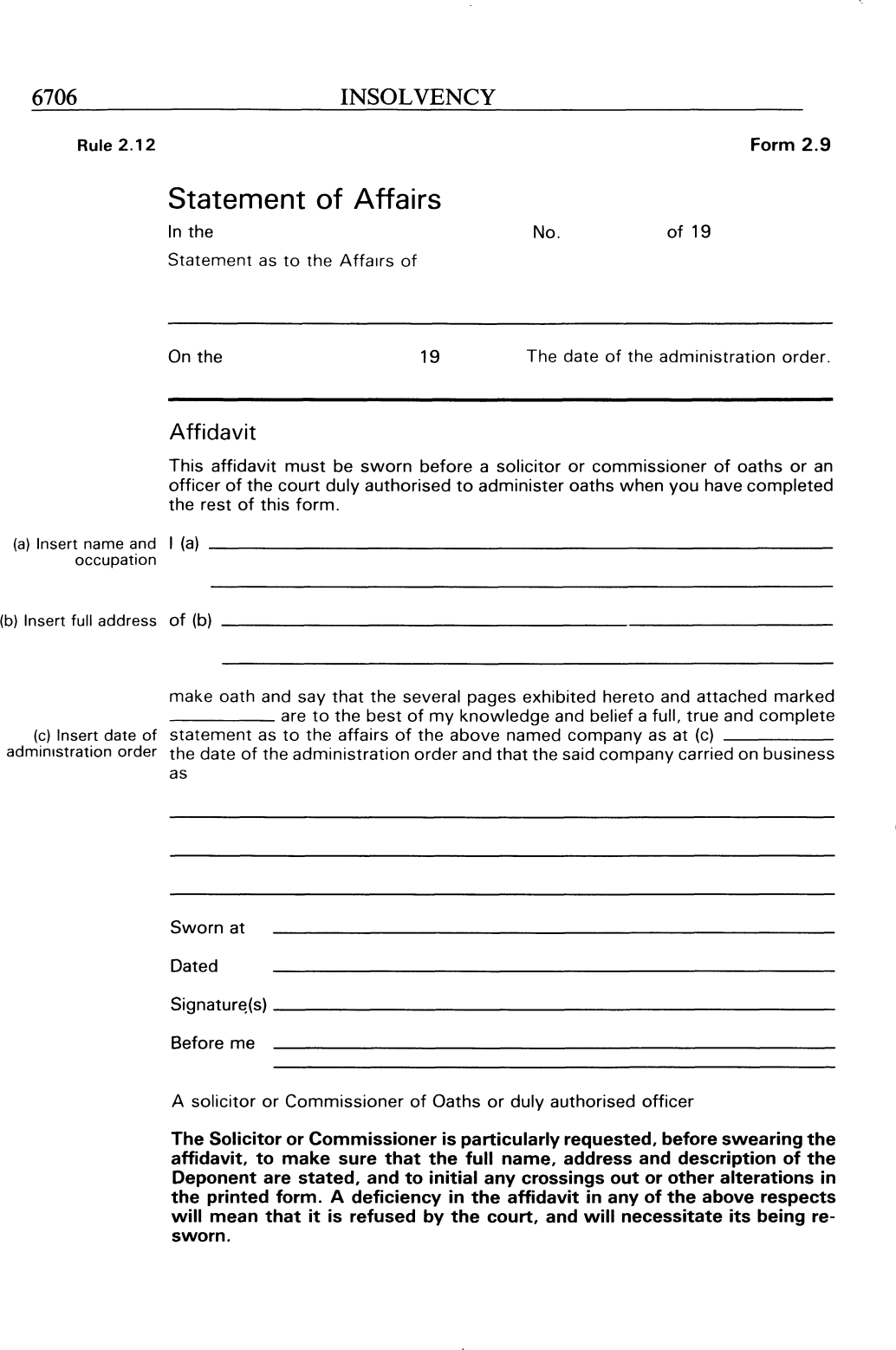


Rule 2.18
Form 2.10 Notice to Directors and Others to Attend Meeting of Creditors

Rule 2.19 and 2.31
Form 2.11 Notice of Meetings in Administration Proceedings

Rule 2.30
Form 2.12 Report of Meeting of Creditors


Rule 2.33
Form 2.13 Certificate of Constitution [Amended Certificate] of Creditors' Committee

Rule 2.33
Form 2.14 Notice by Administrator of a Change in Committee Membership

Rule 2.52
Form 2.15 Administrator's Abstract of Receipts and Payments


Rule 2.53
Form 2.16 Notice to Court of Resignation of Administrator Under Rule 2.53 of the Insolvency Rules 1986

Rule 2.53
Form 2.17 Notice of Resignation by Administrator Pursuant to Rule 2.53(2) of the Insolvency Rules 1986

Form 2.18 Notice of Order to Deal with Charged Property

Form 2.19 Notice of Discharge of Administration Order

Form 2.20 Notice of Variation of Administration Order

Form 2.21 Statement of Administrator's Proposals

Section 25(2)(a)
Form 2.22 Statement of Revised Proposals and Notice of Meeting to Consider Them

Form 2.23 Notice of Result of Meeting of Creditors

Rule 3.3
Form 3.1 Notice Requiring Submission of Administrative Receivership Statement of Affairs

Rule 3.4
Form 3.2 Statement of Affairs


Rule 3.8
Form 3.3 Statement of Affairs in Administrative Receivership Following Report to Creditors

Rule 3.17
Form 3.4 Certificate of Constitution [Amended Certificate] of Creditors' Committee

Rule 3.17
Form 3.5 Administrative Receiver's Report as to Change in Membership of Creditors' Committee

Rule 3.32
Form 3.6 Receiver or Manager or Administrative Receiver's Abstract of Receipts and Payments


Rule 3.34
Form 3.7 Notice of Administrative Receiver's Death

Form 3.8 Notice of Order to Dispose of Charged Property

Section 45(1)
Form 3.9 Notice of Resignation of Administrative Receiver Pursuant to Section 45(1) of the Insolvency Act 1986

Form 3.10 Administrative Receiver's Report

Rule 4.5
Form 4.1 Statutory Demand under section 123(1)(a) or 222(1)(a) of the Insolvency Act 1986


Rule 4.7
Form 4.2 Winding-Up Petition


Rule 4.7, 4.12
Form 4.3 Affidavit Verifying Winding-up Petition

Rule 4.9
Form 4.4 Affidavit of Service of Winding-Up Petition at Registered Office

Rule 4.9
Form 4.5 Affidavit of Service of Winding-Up Petition other than at Registered Office or on an Oversea Company

Rule 4.11
Form 4.6 Advertisement of Winding-Up Petition

Rule 4.14
Form 4.7 Certificate that Relevant Provisions of Rules have been Complied with

Rule 4.15
Form 4.8 Order for Leave to Withdraw Winding-Up Petition

Rule 4.16
Form 4.9 Notice of Intention to Appear on Petition

Rule 4.17
Form 4.10 List of Persons Intending to Appear on the Hearing of the Petition

Rule 4.20
Form 4.11 Order for Winding Up by the Court

Rule 4.20
Form 4.12 Order for Winding Up by the Court Following Upon the Discharge of an Administration Order

Rule 4.20
Form 4.13 Notice to Official Receiver of Winding-Up Order

Rule 4.22
Form 4.14 Petition by Contributory


Rule 4.26
Form 4.15 Order of Appointment of Provisional Liquidator

Rule 4.32
Form 4.16 Notice to Deponent Requiring Preparation and Submission of Statement of Company's Affairs

Rule 4.33
Form 4.17 Statement of Affairs


Rule 4.34-CVL
Form 4.18 Statement of Affairs


Rule 4.34-CVL
Form 4.19 Statement of Affairs


Rule 4.34-CVL
Form 4.20 Statement of Company's Affairs

Rule 4.50, 4.57
Form 4.21 Request by Creditor(s) for a Meeting of the Company's Creditors [and Contributories]

Rule 4.54, 4.108, 4.113, 4.114-CVL, 4.125, 4.126-CVL
Form 4.22 Notice to Creditors of Meeting of Creditors

Rule 4.54
Form 4.23 Notice to Contributories of Meeting of Contributories

Rule 4.57
Form 4.24 Request by Contributory/Contributories for a Meeting of the Company's Contributories

Rule 4.73
Form 4.25 Proof of Debt—General Form


Rule 4.77
Form 4.26 Affidavit of Debt

Rule 4.100, 4.101-CVL, 4. 139
Form 4.27 Certificate of Appointment of Liquidator by Meeting

Rule 4.100, 4.101-CVL, 4.139
Form 4.28 Certificate of Appointment of Two or More Liquidators by Meeting

Rule 4.102, 4.103-CVL, 4.140
Form 4.29 Order of Court Appointing Liquidator

Rule 4.102, 4.103-CVL, 4.140
Form 4.30 Order of Court Appointing Two or More Liquidators

Rule 4.106
Form 4.31 Notice of Appointment of Liquidator in Winding Up by the Court

Rule 4.109
Form 4.32 Notice to Court of Resignation of Liquidator Following Meeting of Creditors

Rule 4.110-CVL, 4.142
Form 4.33 Notice of Resignation as Voluntary Liquidator under Section 171(5) of the Insolvency Act 1986

Rule 4.111
Form 4.34 Order of Court Giving Liquidator Leave to Resign

Rule 4.111
Form 4.35 Order of Court Granting Voluntary Liquidator Leave to Resign

Rule 4.111
Form 4.36 Notice to Court of Resignation of Liquidator Following Leave of the Court

Rule 4.113
Form 4.37 Certificate of Removal of Liquidator

Rule 4.117-CVL
Form 4.38 Certificate of Removal of Voluntary Liquidator

Rule 4.119, 4.120-CVL, 4.143
Form 4.39 Order of Court Removing Liquidator or Directing Liquidator to Summon a Meeting of Creditors for the Purpose of His Removal

Rule 4.120-CVL, 4.122-CVL, 4.143, 4.144
Form 4.40 Notice of Ceasing to Act as Voluntary Liquidator

Rule 4.121, 4.122-CVL, 4.144
Form 4.41 Liquidator's Application to the Secretary of State for his release

Rule 4.125
Form 4.42 Notice to Court of Final Meeting of Creditors

Section 172(8)
Form 4.43 Notice of Final Meeting of Creditors

Rule 4.133-CVL, 4.145
Form 4.44 Notice of Death of Voluntary Liquidator

Rule 4.134, 4.135-CVL, 4.146
Form 4.45 Notice to Official Receiver or Secretary of State by Liquidator on Loss of Qualification as Insolvency Practitioner

Rule 4.135-CVL, 4.146
Form 4.46 Notice of Vacation of Office by Voluntary Liquidator

Rule 4.153
Form 4.47 Certificate of Constitution [Amended Certificate] of Liquidation Committee

Rule 4.153
Form 4.48 Notice of Constitution of Liquidation Committee

Rule 4.153
Form 4.49 Report by Liquidator of any change in Membership of Liquidation Committee

Rule 4.171
Form 4.50 Liquidator's Certificate that Creditors Paid in Full

Rule 4.171
Form 4.51 Certificate that Creditors Have Been Paid in Full

Rule 4.176
Form 4.52 Liquidator's Certificate of Continuance of Liquidation Committee

Rule 4.187, 4.188
Form 4.53 Notice of Disclaimer under Section 178 of the Insolvency Act 1986

Rule 4.191
Form 4.54 Notice to Elect

Rule 4.192
Form 4.55 Notice of Intended Disclaimer to Interested Party

Rule 4.204
Form 4.56 Affidavit of Liquidator in Support of Application for Call

Rule 4.204
Form 4.57 Order Giving Leave to Make a Call

Rule 4.205
Form 4.58 Notice of Call Sanctioned by the Court or the Liquidation Committee to be sent to Contributory

Rule 4.205
Form 4.59 Order for Payment of Call Due from Contributory


Rule 4.206
Form 4.60 Order of Appointment of Special Manager

Rule 4.211
Form 4.61 Order of Public Examination

Rule 4.213
Form 4.62 Notice to Official Receiver by Creditor Requesting Him to Make Application for the Holding of a Public Examination

Rule 4.213
Form 4.63 Notice to Official Receiver by Contributory Requesting Him to Make Application for the Holding of a Public Examination

Rule 4.214
Form 4.64 Order as to Examination of Person who is Suffering from Mental Disorder or Physical Affliction or Disability

Rule 4.215
Form 4.65 Affidavit of Verification of Record of the Public Examination

Rule 4.216
Form 4.66 Order of Adjournment of Public Examination

Rule 4.216
Form 4.67 Order Appointing Time for Proceeding with Public Examination Adjourned Generally

Rule 4.223-CVL
Form 4.68 Liquidator's Statement of Receipts and Payments


Rule 4.225
Form 4.69 Order of Court on Appeal Against Secretary of State's Decision under Section 203(4) or 205(4) of the Insolvency Act 1986

Section 89(3)
Form 4.70 Members' Voluntary Winding Up Declaration of Solvency Embodying a Statement of Assets and Liabilities


Section 94
Form 4.71 Return of Final Meeting in a Members' Voluntary Winding Up


Section 106
Form 4.72 Return of Final Meeting in a Creditors' Voluntary Winding Up

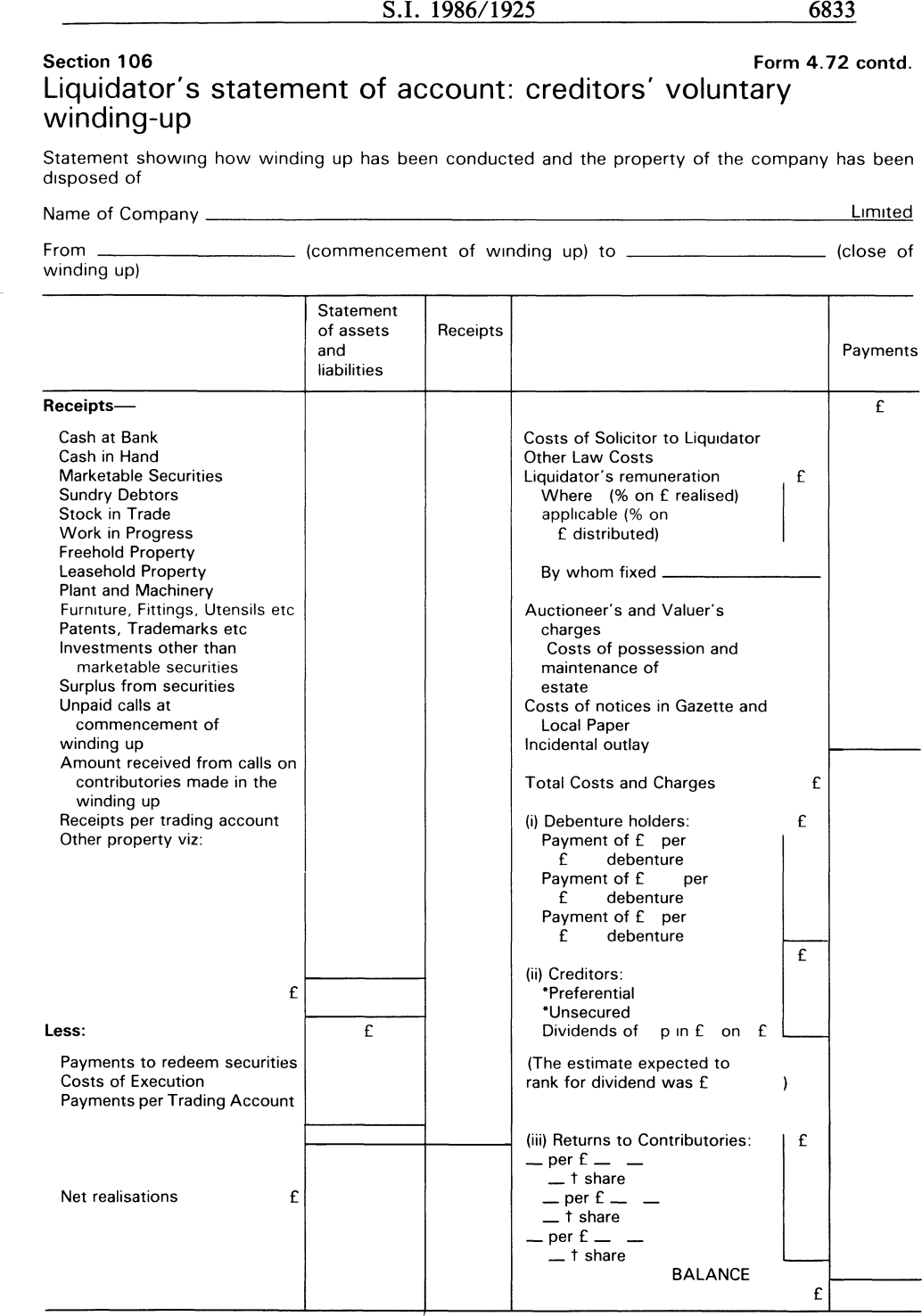

Rule 6.1
Form 6.1 Statutory Demand under section 268(1)(a) of the Insolvency Act 1986 Debt for Liquidated Sum Payable Immediately

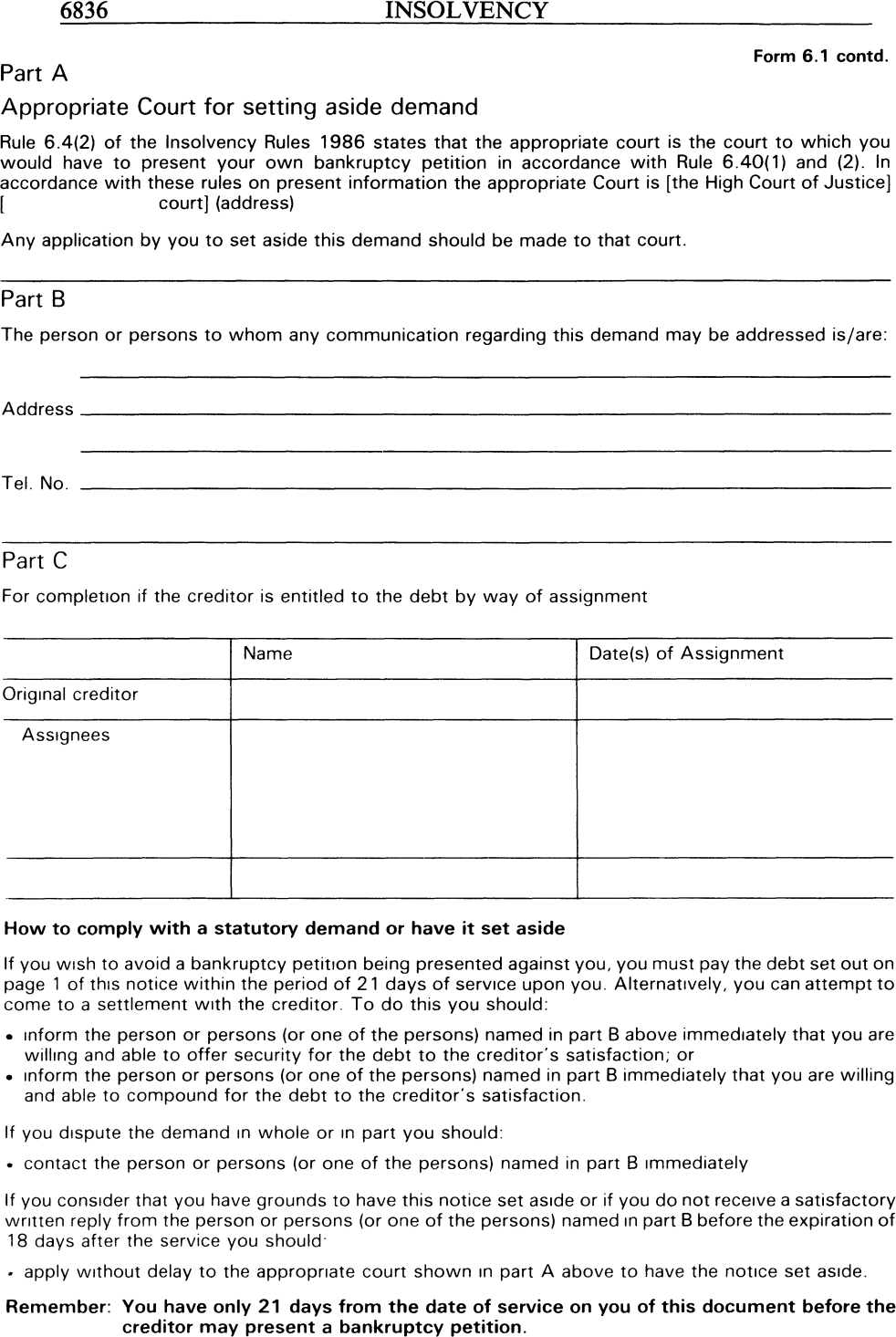
Rule 6.1
Form 6.2 Statutory Demand under section 268(1)(a) of the Insolvency Act 1986 Debt for Liquidated Sum Payable Immediately Following a Judgment or Order of the Court


Rule 6.1
Form 6.3 Statutory Demand under section 268(2) of the Insolvency Act 1986 Debt Payable at Future Date


Rule 6.4
Form 6.4 Application to Set Aside a Statutory Demand

Rule 6.4
Form 6.5 Affidavit in Support of Application to Set Aside Statutory Demand


Rule 6.5
Form 6.6 Order Setting Aside Statutory Demand

Form 6.7 Creditor's Bankruptcy Petition on Failure to Comply with a Statutory Demand for a Liquidated Su


Rule 6.6
Form 6.8 Creditor's Bankruptcy Petition on Failure to Comply with a Statutory Demand for a Liquidated Sum Payable at a Future Date
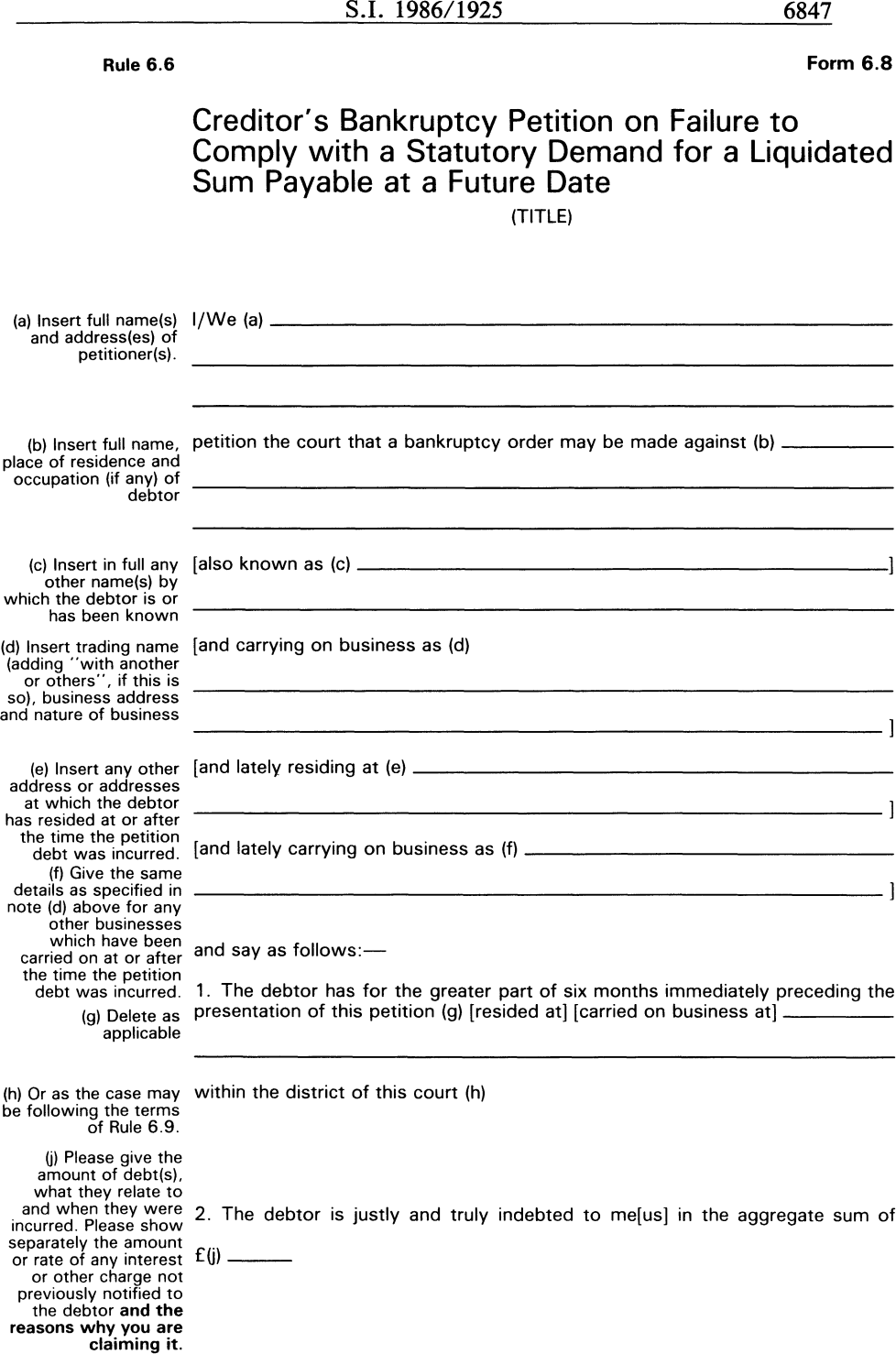

Rule 6.6
Form 6.9 Creditor's Bankruptcy Petition Where Execution or Other Process on a Judgment has been Returned in Whole or Part


Rule 6.6
Form 6.10 Bankruptcy Petition for Default in Connection with Voluntary Arrangement


Rule 6.11
Form 6.11 Affidavit of Personal Service of Statutory Demand

Rule 6.11
Form 6.12 Affidavit of Substituted Service of Statutory Demand

Rule 6.12
Form 6.13 Affidavit of Truth of Statements in Bankruptcy Petition

Rule 6.13, 6.43
Form 6.14 Application for Registration of Petition in Bankruptcy against an Individual under Land Charges Act 1972


Rule 6.14
Form 6.15 Order for Substituted Service of a Bankruptcy Petition

Rule 6.14
Form 6.16 Substituted Service of Bankruptcy Petition—Notice in Gazette

Rule 6.15
Form 6.17 Affidavit of Personal Service of Bankruptcy Petition

Rule 6.15
Form 6.18 Affidavit of Substituted Service of Bankruptcy Petition

Rule 6.21
Form 6.19 Notice by Debtor of Intention to Oppose Bankruptcy Petition

Rule 6.23
Form 6.20 Notice of Intention to Appear on Bankruptcy Petition

Rule 6.24
Form 6.21 List of Creditors Intending to Appear on the Hearing of the Bankruptcy Petition

Rule 6.25, 6.27, 6.32
Form 6.22 Dismissal of Bankruptcy Petition

Rule 6.29
Form 6.23 Order of Adjournment of Bankruptcy Petition

Rule 6.29
Form 6.24 Notice to Debtor and Creditors of Order of Adjournment of Bankruptcy Petition

Rule 6.33
Form 6.25 Bankruptcy Order on Creditor's Petition

Form 6.26 Application for Registration of a Bankruptcy Order against an Individual under Land Charges Act 1972


Rule 6.37
Form 6.27 Debtor's Bankruptcy Petition


Rule 6.41
Form 6.28 Statement of Affairs (Debtor's Petition)


Rule 6.44
Form 6.29 Order of Appointment of Insolvency Practitioner to Prepare a Report Under Section 274(1) of the Insolvency Act 1986

Rule 6.45, 6.48
Form 6.30 Bankruptcy Order on Debtor's Petition

Rule 6.50
Form 6.31 Revocation of Certificate of Summary Administration

Rule 6.52
Form 6.32 Order of Appointment of Interim Receiver

Rule 6.59
Form 6.33 Statement of Affairs (Creditor's Petition)


Rule 6.79, 6.83
Form 6.34 Request by Creditor(s) for a Meeting of the Bankrupt's Creditors

Rule 6.81, 6.127, 6.129, 6.137
Form 6.35 Notice to Creditors of Meeting of Creditors

Rule 6.84
Form 6.36 Notice to Bankrupt of Meeting of Creditors

Rule 6.96
Form 6.37 Proof of Debt-General Form


Rule 6.96
Form 6.38 Proof by Existing Trustee as a Claim in Later Bankruptcy

Rule 6.96, 6.99
Form 6.39 Affidavit of Debt

Rule 6.120
Form 6.40 Certificate of Appointment of Trustee by Creditors' Meeting

Rule 6.120
Form 6.41 Certificate of Appointment of Two or More Trustees by Creditors' Meeting

Rule 6.121
Form 6.42 Order of Court Appointing Trustee

Rule 6.121
Form 6.43 Order of Court Appointing Two or More Trustees

Rule 6.127
Form 6.44 Notice to Court of Resignation of Trustee Following Meeting of Creditors

Rule 6.128
Form 6.45 Order of Court Giving Trustee Leave to Resign

Rule 6.128
Form 6.46 Notice to Court of Resignation of Trustee Following Leave of the Court

Rule 6.129
Form 6.47 Certificate of Removal of Trustee

Rule 6.132
Form 6.48 Order of Court Removing Trustee or Directing Trustee to Summon a Meeting of Creditors for the Purpose of His Removal
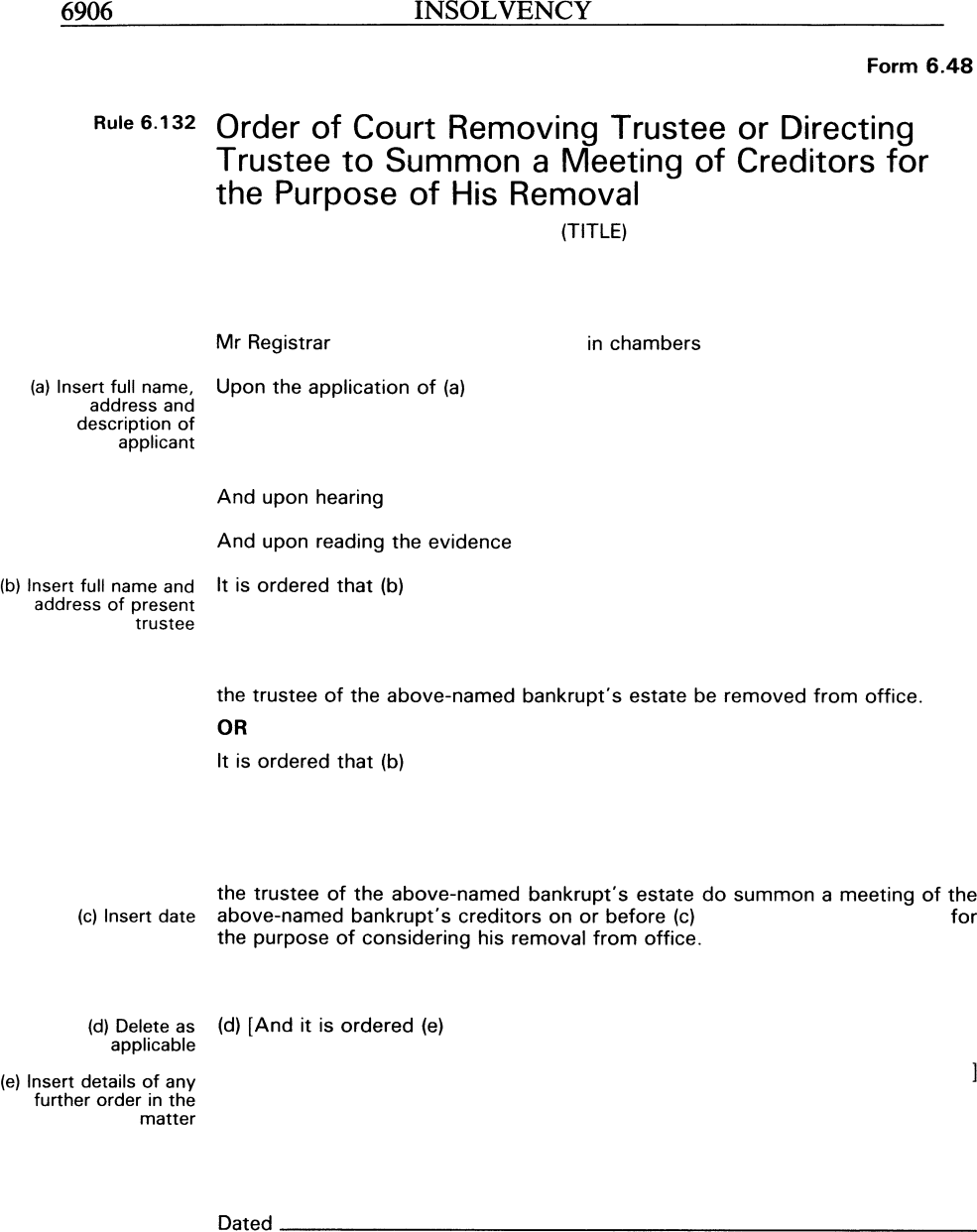
Rule 6.135
Form 6.49 Trustee's Application to the Secretary of State for His Release

Rule 6.137
Form 6.50 Notice to Court of Final Meeting of Creditors

Rule 6.144
Form 6.51 Notice to Official Receiver by Trustee on Loss of Qualification as Insolvency Practitioner

Rule 6.151
Form 6.52 Certificate of Constitution [Amended Certificate] of Creditors' Committee

Rule 6.151
Form 6.53 Report by Trustee of any Change in Membership of Creditors' Committee

Rule 6.167
Form 6.54 Order of Appointment of Special Manager

Rule 6.172
Form 6.55 Order for Public Examination of Bankrupt

Rule 6.173
Form 6.56 Request by Creditor(s) for the Holding of a Public Examination of the Bankrupt

Rule 6.174
Form 6.57 Order as to Examination of Bankrupt who is Suffering from Mental Disorder or Physical Affliction or Disability

Rule 6.175
Form 6.58 Affidavit of Verification of Record of the Public Examination of the Bankrupt

Rule 6.176
Form 6.59 Order of Adjournment of Public Examination of Bankrupt

Rule 6.176
Form 6.60 Order Appointing Time for Proceeding with Public Examination of Bankrupt Adjourned Generally

Rule 6.178
Form 6.61 Notice of Disclaimer under Section 315 of the Insolvency Act 1986

Rule 6.183
Form 6.62 Notice to Elect

Rule 6.184
Form 6.63 Notice of Intended Disclaimer to Interested Party

Rule 6.189
Form 6.64 Notice to Bankrupt of Application Under Section 310 of the Insolvency Act 1986 for Income Payments Order


Rule 6.190
Form 6.65 Order for Income Claimed Under Section 310(3)(a) of the Insolvency Act 1986

Rule 6.190
Form 6.66 Order for Income Claimed Under Section 310(3)(b) of the Insolvency Act 1986

Rule 6.191
Form 6.67 Order Converting Income Payments Order Made Under Section 310(3)(a) to an Order Under Section 310(3)(b) of the Insolvency Act 1986

Rule 6.193
Form 6.68 Discharge or Variation of Order for Income Claimed Under Section 310 of the Insolvency Act 1986

Rule 6.195
Form 6.69 Order Under Section 369(1) of the Insolvency Act 1986

Section 369(2)
Form 6.70 Order Under Section 369(2) of the Insolvency Act 1986

Rule 6.210
Form 6.71 Order of Annulment Under Section 282 of the Insolvency Act 1986

Rule 6.215
Form 6.72 Order of Suspension of Discharge Under Section 279(3) of the Insolvency Act 1986

Rule 6.216
Form 6.73 Order of Court Lifting Suspension of Discharge

Rule 6.216
Form 6.74 Certificate that Order Suspending Discharge has been Lifted

Rule 6.218
Form 6.75 Notice to Court by Bankrupt that he Intends to Dispute Statements Made by Official Receiver in His Report Under Section 289(2) of the Insolvency Act 1986

Rule 6.219
Form 6.76 Order Granting Absolute/Suspended Discharge Under Section 280(2)(b) or (c) of the Insolvency Act 1986

Rule 6.220
Form 6.77 Certificate of Discharge

Section 334(2)
Form 6.78 Notice to Existing Trustee of the Presentation of a Petition for a Later Bankruptcy

Rule 6.229
Form 6.79 Criminal Bankruptcy Petition


Section 371
Form 6.80 Order to Post Office under Section 371 of the Insolvency Act 1986

Rule 7.2
Form 7.1 Originating Application

Rule 7.2
Form 7.2 Ordinary Application

Rule 7.16
Form 7.3 Declaration by Official Shorthand Writer

Rule 7.16
Form 7.4 Appointment of Shorthand Writer to Take Examination Under the Insolvency Act 1986

Form 7.5 Declaration by Shorthand Writer

Rule 7.22
Form 7.6 Warrant For Failure to Attend Examination under Section 133 of the Insolvency Act 1986

Rule 7.22
Form 7.7 Warrant of Arrest etc. under Section 364 of the Insolvency Act 1986

Rule 7.23
Form 7.8 Warrant of Arrest etc. under Section 236 or 366 of the Insolvency Act 1986

Rule 7.23
Form 7.9 Order for Production of Person Arrested under Warrant Issued under Section 236 or 366 of the Insolvency Act 1986

Rule 7.24
Form 7.10 Warrant to Registrar of Court in Whose District a Person Against Whom a Warrant of Arrest Has Been Issued is Believed to Be

Form 7.11 Endorsement of Warrant of Arrest Issued by a Court to Which the Same Has Been Sent for Execution by the Court Which Originally Issued it

Rule 7.25
Form 7.12 Warrant of Seizure of Property under Section 365 of the Insolvency Act 1986

Rule 7.25
Form 7.13 Search Warrant Under Section 365 of the Insolvency Act 1986

Form 7.14 Order of Discharge from Custody Under the Insolvency Act 1986 [General]

Section 291, 312, 333
Form 7.15 Affidavit in Support of Application for Committal of Bankrupt or Other Person Under Section 291, 312 or 333 of the Insolvency Act 1986

Section 363
Form 7.16 Affidavit in Support of Application for Committal of the Bankrupt under Section 363 of the Insolvency Act 1986

Form 7.17 Warrant of Committal for Contempt

Form 7.18 Order of Discharge from Custody on Contempt

Rule 7.44
Form 7.19 Order Appointing Person to Act for Incapacitated Person
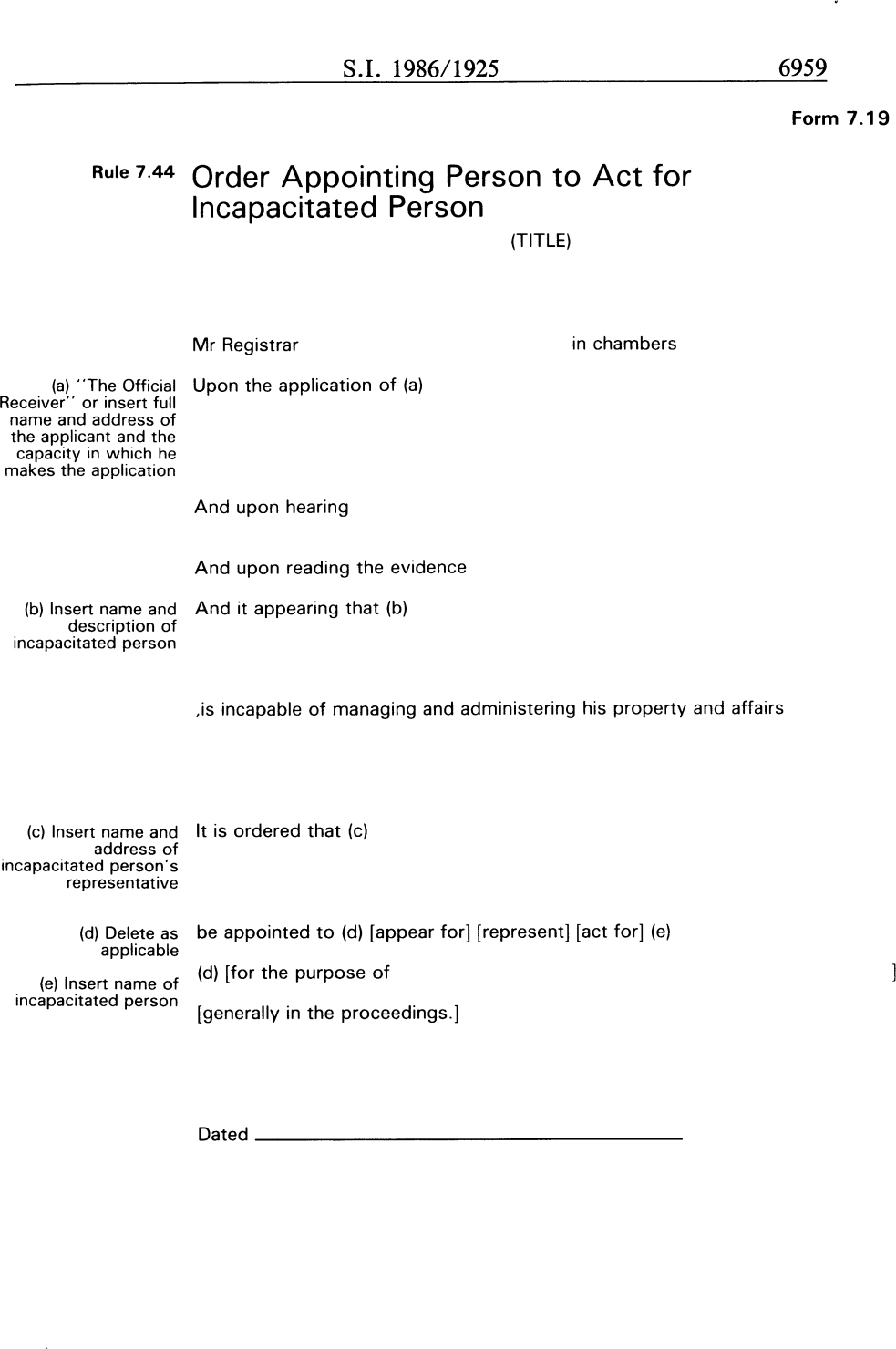
Rule 8.1
Form 8.1 Proxy (Company or Individual Voluntary Arrangements)

Rule 8.1
Form 8.2 Proxy (Administration)

Rule 8.1
Form 8.3 Proxy (Administrative Receivership)

Rule 8.1
Form 8.4 Proxy (Winding up by the Court or Bankruptcy)


Rule 8.1
Form 8.5 Proxy (Members' or Creditors' Voluntary Winding Up)


Rule 9.1
Form 9.1 Order Under Section 236 or 366 of the Insolvency Act 1986

Cases considering this provision (3)
- Hickling v Baker[2007] EWCA Civ 287
- Assured Logistics Solutions Ltd & Anor, Re[2011] EWHC 3029 (Ch)
- Gould & Anor v Itmo Advent Computer Training Ltd & Anor[2010] EWHC 459 (Ch)
Rule 12.21
SCHEDULE 5 PUNISHMENT OF OFFENCES UNDER THE RULES I636
Note: In the fourth and fifth columns of this Schedule, “
the statutory maximum
” means
| Rule creating offence. | General nature of offence. | Mode of prosecution. | Punishment. | Daily default fine (where applicable). |
|---|---|---|---|---|
| F465 . . . | F465 . . . | F465 . . . | F465 . . . | |
| In Part 2, [F466Rule 2.47(6)F466] . | Administrator failing to send notification as to progress of administration. | Summary. | One-fifth of the statutory maximum. | One-fiftieth of the statutory maximum. |
| [F467 Rule 2.111(3): | Administrator failing to file a notice of automatic end of administration; summary; | summary; | one-fifth of the statutory maximum; | one-fiftieth of the statutory maximum.F467] |
| In Part 3, Rule 3.32(5). | Administrative receiver failing to sent notification as to progress of receivership. | Summary. | One-fifth of the statutory maximum. | One-fiftieth of the statutory maximum. |
| F465 ... | F465 . . . | F465 . . . | F465 . . . | |
| In Part 12, Rule 12.18. | False representation of status for purpose of inspecting documents. | 1. On indictment. 2. Summary. | 2 years or a fine, or both. 6 months or the statutory maximum, or both. |
Rules 4.127A, 4.127B,4.148B and 6.138A
case [F468SCHEDULE 6 DETERMINATION OF INSOLVENCY OFFICE HOLDER'S REMUNERATION
As regards the determination of the remuneration of trustees and liquidators the realisation and distribution scales are as set out in the table below—
The realisation scale
(i)on the first £5000 or fraction thereof | 20% |
(ii)on the next £5000 or fraction thereof | 15% |
(iii)on the next £90000 or fraction thereof | 10% |
(iv)on all further sums realised | 5% |
The distribution scale
(i)on the first £5000 or fraction thereof | 10% |
(ii)on the next £5000 or fraction thereof | 7.5% |
(iii)on the next £90000 or fraction thereof | 5% |
(iv)on all further sums distributed | 2.5%.F468] |
Cases considering this provision (3)
- Brook v Reed[2011] EWCA Civ 331
- Green v Bramston & Ors[2010] EWHC 3106 (Ch)
- Simion v Brown[2007] EWHC 511 (Ch)
EXPLANATORY NOTE
These Rules set out the detailed procedure for the conduct of all company and individual insolvency proceedings in England and Wales under the Insolvency Act 1986 and otherwise give effect to that Act. The insolvency proceedings concerned are—
company voluntary arrangements (Part 1 of the Rules),
administration (Part 2),
administrative receivership (Part 3),
companies winding up (Part 4),
individual voluntary arrangements (Part 5), and
bankruptcy (Part 6).
Parts 7 to 13 of the Rules apply to both company and individual insolvency proceedings and are concerned with the following matters—
court procedure and practice (Part 7),
proxies and company representation (Part 8),
examination of persons concerned in company and individual insolvency (Part 9).
official receivers (Part 10),
declaration and payment of dividend (winding up and bankruptcy) (Part 11),
miscellaneous and general (Part 12), and interpretation and application (Part 13).
The Arrangement of Rules at the beginning of the statutory instrument lists the number and contents of all the Rules and Schedules. The Rules come into force on 29th December 1986 and generally apply to all insolvency proceedings commenced on or after that date. The Rules also apply to such proceedings commenced before that date to which provisions of the Insolvency Act 1986 are applied by Schedule 11 of the Act to the extent necessary to give effect to those provisions. In addition, Rules 6.36, 7.11 and 7.34 expressly provide for their application to insolvency proceedings, whenever commenced.
As amended by section 32 of the Finance Act 1985 (c.54).
As amended by section 32 of the Finance Act 1985 (c.54).